What’s so magic about five years? Seems like the world is captivated by the very idea of that stretch of time.
Colleges have their five-year reunions. They look back, drink up a storm, and collect more alumni donations.
Governments – usually the nasty ones like Russia and China – have their five-year plans. They look ahead, map out how they’re going to change themselves, and then find someone else to blame when nothing works out.
Then there’s the five-year lookback rule for transferring your property to escape Medicaid liens, a five-year real estate rule for holding onto the house you’ve bought, and a five-year stretch (supposedly) to play four years of college sports. Seems like everybody’s got a five-year something or other.
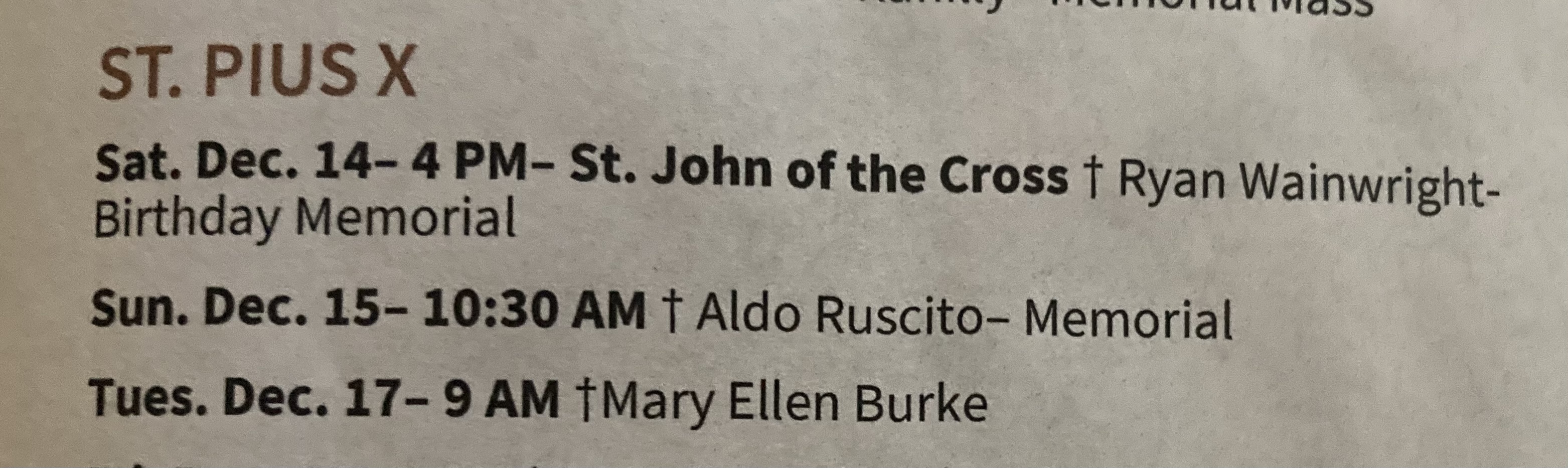
Myself included. Tomorrow, my first quinquennium without my partner comes to an end. The next day is a mass in memory of Mary Ellen, who left this earthly world on December 17, 2019. And another five years will begin. Perhaps, if the Lord spares me.
Did I have a five-year plan that started in 2019? Most certainly not. Do I have a plan that will end in 2029? No, but after much contemplation, much prayer, and not a little reading of those much wiser and more experienced than I, I’ve got some ideas.
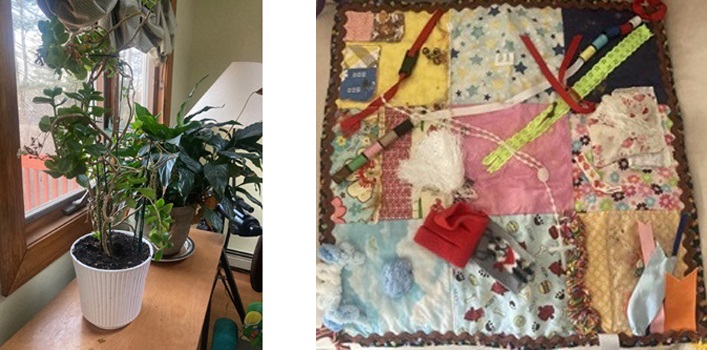
But first, what really happened to me during those first five years? And where did they go? It seems like only last week that they took her from her bed at the nursing home’s memory unit to the funeral home. I packed up the few things that were there and brought them home – including the lovely “fidget quilt” that my friend Barbie made for her, and the little potted plant in the plastic vase.
Here they are now. Aren’t they nice? I recently re-potted the plant for the fourth time. It seemed to do well out on the deck during the warm weather. Now it graces a table overlooking the back yard, right next to a peace plant. My friends at Hockey East sent that plant to Kirby’s for my brother Jackie’s wake in 2014. That’s already two quinquennia – talk about time flying.
So, these tangible items accompanied me along the way for these five years. I’m glad I have them. And they bring a smile to my face rather than a tear to my eye when I see them or touch them. But I ask again, what really happened to me – or maybe better, within me – over the past 1,829 days?
That great man, C.S. Lewis, has helped me to understand. He’s also brought me a measure of comfort. He’s a master storyteller, profoundly deep thinker, and devout – yet sensibly so – Christian and lover of God. I’m no match for him in any of those aspects, but I’ve found that he and I are quite alike in one way: what we went through, and how we wrestled with it, when we lost our spouses.
I have settled into a morning routine of reading first, before any other activity. There’s always a scriptural or philosophical component. Recently, as this five-year milestone approached, I again took up “A Grief Observed” by Lewis. It is his own account of the weeks and months – maybe even longer – of his thoughts and emotions about his beloved, about the God who saw fit to take her from him, and about himself.
I had read that book shortly after Mary Ellen died. But I guess I needed the re-reading at a much later date before I realized that he and I are in many ways kindred spirits.
Early in the book, Lewis writes, “Kind people have said to me, ‘She is with God.’ In one sense, that’s most certain. She is, like God, incomprehensible and unimaginable. But I find that this question, however important it may be in itself, is not after all very important in relation to grief…my heart and my body are crying out, come back, come back…but I know this is impossible. I know that the thing I want is exactly the thing I can never get. The old life, the jokes, the drinks, the arguments, the lovemaking, the tiny, heartbreaking commonplace.”
Yes, the commonplace. There was one time – I forget the occasion – when she and I were praying together. She said, “And thank you, dear God, for an ordinary day.” So Mary Ellen got this as well.
A little later on, Lewis writes,
“One flesh. Or, if you prefer, one ship. The starboard engine has gone. I, the port engine, must chug along somehow until we make harbour. Or rather, till the journey ends. How can I assume a harbour? A lee shore, more likely, a black night, a deafening gale, breakers ahead – and any lights shown from the land probably being waved by wreckers. Such was (her) landfall. Such was my mother’s. I say their landfalls; not their arrivals.”
I can relate to that too. I’m a little more hopeful, at this point, than he was, about eventually calling at a safe harbor. But we’ll have to see.
Mr. Lewis’s wife had a lot in common with mine, too. “Her mind was lithe and quick and muscular as a leopard. Passion, tenderness, and pain were all equally unable to disarm her. It seemed the first whiff of cant or slush; she sprang, and knocked you over before you knew what was happening. How many bubbles of mine she pricked!”
And a little later he adds, “ The most precious give that marriage gave me was this constant impact of something very close and intimate yet all the time unmistakably other, resistant – in a word, real.”
Me too, C.S. I’ve always felt, and I’ve said to many close friends who knew Mary Ellen, that I was the smart one in our relationship but that she was the wise one. School always came easily for me. I was a world champion test-taker, but I didn’t have an ounce of common sense. Book-smarts and snazzy report cards count for very little in the game of life. And in our marriage, in our family life, she was the one who made the decisions that truly mattered. Particularly when it came to raising our three children. And she got all of the big ones exactly right.
A few of those close friends from my early years will recall, I hope, my reaching out to them in the final years of Mary Ellen’s life, at the time when her diagnosis of Alzheimer’s was confirmed. I wanted them to meet her while she was still “with it” and able to let her personality shine through the descending fog. I remain grateful to those who agreed to meet Mary Ellen and me for coffee, lunch, drinks, or whatever.
I had two reasons for this. First, I wanted Mary Ellen to meet some people with whom we never had the chance to socialize, but whose friendship was important to me. I also wanted them to meet her, because they didn’t really know me until they met the love of my life.
And what about the day-to-day, the living without our beloved? How do we cope? How did we cope?
Lewis writes of an emotion that I too have felt – the shame and guilt and overall feeling that something is amiss when our beloved is not in our thoughts. Then came a lifting of his spirits. And a realization that, I think, has come to me as well.
“For various reasons…my heart was lighter that it had been for many weeks…And suddenly at the very moment when so far, I mourned her least, I remembered her best…It was as if the lifting of a sorrow removed a barrier.
“Why has no one told me these things? How easily I might have misjudged another man in the same situation? I might have said, ‘He’s got over it, he’s forgotten his wife,’ when the truth was ‘He remembers her better because he has partly got over it.’…And I believe I can make sense out of it. You can’t see anything properly when your eyes are blurred with tears.”
Coming close to his conclusion, he writes something to his wife that I could have written as well, had I had his genius. But I’ll write it now.
“It is often thought that the dead see us. And we assume, whether reasonably or not, that if they see us at all they see us more clearly than before. Does Mary Ellen now see exactly how much froth or tinsel there was in what she called, and I call, my love? So be it. Look your hardest, dear. I wouldn’t hide it if I could. We didn’t idealize each other. We tried to keep no secrets. You knew most of the rotten places in me already. If you now see anything worse, I can take it.
“So can you. Rebuke, explain, mock, forgive. For this is one of the miracles of love; it gives – to both, but perhaps especially to the woman – a power of seeing through its own enchantments and yet not being disenchanted.”
So here I am. As I write this, I am just about at the end of my first five years without my partner. The day of her anniversary mass, I’ll start another trek of time yet to be determined. Do I have a plan for the next five or whatever years? No. But…
We’ve all heard that men make plans and God laughs. True enough. But I do know that I’ll start my every day as I always do, with a prayer of thanks cribbed from my Jewish friends:
“Grateful am I, eternal and living King. Thou hast mercifully restored my soul within me. Great is your faith.”
Yes, great is God’s faith in me, for giving me another of those ordinary days for which Mary Ellen was so thankful, so long ago.
Then what? Well, one could do worse than to emulate the great Oliver Sacks, who wrote the following during his later years:
“Over the last few days, I have been able to see my life as from a great altitude, as a sort of landscape, and with a deepening sense of the connection of all its parts. This does not mean I am finished with life.
“On the contrary, I feel intensely alive, and I want and hope in the time that remains to deepen my friendships, to say farewell to those I love, to write more, to travel if I have the strength, to achieve new levels of understanding and insight.”
That’s as good a plan as any. And sitting here, well into my eighth decade, I’ve got some of that altitude and perspective as well.
But that’s a plan for me. What about for Mary Ellen? As Lewis points out,
“…bereavement is not the truncation of married love but one of its regular phases, like the honeymoon. What we want is to live our marriage well and faithfully through that phase too. ..We will be still married, still in love…we shall still ache. But we are not at all – if we understand ourselves – seeking the aches for their own sake. The less of them the better, so long as the marriage is preserved. And the more joy there can be in the marriage between the dead and the living, the better.”
I do think that Mary Ellen approves of what I’m going to do for myself, as I try to take Dr. Sacks’s advice. But I will remind her, as well, of the final words of my funeral eulogy to her, five years ago.
After speaking at some length about Mary Ellen and my memories of our life together, I told the congregation that I now wanted to speak for her, to them. I recited the wonderful poem, Epitaph, which concludes,
“Love doesn’t die,
People do.
So, when all that’s left of me
Is love,
Give me away.”
I don’t mind admitting that today I cried once again, as I did at the church, when I read that last line. And I will strive every day to keep giving you away, my darling. That I promise.
Tags: family-history
 Veteranscribe's Blog
December 16, 2024 at 9:55 am |
Lovely. Simple and beautiful. Thank you for sharing, my friend.
December 16, 2024 at 6:20 pm |
Tom, thank you for sharing these deep and wise thoughts five years after losing Mary Ellen. As she once prayed, I wish you many ordinary days to come, remembering the love you continue to share.