Archive for January, 2024

History I Never Knew: Good King Wenceslas

January 14, 2024

You’ve probably heard the Christmas hymn:

“Good King Wenceslas looked out

On the Feast of Stephen”
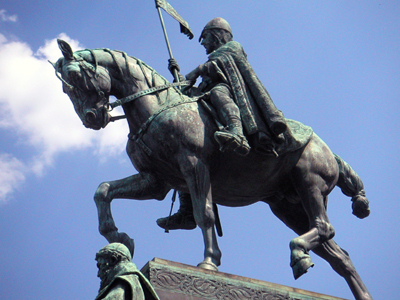
Wensceslas as armed knight on horseback in Prague’s Wenceslas Square.

Maybe you’ve even heard the joke about how he like his pizza cooked:

“Deep and crisp and even.”

But who was this guy, the patron saint of the Czech Republic, whose statue stands in Wenceslas Square in Prague? Legend holds that if the Czech homeland is ever threatened, the statue will come to life, summon the army that sleeps beneath Mount Blanik, ready to defend the homeland. Wenceslas will wield his sword, which is hidden under the stones of the Charles Bridge and is to be found by a child when peril from enemies looms for Prague.

Here’s the rest of the story. There was actually a Wenceslas – real name Václav the Good, as Wenceslas is the Latinized version. He wasn’t a king; rather, he was Duke of Bohemia. He apparently was a very nice guy.  He was from a very dysfunctional family, and he died because of his opposition to slavery.

The Charles Bridge

Yes, slavery. It wasn’t invented in the American South. They used to have it all over Europe. And Prague was the main market for slaves who were being moved overland from central Europe to the west and south.

Wenceslas was against slavery; he would buy slaves himself and set them free.  But he ticked off three rich guys who had made big money in the slave trade. Their names were Tira, Česta, and Hněvsa; all three of them stabbed him before his own brother, Boleslas, ran him through with a lance.

Boleslas, the bad guy, took over the realm and knew where his bread was buttered. He, nominally Christian like Wenceslas, let the slavers make their money. He reigned for more than 35 years.

It didn’t matter that Boleslas already ruled over half the country at the time of the killing. It wasn’t enough for him, and it was the money that mattered. 

According to “Christendom” by historian Peter Heather, Christianity was spreading throughout Europe in those years, driven largely by the political decrees and conquests in the long reigns of Charlemagne and his son, Louis the Pious.

Václav and Boleslas’s father, Vratislaus I, was the Duke of Bohemia and a Christian. Their mother Drahomíra, though baptized before the marriage, was aligned with Bohemia’s pagans. As a child, Václav was raised largely by his Christian paternal grandmother, Ludmila — who was later canonized as a saint in her own right.

When Václav was about 13, his father died in battle and Ludmila became regent. But the regency did not last long. His mother Drahomíra had Ludmila killed, and she then tried to suppress Bohemia’s Christians.
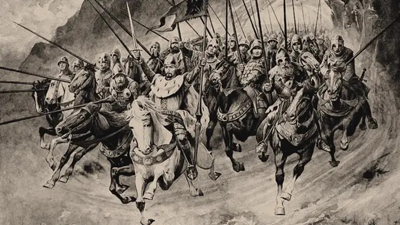
Wenceslas leads the Blanik Knights down the mountain to rescue Prague from its enemies.

When Václav became Duke of Bohemia himself at age 18 and came of age, he banished his mother and foiled her suppression plans by working to spread Christianity. He commissioned the building of several churches including part of what is now St. Vitus Cathedral in Prague. He also developed a reputation as a wise and compassionate ruler, known for his deeds of mercy.

But to try and avoid disputes, the country was split in two, and half was given to the younger brother, Boleslas. But Boleslas wanted the whole enchilada. He also remained the favored son of Drahomira. In September 935 he plotted with the slave-owning a group of noblemen to kill his brother.  He did so by exploiting Wenceslas’s religious faith. He invited Václav to a church dedication on Sept. 27, 929. The next day, while Václav was on his way to prayer, Boleslas and his henchman attacked and killed him.

Only the good die young. Wenceslas was 22. On the base of his statue, the inscription reads “Saint Wenceslas, duke of the Czech land, prince of ours, do not let perish us nor our descendants.’”

I’m told by those who’ve visited that part of Europe that Prague is a particularly beautiful city and that the Charles Bridge is spectacular. That’s one place I’d love to visit. But I won’t be diving into the Vltava River and searching though the rocks for Wenceslas’s sword. As the legend tells us, that’s a job reserved for a child.

Where Do You See Yourself in Five Years? OK, then, How About 50 Years?

January 8, 2024

Did you ever have one of those job interviews in which the robot doing the hiring looked down the list of boilerplate questions and asked, “Where do you see yourself in five years?”

Didn’t you hate that? I did. I always mumbled something that didn’t meet expectations. But I must tell you of the one answer that I wished I’d had the wits to deliver. It was by Jim, a former work colleague who was looking for a humdrum emerging-from-retirement position, answering the phone at an insurance company’s customer inquiry desk.

“I see myself in a rocking chair on my front porch in five years.”

He got the job. Maybe because he was both prescient and honest.

Jim’s cheeky reply came to mind today when I read a magazine piece (National Review, February 2024 edition) about another magazine, long since out of business.  That magazine was Saturday Review/World, and the year was 1974. The editor, antinuclear activist Norman Cousins (1915-1990) conceived and published an entire issue titled “2024 A.D.” Beneath that banner headline came the subtitle “A probe into the future by…” followed by nineteen names of the most eminent minds of the day.

So how did they do?

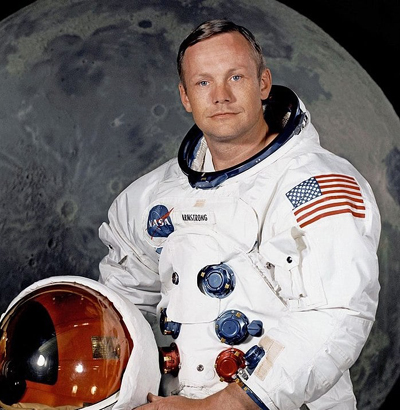
Some of them whiffed. Astronaut Neil Armstrong (1930-2012) predicted that by 2024 there would be colonies of humans on the moon, with “massive subterranean lunar cities, ‘underground apartments and workrooms…connected by tunnels and powered by giant solar generators and flywheels spinning at incredibly high speed.’” He also said that we’d have had manned space flights to Mars and probably a few selected asteroids.

Neil Armstrong

None of that happened, of course. In case you’d forgotten (I did) the last U.S. moon landing was back in 1972, two years before Armstrong made this prediction.

Faring little better than Armstrong was Clare Boothe Luce (1903-1987),the playwright, congresswoman, and ambassador. Despite a few advances such as availability of birth control pills and better access to higher education, Luce lamented that there has been little progress in “overthrowing male supremacy…and achieving equality of the sexes….[and that the American woman of 2024 would be] playing many more roles that were once considered masculine. I see her making a little more money than she is making now. But I still see her trying to make her way up – in a man’s world – and not having much more success than she is having now.”

Nice try, Clare. Looks like you really didn’t have a lot of faith in women and their abilities.

So who got it right? Surprisingly (for me anyway) three of the best answers came from people who’d seen and lived in the darkest and cruelest recesses that humanity devised during the 20th Century: Communism and Nazism.  Perhaps seeing those evil systems from the inside gives one a special clarity of mind. See if you agree.

Andrei Sakharov

Russian physicist and human rights champion Andrei Sakharov (1921-1989), who won the Nobel Peace Prize in 1974, foresaw the unique role that “communications and information” would play, beginning with the creation of a “global telephone and videophone system. Then came his prophecy about what we could only call “the Internet:”

“Far into the future, more than fifty years from now, I foresee a universal information system, (UIS) which will give everyone access at any given moment to the contents of any book that has ever been published or any magazine or any fact. The UIS will have individual miniature-computer terminals, central-control points for the flood of information, and communication channels incorporating thousands of artificial communications from satellites, cables, and laser lines.

“Even the partial realization of the UIS will profoundly affect every person, his leisure activities, and his intellectual and artistic development. Unlike television, the major source of information for many of our contemporaries, the UIS will give each person the maximum freedom of choice and will require individual activities.”

Wow. Sakharov was off a little bit on his timing, but that’s all.

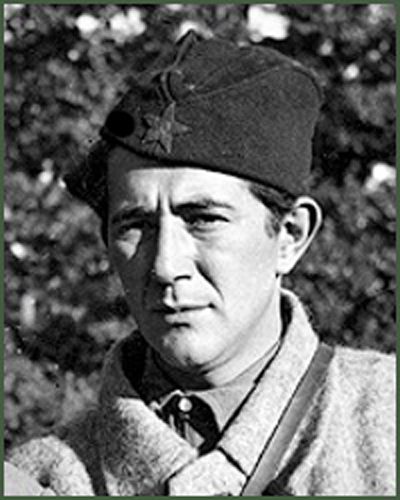
Milovan Djilas

Milovan Djilas (1911-1995) was from Yugoslavia. He was a higher-up in the regime of dictator Josip Broz (Tito), but he became disillusioned with communism and spent six years in prison for his honesty. He saw what would happen in his part of the world when he wrote:

“The most significant change in the next fifty years will be the disintegration of the Soviet empire…The crucial factors will be the domestic ferment and the pressure from China…[and possibly] uprisings in Eastern Europe…With the collapse of the Soviet empire, the Eastern European countries now under Soviet hegemony will become independent and will join the European community. Germany will be reunited, without a civil war.”

Got that right.

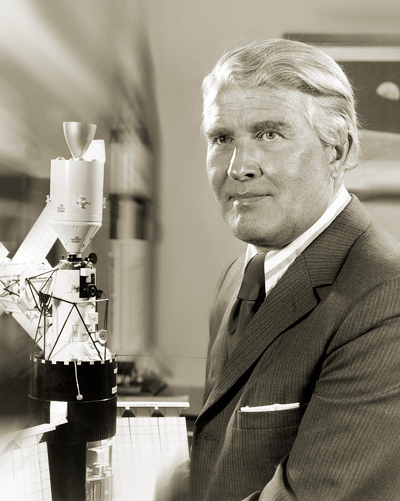
And how about Wernher von Braun (1912-1977), the rocketry whiz who designed the V-1 and V-2 rockets that rained down on Britain from Adolf Hitler’s Germany, and who came to America  after World War II and was the guiding genius behind the Saturn Rocket program?

With a vision much like that of Sakharov, the former Nazi foresaw the power and ubiquity of orbiting satellites, which would spawn a “revolution…a global telephone network interconnecting nearly 100 nations…handling millions of television channels simultaneously and billions of telephone conversations [and providing] direct ties between computers in support of such operations as banking or ticket reservations.”

There was even more, and finely detailed it was, to von Braun’s preview:

Wernher von Braun

“Controlled by an orbital switchboard, laser beam connections could be established (and withdrawn after use) that provide direct links between any two points on Earth. The abundance of available channels would soon lead to worldwide video-telephone service. And as communications improve, commuting for work would go out of style. It would become more convenient to let electrons, rather than people, do the traveling.

“The average American household of 2024 will be equipped with an appliance that combines the features of a television set with those of a desk computer and a Xerox machine. In addition to serving as a TV set and a print-out device for news, the push-button-controlled console will permit its owners to receive facsimile-radioed letters, review the shelves of a nearby grocery store, order food and dry goods, pay bills, balance books, and provide color-video-telephone service to any point on Earth.”

Not totally accurate, but you get ample partial credit and a high final grade, Herr von Braun.

Some others who contributed predictions to that 1974 Saturday Review/World were Indira Gandhi, Robert McNamara, Coretta Scott King, David Rockefeller, and Pierre Trudeau.

The NR piece does not mention any of their predictions. But it does surmise – and I think correctly – that it would be “difficult to imagine anyone convening a panel of ‘influencers’ like this today.” And that’s unfortunate. Society as a whole doesn’t have too many people to whom it can look, with trust and confidence, for advice and guidance.

Maybe there are a few out there who can see the future as clearly as did Messrs. Sakharov, Djilas, and von Braun. But I wouldn’t know where to look for them.

The Visit of the Magi on Twelfth Night: A Science Lesson from the Bible

January 5, 2024

“Dost thou think, because thou art virtuous, there shall be no more cakes and ale?”

That’s Sir Toby Belch, speaking to Feste the Clown in “Twelfth Night.”  During the Middle Ages, Christmas was a time of continuous feasting and merriment, which climaxed on Twelfth Night. The height of celebration became the night before, or eve, of Epiphany. The twelve day count actually begins with the night of December 25, the “first night.” The Twelfth Night is the night before Epiphany, and the twelfth day is Epiphany itself.

Food and drink are there in abundance. A punch called “wassail,” consumed during Christmastime, is especially plentiful on Twelfth Night. Around the world, special pastries, such as the tortell and king cake, are baked on Twelfth Night. They are eaten the following day for the Feast of the Epiphany celebrations. That’s why Sir Toby speaks of the cakes and ale.

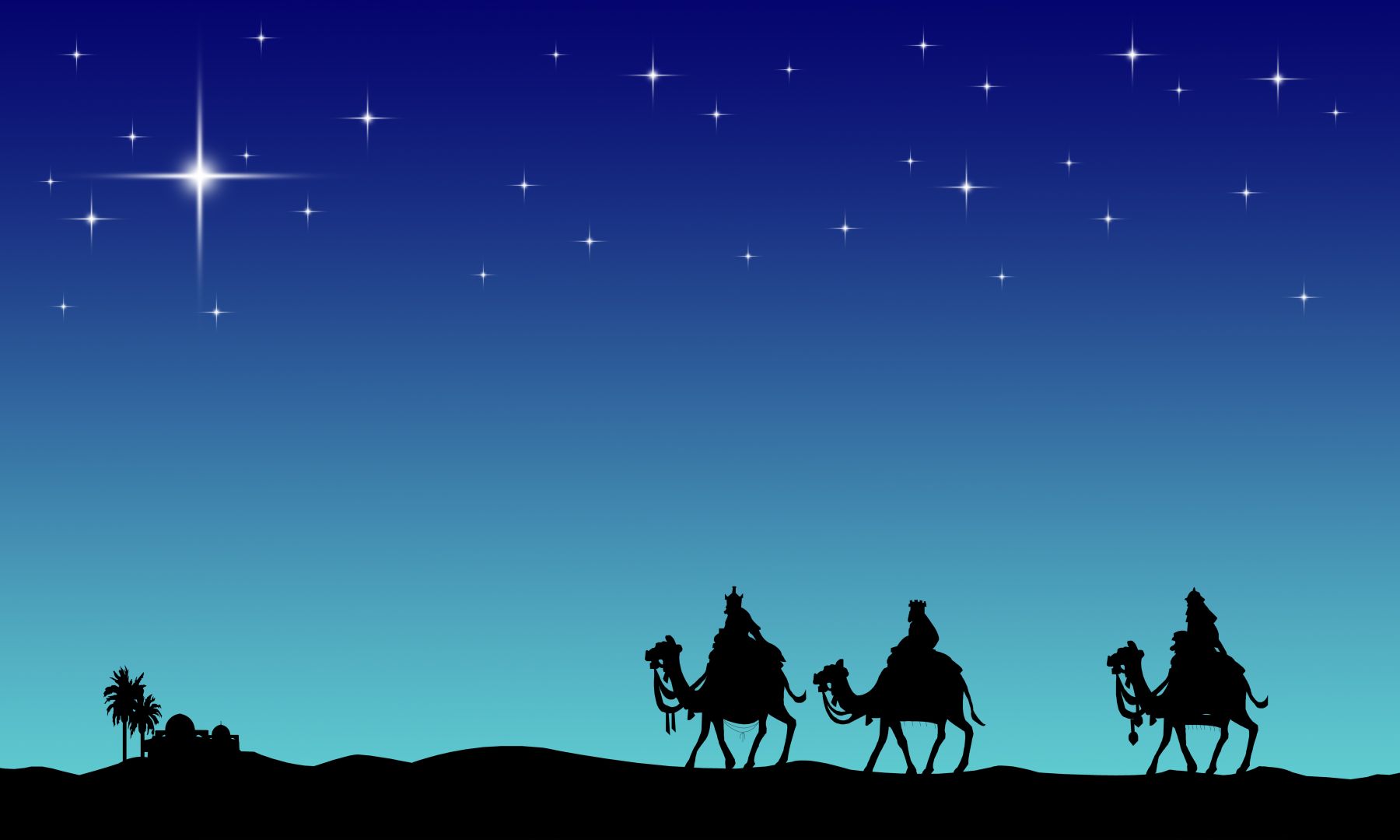
So here we are on January 5, the Eve of the Christian Feast of the Epiphany. The Twelfth Night revelry commemorates the visit of the Magi, the “Wise Men” from the East who followed the Star of Bethlehem and found the baby Jesus. But who were those guys anyway? Is there any grain of historical truth to this biblical legend?

There may be. Here’s the rest of the story.

According to an op-ed in today’s Wall Street Journal, the “magoi” were surveyors of the night sky. Caspar, Balthazar, and Melchior could be called astronomers, astrologers, or magicians. However you label them, they were probably real people. The Latin word “magi” is the pluralization of the Greek singular “magos,” which signifies to the Latin-speaking world a Persian priest or “wise man.” The “magos” to the Greeks also connoted someone who was a sorcerer.

The WSJ piece goes on to state that the three were seeking not only scientific knowledge of the stars and planets, but they were also looking for divine portents. They were probably priests of the Zoroastrian faith, whose studies of astrology were their attempts to understand the relationship of the powers in the universe to humans.

If this is what they were up to, they would have had good reason to set out on their journey. Right around the time of Jesus’s birth, in 7 B.C., there was a “planetary conjunction,” in which Jupiter and Venus came very close to each other. They stayed close together in the sky for the better part of a year. Then, even more dramatically four years later, they sat just one-tenth of degree apart in the sky. On the morning of August 12 in 3 B.C., Jupiter and Venus sat just 1/10th a degree apart in the dawn sky. That’s one-fifth the diameter of the Full Moon. They appeared to be a single body about one-fifth the diameter of the full moon.

We actually had a similar conjunction in December of 2020. I remember going to Millennium Park, a high point in West Roxbury, to view it. There were hundreds of people, crunching through the now and carrying telescopes and binoculars, there who had the same idea. We did indeed see the “Christmas Star” in what was referred to as the Great Conjunction of December 2020.

The Great Conjunction of 2020

So, to me anyway, it’s entirely plausible that these three wise men, scientists first and driven by their thirst for knowledge, did actually see something wonderful in the sky and hopped on their camels to find out what it was.

The Christian religion says that what they found was not an updated map of the sky, but another form of the ultimate good that they were seeking. They were the first people from a foreign land to see the God who had taken on a human nature in order to save humanity.

The Greek prefix “epi” can mean “upon” or “through;” think of how you use an epi-pen. And the Greek word “phaino” means “to appear;” you know what a “phenomenon” is.  Christians call January 6 the Feast of the Epiphany, because God “showed himself” through his human form for the first time.

Now you know the rest of the story, and whether or not you are a believer and whether or not your true love gives you twelve drummers drumming, may the peace and good will that we sang of in our Yuletide carols be with you and your loved ones this whole year through.