Archive for February, 2026

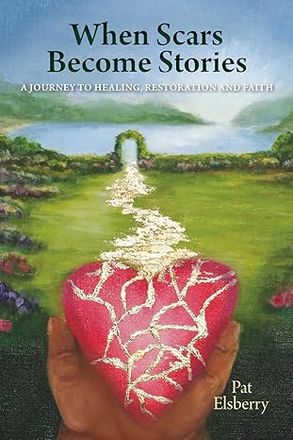
Comfort and Hope for the Bereaved, from One Who Has Been There: “When Scars Become Stories” by Pat Elsberry

February 18, 2026

The first time I read Pat Elsberry’s wonderfully comforting When Scars Become Stories, I likened her to the poet Vergil, who accompanied Dante through the torments of his famous Inferno. Upon re-reading her as she guides us through the grief journey, as she puts the experience of losing a loved one and its aftermath, I see that my initial comparison missed the mark.

Author Pat Elsberry

Vergil knew what to expect in the Inferno, but he had never been through it, never endured those awful punishments. But Pat Elsberry has been there. She suffered the wrenching loss of an adult daughter several years ago. She takes our hand and tells us what to expect, what we feel, how to accept those myriad feelings and how to cope – because she has done it all herself.

Also, the first time I read the book, I went straight through it in just a couple of sittings. It’s only 200 pages, broken up into 50 short chapters, each of which includes a summary reflection and a concluding prayer. However, reading it straight through is not the way to do it. Instead, make one chapter a part of your early-morning routine each day. That’s what I do, and that’s how I believe you can derive the greatest guidance and comfort from Pat.

Prayers, spiritual readings, grateful reflections on life already lived and on life yet to come – they’re all part of my own grief journey, now of more than six years’ duration. And I’m most appreciative to now have Pat Elsberry’s wisdom and strong faith in God to accompany me.

Perhaps a sample of Pat’s own words can tell it better. The following passage captures the essence of When Scars Become Stories, in my opinion. It’s from Chapter 13, whose title coincidentally is the same as that of the entire book:

“There are times when I look at the scars of my grief and feel the ache of loss all over again. They are tender reminders of a story I would never have chosen. But there are also times when I look at them and see beauty – a reminder that God has carried me, sustained me, and is weaving my story into something bigger that I can see. My scars have allowed me to connect with others in ways I could never have otherwise. They give me language to comfort those whose wounds are still raw, to say, ‘You are not alone. I have walked this road too, and God is with us.’  
“When scars become stories, they become gifts. They allow us to give away the comfort we ourselves have received. They allow us to bear witness to God’s faithfulness, to shine light into someone else’s darkness, and to remind the world that healing is possible.”

I can say unreservedly that those who are bereaved, whether recently or in years gone by, will find in When Scars Become Stories a renewed perspective and hope for the rest of their earthly journey, a hope that will sustain them until they are reunited with their loved ones in eternity.
The Hair Care Advertisements that Launched World War II

February 17, 2026

Well, that headline is a bit of an exaggeration. But read on. There’s something to it.

According to “Eastern Europe: An Intimate History of a Divided Land” by Jacob Mikanowski, two towering figures dominated the cultural scene of that region in the idyllic decades before World War I destroyed that world: Habsburg Emperor Franz Joseph I, and Anna Csillag.

That time, from the end of the Franco-Prussian War in 1871 and the outbreak of World War I, is fondly remembered as the Belle Epoque (or Beautiful Era). In America, it was dubbed the Gilded Age by Mark Twain. In Europe, there was peace and stability, and people had money to spend. And they spent a lot of money on the wondrous, but totally bogus, hair pomade made famous by Anna Csillag.

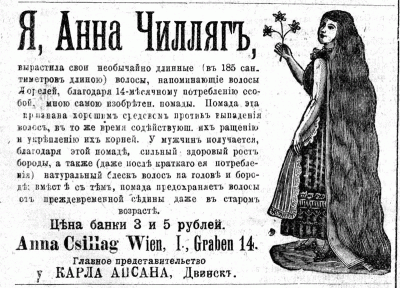
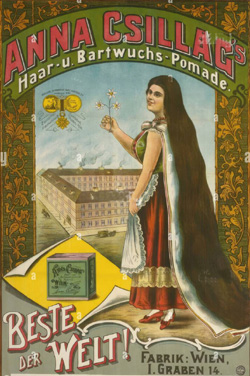
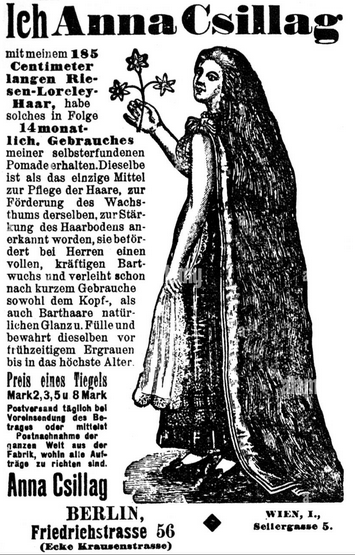
Mikanowski points out that Csillag’s image appeared in advertisements in every newspaper in Europe. The ads showed her in peasant garb, holding aloft three lilies, and nearly covered by her long and lustrous black hair, which “cascaded down her back like a wooly Niagara.”

How did she get that hair? The myth that her ads spun had her a poor young woman, nearly bald, and shunned by all those in her little village. But one day, she was working with chemicals and discovered a miraculous medicine that cured her baldness and became a hair-growing wonder drug. In her ads, printed in many languages, she wrote “I, Anna Csillag, possess an immense, 185-centimeter growth of Lorelei-like locks thanks to fourteen months spent using my specially formulated pomade.”

The men in her family got in on promoting the hair-growing too. The ads depicted them with “astounding pelts of lustrous black hair – fanlike beards stretching past their waists, and ropelike mustachios coiled around their trunks and midsections like so many boa constrictors.”

The ads appeared the papers of “Budapest, Krakow, Lodz, Vienna, Helsinki, Riga, and all points in between…the ads were so ubiquitous that they became part of the background hum or life in the Belle Epoque.” They also featured rapturous letters of endorsement by users.

The whole thing was a brilliantly executed con. Csillag – real name Stern – wasn’t born in “Karlowitz of Moravia,” as her ads claimed, but in Zalagerszeg, Hungary. She also sold a tea that was purportedly a miraculous shampoo, and a bar of soap that she plumped as “the best soap in the world.”

As she operated her business from Vienna and Budapest, the Austro-Hungarian bureaucracy come along to inspect. They found that the soap was just a red-brown toilet soap of inferior quality, and the tea was  nothing but a common chamomile. As for the hair pomade, it was “nothing more than a mixture of fat and bergamot oil. It was white-gray in color, had the consistency of lard, and appeared grainy when spread out in a thin layer.”

Did that reality check matter? Nope. The stuff still sold. Or maybe the bureaucrats’ findings weren’t widely disseminated. And Mikanowski notes wryly, “with the benefit of hindsight we can say the imperial inspectors missed their mark. They evaluated a physical product, when the real miracle sold by Anna Csillag was her message. Repeated over and over again, it acquitted the force of a cryptic gospel or a prayer.”

Ah, the power of advertising. Anna would have made Don Draper and his coterie of Mad Men envious. But he did get the message. As Don he famously said in one episode, “What you call love was invented by guys like me to sell nylons.”

Someone else who was envious to the point of becoming enraged by Anna’s success in advertising was a penniless, struggling art student in Vienna. He spent hours poring over the ads, and he was especially fascinated by the letters of gratitude supposedly sent to Anna’s companies. He found that the letters were all fakes, and the supposed senders were dead.

The art student thought that he had found the key to a great mystery – the secret of propaganda. He ranted about its power, declaring to one friend “Propaganda, good propaganda, turns doubters into believers. Propaganda! We only need propaganda. Of stupid people there are always enough.”

The art student also wanted to turn his dormitory into an “advertising institute,” where the residents would all dedicate themselves to selling some product – perhaps a glass-strengthening paste – and promote it regardless of whether it worked. All they had to do, he claimed, was to repeat their message as often as possible, and, combined with a talent for oratory, they would attract all the customers they could want.

None of the guys in the dorm bought that scheme. One of them replied that they needed something worthwhile to sell, and that “after all, oratory on its own was useless.”

Rebuffed, the art student left school. But he wasn’t finished with the lessons he had learned from Anna Csillag and her fanciful stories. He found another dream to sell, another cryptic, diabolical gospel. He put Anna’s lessons to murderously effective use in his role of chancellor, and ultimately dictator, of the country of Germany.

From phony hair pomade to the brutal reality of a World War…now you know the rest of the story.