History I Never Knew: The Remarkable Annie Oakley

July 7, 2013
Little Sure Shot

Little Sure Shot

In April 1898, three weeks before the Spanish-American War broke out, President William McKinley received the following letter:

“I feel confident that your good judgment will carry America safely through without war. But in case of such an event I am ready to place a company of fifty lady sharpshooters at your disposal. Every one of them will be an American, and as they will furnish their own Arms and Ammunition will be little if any expense to the government. “

–Annie Oakley

President McKinley never responded to the 37-year old Annie’s offer to help. Nor did Woodrow Wilson or his Secretary of War Newton Baker nineteen years later when Oakley wrote “I can guarantee a regiment of women for home protection, every one of whom can and will shoot if necessary.” But she still gave soldiers of World War I shooting lessons, and she helped raise money for Red Cross and other organizations.

Gail Davis as Annie Oakley, with her horse Target

Gail Davis as Annie Oakley, with her horse Target

Annie Oakley, born in 1860, was a remarkable woman. Her name is familiar to my generation. We all remember the TV show of the mid-1950s that starred the glamorous Gail Davis. Gail was also a sharpshooter and expert rider too, but the 81 episodes of the Annie Oakley Show had no resemblance to the life and accomplishments of “Little Sure Shot.”

We boomers have also sung “Anything You Can Do, I Can Do Better” and “There’s No Business Like Show Business.” They’re from Annie Get Your Gun, the popular musical that debuted in 1946. Some of us even remember Barbara Stanwyck as Annie in the 1936 biopic.

So we can thank the showbiz acumen of people like Gail Davis’s mentor Gene Autry and composer Irving Berlin for keeping the name of Annie Oakley alive. That’s a good thing. But she deserves to be remembered for far more than most of us know about her.

Annie Oakley was not just an entertainer with a rifle slung over her shoulder. She was the first bona fide American female superstar. Her story is an inspirational tale of a child who rose from stark and abusive poverty, who never forgot her roots or those who faced similar hurdles, who did everything in her power to better the lives of girls and women, and who was a staunch patriot in deed as well as in word.

During her career, Oakley taught more than 15,000 women how to use a gun, both for the inherent discipline of marksmanship and for self-defense. She even taught ladies how to conceal their guns in umbrellas. She said, “I would like to see every woman know how to handle firearms as naturally as they know how to handle babies.”

Up from Poverty, Rifle in Hand
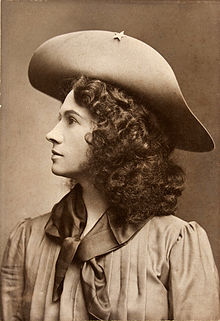
Annie in 1903

Annie in 1903

Phoebe Ann (Annie) Moses was born in a log cabin in rural northwest Ohio, the sixth of seven children of Jacob and Susan Moses. Jacob had fought in the War of 1812. He died of pneumonia in 1866, when Annie was five. Annie taught herself how to shoot, using her late father’s old 40-inch cap-and-ball Kentucky rifle.

At age eight, she began trapping and hunting small game to support her widowed mother and her siblings. She would kill the animals with a head shot, preserving as much edible meat as possible. She sold the game to Katzenberger’s Restaurant in Greenville, Ohio. The owner re-sold most of it to hotels and restaurants in Cincinnati, 80 miles away. Annie was so good that by age 15 she had earned enough to pay off her mother’s mortgage.

At age nine she was admitted to an infirmary in Darke County, Ohio along with her sister. The superintendent’s wife taught her how to sew and decorate. Annie was also “bound out” to a local family to help care for their infant son, on the false promise of fifty cents a week and an education. For two years she endured the couple’s mental and physical abuse. She would often have to do boys’ work. One time she was put out in the freezing cold, without shoes, to punish her for falling asleep over some darning. Annie referred to the family as “the wolves.” But in her autobiography, she did not reveal the couple’s real name.

Word of Annie’s prowess as a sharpshooter spread throughout the region. Her escape hatch from a grinding life of penury was that singular – but now forgotten – American institution, the traveling road show. On Thanksgiving Day, 1875, the Baughman and Butler shooting act was performing in Cincinnati. Traveling marksman and former dog trainer Frank Butler, an Irish immigrant, placed a $100 side bet – one worth more than $2500 today – with Cincinnati hotel owner Jack Frost. The bet: that Butler could beat any local shooter.

Frost arranged a match between the 25-year-old Butler and Annie, saying, “The last opponent Butler expected was a five-foot-tall 15-year old girl.”

Butler missed on his 25th shot, losing both match and bet. But he eventually won big. He began courting Annie. They married in August 1876 and stayed together until their deaths 50 years later. They first lived in the Oakley district of Cincinnati, and Oakley became her stage name. Offstage, she always referred to herself as Mrs. Frank Butler.

Poster for Buffalo Bill's Wild West Show

Poster for Buffalo Bill’s Wild West Show

Annie began as Butler’s assistant in the traveling act. But soon he stepped back from the limelight and let his more talented spouse be the star. They joined Buffalo Bill Cody’s Wild West Show in 1885 and stayed with it for 17 years. Annie was the main attraction. Her most famous trick was repeatedly splitting a playing card, with the edge facing her, and putting several more holes in it before it could touch the ground. She did it from 90 feet away, using a .22 caliber rifle.

That feat prompted people in the theatre business to refer to complimentary tickets as “Annie Oakleys”. Such tickets traditionally have holes punched into them to prevent them from being resold. She could also hit a tossed-up dime from 90 feet, and one day she hit 4,472 of 5,000 glass balls tossed into midair.

How “Little Sure Shot” Got Her Nickname

Sitting Bull

Sitting Bull

In 1884, after a performance in St. Paul, Minnesota, Oakley befriended the fearsome Sitting Bull, chief of the Lakota Sioux. Eight years previously, in 1876, Sitting Bull had led the Indians in the rout of General George Armstrong Custer at Little Big Horn. Sitting Bull fled to Canada, returned in 1881 and surrendered, and was still a political prisoner when he met Annie. Impressed by both her marksmanship and her self-assured demeanor, he gave her the Sioux name “Watanya Cicilla,“ which means “Little Sure Shot.”

Later that year Sitting Bull was allowed to join Cody’s entourage as a show Indian. He earned about $50 a week for riding once around the arena, and he became a popular attraction. But Sitting Bull stayed with the show for just four months. The poverty of the white men’s cities and their patronizing attitude disgusted him.

Sitting Bull was an admirable leader of his people, a superb military tactician, and a good guy. He gave speeches about education for the young and reconciling relations between the Sioux and whites. He earned a small fortune by charging for his autograph and picture, and he often gave his money away to the homeless and beggars. He said that Indian culture would take care of its sick and elderly, and was appalled that white society did not do the same for its own. But Sitting Bull loved Annie Oakley.

Fame, and Fortune Generously Shared

In 1887, Buffalo Bill’s Wild West toured England to join in the Golden Jubilee of Queen Victoria. Annie received a great deal of press coverage, and by the time Cody and his show returned to Europe in 1889, Annie had become a seasoned performer and earned star billing. The troupe stayed in Paris for a six-month exhibition, and then traveled around France, Italy, and Spain. Oakley was especially popular with women. Buffalo Bill made the most of her fame to demonstrate that shooting was neither detrimental nor too intense for women and children.

Annie and Frank Butler with Dave, the "Red Cross Dog" of World War I.

Annie and Frank Butler with Dave, the “Red Cross Dog” of World War I.

In Europe, Annie also performed for King Umberto I of Italy and Marie François Sadi Carnot, president of France. Shooting the ashes off a cigarette held in Frank’s mouth was a big part of the act. She was so good that the newly-crowned German Kaiser Wilhelm II asked her to shoot the ash off his cigarette. She did so, but had him hold the butt in his hand. After World War I began, she wrote him a letter requesting a second shot.

Annie earned $700 a week while on tour in Europe. But she remembered the poverty of childhood and lived frugally. She sent money home to her mother and family, and gave money to orphans, widows and young women who wanted to further their education. Records show she provided funding and professional training for at least 20 young women.

She often said, “Aim at the high mark and you will hit it. No, not the first time, not the second time and maybe not the third. But keep on aiming and keep on shooting for only practice will make you perfect. Finally you’ll hit the bull’s-eye of success.”

Though she had no formal education, Annie instinctively knew all about cultivating her feminine image – today we’d call it brand management. Annie projected womanly allure and sex appeal without being sexy – the perfect little lady. She wore her hair unpinned, like a young girl. She made all of her own clothes, which she styled to hug and display her pleasing curves. But she never showed any skin, covering her legs with long stockings and wearing long sleeves and high collars.

In that uptight, repressed Victorian era, Annie Oakley was breaking barriers at the same time while helping to create an image of American womanhood – proper, attractive, and practical. The woman Annie represented didn’t need protection; she could protect herself.

Setbacks and Hardships

It wasn’t all glory and fame for Annie Oakley and Frank Butler. She left Cody’s show for a year when a younger rival shooter named Lillian Smith joined up and got higher billing. In 1901, she lost a shooting match to a nine-year-old girl, Ethel Nice. Shortly after that, Annie was in a train wreck, was temporarily paralyzed, and had five spinal operations.

She left Buffalo Bill’s show in 1902 and began an acting career. She was on the stage as Nancy Berry, The Western Girl, who got the better of the bad guys by using pistol, rifle, and lariat.

Annie had previously appeared in one of the earliest movies ever produced, “The Little Sure Shot of the Wild West.” A Kinetoscope film shot in 1894 by inventor Thomas Edison, it was the 11th movie made after commercial showings began in April of that year. In the film, Annie performed an exhibition of shooting at glass balls.

In 1904, the odious William Randolph Hearst published a scurrilous story that Annie had been arrested for stealing to support a cocaine habit. A coke-snorting stripper from Chicago had been nabbed by police, and she gave her name as “Annie Oakley.” That “evidence” was apparently enough for the scandal-mongering Hearst.

It took the real Annie six years and 55 libel lawsuits against newspapers to get back her reputation. She won 54 of those suits, but the judgments she collected didn’t even pay her legal bills. Hearst even sent punks from his papers to Ohio to try and dig up dirt about her, but they came back with nothing.

Annie in 1922

Annie in 1922

Following Annie’s change of career and despite her injury, her shooting prowess continued to improve until she was well into her sixties. In a 1922 contest, Annie hit 100 clay targets in a row from 16 yards away. She was 62 at the time.

Later that year, she and Frank were in a car accident that forced her to wear a steel brace on her right leg. But she recovered and set more records in 1924.

Annie’s health declined in 1925. She succumbed to pernicious anemia in Greenville, Ohio and died at age 66 in November 1926. Frank Butler was so disconsolate at her passing that he stopped eating and died just 18 days later.

After Annie’s death, her incomplete autobiography was given to a friend, the stage comedian Fred Stone. Soon it was discovered that her entire fortune had been spent on her family and on her charities.

Her Legacy

So how should we remember Annie Oakley? As one of America’s best. Ever.

Annie Oakley was a model for the Greatest Generation that followed her, and for all generations to come. She overcame poverty, mistreatment and physical injury with her determination and strength of character. She broke barriers for women with her talent and accomplishments in her sport. She loved her country and proved it with many good and patriotic works. She showed compassion and generosity to orphans, widows and other young women. She was a devoted and faithful wife.

Annie Oakley excelled in a man’s world by doing what she loved – winning fame and fortune as the little lady from Ohio who never missed a shot.
Tim Tebow and the Patriots: Nice Move, Coach Bill

June 12, 2013

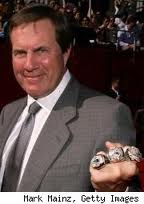
Bill Belichick and his coaching credentials

Bill Belichick and his coaching credentials

I’m amazed by how many people are driven batty by Tim Tebow and his ways of giving thanks to the Almighty. Legitimate evaluations of his football ability almost always get smothered by ad hominem blather.

Please correct me if I’m wrong, but I believe that Tim “Tebows” in gratitude after accomplishing something. It’s not as if he asks God to help him and his team win. I don’t remember that he ever compared his God to an inferior one worshiped by the teams he’s defeated. And there haven’t been too many of those lately anyway.

Let’s chill, see how he does, and save our opprobrium for the real religious hypocrites of the world. There are enough of them to go around. Thus far Tebow hasn’t murdered anyone who disagrees with him.

As for the football possibilities, I’m reminded of the old priest-and-rabbi joke where the two of them go to a boxing match. Just before the bell one of the boxers makes the sign of the cross. The rabbi turns to the priest in puzzlement. “What does that mean? What is it going to do for him?” The priest answers, “Not a damn thing if the kid can’t fight.”

And so it will be with the New England Patriots. Tebow’s feats in long-ago college and his pious, clean-living ways will not matter a whit to Bill Belichick. If Tim can’t contribute, he’ll be on the first train to Clarksville.

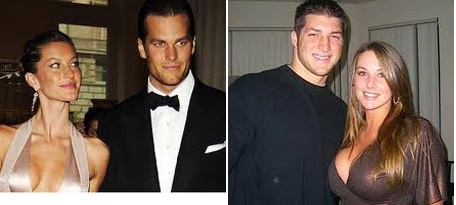
Tom Brady and Gisele Bundchen - Tim Tebow and Lucy Pinder

Tom Brady and Gisele Bundchen – Tim Tebow and Lucy Pinder

Boss Bill was certainly being himself at the press conference, wasn’t he? “He’s talented. He’s smart. He works hard. Let’s see how it goes.”

Tebow can’t be expected to direct the team the way Tom Brady does. But really, now – can anybody? Tim’s quite competitive with Tom in other areas of life, as one of the accompanying photos shows. But on the field, he needs to do different things. Belichick and his guys might just fashion a complementary role that will finally allow Tebow’s strengths to emerge while masking his shortcomings.

Chuck Fairbanks

Chuck Fairbanks

Think of Andy Johnson, one of New England’s most talented and underrated players ever. He played halfback for Chuck Fairbanks beginning in 1974, and lasted with the Pats until 1982. He could run, catch the ball out of the backfield, and throw the option pass – four TD passes in 1981.

Fairbanks spoke at a Gridiron Club dinner a few years ago. After the dinner we had a drink in the bar – he favored Pinot Noir – and I told him that I’d always liked Andy Johnson. He smiled and said, “Let me tell you about Andy Johnson.”

Before coming to the Patriots, Fairbanks had built a number of unstoppable wishbone-option teams at Oklahoma. One day he got a call from his buddy Vince Dooley, the coach at Georgia. Dooley told him that he had recruited this tremendously talented quarterback, and that he needed to build an offense around him. Problem was, he and his coaches didn’t know a thing about options or wishbones.

Fairbanks dispatched a few of his assistants to Georgia that summer to teach Dooley’s coaches all about the option. That season, sophomore quarterback Andy Johnson led the Dawgs to a record of 11-1. He ran for 870 yards and passed for 341. During his three-season college career he rushed 431 times for 1799 yards. At Florida, Tebow played four years and rushed 692 times for 2947 yards.

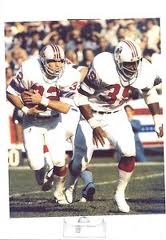
Sam Cunningham leads the way for Andy Johnson

Sam Cunningham leads the way for Andy Johnson

Fairbanks, like Belichick, knew all about selecting and managing football talent. He drafted Johnson in the fifth round and made him a running back. Johnson was in the backfield with Sam Cunningham and Steve Grogan – and I remain convinced that the 1976 Patriots, 11-3 and robbed by referee Ben Dreith in the playoff at Oakland, was the Patriots’ best team ever.

Is something similar going to happen with Tim Tebow? It can’t happen only if they don’t try. As Bill said, “Let’s see how it goes.”

Yes, let’s. Praise the Lord and pass the prolate spheroid. Nice move, Bill.

Boston Pitches in to Help New York – Rebuilding After Hurricane Sandy

May 17, 2013

RTB-new_logo2010[1]-color2I’m pleased to post the attached bulletin from the great people of Rebuilding Together Boston – start spreadin’ the news!

Rebuilding Together Boston and the New York Rebuilding Together affiliate are pitching in to repair many New York-area homes damaged by Superstorm Sandy. This project will be similar to the wonderful effort put forth for families in New Orleans and on the Gulf Coast after their hurricanes. The pdf file (link below) has information for those who would like to volunteer their services.

The work will run from May 20 to June 7. For those willing and able to participate this volunteer event promises to be a well-coordinated effort. If you are interested and available, please call Rebuilding Together’s National Advisory Council Regional Coordinator, Jane Eskelund, at – 401-486-0877.

RebuildAfterSandy_GerritsenBeach_VolunteerRequest

To Doris Matthews White, Her Family, and Her Friends

May 5, 2013

Tom Burke and Doris Matthews White

Tom Burke and Doris Matthews White

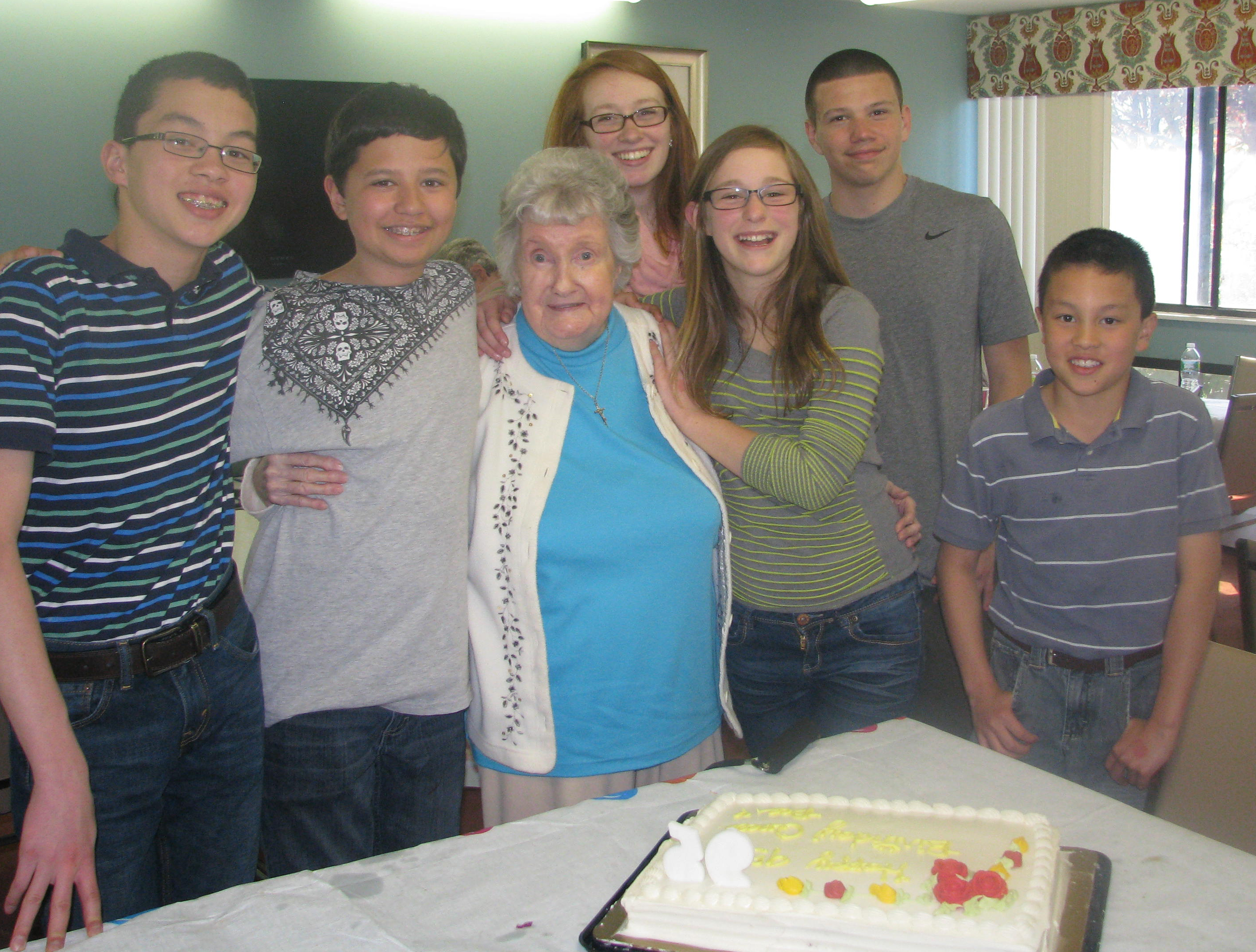
On May 5, 2013, four generations of Doris Matthews White’s family convened at her apartment building in East Boston to celebrate her 95th birthday. They came from as far away as Nevada and Florida. I was honored that she asked me to speak on her behalf. This is what I said.

This is a wonderful occasion, with four generations of Doris’s family here to celebrate her birthday and the birthdays of a few other family members who were also born around this time of the year.

I’m one of Doris’s many friends from Winthrop. We’ve come to know her as our Queen Bee. We’re her fans and friends and admirers. I know I speak for all of those friends and admirers when I say it’s been a wonderful blessing that she’s come into our lives, and that we’ve had the privilege to know her.

Doris and her children

Doris and her children

I’ve met with Doris several times to hear the stories of her life and of her family, and my work on that is far from complete. But I’d like to share with you just a few of the things I’ve already learned from her.

Doris’s mother’s maiden name was Rich. Doris has traced her roots all the way back to Father Hugh Rich, of the Kingdom of Aragon. At one point in his life, Father Rich journeyed to England to become the confessor of Thomas More, the Lord Chancellor, who died as a martyr for opposing King Henry VIII.

Your family is also descended from two of the great names in early colonial America, John Endecott and John Winthrop.

John Endecott, the first Governor of Massachusetts, served for 16 years. He also was a landowner and planter, and he planted the Endecott Pear Tree in Danvers. It is believed to be the oldest cultivated tree in America. Doris is a member of the Endecott Society. Governor Endicott Peabody of Massachusetts is his descendant, and therefore a relative.

John Winthrop was governor of Massachusetts Bay Colony in 1630. He served 12 terms. His writings have provided for us much of the knowledge of what the founders of our country accomplished. Every time you hear someone mention Boston as the Shining City on a Hill, that’s from John Winthrop, a patriarch of your family. His descendants include John Forbes Kerry, now the U.S. Secretary of State, and Charles William Eliot, a president of Harvard. Another John Winthrop was also briefly a president of Harvard.

Doris and six of her great-grandchildren

Doris and six of her great-grandchildren

Moving to the American revolution and the fight for independence — your ancestor Daniel Townsend fought at Lexington, in the first battle of the revolution, and he gave his life. April 19, 1775, Daniel was trapped in a farmhouse with about 30 other patriots. The British set fire to it, and Daniel was able to break open a window and let all the others escape. But he did not escape…he was shot and killed by the redcoats.

He is buried in Lynnfield, just about a mile from where my own son and grandson now live. His epitaph reads:

SACRED to the memory of Mr. Daniel Townsend
Who was slain at the Battle of Lexington April 19th 1775, aged 36
Shades, we trust
Lye, valiant Townsend in the peaceful
Immortal honours mingled with thy dust
What tho thy body struggled in the gore
So did thy Saviour’s body long before
And as he raised his son by power divine
So the faire power shall also quicken thine,
And in eternal glory mayst thou shine

Daniel’s wife Zerviah died six months later, and she lies beside him in Lynnfield.

Also serving the American cause was another ancestor, James Rich. He was a sailor and a senior officer on a privateering vessel. Privateers were critical to the revolution; they, not the navy of John Paul Jones, were the real American naval force of those days. The privateers went up against the strongest navy in the world, the British.

Family members call her "Googie." If it can be found on line, Doris will find it!

Family members call her “Googie.” If it can be found on line, Doris will find it!

And then of course there’s Doris herself. We, her friends have seen a photo of her from her childhood, back in the early 1920’s. What was she doing? Selling poppies – the flowers that grow in the fields of Flanders. Poppies were sold to help out World War I soldiers and their families. Doris has been helping others ever since she was four years old.

And the tradition of service continues. Tom served his country with a full career in the United States Air Force. Ian, of the next generation, is a pilot as well. And I’m sure there are more whose lives I don’t yet know about.

To Doris’s great grandsons Sean and Jonathan, who I understand are meeting her for the first time – this is just a small and incomplete example of all that your marvelous family has done for our country. And even well before our country was founded, going back to the days of Saint Thomas More, for the causes of freedom and justice.

Again, I know that I speak for all of Doris’s Winthrop friends when I say it has been an utter joy for us to get to know her, and to hear her stories, and to have a share in her wisdom.

I would like to end, if I may, with a prayer. I would like to quote some lines from a beautiful hymn from our Jewish friends. They, perhaps more than any other people, know how important it is to pass on to our children and grandchildren the values we have learned. To do so is not just for people of one particular faith, but for everybody.

The hymn is called L’dor VaDor, and it says:

We are gifts and we are blessings, we are history in song,
We are hope and we are healing, we are learning to be strong
We are words and we are stories, we are pictures of the past
We are carriers of wisdom, not the first and not the last.

Remembering our families and honoring our traditions is not about the past. It’s about who we are now. It guides us into our own futures, so we can all do our parts to make this a better world, both as individuals and as American citizens.

And because we – all those present today, all and those Winthrop friends for whom I speak – know and love Doris Matthews White, we’re very well prepared to do just that.

Doris, Queen Bee – Happy Birthday – and thank you.

History I Never Knew: Mary Had a Little Lamb – and He Built the Bunker Hill Monument

April 30, 2013

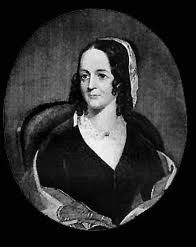
Sarah Josepha Hale

Sarah Josepha Hale

Well, not really. But there’s definitely a connection between that soft and gentle creature and the obelisk commemorating the first major, fiercest, and bloodiest battle of the Revolutionary War.

Construction of the Bunker Hill Monument started in 1825. They built one of America’s first railroads to carry the eight-ton blocks of granite from the quarries south of Boston. But funds ran out and it took a remarkable woman named Sarah Josepha Hale to rescue the project.

Hale was editor – she preferred to be called “editress” – of The Ladies’ Magazine. She’d also published, in 1830, Poems for Our Children, a collection that included Mary’s Lamb. She raised $30,000 for the completion of the Monument. She first asked her readers to donate a dollar each and also organized a week-long craft fair at Quincy Market. The fair sold handmade jewelry, quilts, baskets, jams, jellies, cakes, pies, and autographed letters from George Washington, James Madison, and the Marquis de Lafayette. Without Mrs. Hale, the 221-foot monument might never have been built.

Daniel Webster

Daniel Webster

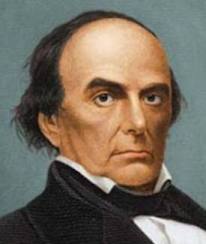
Daniel Webster had addressed a crowd of 100,000 at the laying of the cornerstone. He was still around in 1843, and he spoke again when the finished monument was dedicated that year. It is one of the signature edifices of Boston, a memorial both to the fighting spirit of the colonists and to the staunch patriotism of Sarah Josepha Hale.

Conquest of Breed’s Hill: A Pyrrhic Victory for the Redcoats

As the latest Smithsonian magazine tells it, there’s a lot of mythology about both colonial Boston and the Battle of Bunker Hill. The city was no cradle of liberty or bastion of religion. Though founded by Puritans, Boston had a neighborhood near Beacon Hill that was so thick with prostitutes that maps showed it as “Mount Whoredom.” One out of five families in Boston owned slaves. The city was viciously divided between Loyalists and advocates of independence. Many of the “Sons of Liberty” were vigilantes and thugs.

It had been two months since the skirmishes at Lexington and Concord. The Brits were holed up in the city of Boston, and the colonists were on the outskirts. Fortifying Breed’s Hill, which was closer to the city than Bunker Hill, was probably done as a deliberate provocation. It worked. The British responded, torched Charlestown at the base of the hill, and attacked the entrenched colonials.

The Brits, with their red uniforms and the nattily-dressed officers easily identifiable and thus prime targets, charged twice and were beaten back. The high grass had obscured many rocks, holes and other obstacles that made the uphill advance even more difficult. The third charge was different. They first blasted the hilltop with cannon fire, then marched in spaced columns rather than abreast.

There was no “whites of their eyes” command by Colonel William Prescott or General Israel Putnam. That was made up years later by writer Parson Weems, who also concocted the story of George Washington and the cherry tree. When the British charged, the Americans fired from 50 yards away. One colonel told his men not to shoot until they saw the splash guards, called half-gaiters, which the soldiers wore around their calves. “Don’t fire until you see their half-gaiters” just doesn’t sound the same, does it?

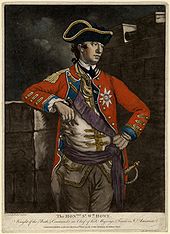
Lord William Howe

Lord William Howe

The Americans ran out of ammunition. Those who couldn’t escape perished in brutal, hand-to-hand combat. The British took the hill top, but had suffered 1,054 casualties to the Americans’ 400. “Success is too dearly bought,” wrote British General William Howe, who lost every member of his staff and the bottle of wine that his aide-de-camp had brought along.

The British got the message: the colonists, though driven off Breed’s Hill that day in June, were going to give them a tough fight. In March 1776, just nine months later, the redcoats evacuated the city of Boston for good.

The First Monument: In Memory of the Dr. Joseph Warren, the Revolution’s First Martyr

Joseph Warren

Joseph Warren

The first monument on the Breed’s Hill site was an 18-foot wooden pillar with a gilt urn erected in 1794 by King Solomon’s Lodge of Masons. They wanted to honor Dr. Joseph Warren, a physician and Mason who was the Revolution’s first martyred hero. There’s a statue of him in Charlestown now, but he is little remembered today.

Warren was a leader of the colonial underground, and he became a major general of the army in the time leading up to Bunker Hill. Clad in a toga, he addressed a crowd of 5,000 before the battle. He didn’t assume a command, but fought as an ordinary soldier. He wore a silk-fringed waistcoat with silver buttons, and he died from a bullet in the face during the final British charge.

Warren’s stripped body was later found and identified through his false teeth, which had been crafted by Paul Revere. He left behind both a fiancée and a pregnant mistress. In 1823, a group of prominent citizens formed the Bunker Hill Monument Association to put up a better memorial. They fell short of their goal, though, and had to be rescued by Sarah Josepha Hale and Mary’s Little Lamb.

America’s Best Friend About Whom You’ve Never Heard: Beaumarchais

April 26, 2013

Beaumarchais

Beaumarchais

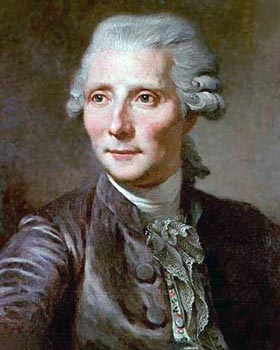
Students of the American Revolution learn of the indispensable aid that the colonists got from France’s King Louis XVI and his men: Lafayette, Rochambeau, and deGrasse. But we never hear of Pierre Augustin Caron de Beaumarchais. And that, mes amis, is une scandale. Without the tireless, entrepreneurial work of the fascinating M. Beaumarchais, we might still be drinking tea and saying “shedule.”

Master Spy

History shows that France formally entered an alliance with the Americans after the army of Horatio Gates defeated the redcoats of John Burgoyne at the Battle of Saratoga. The books don’t tell that our boys were wearing uniforms and firing guns delivered by 20 French ships manned by sailors organized and paid by the firm of Roderigue, Hortalez and Company. That company was a front, set up by Beaumarchais, which would have made the CIA proud.

Secretly backed by the governments of France and Spain, Roderigue, Hortalez purchased and shipped to America: 200 cannon; mortars; 25,000 firearms and ammunition; 200,000 pounds of gunpowder; and uniforms and camping equipment for 25,000 men.

The whole thing was done without the British ambassador to France catching wind of it. King Louis XVI had wanted to support the Americans against the Brits, but he wanted to do it clandestinely. Beaumarchais got the cooperation of admirals and factory owners by issuing many orders in Louis’ name, orders that the king never knew about. When he heard the news of the American victory at Saratoga, Beaumarchais sped off for Paris in a carriage to tell the king, and he suffered a serious injury in an accident along the way.

Stiffed by the “Grateful” Yanks

Silas Deane

Silas Deane

Beaumarchais had to borrow the money to finance the arms shipment. He was to be paid in tobacco, according to his deal with Silas Deane of Connecticut, who was then acting as agent for the Continental Congress. Deane was a slippery character. He didn’t keep his financial records in order, for whatever reason, and was eventually fired from the job in France and replaced by John Adams. Deane ended up advocating for the British cause and living in Europe.

John Jay

John Jay

Beaumarchais was never thanked by the Americans and never got paid for his troubles. Three and a half years later, he received a nice letter from John Jay. It promised that soon the Continental Congress would pass measures to pay up – it didn’t – and went on to say Beaumarchais had “gained the Esteem of this Infant Republic and will receive the merited applause of a new world.”

Merci beaucoup, Chief Justice. Show me the money!

Forty years on, Beaumarchais’ daughter had fallen into poverty. She petitioned Congress to pay the 2.25 million francs that America still owed her father, according to books originally compiled by Alexander Hamilton. Congress told her to take one-third of the amount, or nothing.

The American nation is not the only one that owes M. Beaumarchais its thanks. So do opera fans and literature buffs of all nations. He wrote the plays that eventually made into The Barber of Seville, The Marriage of Figaro, and The Guilty Mother. He also went into the publishing business in Germany and printed many of the works of Voltaire, which were banned in France. Without Beaumarchais’s publishing ventures, unprofitable though they were, we might not know much at all of that great author Voltaire.

Smooth Operator

How did Beaumarchais, son of a middle-class provincial watchmaker, achieve all that he did in and around the royal courts of France? It took a brew of talent, native intelligence, hard work, and a knack for bettering himself through networking and marrying rich women.

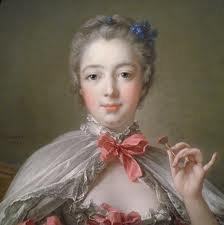
Madame de Pompadour

Madame de Pompadour

Watches were unreliable and worn mostly for ornamentation back then. At age 20, Beaumarchais invented an escapement for the internal works; the escapement made his watches much more accurate. He also designed a watch mounted on an elegant ring. The watch was for Mme de Pompadour, mistress of King Louis XV. That was his entrée to the court at Versailles.

Beaumarchais became a harp instructor to Louis XV’s daughters. He married a second time, bought himself a title and coat of arms, and collaborated with some big French wheeler-dealers on ventures like the building of the Royal Military Academy. He also tried to be named the exclusive exporter of slaves to the French colony of Louisiana.

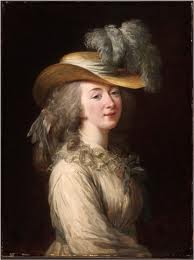
Countess du Barry

Countess du Barry

He fell out of favor when his wealthy patron Joseph Paris Duvereney died, and he got embroiled in a sensational lawsuit known as the Goezman affair. Both Beaumarchais and his opponent tried to bribe the judge, whose name was Goezman. Beaumarchais’s writings about the case were popular, scandalous faire. The verdict was basically a tie, and Beaumarchais ended up losing his civil rights.

He earned those rights back by going to England as Louis XV’s secret emissary. His task: to buy off a blackmailer who was threatening Countess du Barry, another mistress, with a defamatory book named Les mémoires secrets d’une femme publique. He succeeded brilliantly, getting 3,000 copies of the book burned. He persuaded the author to become a valuable informant for the French.

Later on, during the French Revolution, Beaumarchais made big money by supplying the City of Paris with water. He had to flee for his life and spent a couple years in Germany before returning and living out the rest of his days. He married a total of three times, and his enemies accused him of poisoning his first two wives in order to gain access to their money. Whether he ever did so was never proven. But one thing was certain: he did have a talent for wooing wealthy ladies.

Pierre Augustin Caron de Beaumarchais deserved more than the mere esteem of this infant republic. We should be including him in any serious accounts of how the American colonies were able to win their war of independence. Belated applause too, please!

And come on now – admit it. Isn’t history just fascinating?

NCAA Hockey – Thoughts on this Year’s Playoffs and Championship Final

April 12, 2013

As far as I’m concerned, the NCAA Division One hockey championship game will be one of those clichéd contests where it’s too bad that one of the teams has to come out as the loser. There’s ample reason to cheer for Quinnipiac or Yale. And whichever one wins, we can feel good that two teams from the ECAC are going at it for the national title. This hasn’t happened since BU 5, BC 3 in back in 1978 when there was just one major college hockey conference in the East.

Why Yale

YaleI’d like to see Yale prevail to show that student-athletes can win a national championship in college hockey. One of the TV commentators said that Yale has never won a national title in anything. Perhaps the Elis were the best college football team in the land in the days of Walter Camp and Pudge Heffelfinger. But they didn’t have NCAA championships back in those days.

Yale – like all of its fellow Ivy League institutions – would never stand a chance of going all the way in football or basketball, so it would be good to see them make it happen in hockey. They’ve not had a great deal of success in hockey over the years, and only once before, in 1952, did they even make it to the NCAA’s semifinal round. Coach Keith Allain has done a great job in New Haven.

Why Quinnipiac

quinnipiacI’d like to see Quinnipiac prevail for two reasons. First, this is a school that has come out of nowhere to national prominence in hockey. They’ve invested in the program and supported Rand Pecknold and his coaching staff all through the team’s rise. Not all colleges will make that kind of commitment.

Hockey is expensive, and it will never bring in the television-related revenues of basketball and football. You must choose to make hockey an important part of your school’s culture, and you must be prepared to reap comparatively modest financial returns. Bravo to the schools that do so, and to Quinnipiac for being the latest. They can thank athletic director Jack McDonald for making it happen.

The second reason is personal. I’ve known Jack for many years. He is BC ’73, a Hall of Fame track man, and a superb human being. He worked in the athletic department at BC and had a successful tenure as A.D. at Denver before coming to Quinnipiac. It’s wonderful to see his vision and determination pay off.

Why the ECAC

ecaCTwenty-nine years ago, ECAC Division One was the only hockey conference that mattered in the East. There were 17 teams and three divisions – East, West, and Ivy. The scheduling was uniform, at long last, and the politics of playoff qualification were finally a thing of the past. “The ECACs” were the best hockey weekend of the year, period.

Then the Ivy league schools decided that they did not want to subject themselves to games with every one of those teams from the Great Unwashed. I was covering the sport for the Hockey News at the time, and I could never get anyone from the schismatic six to return a phone call or give an adequate explanation. It appeared that Princeton was the prime mover, and they were conveniently removed from the Boston media and could easily fend off inquiring reporters.

Fortunately for the Ivies, they were able to persuade Clarkson, Saint Lawrence, and RPI to stick with them instead of going over to the league that eventually became Hockey East. I heard it took a special appeal from Ivy presidents to their counterparts. Had it gone the other way, Ivy League hockey might have atrophied into a Division Two backwater. But the ECAC remained viable even though Hockey East has been vastly more successful on the national level in the almost three decades since then.

I’m still angry at those people, but they’re long gone. So bravo to the coaches and players of the current ECAC generation, and to the league’s classy commissioner Steve Hagwell. They are doing Eastern hockey proud.

What About the Future?

hockey eastI maintain to this day that the ECAC-Hockey East split was unnecessary and driven largely by Ivy snobbery. Some fabulous rivalries of bygone days have died off. I can only speak as a BC fan here, but I say that it’s terrible that my team rarely if ever plays Cornell, Brown, St. Lawrence, or Clarkson. There is absolutely no reason that ancient rivals BC and Harvard not have a game every year, but they don’t. Ditto for Eagles’ games with Yale and Dartmouth.

I like the intensity and the quality of Hockey East competition, but three regular-season games with each league rival are too many. With Notre Dame joining Hockey East next season, they’ll have to cut back to two Hockey East league games apiece. This should open up more available dates for the continuation or resumption of some the fine, old rivalries. We’ll probably see Penn State’s new team playing a few games in this area too, and more as time goes on.

Will there ever be a formal merger, a recombining, of ECAC and Hockey East? Doubtful, but not needed, especially if we see a few more interleague games along the way. In a way, there’s already one big national conference anyway. The pairwise rankings and power ratings pit your team against those of all conferences. The tougher your schedule, the better. Non-league games count as much as league matchups in figuring eligibility for the 16-team national tournament. Everyone knows what it takes to make it into that dance. All good stuff.

Final Thoughts
UMLI can’t end without a tip of the fedora to UMass Lowell. They were almost left for dead five or six years ago but have come all the way back and then some. It started at the top when Marty Meehan took over the reins at the school. It took more than a little lobbying with the Trustees by Marty and a number of others to keep UML in the big time. Hiring Norm Bazin to coach was a stroke of genius, or luck, or both.

The River Hawks were a jewel of consistency ever since January and all through the playoffs. They laid an egg against Yale, but they’ll be back. Like Quinnipiac, they’ve made the institutional commitment to the sport of hockey, and we’re better off for it.

And lastly, I want the Frozen Four to be a regular event at the TD Garden in Boston. It belongs back here, perhaps one year out of every four or five. Play the game of hockey in hockey cities, guys.

Fun Facts from the History of Preventive Medicine

April 9, 2013

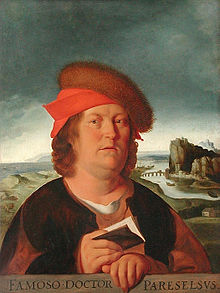
Paracelsus

Paracelsus

Back in the old days, people thought that illness was the result of imbalances of the four “humours” within the body. “Bleeding” to correct those imbalances was standard treatment. Paracelsus (1493-1541) first challenged this view by stating that poisons from outside the body made people sick. Introducing other “poisons,” albeit in smaller doses, could correct things.

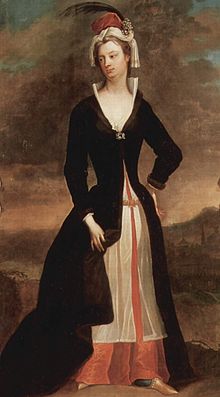
Fast forward two centuries to the early 1700s, when Lady Mary Wortley Montagu of London followed the basic ideas of Paracelsus in her personal crusade to make English people healthier. Smallpox was rampant in those days, and Lady Montagu promoted the radical idea of inserting a small bit of matter from a smallpox patient into the body of a healthy person to ward off the disease. A few people took her up on the offer and proved her right; King George I had his grandchildren “inoculated.”

Lady Montagu

Lady Montagu

In America, the preacher Cotton Mather was a big supporter of the practice, but the only physician to adopt it was Dr. Zabdiel Boylston (1676-1766) of Brookline, Massachusetts. Boylston performed America’s first successful operation for the removal of bladder stones in 1710. In 1718, he did the first surgical removal of a breast tumor.

The “big pox,” or syphilis, was all too common as well. Dr. Thomas Dover (1660-1742) thought that mercury was the cure for syphilis. He prescribed mercury for that and for other venereal diseases and became known as “Dr. Quicksilver.” His “Dover’s Powder,” a concoction of ipecac, opium, and potassium sulfate, was used to induce sweating to defeat the advance of a “cold” and at the beginning of an attack of fever. It remained in use up to the 1960s.

Zabdiel Boylston

Zabdiel Boylston

Thomas Dover was an interesting guy. He gave up his medical practice and sought his fortune in privateering, even though he was a landlubber. On a three-year voyage of that legalized piracy he managed to make that fortune and put down a mutiny along the way. He was also the captain who rescued and brought home Alexander Selkirk, who’d been marooned on an island off Chile. Selkirk’s story was retold in fiction by Daniel Defoe in Robinson Crusoe.

Dover, like Lady Montagu, was a disciple of Paracelsus and a believer that diseases originated outside the body. That growing realization led to support for additional preventive medical techniques. Venereal disease was one affliction that simply cried out for methods of prevention, especially in military circles. The troops of the British Royal Guard suffered more deaths from sexually-transmitted diseases than from enemy swords and bullets.

A Colonel Cundom of the Guards came up with the answer. He designed a “bootie” made from dried lamb intestines which could be oiled before use. A number of writers and poets began to praise the new invention. Englishmen began referring to it as a “French letter,” while the French called it an “English cloak.”

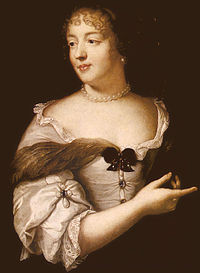
The Marquise de Sévigné

The Marquise de Sévigné

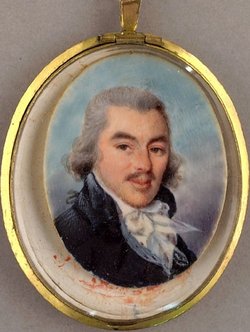
The Marquise de Sévigné (1626-1696), a prolific and witty letter-writer, described it thus to her daughter: “..an armor against enjoyment and a spider web against danger.”

A small company was founded in 1880 to produce the booties that were named for the intrepid colonel. In 1937, the first latex version of the bootie made its appearance. The company named the new product a “Trojan” in honor of the walls of Troy, which had been so effective on holding the Greeks at bay for ten years. The more formal name of the product is “prophylactic,” derived from the Greek words “pro” (for) and “phylax” (gatekeeper).

And that’s our history lesson for today.

Remembering Boston’s Lady in Red

March 18, 2013

The Lady in Red walks Long Island's shore.

The Lady in Red walks Long Island’s shore.

Today we celebrate Evacuation Day in Boston. School is closed because yesterday was a Sunday and the actual anniversary of March 17, 1776 when the British military fled Boston. The fleet of the mightiest navy in the world departed Boston Harbor under heavy cannonading by George Washington’s forces. The colonial army was using guns that had been dragged to Boston from Fort Ticonderoga by a contingent led by Henry Knox.

Abigail Adams saw the fleet departing and described the ships’ masts as a “forest” in the harbor. On board the British ships were 11,000 soldiers and 1,019 citizens who remained loyal to King George and wanted to return to England.

Two of these Loyalists were newlyweds William and Mary Burton. Their hoped-for married life in Britain was not to be, however. Mary was struck in the head by a cannonball fired from Long Island as their ship made its way seaward. She was not killed immediately but lingered on for several days in great pain. As she lay dying, Mary pleaded with her husband not to bury her at sea. After her death on board the ship, the British and the colonial forces on Long Island struck a truce, and William Burton was allowed to come ashore to bury his love.

Burton sewed his wife’s body into a red blanket that Mary had brought aboard to keep warm on the long journey home. He laid her to rest on the East End of Long Island and made a grave marker from a piece of driftwood. He vowed to return to Boston some day and give her a proper head stone, but he never did come back.

The British fleet did not depart immediately. The ships stayed at anchor in Boston’s outer harbor and blockaded the port for another three months, exchanging gunfire with shore batteries. They finally left on June 13, 1776 when a barrage of cannon fire from the East End hit the British flagship Milford. British Commodore Banks ordered his ships to put to sea. On July 17, 1776, that same Long Island Battery on East Head fired a thirteen-gun salute to celebrate the Declaration of Independence.

But Mary Burton refused to be forgotten. Her wooden grave marker soon disappeared. But in 1804, fishermen shipwrecked on Long Island encountered her ghost, wrapped in a red cloak and sighing mournfully. With blood pouring from her head wound, she floated over a hill and disappeared. The Lady in Red was also seen and heard in 1891 by a soldier at Fort Strong, which was built on the island shortly after the Civil War.

March 17 is better known around here as Saint Patrick’s Day. But Evacuation Day was one of the turning points in America’s war for independence. Had it not taken place in 1776, we might not today enjoy the religious freedom that allows us to honor Boston’s patron saint.

But also, had Evacuation Day not taken place, William and Mary Burton would likely have spent many happy years together and given the world their children whose descendants may have been our friends, neighbors and relatives.

Let us today remember Mary Burton, the Lady in Red, and pray that she rest in peace at last.

Jack Parker

March 14, 2013

I started covering college hockey in 1969, the same year that Jack Parker began his coaching career at Boston University. Jack is retiring after 40 seasons as head coach of the Terriers. Here’s a look back, and a few thoughts I’d like to share, on Jack and his life’s work.

Parker meets the media with Mike Lynch, left, and Robert Brown, right.

Parker meets the media with Mike Lynch, left, and Robert Brown, right.

Perhaps the only guy who knows how Jack Parker feels right now is Joseph Ratzinger, the former Pope Benedict XVI.

Both men departed voluntarily from “destination” jobs in their professions. Both devoted their entire working lives to their institutions. When there was some burning question or issue affecting their respective spheres of influence, the faithful immediately wanted to know what they thought about it.

It was more than a family gathering over at Boston University the other day when Parker made it official. This season, his 40th as Boston University hockey coach, will be his last. Many former players and devotees of BU hockey were on hand, of course, along with a crush of media people and dozens more like me who just had to be there. Though we hear it often, and it can sound trite, this was a time to summon all the families: Boston University’s, college hockey’s, and the sports fans of our fair city.

Yes, It’s Time

This was more than the announcing of a coaching change. A brick in the wall – no, make that a large, weight-bearing stone in the foundation – of Boston, City of Sports Champions, must be replaced.

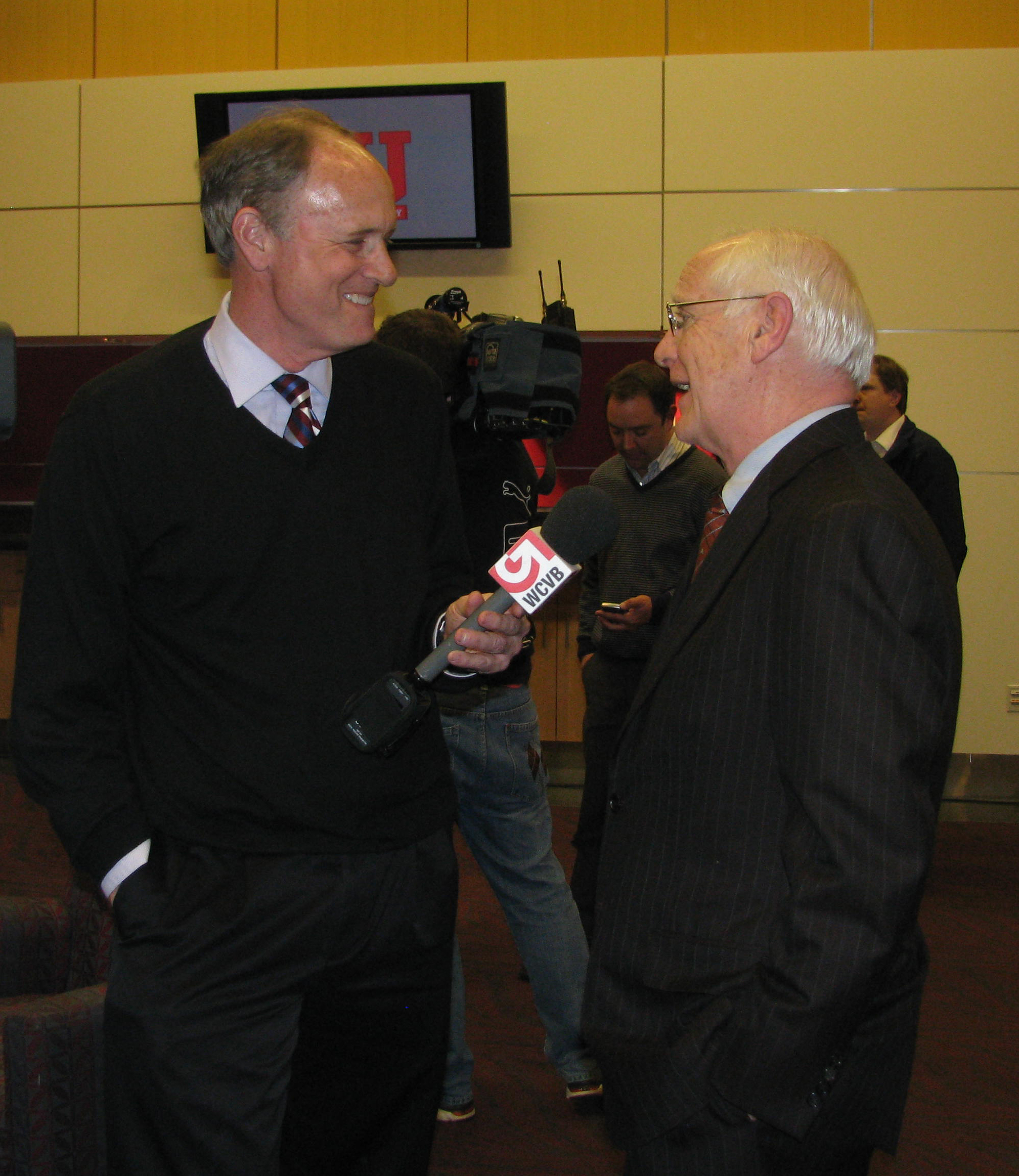
Parker with sportscaster Mike Dowling in one of many TV interviews

Parker with sportscaster Mike Dowling in one of many TV interviews

If there’s been one constant in Boston sports over the past half-century, it has been high-quality hockey at Boston University. Parker pointed out that he’s been reporting for duty at BU hockey for 48 of the last 49 years. That’s counts his time as a player and assistant coach. It is hard to imagine BU hockey without Jack Parker, but yes, it is time, as he said himself.

Athletic director Mike Lynch and President Robert Brown shared the podium with Parker. Supporting cast for him this day, they said all the right things and were appropriately noncommittal about the Who and the When of his successor.

We don’t need to recite chapter and verse of Jack Parker’s accomplishments. But his 21 Beanpot titles will stand for all time, and quite probably his total wins at one school – 894 and counting. His three NCAA championships in three separate decades – the first in 1978, the last in 2009 – show that the game never passed him by and that he could change with the times.

What It Takes, What It Brings

College hockey is a special sport. It’s genuinely big-time, in that many of its players go on to long and satisfying professional careers. But there’s not the money to be made in hockey that a school can make in football and basketball. Hockey is mightily expensive, with lots of equipment, costly physical plant, hefty travel expenses, and no television-package bonanzas. For basketball, all you need are five guys and five pairs of sneakers.

Embracing Dave Silk, 1980 Olympian and one of many former BU players who came to press conference

Embracing Dave Silk, 1980 Olympian and one of many former BU players who came to press conference

Not so in hockey. The institution has to love the sport, embrace it, acknowledge it as integral to the culture. That has been the case at BU, as Parker also stated when he said “This university makes it easy to win. You have to win if you’re going to stay around a long time. The school has to want you to win and be behind you. And this university for a long time has been behind the hockey program and behind the hockey coach.“

A little later on, when asked about the rewards of coaching, Parker cited the relationships he’s had with his players, and said “You don’t coach for the outcome. You coach for the process. A lot of people in this profession would be mighty disappointed in themselves if the only way they could get satisfaction is to win a national championship.”

While all three gentlemen skated around the big question of his successor, Parker responded to a question about that individual when he said “I hope he’s sincere.”

To me, that remark goes beyond hoping for a straight shooter who tells it like it is. I think what he really meant was that he wants a successor who embraces and articulates with sincerity and conviction the distinct values and brand of his institution.

That also means, without stating it, that Boston University’s new coach has to be one of the many Terrier alumni who coach hockey for a living. I don’t know which one is best suited to take the job, but the list is extensive and includes Joe Sacco, David Quinn, Sean McEachern, Mike Bavis, Mike Sullivan, John Hynes, Toot Cahoon, Terry Meagher, Buddy Powers, and possibly a few more.

I doubt very much that BU will go for a non-graudate, even though there are many talented coaches out there. If Norm Bazin (Lowell), Nate Leaman (Providence) or Mark Dennehy (Merrimack) were interested and offered the post, for instance, any of them would do a fine job and keep the Terriers in the upper ranks of Hockey East. But it just wouldn’t be quite the same as having someone who’s been brought up in the BU culture. If any school has learned that lesson, it’s Boston University.

Jack Parker took over the program early in the 1973-74 season after the school fired Leon Abbott over a recruiting issue. Parker had remained on staff as assistant after the school selected Abbott to succeed Jack Kelley in 1972. The hiring of Abbott was one of the biggest what-the-hell-are-they-thinking moves of all time. The administration snubbed Bob Crocker, a BU man who had been Kelley’s long-time assistant, chief recruiter, and co-architect of two NCAA champions.

Leon Abbott was from Western Canada and a capable hockey man. But he had no ties to Boston and was a terrible fit and puzzling choice for head coach of BU. Two years previously, BU’s ECAC quarterfinal playoff against Abbott’s RPI team was a disgraceful woodchopper’s ball. BU had blasted the brawling, mayhem-seeking Engineers 11-0. I remember writing that the RPI team resembled the thuggish droogs in the movie Clockwork Orange. That game was so bad that BU did not schedule RPI the following season.

Crocker went off to be head coach at Penn, a prestigious institution but one that that didn’t really care about hockey and didn’t deserve a BU guy as its leader. The Terriers were lucky that Jack Parker was still around when they pulled the trigger on Abbott. And so it was that a misguided decision led to Jack Parker’s early appointment to the job he would have eventually taken anyway.

But he was up to the task, even at the tender age of 28. He had learned his hockey under Kelley, also one of best coaches Boston has ever seen. But more importantly, Parker had also been steeped in the BU way.

In hockey, that matters. It’s not like basketball or football, where winning is enough. Wins matter in hockey, but so do the tradition and the culture of the institution. Other schools get that message too. In the Eastern leagues, Harvard, Northeastern, BC, UNH, Lowell, Cornell, Yale, Brown, and Dartmouth all have an alumnus as coach.

Friends and Rivals

Parker said that the worst incident of his entire career was Travis Roy’s broken neck, suffered on the first shift of the first game in 1995. Travis rebounded heroically and has been an inspiring presence around BU and the sporting world. Jack went on to add that one of the best things about his career was the manner in which hockey people of every lineage and description rallied around the young man.

Some of the changes in the game of college hockey during Parker’s long tenure have not been beneficial. But one thing that hasn’t changed is the people of the sport of hockey.

“Community” is a much-overused word. It’s a wishy-washy way of describing people who have some sort of common bond. It’s not adequate to describe the tight attraction, the effortless affinity, which we of the college hockey world share. Yes, we badger, tease, and throw verbal stink bombs at one another. But beneath our rivalries is a love and respect for those who play and coach our game, and an appreciation for the institutions that take the game as seriously as our own school does.

With BC coach Jerry York before their game at Fenway Park in January 2010

With BC coach Jerry York before their game at Fenway Park in January 2010

There is no better example of a spirited and appreciative rivalry than that of Boston University and Boston College. We’ve got something wonderful here, and no one knows that as well as Jack Parker. He’s frequently said that one of the best things for BU hockey is BC hockey, and one of the best things for BC hockey is BU hockey. He didn’t always believe that, but he does now. Each team brings its “A” game to every encounter, and it’s always better to be the pre-game underdog than the favorite.

In his first couple of seasons as BU head coach, Jack Parker was rather, er, high strung and a chain smoker as well. It seemed to me that he thought his job his job hinged on never losing to Boston College. BC had a number of off years early in Parker’s career, so for a while that was relatively easy to do.

But I recall fondly the 1976 season. BU was off-the-charts good again, but BC was coming back. They pulled a big upset in the Beanpot and had a couple of other tight losses. Playoff time was drawing near, and the Eagles had a shot at the eighth and final seeding. At a writers’ luncheon in the season’s final week, Parker declared “If we’ve got to play Boston College again my stomach is going to turn inside out.”

Sure enough, it was #8 BC at #1 BU, and it took a late rally and Rick Meagher’s goal-scoring magic to give BU a 6-5 win. The next year’s quarterfinal, same story. Number 4 BU over number 5 BC, 8-7. You can’t imagine the emotions, and you can’t match the memories. There have been many more such clashes, down through the years, and Jack Parker has been there for all of them.

Boston Boy, Hockey Statesman

Something else about Jack Parker. He’s not just about BU. He’s about Boston. He wore number 6 as a player because he admired Bill Russell, without a doubt the biggest winner that sport in Boston has ever produced. That was back in the sixties.

On the other end of his Parker’s career was his 2009 NCAA championship. Miami of Ohio was up 3-1 in the final. When Zack Cohen put home a rebound with 59 seconds left, what popped into Parker’s mind? Bernie Carbo’s pinch-hit 3-run homer against Cincinnati in Game Six of the 1975 World Series.

Carbo’s blast tied that game in the eighth inning. BU scored again to tie up Miami 17 seconds left, and then won it in overtime. Colby Cohen’s deflected shot fluttered up and over the goalie’s shoulder in much the same manner as Carlton Fisk’s 12th-inning home run sneaked inside the left-field foul pole against the Reds 34 years before.

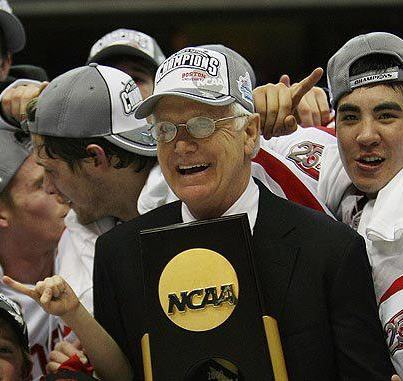
After beating Miami in overtime for the 2009 NCAA Championship

After beating Miami in overtime for the 2009 NCAA Championship

I’d say 2009 had to be Parker’s most satisfying NCAA win. The record was 35-6-4, but it wasn’t his best team. Several squads that had been more talented didn’t make it all the way. His first national champion team had a record of 30-2. The crown was BU’s to lose that year. Not so in 2009. Nobody feared Boston University. They were good, but every playoff opponent thought the Terriers could be had. Didn’t happen. Every puck bounce and close call that truly counted went BU’s way.

I also appreciated Parker’s observations about the game itself. Asked for his views on how the game has changed in his 40 years, he immediately cited the adoption of the full face mask. Total facial protection has made college hockey much faster and much more dangerous. Football’s debilitating injuries and concussions are frequently in the media, but hockey has them too. We have not heard the last of it.

He also commented that the goaltending position has changed and improved dramatically over the past decade. True again. Finally, the college game is no longer a post-high school sport. Twenty-two year old freshmen and 25-year old seniors are not uncommon. That’s not good.

Final Words

I was glad I made it to BU for press conference and got to shake Jack’s hand. Can’t help but think that it would be rather cool to see him go out with 900 wins. We’ll see about that one. He’d have to make it to the Frozen Four. Not impossible but a long shot for this final Jack Parker squad. BU’s best is as good as that of any Eastern team. But we haven’t seen it very frequently this year, and five regulars who started the season are either injured or have left school.

Before closing I want to extend to Jack my congratulations, thanks, and best wishes. Thanks for his friendship and help over the years, and congratulations on the consistent high quality of play and the overall success of his teams over forty seasons.

I started covering college hockey for the Hockey News back in 1969-70. That was the same season that Parker came back to BU from a year at Medford High to become assistant coach to Kelley. I’ve been writing about the game and its people ever since. Though I no longer work the beat full-time, I’ve had at least one interview with Jack Parker every single season since then, as we prepared for the annual rite of February, the Beanpot.

Perhaps the greatest benefit of working as a writer is that you get to meet with all sorts of different people, and you easily put aside your preconceptions about them. Covering the entirety of Eastern college hockey while I was still a student at Boston College taught me that right away. I learned it primarily by covering BU.

Jack Kelley, coach of our bitterest and most implacable foe, wasn’t an ogre whose team of monsters lived to beat up on my school’s team – though they did so regularly. Kelley was unfailingly courteous, generous with his time, and obliging in explaining his thinking and strategies. So too has been Jack Parker. And all those BU kids I’ve interviewed along the way have been were pretty nice young men.

As I write, there’s still plenty of college hockey ahead of us. March is by far the best month of the year in this sport, and for four decades Jack Parker and his teams have been there to take part in it. This is his last hurrah, and I sincerely hope it’s a good, loud, and long one.