Anthony Manning: A Profile in Courage

March 2, 2012

…And his parents are heroes too.

Anthony Manning III with his parents, Debbie and Anthony Manning Jr.

Anthony Manning III’s restrictive cardiomyopathy caused his heart to fail when he was eight years old.  He was placed on life support at Children’ s Hospital in Boston and fortunately, a donor’s heart was found within a day. After transplant surgery he had a lengthy recovery and, by the time he got to high school, was fit enough to try playing for the football team.

Anthony was the first transplant patient from Children’s who was allowed to play the game. He was on the squad at Greater Lowell Vocational Tech High School for four years. The Gridiron Club of Greater Boston gave Anthony its Henry Smith Courage Award for the 2011 season.

Here is a link to the story I wrote about him and his remarkable parents for the Boston Globe North edition of March 1, 2012:tinyurl.com.6u8h2dm


Blondes, Brunettes, and Redheads: The Story Behind the Words for Hair Color

February 23, 2012

(This is taken almost verbatim from the e-newsletter “Daily Writing Tips.”  It covers some of my favorite subjects – particularly etymology, of course!)

The conventions for referring to hair color are tousled. Why is it that we refer to someone with light-colored hair as a blonde (and, rarely, a blond) but we call someone with red hair a redhead? Why are blonde and brunette spelled two ways?

 Blondes

Blond and its feminine form blonde, both from the Latin word blundus (“yellow”) by way of French, may have in turn come from a Frankish word that could be related to Old English blondan, “to mix,” which shares its origins with blend. Blond is usually employed as an adjective, the term as a noun for a man with blond hair, by contrast, is rare. Because blonds and blondes are more likely to be fair-skinned as well as fair-haired, the term is also associated with light complexion.

The presence of both masculine and feminine forms for blond/blonde and brunet/brunette is due to their French (and ultimately Latin) roots, as it were, as opposed to the Germanic origins of black and red, the words for the other major hair colors, which have a neutral form.

Normally, English might have jettisoned one gendered form for blond/blonde. However, the venerable theme in popular culture of the blonde-haired woman as more sexually attractive and available (as well as flighty, shallow, and dimwitted), as compared to females with hair of another color, has caused the noun form blonde and brunette to endure.

The numerous terms for variations in blond hair, not necessarily in order of darkness, include sandy, strawberry, and dirty. Towhead (the first syllable refers to its resemblance to tow, flax or hemp fibers used for twine or yarn) describes a person with yellowish and often unruly hair.

Brunettes

Brunet and brunette, from the gender-specific diminutives of the French brun (“brown”), mean “brown haired.” (Brun and its diminutives originally also referred to a dark complexion.) As with blond and blonde, the male form is rarely used on its own as a noun, though the masculine and feminine variations persist probably because of the same double standard in association of hair color with female sexuality and with personality characteristics as mentioned in reference to blondes above. (Dark-haired women are stereotyped as serious, sophisticated, and capable.) Words for shades of brown hair, from darkest to lightest, are brunet/brunette, chestnut, walnut (the last two as compared to colors of the respective nuts), golden, and ash.

Redheads

  Redhead is yet another term for hair color used as a noun; in contrast to the colors mentioned above, it is not gender specific, though as blonde and brunette  are much more common in usage than blond and brunet, it is more likely to refer to a woman than a man.

Variations in red hair, listed in alphabetical order rather than according to depth of color, include auburn, copper, ginger, and orange. (Auburn derives ultimately from the Latin word albus, meaning “white,” but thanks to the influence of brun, the French spelling — auborne — changed, as did the meaning, to “reddish brown.”) The prevailing — and long-standing — cultural stereotype about redheads is that they are hot tempered; the hair color has also been associated with a high libido.

Alone among descriptions of people with general hair tones, a black-haired person is never referred to by the word black alone.

Hair-color categories are arbitrary — strawberry blond is sometimes considered a type of red hair, and auburn might be classified as a type of brown hair — though a system called the Fischer-Saller scale, devised for anthropological and medical classification, assigns alphabetical letters and roman numerals to various grades of hair color.

So: Is it true blondes have more fun?

Hey, Facebook Friends. I Don’t Care What They Say. I “Like” You.

February 2, 2012

Facebook Might Not Be Forever, But These Are!

The financial world is all agog over Facebook’s impending IPO, which will set the market value of the company at something like $100 Billion, of which Mark Zuckerberg will own around 30%.  Nice going, kid.

I’ve enjoyed what Facebook offers, particularly the ability to make new friends and to reconnect with old friends and family around the world.  This is what I “Like” most about it. I suspect that most of my FB friends feel likewise – ooh, lousy unintended pun.

But Facebook is a business. Business doesn’t succeed unless it delivers something of value. To understand what’s been going on with Facebook, and why it’s been so successful to date, be sure to read Andy Kessler’s Wall Street Journal column of Groundhog Day, 2012,

“The Button That Made Facebook Billions:  The power of ‘Like’ as an emotional sensor is driving the company’s exorbitant valuation.”

 Rather than attempting to condense and paraphrase Andy, I’ll quote him and another WSJ piece. They tell the story better than I can. Andy points out,

“As bizarre as this sounds, one of the most valuable innovations in technology over the last several decades is Facebook’s “Like” button. That’s what has propelled the company to a galaxy-orbit valuation for its forthcoming initial public offering, filed Wednesday.

“This is not only because the word “like” is, like, the identifying word of an entire generation. It’s because computing has evolved beyond just taking directions from humans—and instead is cozying up to us and sniffing out our emotions and intent.

 “[…] running ads next to pictures of your buddy Johnny funneling beers at a lacrosse game is not exactly what [advertisers] had in mind. Then, in mid-2010, Facebook rolled out its Like button, which transformed the company from a somewhat interesting social network into a major media player. The power of Like as an emotional sensor is what’s driving Facebook’s exorbitant valuation.

“Google, worth $190 billion with $38 billion in annual sales, is the closest real competitor to Facebook. Google lures you to its site via its search engine and sells ads against results, paid per click…basically it runs an ad platform. It’s a great business with operating profits of 35%, similar to Facebook’s.

“Facebook doesn’t sell phones or tablets, or ship physical products or even do searches. Instead, it has a vibrant, pulsating community of 845 million people willing to share their personal lives with others. Facebook is a giant emotional locker.

“The adage about advertising is that only half of ads are effective, but no one knows which half. With the ‘Like’ button, Facebook is like Bob Eubanks on “The Newlywed Game,” who promised contestants “a prize chosen especially for you.” Advertising’s nirvana is an ad chosen especially for you. Of all the players, Facebook is the closest to delivering.”

 The Journal article says that Facebook too is profitable, although development and employee costs are growing faster than its revenue, and

“Facebook’s revenue is still driven by online ads. The number of ads delivered on the site grew 42% and the average price per ad grew 18% over 2011 from 2010…”

So can they keep it up? How long will it last? Who knows – success in business breeds imitation and competition.  There surely is a “Next Big Thing” out there somewhere.  Only diamonds are forever.

 In the meantime, let’s understand what’s going on here while we enjoy the ride and our online friendships.

With Facebook, What You ‘Like’ is What You See – in advertising pitches.  Remember that you’re in control here!

Remember too – if you’re reading this, originally posted on Facebook, that means you’re my Facebook Friend. And, doggone it,

I “Like” You.

What’s in a Name?

December 9, 2011

Callista, Calista. A politician’s wife and a well-known actress/main squeeze of well-known actor both sport that lovely name. It’s from the superlative of the Greek word “kalos,” meaning “good” or “beautiful.” So someone with that name is, to her parents and her beau, anyway, the “most beautiful.”

“Callista” was the word that started the Trojan War. Eris, the goddess of strife, was angry that she was not invited to the wedding of Peleus and Thetis. Everybody else from Olympus was there. Eris inscribed “Callistae” – the dative form of the word, which meant “to the fairest” – onto a golden apple and rolled it into the banquet hall.

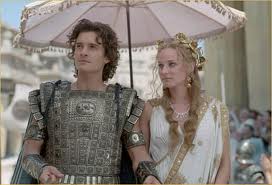
Orlando Bloom as Paris with Diane Kruger as Helen

Naturally, all of the big three celebrity goddesses claimed the apple.  Zeus – this must be why he got to be Zeus, the most high – didn’t get sucked into making the decision. Zeus told Hermes to bring the ladies to Prince Paris of Troy, who was known for his taste in women.  The Judgment of Paris would settle the impossible issue. Aphrodite, goddess of love; Hera, wife of Zeus; and Athena, goddess of wisdom, played the bachelorettes.

It was no evening gown or swimsuit competition that they held, up there on Mount Ida. The girls did their K-Street best to sway him. Athena promised Paris strength and knowledge. Hera promised wealth and power.  Aphrodite promised that he’d marry the world’s most beautiful woman. Guess who won the golden “to the fairest” apple?

Problem was, that most beautiful woman, Helen, was already married to Menelaus, King of Sparta.  Away she went, spirited off to become Helen of Troy. She was the one with “the face that launched a thousand ships;” they sailed off to get her back for her hubby.  It was the original quagmire, taking ten years, but back she came to Sparta.

Callista, Calista. And now you know the rest of the story.

Armistice Day

November 11, 2011

It is Veterans’ Day in America. This national holiday was known as Armistice Day from 1926 until 1954, when an Act of Congress changed the name to Veterans’ Day.

I agree with the thought behind that change. We should remember, honor and thank those who served in all conflicts that imperiled our nation and the free world. Thank you once again to all American veterans, and to your comrades in arms from Britain and Canada, for going into harm’s way for the sake of my freedom.

I am old enough to remember Armistice Day. I think that it is unfortunate that the name of that day, and what it meant, is fading into the background of history. Armistice Day, while a celebration of the cessation of World War One hostilities on the Western Front, also was a sobering and necessary reminder that the War to End All Wars was anything but that. Perhaps the best way to honor our veterans is to learn, and to belatedly apply, the lessons of Armistice Day.

Here is a link to a 1948 Armistice Day speech by General Omar Bradley.

His words are still relevant today, especially the following:

“With the monstrous weapons man already has, humanity is in danger of being trapped in this world by its moral adolescents. Our knowledge of science has clearly outstripped our capacity to control it. We have many men of science; too few men of God. We have grasped the mystery of the atom and rejected the Sermon on the Mount. Man is stumbling blindly through a spiritual darkness while toying with the precarious secrets of life and death. The world has achieved brilliance without wisdom, power without conscience. Ours is a world of nuclear giants and ethical infants.”

The Grandest Italian Master

November 6, 2011

“If you build it, they will come.”  Yes, but first you’ve got to figure out how to build it.

Filippo Brunelleschi

Filippo Brunelleschi

Filippo Brunelleschi figured it out, all right. His unsurpassed work in the field of architecture not only led to the construction of the Duomo of Florence, Italy.  His mathematical and artistic genius also made possible much of the Italian Renaissance, which led the people of the world out of the Dark Ages and into a new era of learning and culture.

I’m no art history expert, but I will venture a guess that no one – not even Leonardo or Michelangelo – had more impact, or unleashed more creative genius resident in others, than Filippo Brunelleschi.

A buddy of fellow sculptor Donatello, Filippo lost a contest to design the bronze panels adorning the west doors of the Cathedral of Santa Maria del Fiore in Florence.  Embittered by the loss, he fled to Rome with Donatello and studied the architecture of the grand old buildings, especially the Pantheon.

But construction of that Florentine cathedral, which had been going on for a hundred years, drew him back. It was time to build the dome, and nobody had the faintest idea of how it was to be accomplished. The dome was to be the widest and highest ever built.  But the plans forbade use of flying buttresses, such as those in the Gothic cathedrals of France, for support. The designer, Neridi Fioravanti, had died without telling anyone how to accomplish the task of vaulting the dome, 70 million pounds of Carrara marble standing 375 feet high.

Brunelleschi was named capomaestro of the project and swore on the Bible that he would adhere to Fioravanti’s vision.  His ideas and innovations included:

  • Building not one dome but two, with the inner and outer domes supporting each other;
  • Herringbone brick pattern on the dome surface, which made the bricks self-supporting until the mortar dried
  • The world’s first reverse gear, built into the hoist that lifted 1,700-pound stones hundreds of feet high. The reverse gear allowed the bucket to be lowered without turning the oxen around and re-hitching them,
  • The castello, the world’s  first sky-crane, built on the lower rim of the dome and used for positioning of the stones once they were lifted to that height;
  • A solid system of parapetti: platforms, scaffolds, lighted stairways and eating rooms for the workmen. Only three men died in the 16 years of construction work, an unheard-of safety record. He also had wine rather than water for the workmen; wine was safer than water back in those days.

Yet for all those innovations in architecture and construction, Brunelleschi’s greatest impact came in the world of art. He discovered the secret to linear perspective.  He did this by having people peer through a hole in the back of a painting he had made of the baptistery of San Giovanni, across the street from the cathedral. In front of the painting, they held a mirror that reflected the painting of the building; the real-life building itself was behind the mirror.

The people who participated in this experiment could not tell the painting apart from the real scene.

Brunelleschi thereby discovered, and quantified, that all lines receded toward a common point relative to the viewer of a painting. In Raphael’s “Betrothal of the Virgin,” for instance, all parallel lines of the painting intersect at a point on the horizon, which in the painting is the one that is farthest away.

What did all this mean?  Artists who learned this lesson could now accurately represent the three-dimensional world on a two-dimensional painting canvas. Brunelleschi’s disciple Masaccio was the first to do so successfully. He launched a movement that eventually included Raphael, da Vinci, and Michelangelo.

The Duomo was finished in 1636. Years later, Michelangelo was commissioned to vault the dome of St. Peter’s in Rome. He said he’d make it bigger and more beautiful than Brunelleschi’s.  Didn’t happen.  The diameter of the dome of St. Peter’s is 7.9 feet smaller than the Duomo’s diameter.

Ben fatto,Filippo Brunelleschi!

Farewell, Filene’s Basement

November 3, 2011

Back when I was a child, I was puzzled about this place called Filene’s. I thought it was owned by Bambi’s girlfriend Faline. She and her beau were nowhere to be found the first time that I went in-town shopping with mother and siblings.

There were at least a few family pilgrimages to Filene’s Basement in Boston every year. It was always a big event. We’d walk through the upstairs store too, and across the street to Jordan Marsh. But we seldom bought anything on the upper levels. Too pricey.

“The Basement” we knew and loved, with its raucous crowds and automatic markdowns and designer duds for cheap, is long gone. But they made it official today with the news that all of its stores would be closing by January.

I have to say that I knew this was coming way back in the 1980s. I was working at the Bank of New England and saw the acquisition/expansion loan proposals touted by CEO Sam Gerson…a leveraged buyout to spin off and expand Filene’s Basement.

Making the Basement a separate company from Filene’s itself – and financing it with mountains of debt – was dumb to begin with. Taking the Basement out of the basement and putting its bastard children into malls around the country was ever crazier. Didn’t they learn anything from Mammoth Mart, Zayre, Orbit, Bradlee’s, and all those other retail busts?

Still, it was with a measure of nostalgia that a read the corporate obituary. Filene’s and its founding family deserve a prominent niche in the business and social history of America.

Wilhelm Katz arrived in the United States from Prussia in the late 1840s. Like many Jewish immigrants of the day, he was fleeing the persecutions and pogroms that had sprung up in Europe after the Revolution of 1848. When he got to Customs in Boston, he wanted to register with an Anglicized version of his surname. Rather than Katz, he preferred “Feline.” The customs officer misspelled the name, and he became William Filene.

William Filene’s Sons Company was established in 1881. The Washington Street store opened in 1890, the start of the “Gay Nineties” and the height of the Gilded Age. William’s son Edward, pictured below, ran the company from 1908 to 1937. He was an exceptionally fine leader and captain of industry.  Among his innovations were:

  • Complete and honest descriptions of merchandise, and a “money back if not satisfied” promise;
  • Organization of the Filene Cooperative Association, America’s first company union, and advocacy of a “buying wage” as opposed to a “living wage;”
  • Minimum wages for women and a 40-hour workweek;
  • Founding the Credit Union National Association, which liberated many people from usury;

Did you also know that:

  •  Boston’s first public telegraph office was opened on the service balcony of Filene’s (1913)

(If you’re a post-boomer, do you even know what a telegraph office is?)

  •  Filene’s was the first American store to get rush shipments of the newest fashions from Paris, sent over on the Graf Zeppelin (1928)

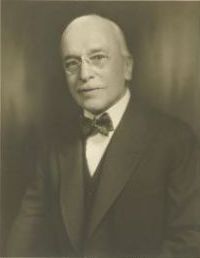
Edward Filene (Photo by Bachrach)

(If you are a post-boomer, do you even know what a zeppelin is?)

  • Filene’s was the first store in New England to be air-conditioned (1935)
  • Filene’s uniform headquarters in Northampton outfitted every WAVE naval officer and every woman officer in the Marines (1945)
  • Filene’s installed a zoo on its roof, complete with an elephant, lions, and monkeys. Hurricane Carol destroyed the zoo the same year (1954). I never went to that zoo, but I remember Carol.

One more thought. We have read much about the drive, innovation, and creativity of the departed Steve Jobs. No one disagrees about the benefits that his company and products brought to the world.

I suggest that the story of Filene’s and Filene’s Basement – for its first 70 or so years anyway – is much like that of Jobs and Apple. It shows what the entrepreneurial spirit in the competitive pursuit of profit can do for a people, a city, a country.

Well done, and rest in peace, William and Edward Filene and family.

We Must Never Forget

October 29, 2011

The Survivor Torah

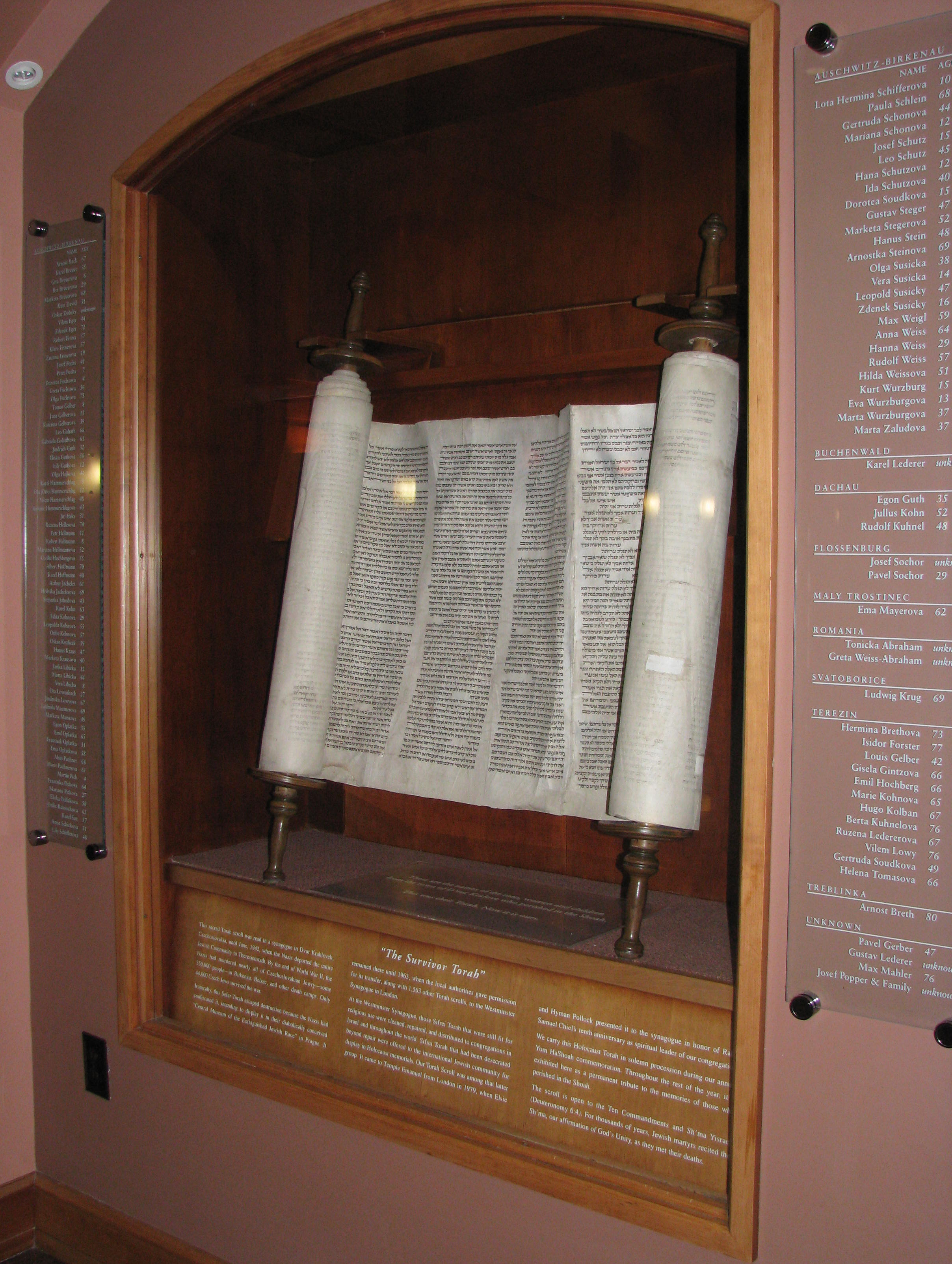
This magnificent Torah Scroll, in a display case at Temple Emanuel in Newton, Massachusetts, is open to the Ten Commandments and to Deuteronomy 6:4:“Hear O Israel, the Lord our God, the Lord is One.”   This is the “Survivor Torah,” and its story speaks to us of the very survival of mankind.

On the external glass frame surrounding the case are etched their names; Helena Tomasova, age 66; Luis Gelber, 42; Zdenek Susicky, 16; Lota Hermina Schifferova, 10; and some 95 others.  They were not survivors.  All members of the Jewish community of Dvur Kralove in Czechoslovakia, they were rounded up and sent to death camps by the Nazis in June, 1942. Of the 350,000 Czech Jews, only 44,000 lived through World War II. None of the survivors were from Dvur Kralove.

The Nazis killed the people, but they preserved this Torah Scroll for their planned “Central Museum of the Extinguished Jewish Race” in Prague. The Torah remained there until 1963, when it was taken to the Westminster Synagogue in London along with 1,563 other scrolls. Many of them, like this one, had been desecrated beyond the point where they could be used in the liturgies.

In 1979, a member of Temple Emanuel obtained this scroll and brought it to America on the occasion of the tenth anniversary of Rabbi Samuel Chiel’s service at the temple. Once a year, on Shoah Remembrance Day, the scroll is carried through temple in solemn procession. The names of the martyred faithful are remembered that day, and all through the year.

I feel a profound sadness when I contemplate their earthly fate, and a melancholy that sometimes verges on despair when I realize the depths of depravity to which members of the human race have sometimes descended, as they did during World War II.  I do take a measure of comfort in knowing that the names of Helena, Luis, Zdenek, Lota Hermina, and the Jews of Dvur Kralove will forever live in memory while the names of their captors and tormentors lie buried deep within the ash heap of human history.

Nazis, and their vile cousins who still infest the earth, are thuggish soldiers of the forces of darkness which, I am sorry to say, will be with us until the Last Day. But comforting, too, is the knowledge that even in times when evil is ascendant, there are the righteous among us who take up arms and thwart that evil – ordinary people like Wallenberg, Schindler, Socha, Sugihara, and the most heroic them all, Irena Sendlerowa.

I agree, as well, with the quote from a Shoah victim’s diary that my sister learned of in a visit to Yad Vashem in Israel. A young girl, who died in the camps, wrote that she hoped that somehow the victims would be remembered not by monuments but by the good deeds of people who learn the story of what happened.

Yes, we must learn and we must remember, just as the good people of Temple Emanuel have done.  In the display case is written, “This was their Torah. Now it is our Torah.”

May it be everybody’s Torah.  May we all remember the people of Dvur Kralove, and may we honor them – by knowing their names, by learning the story of what happened, and by courageously speaking the truth to evil. If we do that, we may yet ensure the survival of mankind and the ultimate victory of light over darkness.

Columbus Day: The Rest of the Story

October 10, 2011

Today is October 10, 2011

Cristoforo Colombo

Mythology inevitably takes root and flourishes around the life stories of all of history’s “great people.” That is certainly the case with Cristoforo Colombo of Genoa, Italy, whose voyages of discovery and entrepreneurship we celebrate in many parts of the United States today.

All of us who attended grade school during the latter half of the 20th Century are familiar with the life and legend of the “Admiral of the Ocean Sea,” as historian Samuel Eliot Morison calls him. I would like to mark this occasion by telling you a few things about the man and his patrons that you may not know, and which might give you another perspective on history, that most fascinating of subjects.

  • He was the son and grandson of weavers who had lived in the Genoese Republic for at least three generations. Ruddy-complexioned and with red hair, he was not an Italian in the modern sense. The people of Genova La Superba held themselves apart from and superior to other Italians.  In his writings, Colombo charged his heirs to “always work for the honor, welfare, and increase for the city of Genoa,” and to always maintain a family house there.
  • He learned seamanship on Portuguese vessels, and might have gotten the backing of King Joao of that country had Bartolomeu Dias not returned in triumph from his Africa voyage in 1488. Columbus was in Lisbon to pitch the king the day Dias returned. Discovery of that sea route to the Indies caused King Joao to lose interest in financing a Western exploration.
  • Queen Isabella of Spain first met with him in 1486 and kept him waiting six years for financing. Exactly why, we’re not sure. She was an effective ruler in a number of ways, especially in fiscal matters. She inherited enormous debt when she assumed power and got it paid off. It may have been that she didn’t have the money to spare in 1486. But she gave him a small retainer to keep him around and not take his project to some other monarch.
  • Isabella la Catolica was totally intolerant of other religions. She employed the infamous Tomas de Torquemada as her confessor and first Inquisitor General. She did her best to drive out from Spain, or to convert to Christianity, Jews and Moors (not Moops).
  • Even though she was anti-Jewish, Isabella employed a Jew named  Luis de Santangel as keeper of the privy purse. Santangel was the one who made the convincing argument that the expense of financing the voyage, less than what it would take to entertain a visiting sovereign at her court, would be worth it if the result was the conversion of people of Asia to Christianity.
  • That the queen sold her royal jewels to finance the first voyage is myth. That option was apparently on the table but Santangel arranged for borrowings from other public accounts instead; he also invested some of his own money.  And Columbus didn’t get paid anything until he returned to Spain. It was a good investment by Santangel.
  • The best, and favorite, of Columbus’ three ships was the Nina.Its real name was the Santa Clara, but the former was its nickname because it belonged to the Nino family of Palos.  The Nina went on three of his four voyages. It and the Pinta were caravels; Portuguese navigators favored such ships for their seaworthiness.
  • The Santa Maria, larger than the other two and the flagship of the fleet, was not a caravel but a nao, a ship less suited for long voyages.
  • The New World was first sighted at 2:00 a.m. on October 12, 1492 by Rodrigo de Triana, the lookout on the Pinta. The Pinta let the flagship, Santa Maria, catch up to them. Columbus gave the captain of the Pinta a bonus of 5,000 maravedis.
  • The Santa Maria drifted onto a coral reef during the night of December 24. The crew disobeyed orders to row out with a stern anchor that would keep the ship steady; rather, they rowed to the Nina, which refused to take them on. During that delay the Santa Maria carried further onto the reef and suffered irreparable hull damage from the rocks.
  • Columbus took that wreck on Christmas day as God’s sign that he should build a fortified settlement there. He called in La Navidad and left 21 sailors there, with instructions to convert the natives. He had no shortage of volunteers, because the men had thought they had reached the Indies and that there would be gold aplenty. They met a bad end at the hands of a local chieftain after roaming around seeking gold and women; all the Spaniards were hunted down and slaughtered.
  • He returned to Spain in triumph, and would have been better off – materially, anyway – if he’d taken his payment and retired. But he made three more voyages. Ponce de Leon was one of 1,000 “gentlemen volunteers” on his second trip. Ten ships went on that voyage.  They discovered Puerto Rico, then called Bourinquen in honor of St. John the Baptist. DeLeon liked that island, came back and conquered it some years later and became royal governor.
  • The second voyage was one of discovery, with about 20 new islands mapped out. But Columbus decided to attempt to subjugate the local population of Hispaniola, and he took 30 of the natives, Tainos, back to Spain as slaves.  Columbus and his brothers Diego and Bartholomew were terrible colonial administrators and could not wield authority properly. They mismanaged the trading post of Isabela to such an extent, neglecting to pay their people, that emissaries sent back to King Ferdinand persuaded him to take action on their behalf.
  • On the third voyage, Columbus discovered mainland South America. But the royal commissioner of Hispaniola, Francisco de Bobadilla, seized him and his brothers Diego and Bartholomew and sent them back to Spain in chains to be tried by the royal court. The king and queen fired the Columbus boys from their jobs in colonial government but allowed him to make a fourth voyage.
  • The fourth one was called the “High Voyage.” Columbus explored the coast of Central America down as far as southern Panama. The fleet ran aground and the crews were marooned on Jamaica for a year and had to send a canoe to Hispaniola to ask for a rescue ship.
  •  The natives there were accommodating but stopped trading Columbus and his men food for trinkets. He pulled his “eclipse trick” on them and scared them into giving food again; knowing that a full moon eclipse would be occurring, he told them that the gods were angry at them and would show their wrath that night. The terrified natives caved and the food shortage ended.
  • They were finally rescued, and Columbus returned to Spain, where he had a comfortable if not lavish retirement. He went to his death not realizing what he had actually discovered; he believed he had reached a province of China in addition to the many islands.
  • That’s today’s history lesson.  I hope you enjoyed it. Columbus had many faults and failings, but his skill as a navigator was unsurpassed. His “Enterprise of the Indies,” the idea that the East could be reached by sailing West, was his idea alone. He had the will and the perseverance to see that idea through, even though he made it less than halfway to where he thought he’d been.

With that, I wish you a very pleasant Columbus Day.

The Jewish Holidays and the Pennant Race: A Baseball Story

September 20, 2011

Rosh Hashanah falls on September 28, and Yom Kippur is on October 7. I wish my Jewish friends every happiness and blessing of this holy time, and I hope that 5772 will be a very good year for you.

As usual, the Jewish holidays come just at that time of the year when the baseball season draws all of our sporting attention.  Either the pennant races are heading down to the wire, or the playoffs or World Series have just begun.  This is a good time to retell the story of Hank Greenberg and Yom Kippur in the year 1934, as recounted in the Baseball Almanac:

Hank GreenbergHank Greenberg was a baseball player. A team leader. A league leader. A Jew. Both Rosh Hashanah and Yom Kippur fall in the regular season and in 1934 Greenberg’s Detroit Tigers were involved in the pennant race.

Greenberg wrote in his autobiography, “The team was fighting for first place, and I was probably the only batter in the lineup who was not in a slump. But in the Jewish religion, it is traditional that one observe the holiday solemnly, with prayer. One should not engage in work or play. And I wasn’t sure what to do.”

Greenberg’s rabbi said that Rosh Hashanah was a “festive holiday” and playing would be acceptable. Hank played and hit two home runs including a ninth inning game winner.

“I caught hell from my fellow parishioners, I caught hell from some rabbis, and I don’t know what to do. It’s ten days until the next holiday — Yom Kippur.”

 Those words, and his choice not to play on Yom Kippur due to its significance, inspired Edgar Guest to pen the following:

Came Yom Kippur

A Hank Greenberg Poem

Author: Edgar Guest. Published in Detroit Free Press, 1934.

“Came Yom Kippur — holy fast day world wide over to the Jew,

And Hank Greenberg to his teaching and the old tradition true

Spent the day among his people and he didn’t come to play.

Said Murphy to Mulrooney, ‘We shall lose the game today!

We shall miss him on the infield and shall miss him at the bat

But he’s true to his religion — and I honor him for that!’”