Archive for the ‘Books’ Category

Book Review: “Beyond the Flight of the Arrow” by James Bradford Taylor

August 1, 2019

Author Brad Taylor

Sometimes, you just want to escape. Get away from here. Have a rollicking, swashbuckling adventure in a far-off land.  Meet your childhood hero or the girl of your dreams.  Tell their story – no, live in their story the way you imagine it was in days of old.

Here’s one way to do it. Make this book by James Bradford “Brad” Taylor part of your summer reading list. Take it to the beach, willingly suspend your disbelief, unsheathe your trusty sword, and offer battle to the forces of evil.

The book, Taylor’s first, is an autobiographically-flavored fantasy fulfillment.  As the book’s hero, Andrew “Finney” Jackson, he is a cinema owner who gets the chance to prowl around the offices and warehouse of a long-dead Hollywood movie mogul.  He falls down some cellar stairs and is transported, Twilight-Zone fashion, back to Sherwood Forest, where his adventure begins.

As a lad growing up in Winthrop, Massachusetts, Brad Taylor stoked his imagination with one of the town’s biggest and best-organized troves of DC Comic books.  Superman and Batman were staples, but he was also a big fan and authority on the likes of Green Lantern; Hawkman; Green Arrow and Speedy, and just about anyone else who was good enough to make the roster of the Justice League of America.
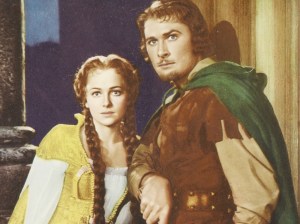
Olivia de Havilland as Maid Marian and Errol Flynn as Robin Hood, 1938

When Brad outgrew the comic book heroes and began to notice girls, he developed a “thing” for Olivia de Havilland. She played Maid Marian in the 1938 film “The Adventures of Robin Hood,” with Errol Flynn in the lead role and other familiar names like Basil Rathbone, Claude Rains, and Alan Hale in the supporting cast. It was the first color film by Warner Brothers studios.

I don’t think it’s revealing too much about the book to say that our hero Finney falls in love with Maid Marian, rescues her, kidnaps her for ransom, but ultimately doesn’t wed her.  He points out that she always went off with Errol Flynn, so he lets Robin Hood marry her in the end.

The book’s subtitle is A Fantasy Adventure Concerning Robin Hood, Errol Flynn, and One Finney Jackson.  Nope.  It should be something like An Adventurous Story of Unrequited Love for Olivia de Havilland by One James B. Taylor.  But that little misdirection notwithstanding, I have to give Brad credit for honesty about his feelings for Olivia. Who among us did not have such fantasies as we stumbled through adolescence? I recall similar crushes that I had on Daniela Bianchi as Tatiana Romanova, and on Katharine Ross as Elaine Robinson.  (Now I rather dig Mrs. Robinson. But I digress.)

Here’s what Brad/Finney had to say after initially encountering Maid Marian in boy’s clothing, disguised as a page, and being the first of the Merry Men to recognize that she was a woman:

“Not only was she a woman, she was incredibly beautiful as well. How did I know this ‘page’ was a woman? Well, when you have seen one of the most beautiful women in the world, you don’t forget her face, even if the next time you see her she’s dressed as a boy. Yes, I had seen this woman before. Not once, but many times.
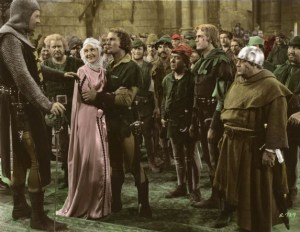
“She had made the biggest impression on me, however, when she co-starred in The Adventures of Robin Hood as Maid Marian, for this ‘page’ riding on the trail below us was none other than Olivia de Havilland…Perhaps it would be more correct to say she was the living, breathing image of Olivia de Havilland; for Robin was the exact double of Errol Flynn, yet he was Robin Hood and not an actor…

“When I was twelve years old I first saw The Adventures of Robin Hood on television, and I fell instantly in love with Olivia de Havilland as Maid Marian. It was my first adolescent crush, and I never really got entirely over it…To me, the beauty of Olivia de Havilland was perfection in every way with her dark hair and those eyes of hers. Those eyes! Has any of God’s creatures ever possessed such eyes?

“She could only be mine when I saw her in The Adventures of Robin Hood; and then she always went off with Errol Flynn…This time, though, I was in a position to determine whether there could be something between us in reality. As far as I was concerned, there would be.”

Well, there is something nice that develops between our hero and the lovely woman. They become good buds.  But that’s all. Along the way Robin stumbles badly and for a while seems most unworthy of her. Our hero Brad/Finney becomes of the realm’s premier swordsmen. He seems to emerge as a contender for Maid Marian’s heart.  However, as previously noted, Robin and Marian eventually wed.  Though the author refashions parts of the Robin Hood legend and rewrites some of the script of the Errol Flynn movie to suit his fancy, he leaves the legend’s essentials intact.

During his daring escapades, Brad/Finney also gets in some commentary on the history of the period. In the movie, King Richard the Lion-Hearted (a big misnomer, actually; he was a nebbish) the scummy Prince John was not yet on the throne of England. Robin Hood and his boys robbed from the rich, gave to the poor, stymied the evil Sir Guy of Gisbourne, and kept Prince John off the throne.

In this book, John has been the king for sixteen years. And it’s Brad/Finney who intervenes with the Archbishop of Canterbury and brings about King John’s reluctant signing of the Magna Carta.

Basil Rathbone as Sir Guy of Gisbourne, Claude Rains as Prince John in the 1938 film.

Robin has already told his new recruit to the Merry Men the truth about the present and previous monarchs of the realm.

“A woeful reign it has been for his subjects. He taxes everyone heavily. And those who cannot pay in gold must pay in crops. It was a foul wind that blew that accursed Norman [Gisbourne] to England’s shores seven years ago. Until then King John wasn’t so bad, but Gisbourne’s intrigues have made everything worse. The King is his puppet.”

That latter story isn’t history, because Sir Guy is fictional; he’s simply a villain who shows up in most of the retellings of the Robin Hood legend.  But by that point of the book we’re beyond letting facts get in the way of a good story.

At the end, before he’s whisked back to the present, Brad/Finney gets to kiss Marian, the bride, at her wedding. But just prior to that little wish-come-true, Robin Hood gives him a small stone, a talisman, which had been a gift to him from Little John.

“It signifies a great friendship,” Robin says. “There are only two things on earth that go beyond the flight of the arrow. One is the love that comes once in a lifetime between a man and a woman. The other is friendship between two men that no force on earth can overcome.”

I’ll raise a tankard of Sherwood Forest’s finest ale to that one.

Book Review: The Animal’s Companion

May 8, 2019

People and Their Pets, a 26,000-Year Love Story

By Jacky Collis Harvey

Author Jacky Collis Harvey

When you read a book by Jacky Collis Harvey, you learn a lot. And with the way she writes, deeply researched and with wit and erudtion, you also have fun as you learn.

Bonus: you also get to know Jacky as a person, because she puts so much of herself into her books. Reading her is like a leisurely date with a new, intriguing friend at the Dog and Duck, or maybe afternoon tea at the Savoy.   When you’re in such a setting with an interesting woman, the best thing to do is to sit back, let her do the talking, drink it all in, and go home wiser and happier.

Jacky’s first book, reviewed here, was Red: A History of the Redhead. There’s no need to tell you the color of her hair, which placed the chip on her shoulder and the flash in her eye.

Her newest work is The Animal’s Companion: People and Their Pets, a 26,000-Year Love Story.  Ms Collis Harvey is one such companion. She loves animals. With passion and appreciation.  She prepares the reader for what’s coming when she writes, in the introductory chapter,

“As I look back, all of the most important lessons in my life were taught by animals: the realities of love and loss and the impenetrability of death, which could take a warm, breathing living flank and overnight turn it into something lifeless, cold and solid; the imperatives of sex; the largeness of care and responsibility…Growing up a redhead made me bold; but it was growing up with animals that made a liberal out of me.”

Okay, Jacky, so tell me more about yourself and those animal friends.

Here’s one passage that I loved; I felt myself shivering in the cold right alongside the author, and feeling her primal fear:

“…if you are a woman. The psychological effect of walking with a big dog padding along obediently beside you is intoxicating. The world opens up, no matter how timid by nature you may be yourself…Fergus, my wolfhound, and I used to set off into the murk of winter fields and winter evenings without hesitation. And then one particular evening, he off his leash and me holding a flashlight rather than a burning brand, Fergus saw something at the side of the fields that caused a growl to rise from within his chest that was both the deepest and most horripilating sound I have ever heard an animal produce. It was like listening to the ominous drawing-back of the sea before the crash of some terrible wave. My own hackles were up at the sound of it, never mind his. My nerve ends soaked with adrenaline in nanoseconds – the kind of atavistic response you forget the human body is still capable of producing.”

Later on in the book, after telling about the ways that literary and historical luminaries, like Samuel Pepys, King John, Plutarch, Elizabeth Barrett and Alexandre Dumas cared for animals, she relates how she unhesitatingly ponied up £3,000 for emergency medical care for her cat, Miss Puss. The cat made it and lived another seven years, though it cost what she said was “more money than we had in the world” at that point.  In declaring that the little creature’s emotional value to her was far beyond any vet’s bill, she speaks for just about all people who have pets of their own.

Each of the book’s chapters deals with a different theme in the life of humans who love animals: Finding, Choosing, Fashioning, Naming, Communicating, Connecting, Caring, Losing, and Imagining. Her own anecdotes, observations, and philosophical musings crop up frequently, but not so much that the book seems to be about her. She strikes a nice balance and re-introduces the reader to many familiar names of animal lovers from history, literature and art.

The 26,000 years in the book’s subtitle refers to the approximate age of the fossilized footprints of a boy and his dog in the Chauvet cave, rediscovered in France by archaeologists in 1995. That, the author maintains, is the oldest known evidence of a human as an animal’s companion.

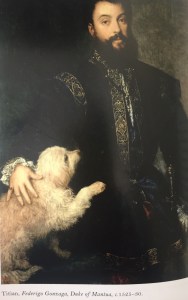
Federico Gonzaga: “notoriously bad husband material.”

That’s a great answer for Final Jeopardy, so keep it in mind. But more amusing, and an example of Collis Harvey’s fine eye for history that we can relate to, is the story behind Titian’s painting of Federico Gonzaga, Duke of Mantua. Federico was on the make and targeting Margherita, heiress to the Marquis of Monferrato. Problem was, as Collis Harvey relates, the Gonzagas were “notoriously bad husband material,” and the heiress was hesitating.

So what to do? Commission a painting of yourself with a cute, fluffy little dog, looking longingly up at you while extending a supplicating paw. The little dog is there “to say that she has nothing to worry about, that as a husband Federico will be both faithful and protective…to reinforce the message that he was benevolent and trustworthy, neither of which in fact was true.”

Readers also hear from the likes of Emily Dickinson, Charles Dickens, Renoir, the Book of Job, Alfred Hitchcock, Friedrich Engels, A.A. Milne, William Blake, Lord Byron, and Horace Walpole.  All in all, this book is a delightful romp through the ages. It even feels that you’re taking that romp in the company of your own beloved pet. Several times along the way I felt the presence of my sweet golden retriever Molly, who’s been gone from this earth for more than a decade.

Yes, we do learn great life lessons from our dealings with animal friends. Those intertwining lives can also bring broader lessons for society as a whole. In the final chapter, after discussing animals’ rights and reminding readers of Mary Wollstonecraft’s pioneering writings on the rights of women, Collis Harvey muses,

“What was once, in its demand for equality and respect, the cutting edge of social change is now a given across most of the planet (and will get all the way there too)…We are coming to recognize that we cannot claim rights without also granting them; not insist upon them for ourselves without acknowledging them for others.”

Good thought. Good lesson. Good book.

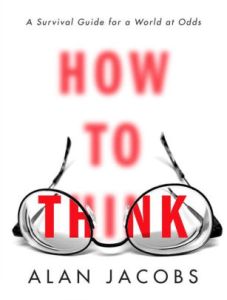
How to Think: Book Review and Reflection

November 17, 2017

Alan Jacobs

Well, I guess that a book with such a title would strive to be that most-clichéd of written works: one that is “thought-provoking.”

Okay, mission accomplished, Alan Jacobs.  But for me, the book is better described as “introspection-inspiring.”

The book’s subtitle is “A Survival Guide for a World at Odds.” I read a Wall Street Journal review of it a few weeks ago and was intrigued. The review didn’t lead me to believe that it was a self-help book. Rather, it held out the promise that How to Think would give the reader a measured and sober understanding of the causes and cures for the vast chasm that divides the left and the right in America’s body politic.

You can get a good deal of that understanding from this compact (156 pages) book by Jacobs, a professor of humanities at Baylor University. You’ll probably recognize attitudes and tactics from both your side of the political divide and the other side. You might even acknowledge the existence of your side’s version of the “RCO” — the “Repugnant Cultural Other” who inhabits the far shore (but who actually might be your next-door neighbor or long-time friend.)

Corollary to that will likely be a realization that you and those on your side are somebody else’s RCOs. It is, as he puts it, a “profoundly unhealthy situation.” Duh.

So, why is it this way nowadays? And is there anything we, as individuals, can do about it? If not to change the world (we can’t), then at least to chart a course through calmer waters and steer between the Scylla of the alt-left and the Charybdis of the alt-right? That we can do, and this book is a helpful guide.

Groupthink

Early in the book, Jacobs gives the example of people’s attitudes towards “The Puritans.” For the most part, to be called “puritanical” is to be insulted. Puritans are rigid, authoritarian, judgmental—right? Jacobs cites writer Marilynne Robinson, who states that this easy characterization is a “great example of our collective eagerness to disparage without the knowledge or information about the thing being disparaged, when the reward is the pleasure of sharing an attitude one knows is socially approved.”

Emphasis mine in that last sentence. I think Jacobs gets it about something, a phenomenon that’s common in these days of social media, the era of the knee-jerk retweet and the forwarded-without-thinking disparagement.

We all want to belong to a group or a community, and that’s usually a positive thing. No man is an island, and so on. But a problem crops up when the group exists primarily to exclude and denigrate others. Those who belong get their comfort and feelings of safety and power from belonging. But that belonging exacts a price, both from the individual person and from the wider society.

Jacobs mentions the case of Megan Phelps-Roper, who was a card-carrying, insult-hurling member of the Westboro Baptist Church. She goes through a gradual and wrenching transformation when she encounters and is willing to talk to one of those RCOs. In the case of the Westboro crowd, the RCO is a gay guy – and she eventually sees his humanity and leaves the Westboro cocoon and her old comrades-in-arms behind.

This is an unusual example, but it’s proof that the battle lines in today’s culture wars aren’t permanent, that there’s hope. Jodi Picoult tells a story of such a transformation in her novel Small Great Things.  In that fictional account, the convert is a pickup-driving, tobacco-chawing racist who eventually come to see the loving decency and professional competence of a black nurse who has cared for his child. The guy sees the light; his wife remains behind.

Both the real person and the fictional person cited here experienced a loss: of group security, of friends, and of family members. Whether it was truly a net loss, in either case, seems unlikely, because new affiliations await those who are willing to change their minds and evolve.

These experiences also both predict the final words of Jacobs’s book, Item 12 on his “Thinking Person’s Checklist.” He writes, “Be Brave. “

Yes, it does take more than a little courage to be open to the possibility of modifying your views at the risk of distancing yourself from your fellow travelers. Not everybody is up to it. Jacobs says as much near the end of the book:

“You have to be a certain kind of person to make this book work for you: the kind of person who, at least some of the time, cares more about working toward the truth than about one’s current social position.”

There are many pithy examples and light-bulb-inducing “Oh, of course” explanations sprinkled throughout the book.  I’d like to cite just a couple that struck me as particularly relevant.

C.S. Lewis and the Inner Ring

It’s not surprising that Jacobs turns to C.S. Lewis, author of The Chronicles of Narnia and many other works of Christian humanism, for an erudite and prescient look at what’s become of much of our society. Lewis delivered a lecture titled The Inner Ring at King’s College, London, in 1944. I remember reading and re-reading it a few years ago, and I thought it was spot-on even then.

“…you have met the phenomenon of an Inner Ring… And I can assure you that in whatever hospital, inn of court, diocese, school, business, or college you arrive after going down, you will find the Rings—what Tolstoy calls the second or unwritten systems,” Lewis told students more than 70 years ago.

And he continued,

“And you will be drawn in, if you are drawn in, not by desire for gain or ease, but simply because at that moment, when the cup was so near your lips, you cannot bear to be thrust back again into the cold outer world…I believe that in all men’s lives at certain periods between infancy and extreme old age, one of the most dominant elements is the desire to be inside the local Ring and the terror of being left outside. ..of all passions the passion for the Inner Ring is most skillful in making a man who is not yet a very bad man do very bad things.”

In applying the notion of the Inner Ring to present-day social affiliations and communities of interest, Jacobs offers the following observations and advice:

“…once we’re part of an Inner Ring, we maintain our status in part by coming up with those post-hoc rationalizations that confirm our identity and, equally important, confirm the nastiness of those Outside…Smart people have a problem, especially (though not only) when you put them in large groups. That problem is an ability to convincingly rationalize anything.”

But he does offer some hope to those who try to do better, suggesting,

“You can know whether your social environment is healthy for thinking by its attitude toward ideas from the outgroup…If you have to respond to what everyone else is responding to in order to signal your virtue and right-mindedness, or else lose your status in your community, then you should realize that it’s not a community but rather an Inner Ring.”

And Now for Some of my Most-Admired Friends

As for the “introspection-inspiring” that I mentioned up front, I‘ll give this last example because I can relate entirely to Prof. Jacobs’s feelings.  I, like him, hold rather passionately to a set of beliefs and attitudes. Not all of those who are dear to me and whose friendship I treasure share those beliefs. In fact, we’re at opposite ends of the spectrum on some important cultural and political matters.

Of his friends, Jacobs writes,

“Over the years, I’ve had to acknowledge that some of the people whose views on education appall me are more devoted to their students than I am to mine; and that some of the people whose theological positions strike me as immensely damaging to the health of the church are nevertheless more prayerful and charitable, more Christian, than I will ever be. This is immensely disconcerting…Being around those people forces me to confront certain truths about myself that I would rather avoid; and that alone is the reason to seek every means possible to constrain the energies of animus.”

Bingo there, Alan. I’m glad you brought that up, and put it as you did. It’s nice to know that someone else feels as I do.

I can think of several people whom I respect and admire greatly, for things like their love for others, their worldly wisdom, and their just plain personal class. I wish I were more like them. But I know I’ll not be voting like them either, or trying to bring them around to my points of view. Not long ago, I was reminiscing with one of them about our many years of friendship. She remarked that it was good that we never tried to make it as a couple because we’d probably have ended up trying to kill each other.

Anyway, I liked this book. And perhaps I’m flattering myself, but I also like to think that I’m the type of person for whom the book will work. If you do decide to read it, please let me know if you think the same way.

Book Review and Reflection: The Book of Separation

October 25, 2017

I’m not Jewish.  I’ve never been through a divorce. And I’m not a woman.  But I can certainly relate to author Tova Mirvis and her life story, as told in her latest work, The Book of Separation.

The book, Mirvis’s fourth, tells of her journey toward ending both her first marriage and her life in Orthodox Judaism. That all-encompassing religious community both enfolded and protected her even as it constricted and repressed her throughout her youth and early adulthood.  Many of us, I’m sure, have felt and grappled with fears, misgivings, and doubts similar to those that Mirvis recounts.

As the book begins, she is standing alone, before the panel of bearded, black-garbed Orthodox rabbis who will rule upon the legitimacy of the get, the divorce document that, by Jewish law, can only be issued by the husband. It’s a dramatic scene. As one who was brought up in old-time, fire-and-brimstone Catholicism, I can only imagine how I would have felt if I’d stood before a phalanx of black cassocks and Roman collars to take my leave of my own Church.

I probably would have chickened out. She didn’t. But she must have considered it many times. As she stated in those first few pages, “If you left, you were in danger of losing everyone you had loved. If you left, you were in danger of losing yourself.”

Mirvis did leave, and she did lose a lot. But she gained and learned much too. I daresay she will bring to mind, in many readers, a raft of similar emotions and memories and should-have-dones – particularly if religion was a defining factor in their lives.

Did you ever feel, for instance, as she did one Rosh Hashanah when, as she remembers looking at the hats of the ladies in synagogue,

“I tried to pray, but my mind kept wandering. Under all these brims and bows, what were people really thinking? Did any of these women ever worry, as I did, that too much thinking might unravel their lives? You were supposed to believe that this way of life was the only true one…Yet along with the actual rules, there was another set of laws, equally stringent yet more unforgiving, enforced not by a belief in God but by communal eyes that were just as all-seeing and all knowing. Inside my head, a voice constantly whispered, What will they think?”

Well, I had learned that my religion was the one true faith as well.  My mind also used to wander as I sat through all those masses and novenas and parish missions and Stations of the Cross. And back then, I would have dreaded the mere thought of facing the opprobrium of parents, clergy, and my Catholic community if I’d voiced my own growing doubts.  I do have a few friends who did boldly voice their own doubts, early in their adult years, and in hindsight I wish I’d had their courage.

I also once lived in fear of the same God about Whom Mirvis expressed her nagging doubts: “”Did I believe in a God who cared about the smallest details of what I ate and what I wore – God the Scorekeeper, God the Punisher, God the King?”

With such passages, Tova Mirvis surely touches some raw nerves and long-buried feelings. Her readers who have ever struggled to strike a balance between God’s message and God’s earthly, self-designated messengers will probably nod in agreement and recognition.

Much of the book chronicles Mirvis’s passage through everyday life: education, marriage and family, friendships, religious practices, and eventually the harsh realities of drifting further away from spouse and community. Along the way she also explains many of the reasons behind Jewish rituals, the rich tapestry of tradition that has distinguished that remarkable people for millennia and will continue to do so.

One of the story’s turning points calls to mind another famous Jewish author – another who was divorced and remarried – Midge Decter. She once said, “Nerve is one thing all writers need.” Mirvis showed the requisite nerve when she spoke, and stood her ground, at a cultural conference run by a large group of Orthodox rabbis.

That occasion was, she noted “the last time I considered myself still inside.” She would not make her writing conform to their rules and demands.  “I didn’t believe their rules contained the ultimate truth…it wasn’t just about writing honestly and freely, it was about living honestly and freely…I was no longer willing to pretend in order to belong.”

Stepping to the outside of the Orthodox community did, as expected, sever friendships and bring rejection and avoidance. The author missed being inside that old community, especially on occasions like Shabbat. One consolation was her knowing “there are other kinds of communities that I can eventually build for myself – smaller maybe, less all encompassing, ones in which I won’t have to cede my independence in order to belong.

There is a telling observation Mirvis makes near the end of the book. Her children have come for the weekend. Her son Noam, who has remained Orthodox, asks her to unscrew the refrigerator’s light bulb so that it won’t go on – one of many Shabbat practices that Mirvis no longer follows.

She gladly agrees to honor his request, noting “I’m doing this, and other actions like it, to help Noam be part of this world that he is choosing. And doing so comes not only in the broad strokes and large proclamations about love and respect but in each of the minute actions – not just God, not just sin, lay in the details, but love lived there too.”

Yes, it is the little things. God and love both are to be found in the details of our everyday lives.

Another heartening passage comes late in the book when Mirvis returns to the scene at the beginning. She’s alone with that formidable panel of senior rabbis. They’ve examined the get, the divorce document whose official name is sefer kritut, a book of termination, of rending, of separation.

The document, written in Aramaic and dated 5772 from the creation of the world, is in order.  In keeping with ancient rite, the senior rabbi folds it up tight and drops it into her cupped hands. She must signify acceptance – clasp the get to her bosom, turn, and walk from the room. When the door closes behind her, the divorce takes effect.

They summon her back into the room, where one of the rabbis takes the document, draws an X on it, then tears it up so that no one could ever examine it and find an error. It’s over.  After the rabbis recount some of her future obligations and she’s about to leave, the head of the court looks her in the eye.

She says, at that point, that she was steeling herself for rebuke. That’s another thing I can imagine doing. In fact, I’d be expecting to hear that I’m bound for the outer darkness, where there would be weeping and gnashing of teeth.

No such rebuke happened. Instead, the man tells her a story. The Talmud, he explains, said that the Temple altar weeps when a man divorces his wife. There was once a rabbi who went through a divorce; his students were confused and puzzled that it could even happen.

“Better the altar should weep than should I,” came that divorced rabbi’s reply.

With that, the senior rabbi tells Mirvis, “It’s a new beginning. Go forth, become the person you need to be.”

That’s wise counsel for anyone, of any age, of any religious faith. And this is a book I’d recommend for anyone of any age, gender, or faith as well.