Archive for the ‘Events and Society’ Category

Columbus Day: The Rest of the Story

October 10, 2011

Today is October 10, 2011

Cristoforo Colombo

Mythology inevitably takes root and flourishes around the life stories of all of history’s “great people.” That is certainly the case with Cristoforo Colombo of Genoa, Italy, whose voyages of discovery and entrepreneurship we celebrate in many parts of the United States today.

All of us who attended grade school during the latter half of the 20th Century are familiar with the life and legend of the “Admiral of the Ocean Sea,” as historian Samuel Eliot Morison calls him. I would like to mark this occasion by telling you a few things about the man and his patrons that you may not know, and which might give you another perspective on history, that most fascinating of subjects.

  • He was the son and grandson of weavers who had lived in the Genoese Republic for at least three generations. Ruddy-complexioned and with red hair, he was not an Italian in the modern sense. The people of Genova La Superba held themselves apart from and superior to other Italians.  In his writings, Colombo charged his heirs to “always work for the honor, welfare, and increase for the city of Genoa,” and to always maintain a family house there.
  • He learned seamanship on Portuguese vessels, and might have gotten the backing of King Joao of that country had Bartolomeu Dias not returned in triumph from his Africa voyage in 1488. Columbus was in Lisbon to pitch the king the day Dias returned. Discovery of that sea route to the Indies caused King Joao to lose interest in financing a Western exploration.
  • Queen Isabella of Spain first met with him in 1486 and kept him waiting six years for financing. Exactly why, we’re not sure. She was an effective ruler in a number of ways, especially in fiscal matters. She inherited enormous debt when she assumed power and got it paid off. It may have been that she didn’t have the money to spare in 1486. But she gave him a small retainer to keep him around and not take his project to some other monarch.
  • Isabella la Catolica was totally intolerant of other religions. She employed the infamous Tomas de Torquemada as her confessor and first Inquisitor General. She did her best to drive out from Spain, or to convert to Christianity, Jews and Moors (not Moops).
  • Even though she was anti-Jewish, Isabella employed a Jew named  Luis de Santangel as keeper of the privy purse. Santangel was the one who made the convincing argument that the expense of financing the voyage, less than what it would take to entertain a visiting sovereign at her court, would be worth it if the result was the conversion of people of Asia to Christianity.
  • That the queen sold her royal jewels to finance the first voyage is myth. That option was apparently on the table but Santangel arranged for borrowings from other public accounts instead; he also invested some of his own money.  And Columbus didn’t get paid anything until he returned to Spain. It was a good investment by Santangel.
  • The best, and favorite, of Columbus’ three ships was the Nina.Its real name was the Santa Clara, but the former was its nickname because it belonged to the Nino family of Palos.  The Nina went on three of his four voyages. It and the Pinta were caravels; Portuguese navigators favored such ships for their seaworthiness.
  • The Santa Maria, larger than the other two and the flagship of the fleet, was not a caravel but a nao, a ship less suited for long voyages.
  • The New World was first sighted at 2:00 a.m. on October 12, 1492 by Rodrigo de Triana, the lookout on the Pinta. The Pinta let the flagship, Santa Maria, catch up to them. Columbus gave the captain of the Pinta a bonus of 5,000 maravedis.
  • The Santa Maria drifted onto a coral reef during the night of December 24. The crew disobeyed orders to row out with a stern anchor that would keep the ship steady; rather, they rowed to the Nina, which refused to take them on. During that delay the Santa Maria carried further onto the reef and suffered irreparable hull damage from the rocks.
  • Columbus took that wreck on Christmas day as God’s sign that he should build a fortified settlement there. He called in La Navidad and left 21 sailors there, with instructions to convert the natives. He had no shortage of volunteers, because the men had thought they had reached the Indies and that there would be gold aplenty. They met a bad end at the hands of a local chieftain after roaming around seeking gold and women; all the Spaniards were hunted down and slaughtered.
  • He returned to Spain in triumph, and would have been better off – materially, anyway – if he’d taken his payment and retired. But he made three more voyages. Ponce de Leon was one of 1,000 “gentlemen volunteers” on his second trip. Ten ships went on that voyage.  They discovered Puerto Rico, then called Bourinquen in honor of St. John the Baptist. DeLeon liked that island, came back and conquered it some years later and became royal governor.
  • The second voyage was one of discovery, with about 20 new islands mapped out. But Columbus decided to attempt to subjugate the local population of Hispaniola, and he took 30 of the natives, Tainos, back to Spain as slaves.  Columbus and his brothers Diego and Bartholomew were terrible colonial administrators and could not wield authority properly. They mismanaged the trading post of Isabela to such an extent, neglecting to pay their people, that emissaries sent back to King Ferdinand persuaded him to take action on their behalf.
  • On the third voyage, Columbus discovered mainland South America. But the royal commissioner of Hispaniola, Francisco de Bobadilla, seized him and his brothers Diego and Bartholomew and sent them back to Spain in chains to be tried by the royal court. The king and queen fired the Columbus boys from their jobs in colonial government but allowed him to make a fourth voyage.
  • The fourth one was called the “High Voyage.” Columbus explored the coast of Central America down as far as southern Panama. The fleet ran aground and the crews were marooned on Jamaica for a year and had to send a canoe to Hispaniola to ask for a rescue ship.
  •  The natives there were accommodating but stopped trading Columbus and his men food for trinkets. He pulled his “eclipse trick” on them and scared them into giving food again; knowing that a full moon eclipse would be occurring, he told them that the gods were angry at them and would show their wrath that night. The terrified natives caved and the food shortage ended.
  • They were finally rescued, and Columbus returned to Spain, where he had a comfortable if not lavish retirement. He went to his death not realizing what he had actually discovered; he believed he had reached a province of China in addition to the many islands.
  • That’s today’s history lesson.  I hope you enjoyed it. Columbus had many faults and failings, but his skill as a navigator was unsurpassed. His “Enterprise of the Indies,” the idea that the East could be reached by sailing West, was his idea alone. He had the will and the perseverance to see that idea through, even though he made it less than halfway to where he thought he’d been.

With that, I wish you a very pleasant Columbus Day.

Gouverneur Morris, Our Country’s Master Wordsmith

September 16, 2011

Gouverneur Morris

September 17 is Constitution Day in America, a time to celebrate history’s greatest document this side of the Ten Commandments.  Let’s not forget Gouverneur Morris, who gets an “A+” for that masterful work of composition.

Constitution Day deserves much more attention and appreciation than it now receives. So too does Mr. Morris, who has been relegated to the back benches of the Founding Fathers.  “The Penman of the Constitution,” he deserves better.

A native of New York City and a gifted scholar, Morris enrolled in 1764 at the age of twelve at King’s College, predecessor to Columbia University in New York City. He graduated at age 16 in 1768 and received a master’s degree in 1771.

Morris represented Pennsylvania in the Constitutional Convention of 1787.  Morris was a signatory to the Articles of Confederation.  He saw and lived with the weaknesses of the new nation’s first attempt at self-government, and did his part to rectify them the second time around.

Morris was an author of large sections of the Constitution of the United States and one of its signers.

He is widely credited as the author of the document’s preamble: “We the People of the United States, in order to form a more perfect union …” That was still an era when most Americans thought of themselves as citizens of their respective states. Morris advanced the idea of being a citizen of a single union of states.

Born to a wealthy family in Westchester County, he was elected in 1775 to represent his family estate in the New York Provincial Congress.  After the Battle of Long Island in August 1776, the British seized New York City and his family’s estate across the Harlem River from Manhattan. His mother, a loyalist, gave the estate to the British for military use.

Morris was a member of the New York State Assembly in 1777-78 and was appointed as a delegate to the Continental Congress, and took his seat in Congress on 28 January 1778. He was selected to a committee in charge of coordinating reforms of the military with George Washington. After witnessing the army encamped at Valley Forge, he was so appalled by the conditions of the troops that he became the spokesman for the Continental Army in Congress, and subsequently helped enact substantial reforms in its training, methods, and financing. He also signed the Articles of Confederation in 1778.

In 1779, he was defeated for re-election to Congress, largely because his advocacy of a strong central government was at odds with the decentralist views prevalent in New York. Defeated in his home state, he moved to Philadelphia to work as a lawyer and merchant.

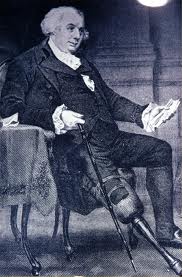
In 1780, Morris’s left leg was shattered and replaced with a wooden pegleg. Morris’s public account for the loss of his leg was that it happened in a carriage accident, but there is evidence that this was a false story concocted to cover for a dalliance with a woman, during which he jumped from a window to escape a jealous husband.

Morris was well-known throughout much of his life for having many affairs, with both married and unmarried women, and he recorded many of these adventures and misadventures in his diary.

Before the Constitutional Convention, Morris lived in Philadelphia where he worked as a merchant for some time.  The financier Robert Morris (no relation), recommended him for the convention.

During the Philadelphia Convention, he was a friend and ally of George Washington and others who favored a strong central government. Morris was elected to serve on a committee of five (chaired by William Samuel Johnson) who drafted the final language of the proposed constitution. Catherine Drinker Bowen, in Miracle at Philadelphia, called Morris the committee’s “amanuensis,” meaning that it was his pen that was responsible for most of the draft, as well as its final polished form.

“An aristocrat to the core,” Morris believed that “there never was, nor ever will be a civilized Society without an Aristocracy”. He also thought that common people were incapable of self-government because he feared that the poor would sell their votes to the rich. Consequently, he thought that voting should be restricted to property owners. Morris also opposed admitting new western states on an equal basis with the existing eastern states, fearing that the interior wilderness could not furnish “enlightened” statesmen to the country.

At the convention he gave more speeches than any other delegate, a total of 173.  He believed strongly in a guiding god and in morality as taught through religion. Nonetheless, he did not have much patience for any established religion. As a matter of principle, he often vigorously defended the right of anyone to practice his chosen religion without interference, and he argued to include such language in the Constitution.

Gouverneur Morris was one of the few delegates at the Philadelphia Convention who spoke openly against domestic slavery. According to James Madison who took notes at the Convention, Morris spoke openly against slavery on August 8:

“He [Gouverneur Morris] never would concur in upholding domestic slavery. It was a nefarious institution. It was the curse of heaven on the states where it prevailed. …with the misery and poverty which overspread the barren wastes of Virginia, Maryland, and the other states having slaves…. Proceed southwardly, and every step you take, through the great regions of slaves, presents a desert increasing with the increasing proportion of these wretched beings. Upon what principle is it that the slaves shall be computed in the representation? Are they men? Then make them citizens, and let them vote. Are they property? Why, then, is no other property included?”

Morris went to France on business in 1789 and served as Minister Plenipotentiary to France from 1792 to 1794. His diaries during that time have become a valuable chronicle of the French Revolution, capturing much of the turbulence and violence of that era, as well as documenting his affairs with women there.

Mr. Morris with pegleg after his unfortunate "accident."

He returned to the United States in 1798, and he was elected in April 1800, as a Federalist, to the United States Senate, filling the vacancy caused by the resignation of James Watson. He was defeated for re-election in February 1803.

After leaving the U.S. Senate, he served as Chairman of the Erie Canal Commission from 1810 to 1813. The Erie Canal helped to transform New York City into a financial capital, the possibilities of which were apparent to Morris when he said “the proudest empire in Europe is but a bubble compared to what America will be, must be, in the course of two centuries, perhaps of one.”

At the age of 57, he married Anne Cary (“Nancy”) Randolph, who was the sister of Thomas Mann Randolph, Jr., husband of Thomas Jefferson’s daughter, Martha Jefferson Randolph.

Morris also established himself as an important landowner in northern New York, where the Town of Gouverneur and Village of Gouverneur in St. Lawrence County are named for him.  He died at the family estate, Morrisania, and was buried at St. Ann’s Church in the The Bronx.

This distinguished, aristocratic man died an unusual and painful death in 1816. He stuck a piece of whale bone through his urinary tract in an attempt to relieve a blockage.

So it’s Constitution Day, a time to celebrate history’s greatest document this side of the Ten Commandments.  Let’s not forget the Constitution’s Penman, who gets an “A+” for his masterful composition.

Here’s to you, Gouverneur!

An Act of Pure Evil

September 6, 2011

In writing my blog and posting on Facebook I have tried to avoid the political realm. This time I would like to make an exception.

The Bret Stephens column in the Wall Street Journal of September 6, 2011 struck a chord with me. I think that his central point is worth repeating here, and pondering as we look back on September 11, 2001. That day has its own sobering meaning for me; I flew out of Boston early that morning to attend a trade show in Atlanta.  I began the day one airline terminal distant from the mass murderers.

Stephens takes issue with the way that we – or most of us in America, anyway – have come to remember and refer to September 11, 2001. As someone who works every day to use our wondrous English language as effectively as possible, I agree with him when he writes, “An act of evil has been reduced, in our debased parlance, to a ‘tragedy.’”

He also rightly points out that while 9/11 was a day of monumental loss, it was also a day of extraordinary love and giving. He cites the first responders, the heroic and courageous “Let’s roll” passengers of Flight 93, the volunteers, emergency crews, and those inside the buildings who helped others and managed to save individual lives.

Earlier, on my Facebook page, I posted a link to ESPN’s beautiful story of the man in the red bandanna, Welles Crowther, Boston College lacrosse player. He is credited with saving at least a dozen people that day. If you have not yet seen it, find it on YouTube.

Stephens says that our remembrance of September 11 should largely be to reflect on, and be thankful for, those selfless people. Agree. If we all strive to emulate them, in ways large and small, our world will be a better place.

He goes on to remind us of a deeper danger here, and I believe he’s correct.

He compares the September 11 attack to the one on Pearl Harbor. In 1941, a comparable number of Americans lost their lives. While the nation mourned, it also responded. The day became a “bookend” in a war that was fought with a clear purpose and righteous resolve.  But 9/11 is an event that has no corresponding bookend; we don’t know whether we’re early, late, or somewhere in between in a similar book. In short, 9/11 has become an event unto itself, somehow disconnected from everything that still flows around it.

This way of looking at 9/11/2001has brought about our coming to refer to “the tragic events of 9/11” rather than calling that day what it was, a monstrous act of evil and of war.  Quoting Stephens’ final paragraphs:

“There is something dangerous about this. Dangerous because we risk losing sight of what brought 9/11 about. Dangerous because nations should not send men to war in far-flung places to avenge an outrage and then decide, mid-course, that the outrage and the war are two separate things. Dangerous above all because nations define themselves through the meanings they attach to memories, and 9/11 remains, 10 years on, a memory without a settled meaning.

None of that was true in 1951. We had gone to war to avenge Pearl Harbor. We had won the war. We had been magnanimous in victory. The principal memorial that generation built was formed of the enemies they defeated, the people they saved, the world they built and the men and women they became. Our task on this 9/11 is to strive to do likewise.”

Once again, I agree. American greatness does not reside in its presidents, congress people, actors, CEOs, or athletes.  On September 11, 2001, we saw once again that such greatness lies in ordinary people like you and me who, in times of dire need or extreme peril, performed supererogational acts for their fellow human beings.

My favorite John F. Kennedy quote says that countries define themselves not by the men they produce, but by the men they honor, the men they remember.

Let us resolve to do more than remember, this September 11 and on every one to follow. Let us strive to live our lives as the kind of Americans whom the heroes of September 11, 2001 died to save. If we do, we can still build a world that is another principal, fitting memorial to them.

Yo, Rinty!

August 26, 2011

Reading recommendation as you sit out Hurricane Irene: “The Dog Star,” in the Aug 29 New Yorker tells of the origin and career of Rin Tin Tin and his critical role in the early success of four guys named Warner from Youngstown Ohio. Great stuff!

The original Rin Tin Tin was born on a World War I battlefield in the Meuse Valley of France. He and Nanette, his sister from the litter of five, were rescued by an American GI named Lee Duncan. The dogs got their names from good-luck charms worn by French soldiers. Those charms were named for a pair of lovers who, according to legend, survived the bombing of a Paris railway station at the start of the war.

Rinty got several breaks during his career. Duncan married a wealthy, older woman whose money helped finance things. They ended up divorcing because, the article states, he loved his dogs more. German Shepherd dogs were the coming thing in cinema; a dog named Strongheart had a very successful 1921 film, “The Silent Call.” Rinty made a total of 23 silent films. He eclipsed Strongheart eventually and outlasted many other aspiring dog stars. His first starring role was in a Warner Brothers’ production “Where the North Begins.” Rinty was actually cast as the lead in that flick; he had an ability to portray a variety of emotions, such as anger, love, loyalty, defiance, nobility and so on. He could also climb a tree and jump over 12-foot barriers.

Rinty made four Warner Brothers films in 1927: “A Dog of the Regiment,” “Jaws of Steel,” “Tracked by the Police,” and “Hills of Kentucky.” Warner Brothers was evaluated at $16 million in 1928. In 1930, its value was over $200 million.

The Academy Awards were presented for the first time in 1929. Hollywood legend has it that Rinty received the most votes for Best Actor, but the Academy didn’t think it should give the award to an animal.

The original Rin Tin Tin is obviously not the one we watched on television, continually saving the lives and military careers of Lt. Rip Masters and Corporal Rusty at Fort Apache. That Rinty, whom I once met at the Boston Garden, was probably a grandson or great-grandson. No matter. He was a true member of canine nobility, and he wore his mantle well!

Why I Love Writing

August 4, 2011

There are times when we of a certain age might feel pessimistic about “young people nowadays” and the future of our society under their direction. Then we meet someone like the young woman profiled in this article. This is why I love writing. It allows me to tell the stories of those like her.

http://www.metrowestdailynews.com/top_stories/x633531666/Natick-residents-essay-wins-5-000-scholarship

Yogi and Artie, Hall of Famers, Need Some Company

July 2, 2011

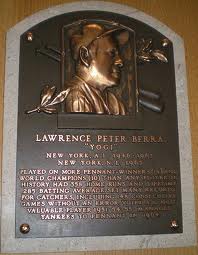
Yogi Berra's Plaque in Baseball's Hall of Fame

Excellent cover story on Yogi Berra in the week’s Sports Illustrated.  I had forgotten, or perhaps never knew, that he was aboard an assault craft on D-Day back in 1944. Yogi had played one season of minor league baseball before joining the Navy and volunteering for duty on a rocket boat that led the invasion of Utah Beach.

The same issue has a brief profile of  Artie Donovan, who also served in World War II and returned home to fashion a brilliant career in the sport of football.

We know stories of other athletic immortals who did likewise – Ted Williams the fighter pilot; Warren Spahn, who fought in the Battle of the Bulge; Christy Mathewson, accidentally gassed in a training exercise in World War I; Milt Schmidt, Woody Dumart and Bobby Bauer, the “Kraut Line” who went off together to face the Germans as members of the Royal Canadian Air Force .  Like Yogi, all these gentlemen are enshrined in their respective Halls of Fame: Spahn, Williams and Mathewson  at Cooperstown, Donovan at Canton, the “Krauts” in Toronto.

But how many other men of that era left the playing fields to don the uniform of their country and did not make it back?  There must be dozens of them, if not hundreds. They may have lost their lives in battle or suffered debilitating injuries, or may have been too old to resume their athletic careers after the war.

Our Northern neighbors and partners in freedom just celebrated their national holiday.  America is preparing for its own birthday, to celebrate the incomparable gifts that our parents, grandparents, and earlier forebears earned for us and bequeathed to us.

At this time of patriotic reflection and thanks to those who made our lands what they are today, here’s a thought for those who run the Halls of Fame in baseball, football, hockey, basketball, and all the other sports, for that matter. You’re the Keepers of the Flame. You honor and remember those who achieved and excelled. Now tell us the stories of those who might also have achieved and excelled, but who put their sporting lives aside for a higher cause and did not return. Carve them a niche, enroll them, and down through the years, tell your visitors about them – how good they were, how greater still they might have been.

The Summer Solstice

June 21, 2011

June 21, 2011: Today’s Fun Facts:

“Solstice” means “Sun Stands Still.” This year the summer solstice officially begins at 1:16 p.m. EDT

“Midsummer Night’s Dream” was all about events in and around the summer solstice.

Hippolyta remarks:

“Four days will quickly steep themselves in night;

Four nights will quickly dream away the time;

And then the moon, like to a silver bow

New-bent in heaven, shall behold the night

Of our solemnities.”


And  Theseus, soon to wed her, directs his servant Philostrate:

“Stir up the Athenian youth to merriments;

Awake the pert and nimble spirit of mirth;

Turn melancholy forth to funerals;

The pale companion is not for our pomp.”


The ancients called the Midsummer moon the “Honey Moon” for the mead made from fermented honey that was part of wedding ceremonies performed at the Summer Solstice. Perhaps the most enduring modern ties with Summer Solstice were the Druids’ celebration of the day as the “wedding of Heaven and Earth“, resulting in the present day belief of a “lucky” wedding in June.

They also celebrated Midsummer with bonfires, when couples would leap through the flames, believing their crops would grow as high as the couples were able to jump. The bonfires were also thought to protect against evil spirits, which were thought to roam freely when the sun turned southward again.

To thwart the evil spirits, pagans often wore protective garlands of herbs and flowers. One of the most powerful of them was a plant called ‘chase-devil’, which is known today as St. John’s Wort and still used by modern herbalists as a mood stabilizer.  Some people believed that mid-summer plants, especially Calendula, had miraculous healing powers and they therefore picked them on this night.

Religious party-poopers couldn’t stay away, though. In the 7th century, Saint Eligius (you remember the hospital named after him in St. Elsewhere) warned recently-converted inhabitants of Flanders against the age-old pagan solstice celebrations.  He said,  “No Christian on the feast of Saint John or the solemnity of any other saint performs solestitia [summer solstice rites] or dancing or leaping or diabolical chants.”

As Christianity entered pagan areas, midsummer celebrations came to be often borrowed and transferred into new Christian holidays, often resulting in celebrations that mixed Christian traditions with traditions derived from pagan Midsummer festivities. The Gospel of Luke said that John the Baptist was six months older than Jesus, and because Jesus was born right after the winter solstice, Saint John had to have been born right after the summer solstice. Saint John’s Day is June 24.

Many medieval Catholic churches were also built as solar observatories. The church needed astronomy to predict the date of Easter. And so observatories were built into cathedrals and churches throughout Europe. A hole in the roof admitted a beam of sunlight, which would trace a path along the floor. The path, called the meridian line, was often marked by inlays and zodiacal motifs. The position at noon throughout the year, including the extremes of the solstices, was also carefully marked.

So, as the Jamies sang, in the song written by long-time Red Sox public address announcer Sherm Feller,

“It’s Summertime Summertime Sum-Sum-Summertime!”

Happy summer!