Archive for the ‘Events and Society’ Category

Will You Do the Fandango?

June 19, 2014

(Cultural) History I Never Knew:
Scaramouche, Scaramouche. Who is That Guy?

Scaramuccia, also known as Scaramouche or Scaramouch, is a roguish clown character of the commedia dell’arte, which began in 16th-century Italy.

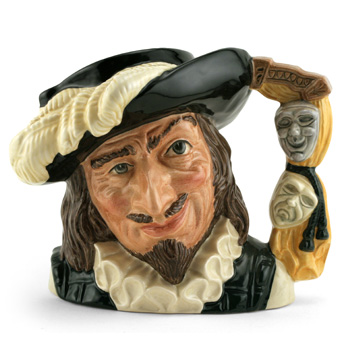
A Royal Doulton mug of Scaramouche

A Royal Doulton mug of Scaramouche

Scaramuccia (literally “skirmish”) wears a black mask and, sometimes, glasses. He entertains the audience by his “grimaces and affected language.” Another such minor character is Coviello, described by painter Salvator Rosa as, (like Scaramouche) “sly, adroit, supple, and conceited”. In Molière’s “The Bourgeois Gentleman,” Coviello disguises his master as a Turk and pretends to speak Turkish. Both Scaramouche and Coviello can be clever or stupid—as the actor sees fit to portray him.

Scaramouche is also one of the iconic characters in the Punch and Judy puppet shows, which have their roots in commedia dell’arte. In some scenarios, Scaramouche is the owner of The Dog, another stock character. During performances, Punch frequently strikes Scaramouche, causing his head to come off his shoulders. Because of this, the term “scaramouche” has become associated with a class of puppets with extendable necks.

The accompanying picture is that of a Royal Doulton mug of Scaramouche.

Many of us who are unfamiliar with Italian comedy or with Punch and Judy first heard of Scaramouche in Bohemian Rhapsody:

“I see a little silhouetto of a man,
Scaramouche, Scaramouche, will you do the Fandango?
Thunderbolt and lightning,
Very, very frightening me.
(Galileo) Galileo.
(Galileo) Galileo,
Galileo Figaro
Magnifico.

“I’m just a poor boy, nobody loves me.
He’s just a poor boy from a poor family,
Spare him his life from this monstrosity.

“Easy come, easy go, will you let me go?
Bismillah! No, we will not let you go. (Let him go!)
Bismillah! We will not let you go. (Let him go!)
Bismillah! We will not let you go. (Let me go!)”

The fandango is a lively couples’ dance usually accompanied by guitars, hand claps and castanets.

“Bismillah” is an Arabic word that means “in the name of God.” It is used at the head of almost every chapter in the Koran.

Hey – who said you couldn’t absorb some serious culture by watching “Wayne’s World?”

The Worldly Wisdom and Wit of Judith Wax: Book Review and Personal Reflection

May 15, 2014

Altered Aspirations
I once wanted to grow up to be Grantland Rice. He was the classics-steeped dean of American sportswriters who came up with “Outlined against a blue-gray October sky, the Four Horsemen rode again…” To my young mind, that line was perfection itself. If only I could write like him!
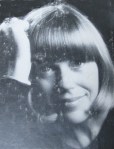
Author Judith Wax

Author Judith Wax

That was until I read Judith Wax. She was my first professional crush. I wanted to write like Judith Wax. I still want to.

Grantland Rice wrote about sports. Judith Wax wrote, for the most part, about a much more interesting subject: women.

In 1973, she burst onto the journalistic/literary scene with “The Waterbury Tales,” subject of which was the Watergate scandal. It was a wonderfully creative, funny, and stylistically accurate parody of Chaucer’s “Canterbury Tales.”

Judith was 42 years old at the time. Her poem was picked up by several national publications, and she quickly became a hot commodity as a magazine feature writer and interviewer.

Judith’s first book was “Starting in the Middle,” published in 1979. The prologue begins

“Whan that forty with his hot pursuite,
Play happy birthday to yow on his floote,
And even they who marathon hath wonne
Can no the moving calendar outronne,
When heads that hadde blacke hayr, and blondys,
Discovyr in ther midst some straunge strondes,
Whan dimplyn’ folks flesshe with cellulyte,
And troubyl creepin’ in on smal crow’s feete,
Whan Mothyr Bell hath print her book too smalle,
Whan movying hands writ HOT FLASSH on youre walle,
Than starts the pilgrimage thru middle ages,
A tryp the OLDE WYFE tel in these pagys.”

Is that not brilliant? This is what “The Waterbury Tales” was like. As soon as I heard she’d done a book, I bought it, devoured it, and eventually lent it to someone who never returned it. Just recently, I bought another copy via Amazon. I love it even more than I did 30 years ago.

Back then, I longed to be as clever and witty as Judith Wax was with her similes, metaphors, literary allusions, and observations. One of the worst shocks about middle age, she suggested, was finding out that no one is really in charge. I can’t disagree with that.

She titled a chapter about raising her children “Slouching Toward Bettelheim.” In a piece titled “The Latest Wrinkle,” she interviewed people who’d undergone cosmetic surgery. She wrote

“Gather ye rosebuds while ye may is still advice for virgins
For this same flower that smiles today too soon seeks plastic surgeons.”

In that same article, Judith went on to surmise that people feel comfortable talking to her about having face-craft done was for the same reason she could draw them out on such sensitive subjects as child-rearing and marriage problems: that we are comfortable talking with those “…as least as far from perfection as we are…Would you ask Cybill Shepherd whether she thinks your laugh lines are all that bad?”

The chapter concluded with a personal anecdote. Near the end of a vacation trip, she and her husband had gotten up early to catch a flight out of Rome. Her makeup-less face was the “worst Roman ruin around” as her husband shoved her into a tiny hotel elevator where she came face-to-face with Catherine Deneuve.

“Has any middle-aged woman ever had a crueler confrontation at dawn’s early light?” Her spouse had arranged for himself, she said, “…a close-up comparative view, cheek-by-jowl, of Catherine and me – Beauty and the Creased.”

In an earlier chapter she wrote that she’d met her husband at college, went steady for two years, got “pinned” and then engaged, and married him only partly because, in the dark garage behind her freshman dorm, he had explained “Sex is an integral part of life. Nobody had ever said ‘integral’ to me before.’”

My First Impressions

Wax - book2When I first read this delightful work so long ago, I marveled at all that – Judith’s humor, artistry, and self-deprecating personality. Also, like any male who’s honest will admit to, I couldn’t get enough of her confidential talks with thoughtful, experienced women on such topics as beauty, sex, and marriage. Several of the chapters have material like the above that had originally run in magazines like Cosmopolitan, Vanity Fair, and Vogue. None of them were on my subscription list.

Here’s just an example of such a discussion. In a chapter on women who’ve had, or are contemplating, an extramarital affair, she begins “…a lot of us didn’t discover the possibilities of the double life until we’d been hit by the possibilities of the double chin.”

She interviewed a woman named Norma, twenty-one years married, who admitted to fantasizing for years about “…an aging Prince Charming somewhere around who had the balls to break my spell.” In anticipation of such a liaison, Norma secretly built up a stash of “adultery underwear.” Pantyhose had not yet arrived on the scene, so she bought a flame-red latex girdle with black lace, so as to distract her lover-to-be from the ugly girdle grippers that held up her stockings.

As it turned out, Norma never did go through with her plans to cheat on her husband, and stated, “It’s too late for the red girdle. But maybe just as well. With my luck, I probably would have picked a man who would have asked to borrow it.”

Re-Visiting and Looking Deeper

Going back to Judith and re-reading her three decades later was even better. Much better. My appreciation for her work, when I was young, could never have matched what I felt and realized about her the second time around.

Why? Because I’ve been through middle age myself. Like Judith had, I’ve heard Time’s Winged Chariot at my back. I too have worried about my looks and my physical and mental capacities. More telling, I’ve lost dear friends to cancer, as Judith did. Some beautiful ladies I know would be worthy interviewees for her.

Judith Wax gets to the heart of the matter in her conversations with people. She captures them and tells their stories with grace, respect, good humor, and loving sympathy when it’s needed. That’s the kind of writer I try to be.

About friendship and her own life, she says “The best thing about the midyears, at least about mine. Is the depth of the friendships. The worst thing can be losing them. It’s to be expected that in middle age, mortality is not only intimated, but sometimes delivered, that pain and loss are birthday presents no one asks for.”

Bringing her own experience into the matter, she goes on about “The December day the wittiest friend I’ve ever had had come home from the hospital. I brought her homemade soup and instant lies. Both offerings were meant to comfort (me as well as her); neither could be swallowed with ease any more. I found her sitting at her living room window, watching the melting snow. ‘I’m sitting here in a blaze of optimism, planning my garden,’ she said. We both laughed, an astonished burst, and then stared at each other in shocked recognition of what had been unspeakable between us, that maybe she wouldn’t live to see the garden’s blossoming. She didn’t.”

That passage cut right through me. I’d been there too. It was just a few years ago that Bobby, beloved and admired companion of my youth, was fast losing his battle with cancer. Our lives had diverged and I hadn’t seen him for a long while. Knowing he wasn’t doing well, I temporized about going over to the old home town. Would he even be well enough to see me? Will he want to? When his reply to my query came back almost immediately, “would love to see you,” I promised to be there the next day.

I had him all to myself for about three hours – a lot of laughing and reminiscing, a few long-wondered-about questions asked and answered, and just a little reflecting on the rotten hand of failing health he’d been dealt. He wasn’t able to drink the half-quart bottle of Schaefer beer – one of our favorites – I’d bought him for the occasion. I left, feeling tremendously guilty at how healthy I still was but grateful that I’d had the chance to talk with him once more. That day was the very last time I could have done so. He was dead within a week.

I suppose I could go on and on with examples both funny and poignant, on topics like emptying-nest angst, Jewish-mother-guilt, psychiatrists and rebellious children, career versus stay-at-home, the instant and unwelcome change of social status that comes with widowhood, and coming of age sexually. But maybe, if this review/ reflection appeals to you, then you could go and find a copy of the book. It’s out of print, but can be found on line.

The Key to Happiness?

While Judith Wax doesn’t purport to dispense advice, much of what she wrote is wisdom to be heeded. I’d like to cite one more passage as an example because I, too, have known people who’ve done what she tells. I also know people who’ve gone the opposite way in their lives.

On the topic of aging gracefully and happily, she mentions two women. One is wealthy, the other nearly penniless. But they both “…share continuing engagement. What their newspapers tell them each day is infinitely more interesting to them that what their mirrors do (though both are strikingly, and painstakingly, attractive). ..And whatever sneak attacks fate has prepared for them, they have stayed participants in a larger sphere than self-concern.”

Haven’t you met them too? Some people who can’t get enough of life, or can’t give enough? And others who have already quit at age fifty?

This compact little book is both Judith Wax’s self-introduction to her reading public and her smiling embrace of her own life and her future. At the end, she returns to the style of Chaucer and writes,

“I telle you that ripeness is the beste.
I vow that midlyfe’s bettyr than the reste.
I swear young folk have naught on myddl-agyrs,
(I swear, also, I’m Far y-Fawcett-Majyrs.)”

A Tragic Ending

“Starting in the Middle” was the only book that Judith Wax wrote. She and her husband were passengers on American Airlines Flight 191. Leaving Chicago on May 25, 1979, the plane crashed on takeoff from O’Hare Airport, exploding into a roaring fireball that killed all 271 people on board instantly.

For me, who believes that there’s a story worth telling about everyone, Judith Wax will always be an inspiration, an interviewer and storyteller to emulate. Here, that word means to imitate with the hope of equaling or surpassing. I doubt I’ll ever get there. No one did it better than she.
An Address to the Massachusetts All-State High School Football Team

March 2, 2014

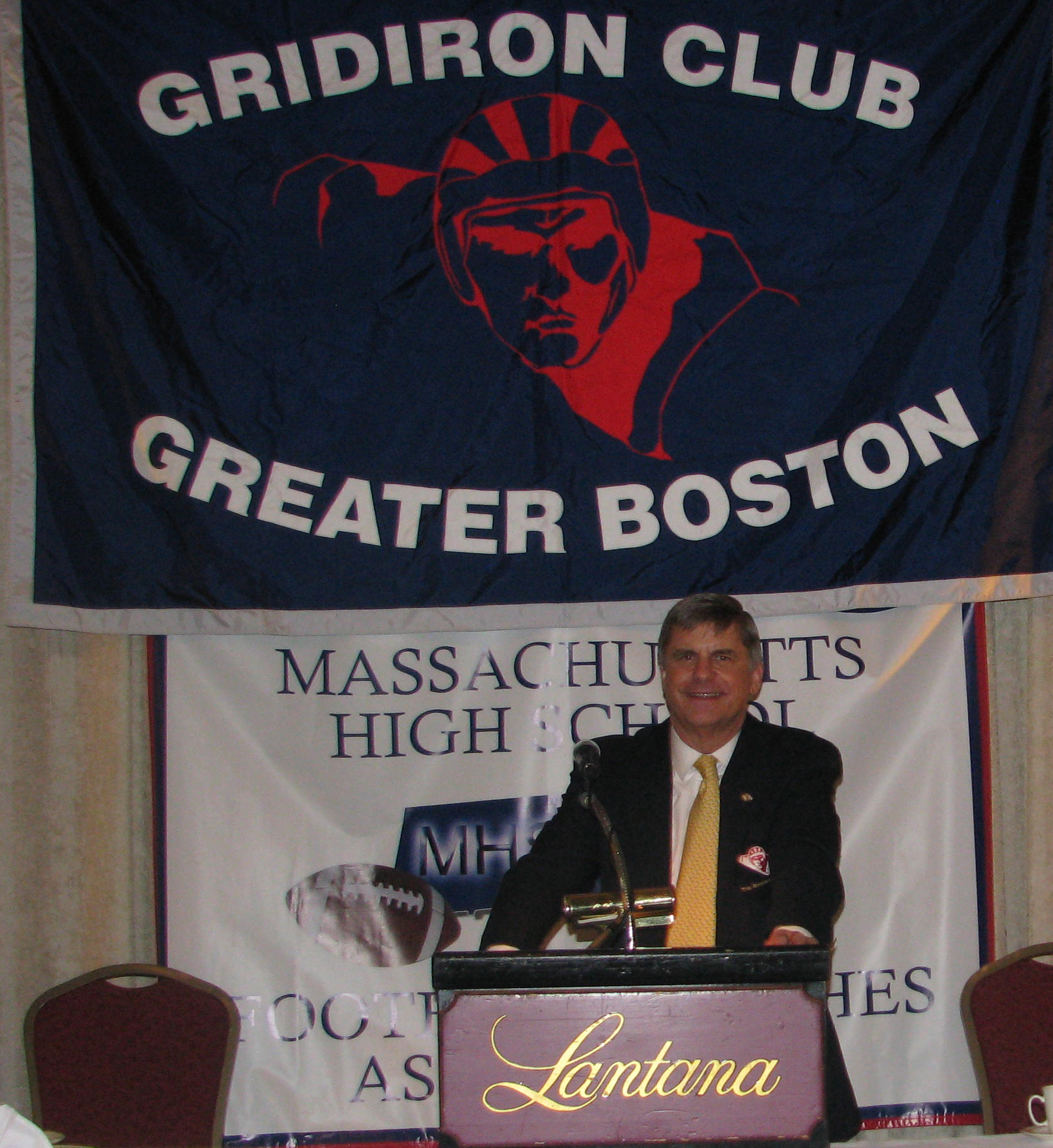
IMG_7919aMaster of Ceremonies’ Welcoming Remarks
Delivered at the Super26 High School Football Awards Dinner
March 2, 2014

Ladies and gentlemen, welcome to the 16th annual Super26 dinner, co-hosted by the Massachusetts High School Football Coaches Association and the Gridiron Club of Greater Boston.

I know I speak for both organizations when I say thank you for being with us this evening. You’ll hear from their presidents shortly.

If I were the president – president of the United States – I’d be thanking you too. And we’d be holding this gathering in the White House, and the award presentations in the Rose Garden.

That’s because what you’ve done is critically important to our country. To the fabric of our society. To what makes us Americans. You may well be the ones who are standing in the front lines, holding back a trend that is not good news for America.

I hope I’m wrong about that. But it’s worth mentioning.

When Alexis de Tocqueville traveled around this country back in the 1830s. He wrote his monumental work, “Democracy in America.” He was trying to tell the people of the Old World why America is unique among nations.

What he said then, I think, is just as true today as it was 180 years ago.

Americans are individual achievers. They strive to better themselves in ways that Europeans never imagined. But Americans also put that individualism together with that of others whose values they share. To strive for a common purpose, in community groups that are independent of their king and theig government.

DeTocqueville called that “self-interest properly understood.” It was a check on the tyranny that Americans had come here to escape. It was unique. It made America, America.

This is political philosophy, but it’s relevant to our gathering this evening. I got to thinking about it recently when I read a Wall Street Journal Article about trends in youth sports participation. Over the last five years, those trends are not encouraging.

In the four most-popular team sports – baseball, basketball, soccer, and football – combined participation by both boys and girls is off by 4% between 2008 and 2012. In some places, it’s worse. Ohio high-school basketball is off 15%. Sales of baseball bats are down 18%.

According to the soccer federation’s physical activity council, the percentages of inactive youth are up from 15% to 20%.

During those same five years, the population of six-to-17 year olds went down by less than one percent. Translation: same number of kids, a lot fewer of them playing team sports.

What’s going on here? Yes, there is a heightened fear of injury. But these numbers are from all sports, not just the contact ones.

Is it too much technology, and social networking, and video games? Have sports become too expensive? Is it not that much fun anymore, to be a member of a team, unless you’re an elite player?

I don’t know the answers to these questions. But if these figures tell of a real sustaining trend, it’s a problem for America. And if it’s a problem, what you are doing is the solution.

The Center for Disease Control has been telling us that childhood obesity is way up since the 1980s. And our political leaders are blaming sugary drinks in high school cafeterias. Wrong.

Being physically active is the way to overcome obesity. But that is just one big benefit. Being physically active, in the context of a team sport, brings so much more. Self-control. Discipline. Pushing your own limits. Contributing to your group’s success. Understanding your own role and responsibility to others.

Or, as Mr. DeTocqueville would say, seeing to your self-interest, properly understood. The essence of America.

Playing team sports, and representing our schools and communities as you do, is one of the many things that make this country exceptional.

Super26 members, you’re the cream, and I congratulate you. But the cream can’t rise to the top unless it’s part of big jug of milk.
We’re honoring you tonight, but we’re celebrating all of your team mates. And your coaches and officials. They’ve all made possible what you’ve done. And they, like you, have done their parts to keep this great country strong and great and exceptional.

That’s why, when I’m elected president, we’re moving this dinner to the White House. I hope I’ll see you all there.

History I Never Knew: From the Annals of Mixology and Medicine

February 28, 2014

The Monkey Gland

The Monkey Gland

Hey guys – looking for a “potent” cocktail to order the next time you’re out on the town?

Try the following: 2 ounces gin, 1 1/2 ounces orange juice, 2 dashes of grenadine, 2 dashes of Pernod or Bénédictine, and a twist of orange peel.

Tell the bartender to shake the gin, orange juice, grenadine, and Pernod with ice, then strain it into a chilled cocktail glass and garnish it with the orange peel.

And be sure to order it that way and not by its name, lest you provoke a snicker from a bartender who knows the drink’s history. This cocktail is a Monkey Gland. And its history is an interesting one indeed.

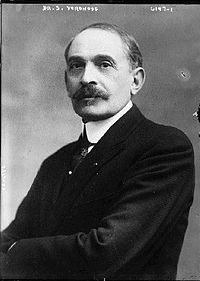
Harry MacElhone, owner of Harry’s New York Bar in Paris, mixed the first Monkey Gland in the 1920s. He did it in recognition of the work of French surgeon Serge Voronoff.

Serge Voronoff (1866 - 1951)

Serge Voronoff (1866 – 1951)

Voronoff was born to a Jewish family near Voronezh, Russia in 1866. He emigrated to France at the age of 18, where he studied medicine and learned surgical techniques of transplantation under tutelage of Nobel Prize recipient Alexis Carrel. Between 1896 and 1910, Voronoff worked in Egypt, studying the retarding effects that castration had on eunuchs. That experience led him to his later work that ultimately gave the world the Monkey Gland cocktail.

Voronoff perfected the technique of transplanting testicle tissue from various primates into men. This, he claimed, would increase both longevity and sex drive. His research was bankrolled by a daughter of Jabez Bostwick, first treasurer of the Standard Oil Company. He started off transplanting testicle tissue from younger animals into older ones – sheep, goats, and bulls – and claimed that that the older ones became stronger and more vigorous.

Eventually, Voronoff moved to human male patients and began grafting thin slices of baboon and ape testicles into them. He wrote a book titled “Rejuvenation by Grafting.” The poet e.e. cummings wrote of “a famous doctor who inserted monkey glands in millionaires.” Irving Berlin’s song “Monkey-Doodle-Doo,” featured in a Marx Brothers film “The Coconuts,” has a line, “If you’re too old for dancing/Get yourself a monkey gland.”

About 500 men underwent the procedure in France, and thousands more around the world did too. They included Harold McCormick, chairman of the board of International Harvester and Mustafa Kemal Atatürk, military hero of World War I and president of Turkey.

The operation was in such high demand that Voronoff set up a monkey farm on the Italian Riviera. He gained fame and made a lot of money. The procedure was fashionable until the 1940s, when its ineffectiveness became known throughout the scientific and medical communities.

Voronoff was quickly discredited and became the butt of jokes. He died in 1951. His reputation did not recover any ground until the 1990s when discovery that the Sertoli cells of the testes constitute a barrier to the immune system. This makes the testes an immunologically privileged site for the transplantation of foreign tissue. So, in fact, the thin slices of monkey testicles implanted by Voronoff may have survived to produce some benefit.

More recently, there have been successful experiments in reducing insulin requirements in diabetics. The techniques involved implanting into the diabetic patients pancreatic islet cells from pigs. The pig cells were coated in Sertoli cells, which insulated the pig cells from attack by the patients’ immune systems. No immunosuppressive drugs were required.

So maybe we should raise a glass to the good Doctor Voronoff after all. Need I suggest what drink we quaff in his honor?

The Story of the First Anecdote, and Other History I Never Knew

February 24, 2014

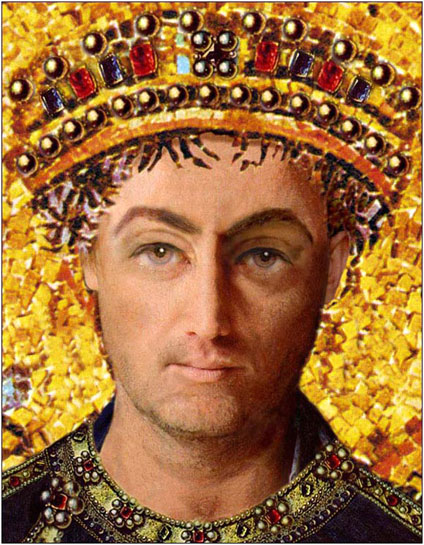
The Emperor Justinian

The Emperor Justinian

Justinian the Great was a mighty important guy in the history of the world.

The last Roman Emperor whose native tongue was Latin, he ruled the Byzantine Empire from 527 to 565. His armies reconquered much of the old Roman Empire that had been lost to invading hordes. He rewrote the body of law, the Corpus Juris Civilis, which is still the basis of civil law in many countries.

The Hagia Sophia

The Hagia Sophia

Justinian’s building program included the Hagia Sophia in Istanbul, which was the center of Eastern Orthodox Christianity for almost a thousand years. After the Ottomans took over, it became a mosque. Since 1935, it has been a museum.

Like most powerful politicians who tend to their image, Justinian had a historian who crafted fawning, flattering accounts of his exploits. Procopius of Caesarea wrote “The Wars of Justinian” and “The Buildings of Justinian.” Both were published during the emperor’s lifetime. The accomplishments chronicled therein were noteworthy.

The seductive Theodora

The seductive Theodora

However, the military and architectural feasts weren’t the emperor’s whole story. Procopius also wrote “The Secret History.” It contained the really interesting stuff, including unvarnished tales about the often scandalous private lives of Justinian and his seductive wife Theodora. The manuscript remained unpublished until 1623, when it was discovered in the Vatican Library.

The existence of The Secret History had been known earlier. It was mentioned in a 10th Century Byzantine encyclopedia called the Suda. In that encyclopedia, the Secret History was referred to by the Greek word “Anekdota,” or in Latin as “Anecdota.” Both of these mean “unpublished writings.”

Procopius of Caesarea

Procopius of Caesarea

The earliest meaning of “anecdote” in English was thus “Secret, private, or hitherto unpublished narratives or details of history.” Only later did the word come to have its present meaning: “The narrative of a detached incident, or of a single event, told as being in itself interesting or striking.”

Justinian and Theodora, perhaps the Western World’s first Power Couple, didn’t have to worry about paparazzi, bloggers, or Facebook. Their naughty antics remained secret for nearly a thousand years. But the first anecdote, starring them, eventually found the light of day.

So, my friend, be careful what you write and what you post, lest you too have your own anecdotes become known to all the world.

Today’s History Lesson: Music and Sports – How Golf’s Bogey Got Its Name, and Who Colonel Bogey Really Was

February 6, 2014

Bandmaster Lt. J.F. Ricketts, composer of  "The Colonel Bogey March."

Bandmaster Lt. J.F. Ricketts, composer of “The Colonel Bogey March.”

By the time Lieutenant J.F. Ricketts wrote “The Colonel Bogey March” in 1914, the fictitious Colonel Bogey was already the presiding spirit of golf links in Britain. This is the story of how Ricketts’s famous song was written, and of how the bogey came to mean one over par in golf.

Let’s go back, first, to a popular British song of the late 19th century. The “Bogey Man,” who lived in the shadows, was the star of said song. It went “I’m the Bogey man, catch me if you can.” “Bogle” had been the term for a Scottish goblin since the 16th Century. A Bogey-man was a popular term for a goblin or devil.

In 1890, Hugh Rotherham, secretary of the Coventry, England Golf Club, proposed standardizing the number of shots at each hole that a good golfer should take. He called that number the “ground score.” A Dr. Browne, Secretary of the Great Yarmouth Club, adopted the idea. Great Yarmouth used it in match play. During one competition, a Major Charles Wellman exclaimed to Dr. Browne, “This player of yours is a regular Bogey man.”

In Yarmouth and elsewhere the ground score became known as the Bogey score. So it was, originally, the measure of a well-played round of golf. Golfers of the time thought that they were playing against “Mister Bogey” when measuring themselves against the bogey score. They would, as the song went, try to catch the Bogey man. Bogey was interchangeable with the word “par.”

In 1892, Colonel Seely-Vidal, the Secretary of the United Services Club at Gosport, worked out the “Bogey” for his course. All members of the United Club had a military rank, and they felt they could not measure themselves against a “Mister” Bogey or have him as a member. So they gave him the honorary rank of Colonel, and “Colonel Bogey” was born.

Alec Guinness and Sessue Hayakawa in "Bridge on the River Kwai," the movie that introduced a generation of Americans to "The Colonel Bogey March."

Alec Guinness and Sessue Hayakawa in “Bridge on the River Kwai,” the movie that introduced a generation of Americans to “The Colonel Bogey March.”

Lieutenant Ricketts (1881-1945) was a British army bandmaster who later became director of music for the Royal Marines at Plymouth. He published “Colonel Bogey” and his other compositions under the pseudonym Kenneth Alford, because service personnel were not supposed to have jobs outside of the military.

The tune was said to have been inspired by a military man who was also a golfer. That golfer did not shout “Fore” when it was called for. Instead, he whistled a two-note phrase, a descending interval which begins each line of the march’s melody.

The bogey got demoted to its present one-over-par status in the early 20th century. Although the first noted use of the word “Par” in golf was in Britain and predates that of Bogey. “Par” comes from a stock exchange term – a stock may be priced above or below its normal or “par” figure.

In 1870, a British golf writer asked golf professionals David Strath and James Anderson, what score would win “The Belt,” which was the winning trophy for “The Open” at Prestwick. Strath and Anderson said that perfect play should produce a score of 49 for Prestwick’s twelve holes. The writer, whose name was Doleman, called this “Par for Prestwick.”

However, the bogey scoring system as the high-performance standard would take effect in Britain first. But over Across the Pond, things were changing.

Shortly before the turn of the century, the American Women’s Golf Association began to develop a national handicapping system for women, and the Men’s Association soon followed suit. In 1911, the Men’s USGA set down the following modern distances for determining Par: Up to 225 yards, Par 3; 225 to 425 yards, Par 4; 426 to 600 yards, Par 5; and over 601 yards, Par 6.

Golf continued to improve in America, and scores started to come down. But many old British courses did not adjust their courses or their Bogey scores.

This meant that good golfers and all the professionals were achieving lower than a Bogey score. The United States had an up-to-date national standard of distances for holes, but the British Bogey ratings were determined by each club and were no longer appropriate for professionals.

Americans began referring to one over Par as a Bogey, much to British chagrin.

And now you know the rest of the story.

History I Never Knew: Aristides de Sousa Mendes; and Why We Should All Try to be Historians

February 4, 2014

Not long ago I came across this story in The Forward. It is about Aristides de Souza Mendes, the “Portuguese Schindler,” as he is called.

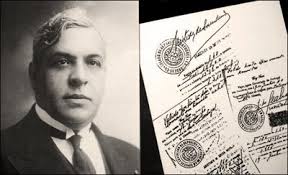
Aristides de Sousa Mendes and a life-saving transit visa

Aristides de Sousa Mendes and a life-saving transit visa

I’d never heard of Sousa Mendes before. He was another of those most admirable people of the hellish Europe of the 1930’s – people who did everything in their power, at great risk to themselves, to aid the Jews persecuted by the Nazis.

A diplomat stationed in Bordeaux, France, Sousa Mendes used his official position to provide transit visas to Jews who were fleeing through Portugal to safer countries. Portuguese dictator Antonio de Oliveira Salazar had forbidden it; Sousa Mendes did it anyway.

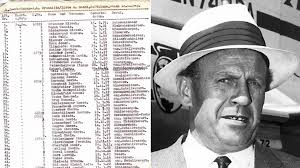
Oskar Schindler and his "List"

Oskar Schindler and his “List”

This article also serves as an important lesson about human history. That lesson: history’s heroes are those whose stories are faithfully recorded and told. But not all of those stories have been told. History is forever incomplete, a work in process. We can all do our part to advance that work.

Until the 1970s, the story of Aristides Sousa Mendes remained hidden. It had been suppressed by Salazar, who ruled Portugal from 1932 to 1968. Today, Mendes is rightly regarded as a Portuguese national hero. Salazar? Who the hell cares.

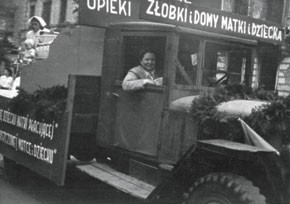
Irena Sendler and the truck she used to smuggle about 2,500 Jewish children out of the Warsaw ghetto

Irena Sendler and the truck she used to smuggle about 2,500 Jewish children out of the Warsaw ghetto

Sousa Mendes is honored along with Oskar Schindler, Raoul Wallenberg, Irena Sendler, and almost 25,000 others in the Garden of the Righteous Among Nations at Yad Vashem in Jerusalem.

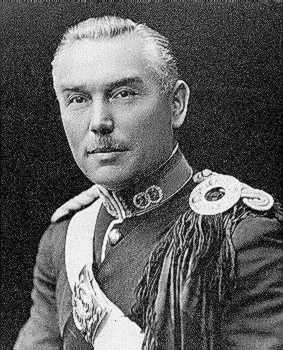
Antonio de Oliveira Salazar, dictator of Portugal

Antonio de Oliveira Salazar, dictator of Portugal

In this case, the good man finally receives his due. The bad man, prosperous and powerful while on earth, shrinks further into the dark alleyways of oblivion with every passing year.

Avenue of the Righteous in Yad Vashem, Jerusalem

Avenue of the Righteous in Yad Vashem, Jerusalem

It doesn’t always happen that way. There are millions of stories out there, still waiting to be told. Their heroes and heroines aren’t always the “great people” either. They won’t be in the history books. But they should remain in our hearts.

You don’t need to be a professional historian. You don’t have to write a book. But you can seek out those quiet, unknown heroes. Listen to their stories. And pass those stories on.

Holy Ground

January 27, 2014

The beach at Colleville sur Mer, France. Nearby is the American cemetery with the sculpture "The Spirit of American Youth Rising."

The beach at Colleville sur Mer, France. Nearby is the American cemetery with the sculpture “The Spirit of American Youth Rising.”

Few places on earth can compare with Normandy in France. Can you imagine a scene as placid and peaceful as this one?

In the first photo, my wife Mary Ellen gazes over the bluff and down onto the beach at Colleville sur Mer. Such quiet, such tranquility. It was not always this way.

This is near the eastern end of the shore section code-named Omaha Beach on D-Day in 1944. That June 6 it was anything but placid and peaceful, as American soldiers waded slowly onto the shore and into cataracts of bullets fired by unseen enemies high above.

As one proceeds to the west, the bluff rises higher and steeper and gives an even stronger advantage to entrenched defenders. The second photo is of Vierville sur Mer, on the western end of the Omaha Beach sector. The large objects in the water there are the remains of “mulberries,” the artificial docks that were needed to bring trucks, tanks, and other mechanized equipment to the land.

Vierville sur Mer, France, the westernmost part of Omaha Beach.

Vierville sur Mer, France, the westernmost part of Omaha Beach.

Beyond Vierville is Point du Hoc, the high vertical cliff that Army Rangers scaled with the aid of extension ladders from the London Fire Department, and the beach code-named Utah.

Such a flood of emotions gripped me on our trip there in 2000: patriotic pride, and gratitude and admiration for those who came ashore and somehow, some way, prevailed in the end. But most of all, it was sadness, an overwhelming sadness for all those young men from Canada and Britain and America who suffered so much that day and did not return.

I wasn’t there that day, and I’ve known just a few people who were. Andy Rooney – good old, acid-tongued, unsentimental Andy – landed a few days after D-Day and proceeded to write about what he’d seen on the war’s front lines. One of his most revered commentaries goes, in part,

“No one can tell the whole story of D-Day because no one knows it. Each of the 60,000 men who waded ashore that day knew a little part of the story too well. To them, the landing looked like a catastrophe.

“Each knew a friend shot through the throat, shot through a knee. Each knew names of five hanging dead on the barbed wire in the water 20 off shore, three who lay unattended on the stony beach as the blood drained from holes in their bodies. They saw whole tank crews drowned when the tanks rumbled off the ramps of their landing craft and dropped into 20 feet of water.

“There were heroes here no one will ever know because they’re dead. The heroism of others is known only to themselves…On each visit to the Beaches over the years, I’ve wept. It’s impossible to keep back the tears as you look across the rows of markers and think of the boys under them who died that day.

“Even if you didn’t know anyone who died, your heart knows something your brain does not – and you weep.”

Mr. Rooney is so right. When I came across these pictures today, almost fifteen years after standing there in Normandy and taking the pictures, I felt those tears welling up once again.

I think that every American should make the pilgrimage to Normandy at least once in his or her life. That’s what it is. It’s not a trip. It is a pilgrimage to holy ground.

Book Review and Reflections: “Easy to Remember” by William Zinsser

December 18, 2013

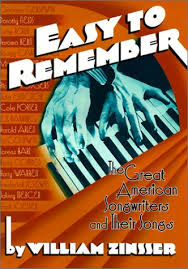
easy to rememberWhen I saw the author’s name on the spine of the large paperback,I bought the book immediately. I’m glad I did. Just finished the book, and loved it.

I consider myself a disciple of William Zinsser. His “On Writing Well” is one of the best books I’ve ever read about the art and craft of non-fiction writing.

Zinsser wrote “On Writing Well” in 1974 when he was teaching at Yale. Before going into teaching in the 1970s, he’d been a writer and drama critic for the New York Herald Tribune for ten years and a free-lance magazine feature writer for another decade or so. He’s penned several other books about writers and writing. The man knows his business.

“I write to affirm,” he once put it. He’d rather celebrate that denigrate. So would I.

American Music’s Golden Age and Its People

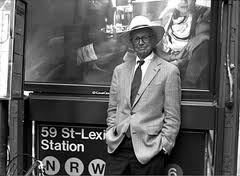
Author William Zinsser

Author William Zinsser

Zinsser also knows his music. “Easy to Remember,” written in 2001, is an education in America’s four-decade golden age of music. That golden age began in the magical American year of 1927 with “Show Boat,” a work that drew upon the talents of composer Jerome Kern and librettist Oscar Hammerstein. With its songs like “Ol’ Man River,” “Can’t Help Lovin’ Dat Man,” and “Misery’s Comin’ Around.”

“Show Boat,” as Zinsser puts it, elevated the musical from a grab-bag of songs into “a drama with musical numbers that established character and anchored the story in a social context.”
For about 40 years – through the rest of the Jazz Age Roaring 20’s, the Depression, World War II, and the Fabulous Fifties – music and songs written for Broadway and Hollywood were the standard-bearers of our country’s culture. This book tells of the people who composed the music and wrote the lyrics for those songs.

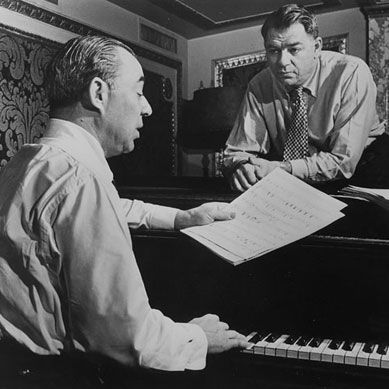
The team of Richard Rodgers (at piano) and Oscar Hammerstein

The team of Richard Rodgers (at piano) and Oscar Hammerstein

Some of their names were familiar to me, though I knew little about their personal histories: Hammerstein, George and Ira Gershwin, Irving Berlin, Cole Porter, and Richard Rodgers among them.

Other giants of the era about whom I knew next to nothing included Frank Loesser, composer and lyricist of “Guys and Dolls;” E.Y. Harburg, who wrote “Brother Can You Spare a Dime,” and “Over the Rainbow” for Judy Garland and “the Wizard of Oz;” the prolific Harry Warren, who gave us “There Will Never be Another You,” “Chattanooga Choo-Choo,” and “I Only Have Eyes for You;” and Jule Styne, whose “Diamonds Are a Girl’s Best Friend” in “Gentlemen Prefer Blondes” shot Carol Channing to stardom.

Society and the Movies

Zinsser builds the book largely around the biographies of the musical artists. But he also delves into the cultural and societal influences such as sheet music, African-America jazz, and World War II. He writes of the outsize impact of performers like Frank Sinatra, Fred Astaire, Ethel Merman, and Ella Fitzgerald, and of game-changing movies like “Wizard of Oz” and “Casablanca.”

“As Time Goes By” by Herman Hupfeld was the seventh-most frequently played song of the 20th Century, according to ASCAP, the American Society of Authors, Composers, and Publishers. Zinsser devotes almost a chapter to that song and to “Casablanca,” and it’s a fascinating little story in itself.

Hupfeld wrote the piece for a 1931 Broadway musical, “Everybody’s Welcome.” A woman named Frances Williams sang it so beautifully that a Cornell student named Murray Burnett fell in love with it and made a recording, which he played often.

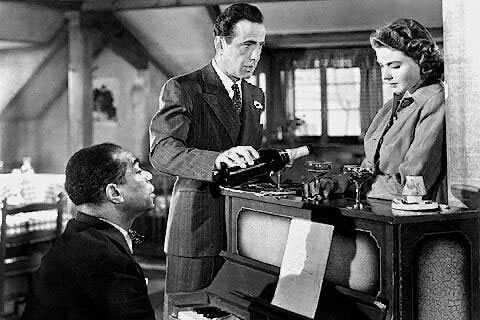
Dooley Wilson as Sam, Humphrey Bogart as Rick, and Ingrid Bergman as Ilsa in "Casablanca"

Dooley Wilson as Sam, Humphrey Bogart as Rick, and Ingrid Bergman as Ilsa in “Casablanca”

Burnett went to Vienna in 1938 and saw first-hand the horrible treatment of Jews at the hands of the Nazis. On his way back to America he happened to visit a bar in Paris where a black guy was playing the piano. He returned to New York and wrote his own play, “Everybody Goes to Rick’s,” which Warner Brothers bought and made into “Casablanca.”

That’s not the end of the story, however. The script calls for Ilsa to enter the bar and ask the piano man to play “As Time Goes By.” Producer Max Steiner of Warner Brothers didn’t like the song and wanted to cut it. But Jack Warner liked the song and ordered him to make it the musical centerpiece of the movie. Zinsser explains how the song and the movie gradually grew into twin cultural icons. He says, further, that it really isn’t much of a song and that jazz musicians tend not to play it unless asked. He concludes, “Melodically it’s inert. Lyrically it’s platitudinous. But emotionally it’s off the charts.”

End of an Era

The author says that he was lucky enough to be born right at the beginning of that golden age. I and my boomer friends came into this world just as that era was ending and rock and roll took over. The songs discussed in this book were all just out of reach in my generation’s immediate past. Zinsser’s America was one where just about every home had a piano and at least one family member who could play it. America back then was a self-entertaining country. It’s no longer that way, for many reasons.

Unlike William Zinsser, I have no musical talent, no ear for music, no skill in any instrument. But music moves me – to laughter, to melancholy, to tears. That only makes me human, I guess. Gogi Grant’s rendition of “Wayward Wind” never fails to raise goose bumps. Singers like Barbra Streisand, Judith Durham, Linda Ronstadt, Johnny Mathis, and Don McLean usually make me pause what I’m doing and enjoy the emotional ride along with them. Recordings played on my favorite oldies station transport me back to those high school dances of fondest memory.

The book explains that the dawn of the rock and roll era and a larger, underlying cultural shift ended the musical theater era. True, we have a number of contemporary masterpieces that will be around for a long time: “Les Mis,” “Phantom of the Opera,” “Beauty and the Beast” and “The Lion King” are some the author cites.

Zinsser, the master writer and lover of language, explains that rock also altered the way we Americans listen to music. Our generation, he says “…didn’t insist on songs that told a story, or on rhymes that exactly rhymed…But what fundamentally changed was the audience. The love affair with language was over…The great American songwriters wrote for men and women who cared about literary forms. It was the end product of a heritage that esteemed the written and the spoken word.”

The words, he said, needed exactly the right melodies, and the melodies needed exactly the right words. The combination was easy to remember and impossible to forget.

I highly recommend this book, and I agree with a quote on its jacket: “It’s a de-lovely biographical companion to the Great American Songbook.”

This is Your America

November 18, 2013

George Lermond West Point 1930 Graduation Photo

George Lermond
West Point 1930 Graduation Photo

The “great people” are the ones who make history. Or at least they’re the ones who get credit for it.

Presidents and potentates, generals and warlords, captains of industry and show-business celebrities – we chronicle and study their lives. Their deeds – and their misdeeds – are the Cliff’s Notes stories of our civilization. We are supposed to know those stories so that we may make sense of the world we live in.

But it’s not enough to read about those with the big jobs, impressive titles, and bottomless bank accounts. Not if we want to learn the possibilities of the human spirit, to hear of the heights of personal accomplishment, to grasp the boundless potential of human love and sacrifice. Not if we want to understand what it means to be an American.

To comprehend and appreciate such possibilities, heights, and potential, we must know the people who have been there. They’re not in the pages of the history books. But they are all around us, and always have been. I would like you to meet one such man. His name is George Lermond.

George Lermond and his sister Mary in Nahant before BC High graduation, 1921

George Lermond and his sister Mary in Nahant before BC High graduation, 1921

George was born into a poor Massachusetts family. He was a hard-working student, loving son and brother, altar boy, Olympic athlete, soldier, and father. His life touched many of those whom history considers great men.

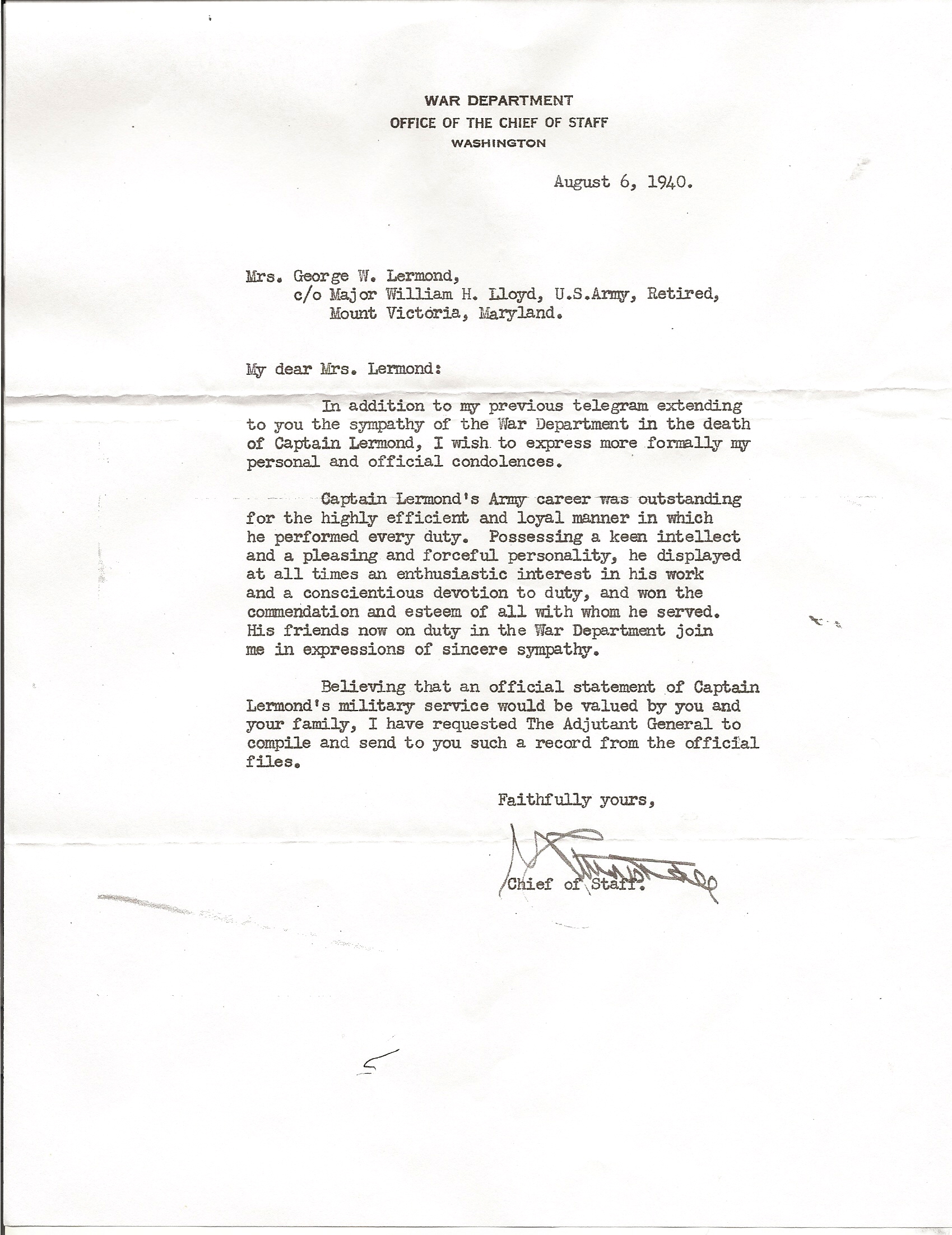
Dwight Eisenhower promoted George Lermond to captain in the U.S. Army. Franklin Roosevelt called on him when he needed trained pilots to fly U.S. air mail. George Patton was to be his next immediate superior before his tragic death in a house fire. George Marshall commended his exemplary service in a personal letter to his family. Roosevelt directed that Lermond and his son, George Junior, be buried together in Arlington National Cemetery.

George Lermond commuted from Nahant to Boston College High School. He graduated from there in 1921 and from Boston College in 1925. He was a superb track athlete, the only one from his college squad chosen to compete in the 1924 Olympics. After BC, he went to West Point and graduated in 1930. I researched and wrote his biography for his induction to the BC Hall of Fame in early October. The full text of the story appears below, along with some photos and letters that I received from family members.

George’s son Bill journeyed from Maryland for the Hall of Fame induction ceremony. His heartfelt words of thanks, as he accepted the bronze plaque for the father he hardly knew, brought tears to many eyes that evening.

Bill, his sister Edith, and his mother Edith, were saved from the blaze that took George Lermond’s life. George lowered the two children, who were wrapped in a blanket, from a window to his wife on the veranda. George then went back inside to save the third child, and perished.

I want the world to know of this man’s exemplary life. Perhaps history won’t number him among the greatest of men. But I do, and I suspect you will agree.

In this our time, it is all too easy to become distressed at the sight of so many charlatans, mountebanks, and outright villains who occupy positions of power and prestige. Do not be distressed. They will be gone and forgotten.

To my fellow baby boomers, who’ve reaped our blessed land’s bounty that was sown by our fathers and grandfathers, I say take heart. The generation of our children, and soon enough, their children, has its own ample supply of George Lermonds. They’ll soon be in charge.

You made them and set them on their way. Have faith.

George Lermond
Boston College High School ’21, Boston College ’25, United States Military Academy ‘30

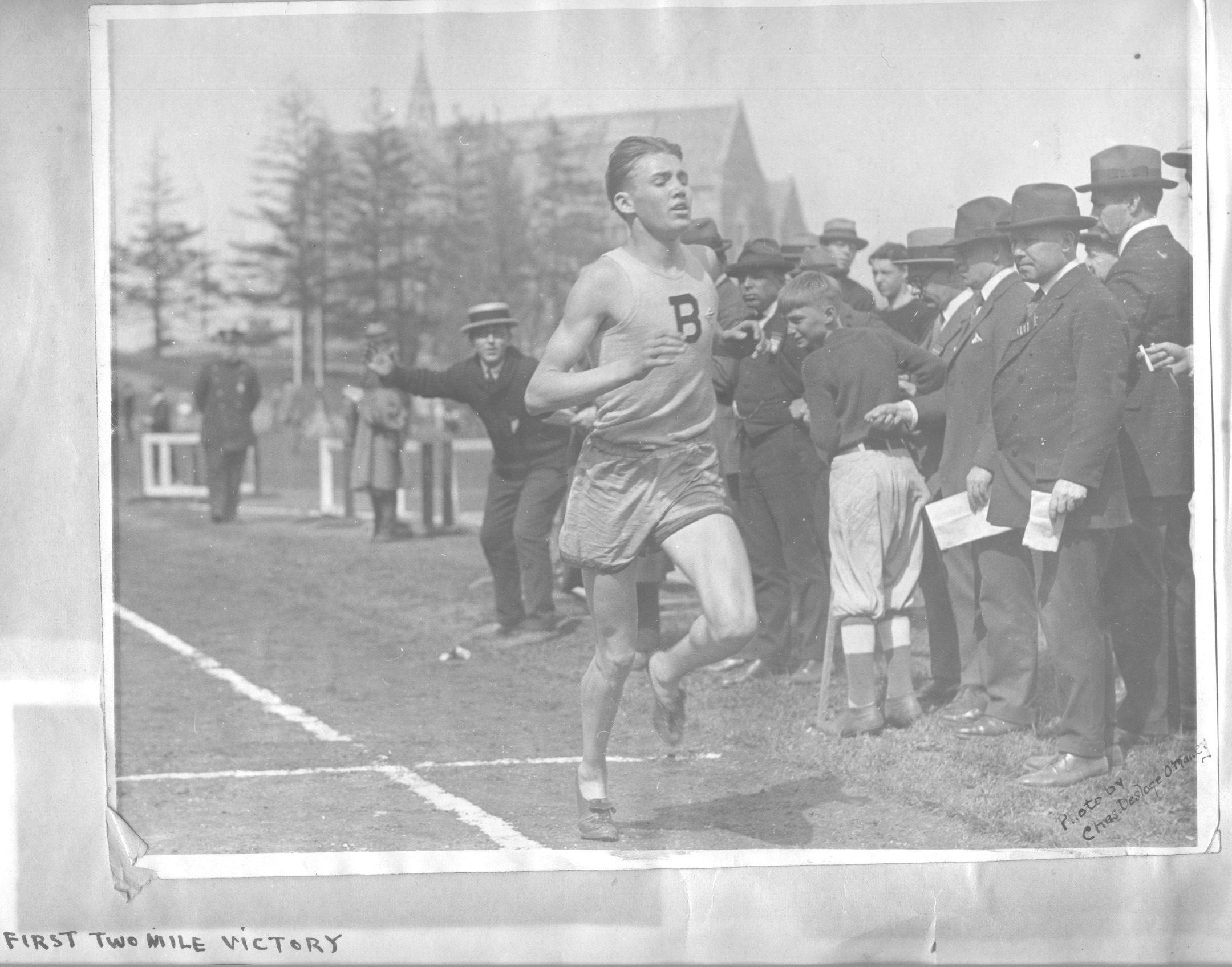
Winning the two-mile run at Boston College

Winning the two-mile run at Boston College

The first glorious era for Boston College track and field was the Roaring 20’s. Nine Eagle athletes of that time along with coach Jack Ryder, are already enshrined in the Hall of Fame. But none of those athletes distinguished himself, both on the fields of play and in later life of service to his country, more than George Lermond.

A middle distance runner and winner of innumerable races and championships during his time at Boston College, Lermond was the only Eagle who made the 1924 Olympic team.

After Boston College he enrolled at West Point and graduated in 1930 while continuing his track career and grooming his younger brother Leo to track stardom.

George was a championship-caliber runner well into the 1930s while serving in the United States Army. He died tragically in a house fire in1940, on the eve of World War II.

George Lermond was the prototypical student for whom Boston College was founded. The third child in a poor but hard-working Catholic family, George was born in Revere, Massachusetts. His father left when he was ten years old, and his mother Julia Lenehan Lermond moved to Nahant to be with her parents.

George’s uncle, Father Daniel Lenehan, was pastor of Sacred Heart Parish in Malden. A frequent visitor to the house, he undoubtedly had something to do with George’s enrolling at Boston College High School in Boston’s South End. George commuted the 15 miles every day. Like many BC High lads, he then proceeded right to Boston College.

“Lemons” fit right in with the other Eagle track stars. He was on the distance medley team with Tom Cavanaugh, Luke McCloskey, and Louis Welch. They won four national championships and broke three world records.

George was the New England two-mile champion three straight years, and in one of those victories he set a course record of 9:33.5. Sportswriters called him “the sensation of the Eastern track world” in 1924. Among his many victories were the Millrose Three Mile in New York, the New England Two Mile championship, both indoor and outdoor, the National AAU 5- Mile, and the BAA Games Two Mile.

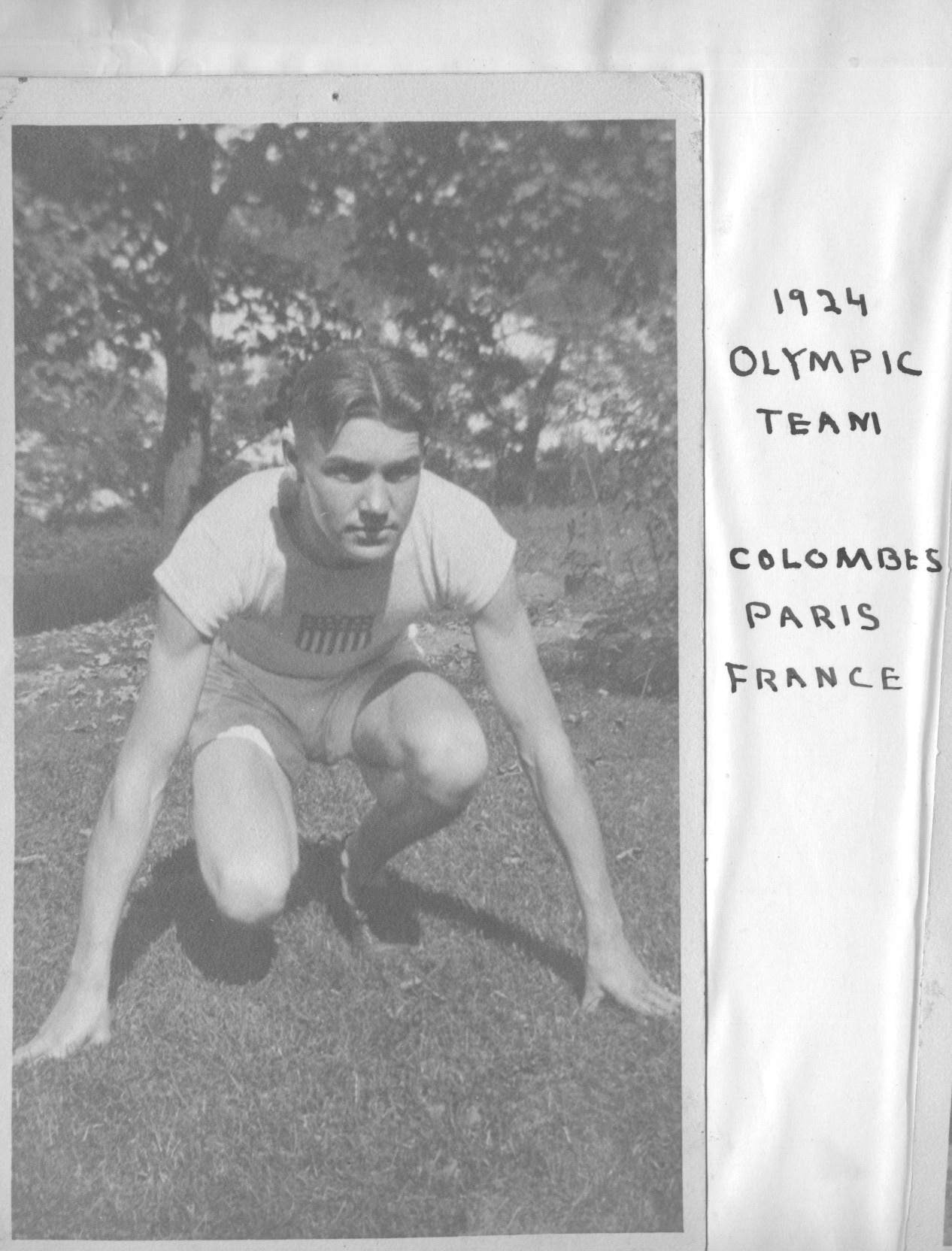
At Paris Olympics, 1924

At Paris Olympics, 1924

At the Paris Olympics George faced the immortal Paavo Nurmi and his mates from Finland in the 5000-meter run. Nurmi won the gold and George finished 24th. Aged 19, George was the second-youngest American ever to compete in the 5000.

Returning to Boston after the Olympics, George was the AAU six-mile champion in 1925. In January of 1925, he placed fourth against Nurmi in the 5000 at the Millrose Games in Madison Square Garden.

George also ran for the Boston Athletic Association. He introduced his younger brother Leo to Jack Ryder and the BAA. Under Ryder’s direction Leo became as big a star as George. Leo finished fourth in the 5000 at the 1928 Olympics in Amsterdam.

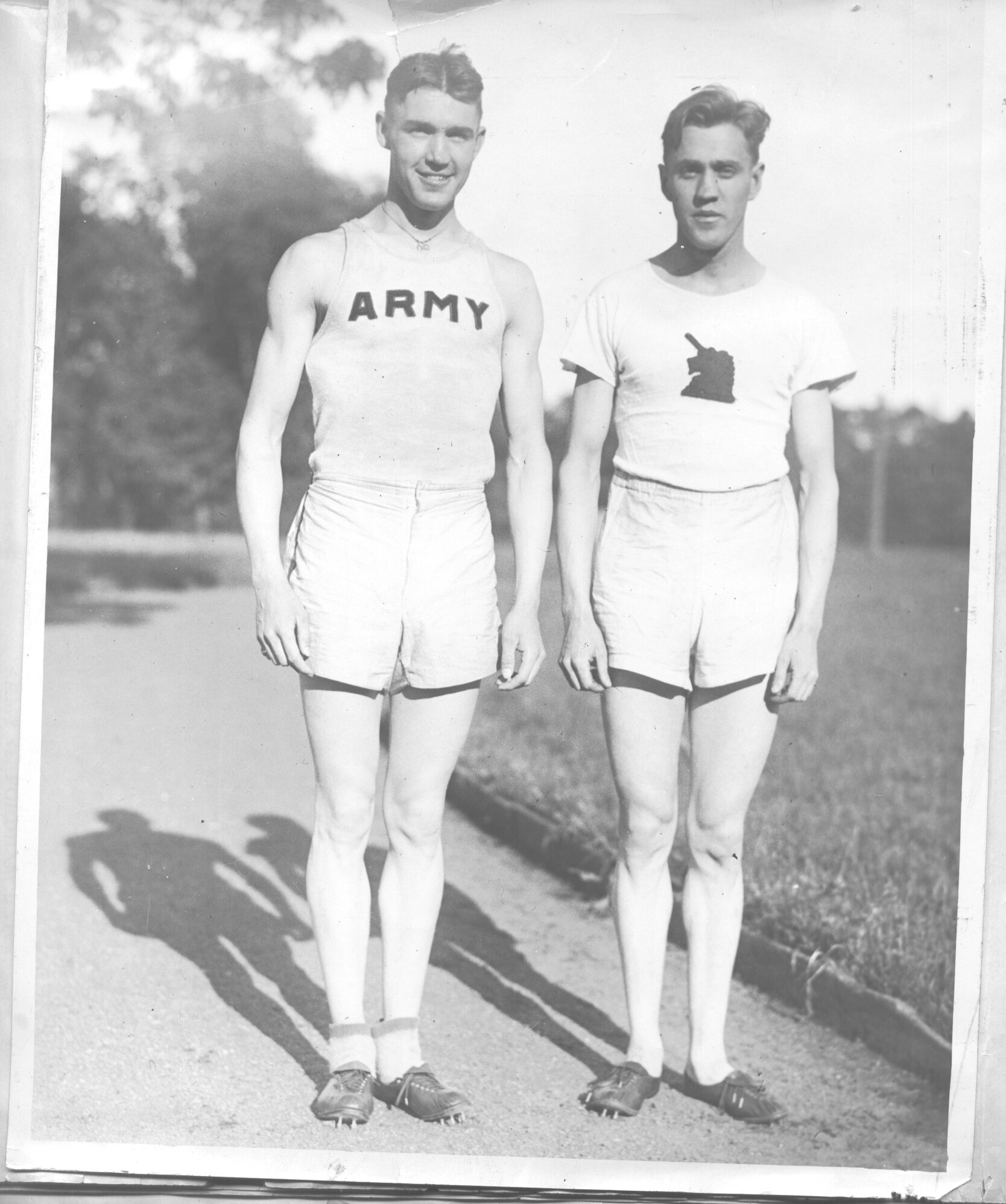
George in West Point track uniform, brother Leo in BAA gear

George in West Point track uniform, brother Leo in BAA gear

George and Leo also ran for the New York Athletic Club during the 1920’s, and press reports speculated that the United States would have two brothers competing at the Amsterdam Olympics in the 5000. George was at the peak of his powers at the time, holding the Military Academy records for the half-mile, the mile, and the two-mile. But he came up short during the trials, probably wearied from competing in multiple events at West Point.

Service to the county was in George’s family history. His grandfather Patrick had lied about his age to get into the 55th Massachusetts Infantry in the Civil War. A great-grandfather, William McCallister, served at both Petersburg and Appomattox.

George’s first military career stop was at the Air Corps Flying School in California. Though commissioned as a flyer, he stayed with the infantry. However, he was one of 262 Army pilots who delivered the nation’s air mail for 78 days in 1934.

George's 15th Infantry Defending Post in Tientsin, China

George’s 15th Infantry Defending Post in Tientsin, China

George returned to an infantry assignment at Fort Jay on Governor’s Island in New York Harbor. He kept running and aimed for the 1932 Olympics in Los Angeles. His personal bests in several events took place around that time. In 1930 he posed a 1:55.3 in the 880 and a 4:15.2 in the mile. In 1932, he ran the two-mile in 9:16.6. It was also in 1932 that he set the unofficial world record for the 3000 meter steeplechase at the Eastern Olympic Tryouts at Harvard, with a time of 9:08 2/3.

He and Leo competed in a track meet in Lynn before the national Olympic tryouts, and George injured an ankle going over a water jump and missed the national final tryouts. The winner was Joe McCluskey, with a time of 9:14.8, much slower than George. McCluskey ended up taking the bronze in Los Angeles.

George did go to Los Angeles in 1932, however. He was a coach in the pentathlon. That event, consisting of fencing, swimming, show jumping, pistol shooting, and a distance run, was a showcase for military competitors. Richard Mayo won America’s first-ever pentathlon medal, a bronze.

George attended chemical warfare school in Maryland in 1934. After a graduate course in infantry at Fort Benning, Georgia, he was assigned to the 15th Infantry Brigade in Tientsin, China in 1936. His wife Edith accompanied him.

Japan invaded China in 1937, and the 15th ‘was reassigned to Fort Lewis, Washington. George’s immediate superior was and up-and-coming colonel named Dwight Eisenhower. Ike promoted George to captain in 1940.

George Lermond’s final assignment was to tank school at Fort Benning. He was slated to train under General George Patton, but he never got there. He and his family stopped for a few days at the luxurious Mount Victoria in LaPlata, Maryland, while Edith’s parents took a short vacation.

On the night of July 5, a fire broke out in the upper floors and spread quickly. George was able to lower Edith, four-year old Bill, and 15-month old daughter Edith to a porch by using a bedsheet. He dashed back into the house to save George junior and was overcome by the smoke. He was 35 years old. President Roosevelt directed that he be buried in Arlington National Cemetery.

1932 Letter from Major Harold Rayner, Major of Cavalry and Master of the Sword

1932 Letter from Major Harold Rayner, Major of Cavalry and Master of the Sword

1940 Letter of Condolence from General George C. Marshall, U.S. Army Chief of Staff

1940 Letter of Condolence from General George C. Marshall, U.S. Army Chief of Staff