Archive for the ‘history’ Category

Book Review and Reflection  – “Katherine:” Back to the Middle Ages.

February 24, 2025

Several times during the last few weeks, I found myself thinking of Jiminy Cricket and Emily Dickinson.

Jiminy, those of a certain age will recall, used to sing “Books take you ‘cross the sea and down along a trail that never ends.”  Emily, many will remember from high school, wrote “There is no Frigate like a Book, To take us Lands away.”

I recently returned from across the sea and lands away when I put down the 592-page historical novel Katherine, by Anya Seaton.  This was one of those exceptional books that I just didn’t want to end. I felt like I was back in that time of Geoffrey Chaucer, of courtly love and arranged dynastic marriages, of treachery, adultery, and murder in the castles, of the Black Death and the Hundred Years’ War, and of the history plays of William Shakespeare.
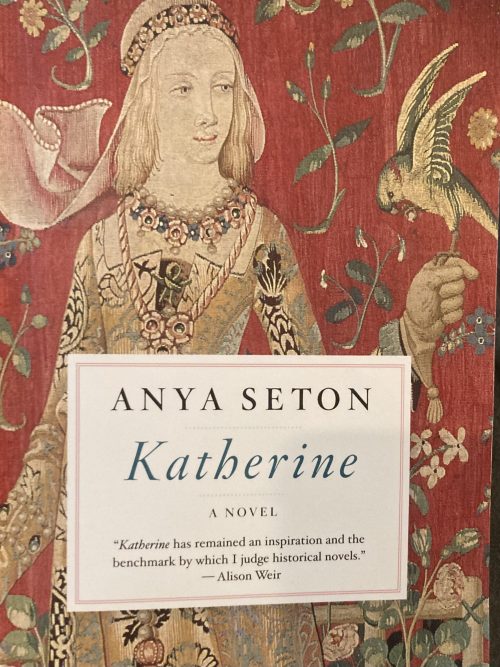
Katherine Swynford was mistress, love-of-life and eventual third wife to John of Gaunt, one of England’s greatest noblemen. Son of King Edward III and Duke of Lancaster, he never became King of England. But he would have been a much better monarch than his simpering nephew, Richard II, who succeeded Edward III on the throne and eventually screwed things up royally – pun intended.

Gaunt was smitten by Katherine’s beauty and regal presence almost from the time they met.  He was married to the wealthy Blanche of Lancaster, with whom he had three children. Catherine, without dowry and second daughter of Payn de Roet, a knight who died at an early age, was married to another knight of slender means, Sir Hugh Swynford.  She bore him two children.

Swynford was in Gaunt’s service and was a reliable and fierce warrior, but that’s about all he had going for him. He died under mysterious circumstances after returning from a military campaign. Gaunt’s first wife Blanche perished in the Black Death plague. Their spouses’ deaths would have freed John  and Katherine to be together and make it official, you’d have thought, but that’s not what happened. He first married Queen Costanza of Castile, and he spent a good deal of time away in Spain trying to win more military victories and to become king of that realm. When he was in England, he eclipsed in strength and prestige the hapless King Richard, but he remained loyal until his death.

John’s loveless, political second marriage didn’t keep him and Katherine from having four children of their own. Somehow, that flame kept flickering and never went out. John found ways to share some of his wealth and keep her and their four bastard children financially solvent. It wasn’t that she was always there standing by him. They were apart and out of touch for long periods of time. She even contemplated suicide at one point. They finally married after his second wife died and spent three years together as husband and wife.

The author, Anya Seaton, took about a year and a half to write this book. She stayed true to historical fact and interpolated plausible though undocumented facts and motives where the record was lacking. She traveled through England and stood where her chronicled events took place. Her sources, among others, were Gaunt’s personal registers and the Jean Froissart’s Chronicles, highly detailed descriptions of the events of the Hundred Years’ War.
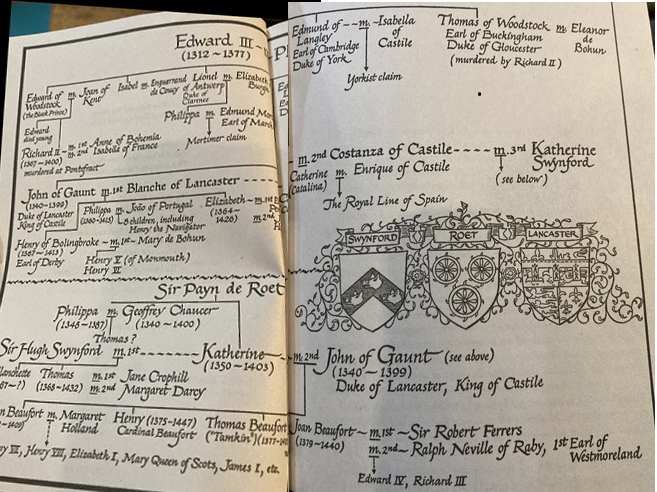
John’s and Katherine’s genealogy chart

As she remarked in her journals, “I’m writing at least plausible history… I’m taking some liberties, etc.”  Some of those liberties included imagining a deep-seated demon that plagued Gaunt from childhood and almost caused him to plunge England into a civil war. She has Katherine intervene and, through loving attention, quell the fires of his fury. As Seaton describes it, “Pretty psychiatric but I had to do it.”

Another couple of undocumented surmises by the author were her treatment of Geoffrey Chaucer and of Julian of Norwich, the revered religious leader, anchoress and author of the book of mystical devotions, Revelations of Divine Love.

Chaucer was actually Katherine’s brother-in-law, in a loveless marriage to her sister Philippa. He makes several brief appearances and inserts some wry and pithy observations; Seaton imagines that his Troilus and Criseyde was inspired by Katherine and John.  She also had Swynford poisoned by a treacherous loyalist of Gaunt’s, although there is no evidence of that. Late in the book, Katherine, overwhelmed with guilt and on the brink of despair, is brought to Julian. Her experiences there, of course, are imagined by the author. Still, it is plausible – and I wanted to believe it was this way – that Julian relayed the following divine message to Katherine:

“It is truth that sin is the cause of all pain; sin is behovable – none the less all shall be well…Accuse not thyself overdone much, deeming that thy tribulation and thy woe is all thy fault; for I will not that thou be heavy or sorrowful indiscreetly.”                                                                                                                                                                                     

Yes, these are liberties taken by the author.  But they work. As Seaton’s biographer Lucinda MacKethan points out about this book and Seaton’s next work, The Winthrop Woman, “Some readers have criticized the history of these works as too heavy, but for most, Anya’s great respect for what might be called the knowability of the worlds she was bringing to light in their greatest asset.”

I have to agree with that. As mentioned above, I felt like I was immersed in those worlds. No one can know what the people in them were actually thinking and feeling.  And her description of the sack and burning of Savoy Palace during the Peasants’ Revolt was nothing short of terrifying. It certainly seemed true to history as far as I was concerned.

And for those aforementioned history plays of Shakespeare – particularly I Henry IV, Henry V, and Richard II – I finally learned who all those characters and parties to the conflicts were. They include, in addition to John of Gaunt, Henry Bolingbroke, Edward the Black Prince, Lord Harry Percy of Northumberland and his son Hotspur, Wat Tyler, Jack Straw, and the Dukes of Gloucester and York. They flit in and out of the history plays, and I always had a hard time remembering who the good guys were and who the bad guys were. Now I feel that I know where they all fit in the tumultuous history of the period.

Anyone who has read Shakespeare or dabbled in history has at least heard the name John of Gaunt. Like me, you probably regarded him as one of the big-time operators in a bygone age. And in that, you’d be right. But that’s the extent of it. Like me, you also would not have realized the profound impact he had on the history of the country of England. Nor, I daresay, had you ever heard of the formidable woman, the long-time mistress who at last became his wife, without whom John of Gaunt would have been just another member of the gone-and-forgotten noble class.

After Gaunt’s death, Richard II went off the rails and was succeeded by Bolingbroke, Gaunt’s son from his first marriage. He became Henry IV, and his son was the much mythologized Henry V. The Beauforts, who were the initially illegitimate children of Gaunt and Katherine, were the progenitors of Henry VII, the Tudor royal line, and the Stuart royal line. That includes, among others, Henry VIII, Elizabeth I, Mary Queen of Scots, and James I. Katherine’s grandsons were Edward IV and Richard III.

Quite a legacy. As the final line of this wonderful book states, in quoting the witches in Macbeth, “Thou shalt get kings, though thou be none.”
Where Algebra and Algorithms Came From

July 15, 2024

Did you ever wonder why, when your make out a check to someone or some business, you have to write in the sum in both numbers and words? If you’re bothered by all those unwanted ads cropping up on your social media, did you ever wish there was no such thing as an algorithm? And, be honest, did you ever wish that you didn’t have to take those required algebra courses back in high school?

All those feelings have occurred to me, but at least now I know who to blame. It’s those clerics and merchants and high-falutin’ academics who prowled the earth more than 1,500 years ago, from Baghdad to Cordoba to Florence and back again.

The Abacus and the Cross, a biography of learned scientist and teacher Gerbert of Aurillac, who ultimately became Pope Sylvester II, shows that the so-called “Dark Ages” weren’t so dark after all. In fact, there was a great deal of learning and trafficking in scientific knowledge going on.  Gerbert was a renowned schoolmaster, scientist, and cleric of that era. He intrigued his way to the papacy and got appointed to it by Otto III, the Holy Roman Emperor, in the year 999.

Gerbert’s biography goes into the backstories behind those matters in the first paragraph. It tells of the House of Wisdom in Baghdad, which became a veritable research institute around the year 800. It saved for posterity works by such giants as Euclid, Ptolemy, Archimedes, and Aristotle. Much of the scientific know-how from Baghdad eventually made its way to Europe via al-Andalus, the Muslim stronghold in Spain.

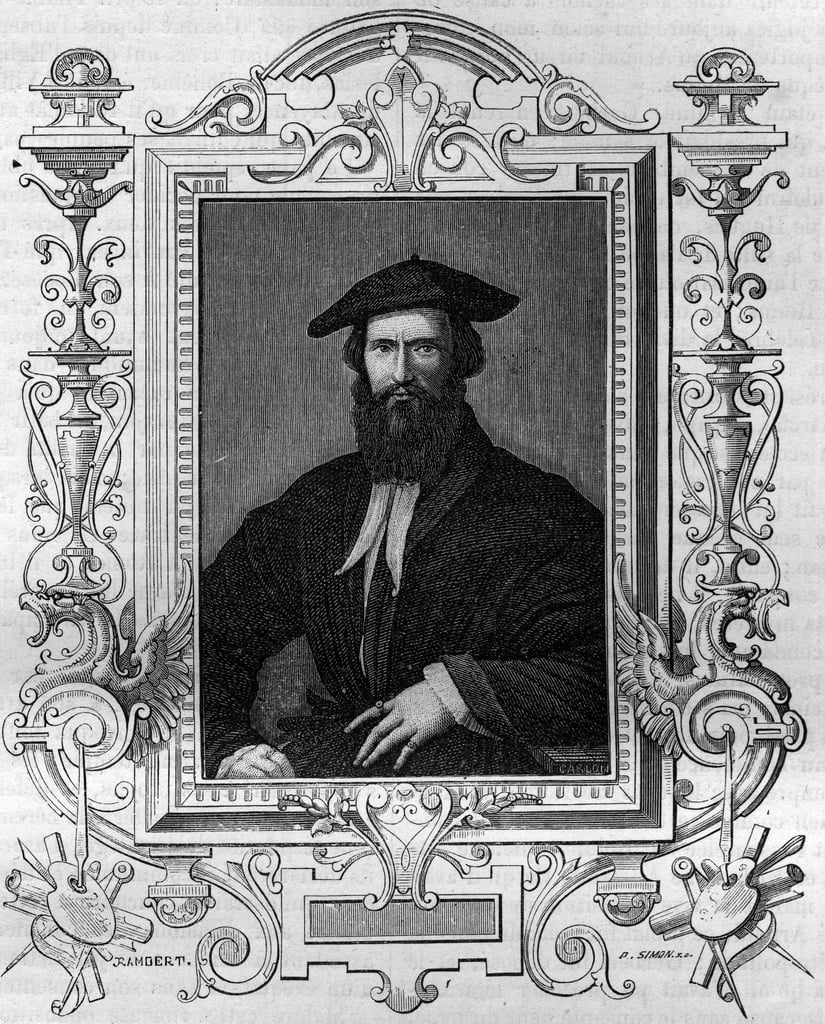
Gerbert of Aurillac – the future Pope Sylvester II

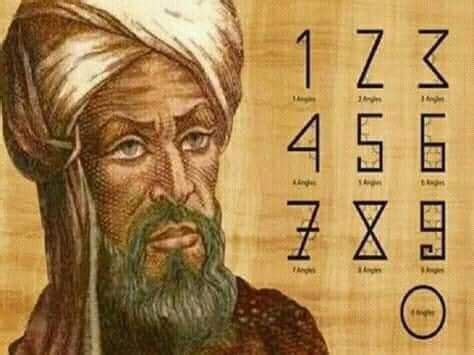
One of the all-star mathematicians from the House of Wisdom was Muhammad ibn Musa al-Khwarizmi, who died in 850. He wrote On Indian Calculation, the world’s first book on Arabic numbers – the numbers that ran from 1 to 9 – and the place-value system of working with those numbers.  That system originally came from India. 

He also wrote The Compendious Book on Calculation by Completing and Balancing. In Arabic, that’s Kitabl al-muktasar fi hisab al-jabar wa’l-muqubalah. That was the first book of modern algebra – or the “al jabar” of the book’s title. But that’s not the last we hear of al-Khwarizmi.

Fast-forward to the career of Gerbert of Aurillac and beyond. Gerbert was an absolute whiz with the abacus, which was the personal computer of its day. For a couple of centuries, monastery schools used the abacus to teach arithmetic. Eventually they evolved from shuffling beads on a counting board to calculating with pen on parchment or with stylus on a wax tablet. They used as a guide a Latin translation of On Indian Calculation by al-Khwarizmi. The Latinized form of his name is “Algorismus.”

So it is that we get both algebra and algorithms from the math whiz of Baghdad.

But as with all evolutions in thought and methods, change was resisted. In 1299, the money changers of Florence, Italy, got into the act. They didn’t trust the Arabic numerals, so they banned the use of “letters of the abacus.” They decreed that no one “dare or allow that he or another write or let write in his account books or ledgers or in any part of it in which he writes debits and credits, anything that is written by means of or in letters of the abacus, but let him write it openly and full by way of letters.”

al-Khwarizmi – “Mr. Algorithm”

More than 1,100 years later, we in America still adhere to that proscription – or to some of it, anyway. As I learned when I was a banker-in-training, the Law of Negotiable Instruments states that such an instrument. i.e. a check, must have the amount written out in both numbers and words. If the sums differ, then the verbal one is the official amount.

Now you know the rest of the story.

Our Devious Founding Fathers

February 29, 2024

As I write this, it’s the last day of February.  Presidents are on everyone’s mind.

Last week, the country celebrated Presidents’ Day.  It used to be Washington’s Birthday, celebrated on February 22. He was born on that date in 1732, but did you know that he actually was born on February 11, 1731? At the time of his birth, the Julian calendar was still in use, and would be for the first 20 years of his life. The Gregorian calendar was adopted in 1752, adding a year and 11 days, in order to more accurately calculate leap years.

Jefferson at work

Then there’s Lincoln’s Birthday on February 12. Abe deserves his own holiday, in my opinion, but he didn’t get one. I suppose that a Presidents’ Day, in which we honor both of these giants of American history, is a reasonable approach.

This year too, we’re going to be electing a president, come November. So we’re all thinking of that, and mostly with some trepidation.  I don’t think I’m being too overtly political here when I say that most likely you agree with me and with most of America that none of the prospective candidates for the November ballot is in any way comparable to our Founding Fathers.

The Founders, after all, were brave, articulate, forthright men of sterling character. They put their lives on the line. And they were totally honest. All the time. Beginning with that felled cherry tree in George Washington’s back yard, they never told a lie. Always played it straight.

Er, not exactly. Not all the time. But sometimes, you gotta do what you gotta do, even if it means lying or exaggerating or dissembling. And history will reward you for it, if you play for the good guys. Consider these little-known backstories about two of our most revered founders, Thomas Jefferson and George Washington.

Take Jefferson and his writing of the Declaration of Independence. Without a doubt, that document is masterful and sublime – at least at the beginning, with the “We hold these truths to be self-evident, that all men are created equal, that they are endowed by their Creator with certain unalienable Rights, that among these are Life, Liberty and the pursuit of Happiness….” And so on.

But that first section ends with “The history of the present King of Great Britain is a history of repeated injuries and usurpations, all having in direct object the establishment of an absolute Tyranny over these States. To prove this, let Facts be submitted to a candid world.”

George III

Those “facts,” are anything but facts. Rather, they are 28 ad-hominem accusations against King George III, a king to whom on December 6, 1775, the Second Continental Congress had declared its allegiance while distancing itself from the real oppressors, the British Parliament: “Allegiance to Parliament? We never owed – we never owned it. Allegiance to our King? We have ever avowed it – our conduct has been ever consistent with it.”

So what happened, over the following six months? Did George III turn into a hateful monster? Did he desire to put into place a reign of tyranny and terror?  Of course not. But Thomas Jefferson, probably the most facile wordsmith of all the leaders in the colonies, had to paint the King as just such a villain. He had to make it personal. The nuanced truth behind the issues be damned. And it worked.

Andrew Roberts’s fine book, “The Last King of America,” takes up the rhetorical excesses of the Declaration of Independence in great detail. He maintains that, because it was the King to whom Congress had recently declared allegiance, “unless it took the form of a personal attack, it would not answer the Loyalists’ argument that it was possible to become independent of Britain but remain in a political condominium of some sort with the Crown.”

In other words, they had to go negative  – sound familiar? – and do it in a personal manner which also had to be untruthful in the extreme.  The 28 charges “were kept deliberately unspecific regarding places and dates, for the obvious reason that most were untrue, since George had never sought to establish any kind of tyranny over America.”

Space doesn’t allow us to go into the detail that Roberts lays out. But here are just a few examples:

“He has kept among us, in times of peace, standing armies without the consent of our legislatures.” Well, yeah. The French and Indian War had concluded in 1763, and according to Roberts  “a standing army on the western border had been the only way of protecting the colonies; the colonies had actually voted their thanks for what the British army had done.”

“He has transported us beyond the seas to be tried for pretended offences.” That never happened. A law allowing for this had been in place since the time on Henry VIII, and it was to deal with traitors and treasonable crimes. But George III never used it.

“He has transported large armies of foreign mercenaries to complete the works of death, desolation, and tyranny, already begun with circumstances of cruelty and perfidy scarcely paralleled in the most barbarous ages, and totally unworthy of the head of a civilized nation.”  But Jefferson failed to mention that, fighting on America’s side, were Baron von Steuben, the Marquis de Lafayette, General Casimir Pulaski’s Legion, Bartholomew von Heer’s Provost Corps, and General Armand’s Independent Chasseurs.

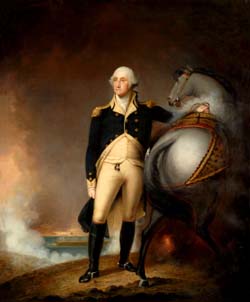
George Washington at Dorchester Heights, Boston

“He has excited domestic insurrections against us and has endeavoured to bring on the inhabitants of our frontiers the merciless Indian savages, whose known rule of warfare is an undistinguished destruction of all ages, sexes, and conditions.” Jefferson must have forgotten that Congress tried to outbid the British for the supports of the Indigenous Nations, and that Stockbridge Native Americans were members of the Massachusetts Militia, and that Massachusetts  had a provincial alliance with the Mohawks.

“He has plundered our seas, ravaged our coasts, burnt our towns, and destroyed the lives of our people.” This points to the destruction of Norfolk, Virginia. Only problem was that Norfolk was primarily a Loyalist town and the burning was done by the Patriots, not by the Redcoats.

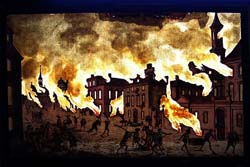
By now, I think you get the point. Thomas Jefferson never let the facts get in the way of a good story. And that final item lets us segue neatly into an adventure in plausible deniability by the father of our country, George Washington. He was almost certainly involved in and ultimately responsible for “The Great Fire of 1776” in New York. More than 500 buildings, including Trinity and Lutheran churches, were destroyed.

British soldiers had marched triumphantly into New York on September 15, 1776. Washington’s army had to flee, but six nights later, fire broke out in the city’s southern wharves. There were no bells left in the city of sound the alarm; Washington’s men had taken them all for cannon fodder.  Strong winds had spread the blaze and turned much of the city, which was also teeming with Loyalists, into a waste land.

Washington had wanted to burn the city down before he fled, but Congress forbade it and told him to make a peaceful retreat. He complied grudgingly.

But two weeks later, writing to Lund Washington, a distant relative and manager of his Mount Vernon estate, GW stated, “Providence – or some good honest Fellow, has done more for us than we were disposed to do ourselves.”

The Great Fire of 1776

The rhetoric on the Patriots’ side claimed it was indeed some divine providence, or perhaps even British soldiers out plundering the city, that started the blaze. The Brits believed otherwise, pointing out that arsonists had to have done it because the blaze broke out in several places at once. They also pointed to Washington’s absconding with the fire bells as something that couldn’t have been a coincidence.

A subsequent investigation by the Brits couldn’t prove anything. But in June 1777, they caught Abraham Patten, a spy who was plotting to set afire the town of Brunswick, NJ. Before he was hanged as a spy, Patten admitted that he had helped start the New York fire. He didn’t name any accomplices, however. Shortly thereafter, Washington wrote to John Hancock and requested that they secure some funds for Patten’s widow.

No, we can’t expect our presidents to be totally honest all the time. We should know that by now. And they should have known it back in 1776. Some things never change.

History I Never Knew: Good King Wenceslas

January 14, 2024

You’ve probably heard the Christmas hymn:

“Good King Wenceslas looked out

On the Feast of Stephen”

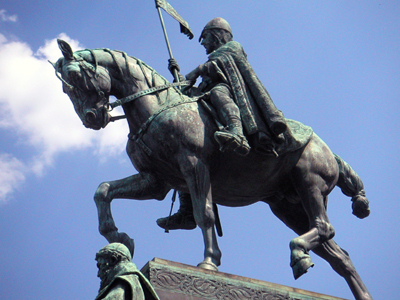
Wensceslas as armed knight on horseback in Prague’s Wenceslas Square.

Maybe you’ve even heard the joke about how he like his pizza cooked:

“Deep and crisp and even.”

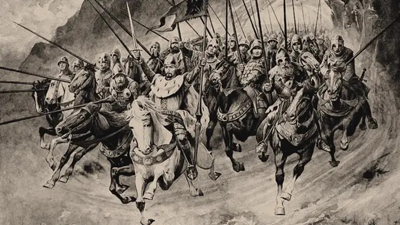
But who was this guy, the patron saint of the Czech Republic, whose statue stands in Wenceslas Square in Prague? Legend holds that if the Czech homeland is ever threatened, the statue will come to life, summon the army that sleeps beneath Mount Blanik, ready to defend the homeland. Wenceslas will wield his sword, which is hidden under the stones of the Charles Bridge and is to be found by a child when peril from enemies looms for Prague.

Here’s the rest of the story. There was actually a Wenceslas – real name Václav the Good, as Wenceslas is the Latinized version. He wasn’t a king; rather, he was Duke of Bohemia. He apparently was a very nice guy.  He was from a very dysfunctional family, and he died because of his opposition to slavery.

The Charles Bridge

Yes, slavery. It wasn’t invented in the American South. They used to have it all over Europe. And Prague was the main market for slaves who were being moved overland from central Europe to the west and south.

Wenceslas was against slavery; he would buy slaves himself and set them free.  But he ticked off three rich guys who had made big money in the slave trade. Their names were Tira, Česta, and Hněvsa; all three of them stabbed him before his own brother, Boleslas, ran him through with a lance.

Boleslas, the bad guy, took over the realm and knew where his bread was buttered. He, nominally Christian like Wenceslas, let the slavers make their money. He reigned for more than 35 years.

It didn’t matter that Boleslas already ruled over half the country at the time of the killing. It wasn’t enough for him, and it was the money that mattered. 

According to “Christendom” by historian Peter Heather, Christianity was spreading throughout Europe in those years, driven largely by the political decrees and conquests in the long reigns of Charlemagne and his son, Louis the Pious.

Václav and Boleslas’s father, Vratislaus I, was the Duke of Bohemia and a Christian. Their mother Drahomíra, though baptized before the marriage, was aligned with Bohemia’s pagans. As a child, Václav was raised largely by his Christian paternal grandmother, Ludmila — who was later canonized as a saint in her own right.

When Václav was about 13, his father died in battle and Ludmila became regent. But the regency did not last long. His mother Drahomíra had Ludmila killed, and she then tried to suppress Bohemia’s Christians.

Wenceslas leads the Blanik Knights down the mountain to rescue Prague from its enemies.

When Václav became Duke of Bohemia himself at age 18 and came of age, he banished his mother and foiled her suppression plans by working to spread Christianity. He commissioned the building of several churches including part of what is now St. Vitus Cathedral in Prague. He also developed a reputation as a wise and compassionate ruler, known for his deeds of mercy.

But to try and avoid disputes, the country was split in two, and half was given to the younger brother, Boleslas. But Boleslas wanted the whole enchilada. He also remained the favored son of Drahomira. In September 935 he plotted with the slave-owning a group of noblemen to kill his brother.  He did so by exploiting Wenceslas’s religious faith. He invited Václav to a church dedication on Sept. 27, 929. The next day, while Václav was on his way to prayer, Boleslas and his henchman attacked and killed him.

Only the good die young. Wenceslas was 22. On the base of his statue, the inscription reads “Saint Wenceslas, duke of the Czech land, prince of ours, do not let perish us nor our descendants.’”

I’m told by those who’ve visited that part of Europe that Prague is a particularly beautiful city and that the Charles Bridge is spectacular. That’s one place I’d love to visit. But I won’t be diving into the Vltava River and searching though the rocks for Wenceslas’s sword. As the legend tells us, that’s a job reserved for a child.

Where Do You See Yourself in Five Years? OK, then, How About 50 Years?

January 8, 2024

Did you ever have one of those job interviews in which the robot doing the hiring looked down the list of boilerplate questions and asked, “Where do you see yourself in five years?”

Didn’t you hate that? I did. I always mumbled something that didn’t meet expectations. But I must tell you of the one answer that I wished I’d had the wits to deliver. It was by Jim, a former work colleague who was looking for a humdrum emerging-from-retirement position, answering the phone at an insurance company’s customer inquiry desk.

“I see myself in a rocking chair on my front porch in five years.”

He got the job. Maybe because he was both prescient and honest.

Jim’s cheeky reply came to mind today when I read a magazine piece (National Review, February 2024 edition) about another magazine, long since out of business.  That magazine was Saturday Review/World, and the year was 1974. The editor, antinuclear activist Norman Cousins (1915-1990) conceived and published an entire issue titled “2024 A.D.” Beneath that banner headline came the subtitle “A probe into the future by…” followed by nineteen names of the most eminent minds of the day.

So how did they do?

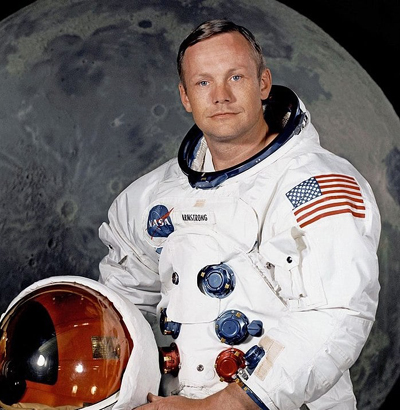
Some of them whiffed. Astronaut Neil Armstrong (1930-2012) predicted that by 2024 there would be colonies of humans on the moon, with “massive subterranean lunar cities, ‘underground apartments and workrooms…connected by tunnels and powered by giant solar generators and flywheels spinning at incredibly high speed.’” He also said that we’d have had manned space flights to Mars and probably a few selected asteroids.

Neil Armstrong

None of that happened, of course. In case you’d forgotten (I did) the last U.S. moon landing was back in 1972, two years before Armstrong made this prediction.

Faring little better than Armstrong was Clare Boothe Luce (1903-1987),the playwright, congresswoman, and ambassador. Despite a few advances such as availability of birth control pills and better access to higher education, Luce lamented that there has been little progress in “overthrowing male supremacy…and achieving equality of the sexes….[and that the American woman of 2024 would be] playing many more roles that were once considered masculine. I see her making a little more money than she is making now. But I still see her trying to make her way up – in a man’s world – and not having much more success than she is having now.”

Nice try, Clare. Looks like you really didn’t have a lot of faith in women and their abilities.

So who got it right? Surprisingly (for me anyway) three of the best answers came from people who’d seen and lived in the darkest and cruelest recesses that humanity devised during the 20th Century: Communism and Nazism.  Perhaps seeing those evil systems from the inside gives one a special clarity of mind. See if you agree.

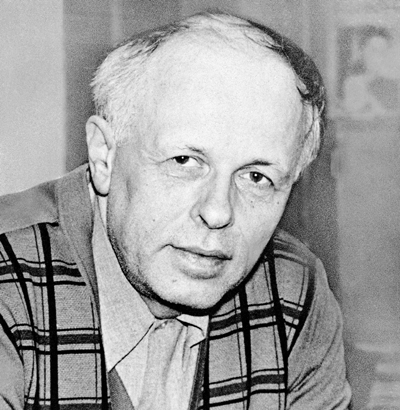
Andrei Sakharov

Russian physicist and human rights champion Andrei Sakharov (1921-1989), who won the Nobel Peace Prize in 1974, foresaw the unique role that “communications and information” would play, beginning with the creation of a “global telephone and videophone system. Then came his prophecy about what we could only call “the Internet:”

“Far into the future, more than fifty years from now, I foresee a universal information system, (UIS) which will give everyone access at any given moment to the contents of any book that has ever been published or any magazine or any fact. The UIS will have individual miniature-computer terminals, central-control points for the flood of information, and communication channels incorporating thousands of artificial communications from satellites, cables, and laser lines.

“Even the partial realization of the UIS will profoundly affect every person, his leisure activities, and his intellectual and artistic development. Unlike television, the major source of information for many of our contemporaries, the UIS will give each person the maximum freedom of choice and will require individual activities.”

Wow. Sakharov was off a little bit on his timing, but that’s all.

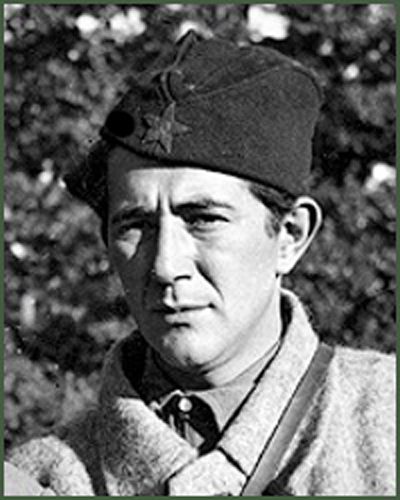
Milovan Djilas

Milovan Djilas (1911-1995) was from Yugoslavia. He was a higher-up in the regime of dictator Josip Broz (Tito), but he became disillusioned with communism and spent six years in prison for his honesty. He saw what would happen in his part of the world when he wrote:

“The most significant change in the next fifty years will be the disintegration of the Soviet empire…The crucial factors will be the domestic ferment and the pressure from China…[and possibly] uprisings in Eastern Europe…With the collapse of the Soviet empire, the Eastern European countries now under Soviet hegemony will become independent and will join the European community. Germany will be reunited, without a civil war.”

Got that right.

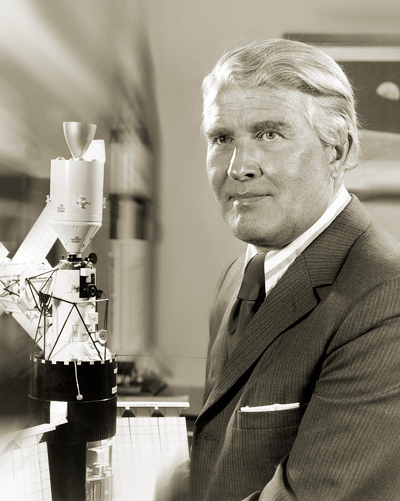
And how about Wernher von Braun (1912-1977), the rocketry whiz who designed the V-1 and V-2 rockets that rained down on Britain from Adolf Hitler’s Germany, and who came to America  after World War II and was the guiding genius behind the Saturn Rocket program?

With a vision much like that of Sakharov, the former Nazi foresaw the power and ubiquity of orbiting satellites, which would spawn a “revolution…a global telephone network interconnecting nearly 100 nations…handling millions of television channels simultaneously and billions of telephone conversations [and providing] direct ties between computers in support of such operations as banking or ticket reservations.”

There was even more, and finely detailed it was, to von Braun’s preview:

Wernher von Braun

“Controlled by an orbital switchboard, laser beam connections could be established (and withdrawn after use) that provide direct links between any two points on Earth. The abundance of available channels would soon lead to worldwide video-telephone service. And as communications improve, commuting for work would go out of style. It would become more convenient to let electrons, rather than people, do the traveling.

“The average American household of 2024 will be equipped with an appliance that combines the features of a television set with those of a desk computer and a Xerox machine. In addition to serving as a TV set and a print-out device for news, the push-button-controlled console will permit its owners to receive facsimile-radioed letters, review the shelves of a nearby grocery store, order food and dry goods, pay bills, balance books, and provide color-video-telephone service to any point on Earth.”

Not totally accurate, but you get ample partial credit and a high final grade, Herr von Braun.

Some others who contributed predictions to that 1974 Saturday Review/World were Indira Gandhi, Robert McNamara, Coretta Scott King, David Rockefeller, and Pierre Trudeau.

The NR piece does not mention any of their predictions. But it does surmise – and I think correctly – that it would be “difficult to imagine anyone convening a panel of ‘influencers’ like this today.” And that’s unfortunate. Society as a whole doesn’t have too many people to whom it can look, with trust and confidence, for advice and guidance.

Maybe there are a few out there who can see the future as clearly as did Messrs. Sakharov, Djilas, and von Braun. But I wouldn’t know where to look for them.

History I Never Knew – “The Matrix” and Its Biblical Origin

February 13, 2023

I’m not big on science fiction, so I never saw that Keanu Reeves movie about a dystopian future; Wikipedia calls “The Matrix” “the cyberpunk of science fiction.” Not my thing.  I do vaguely remember matrices from Algebra II. Wasn’t very good at them or that subject, but at least I passed.

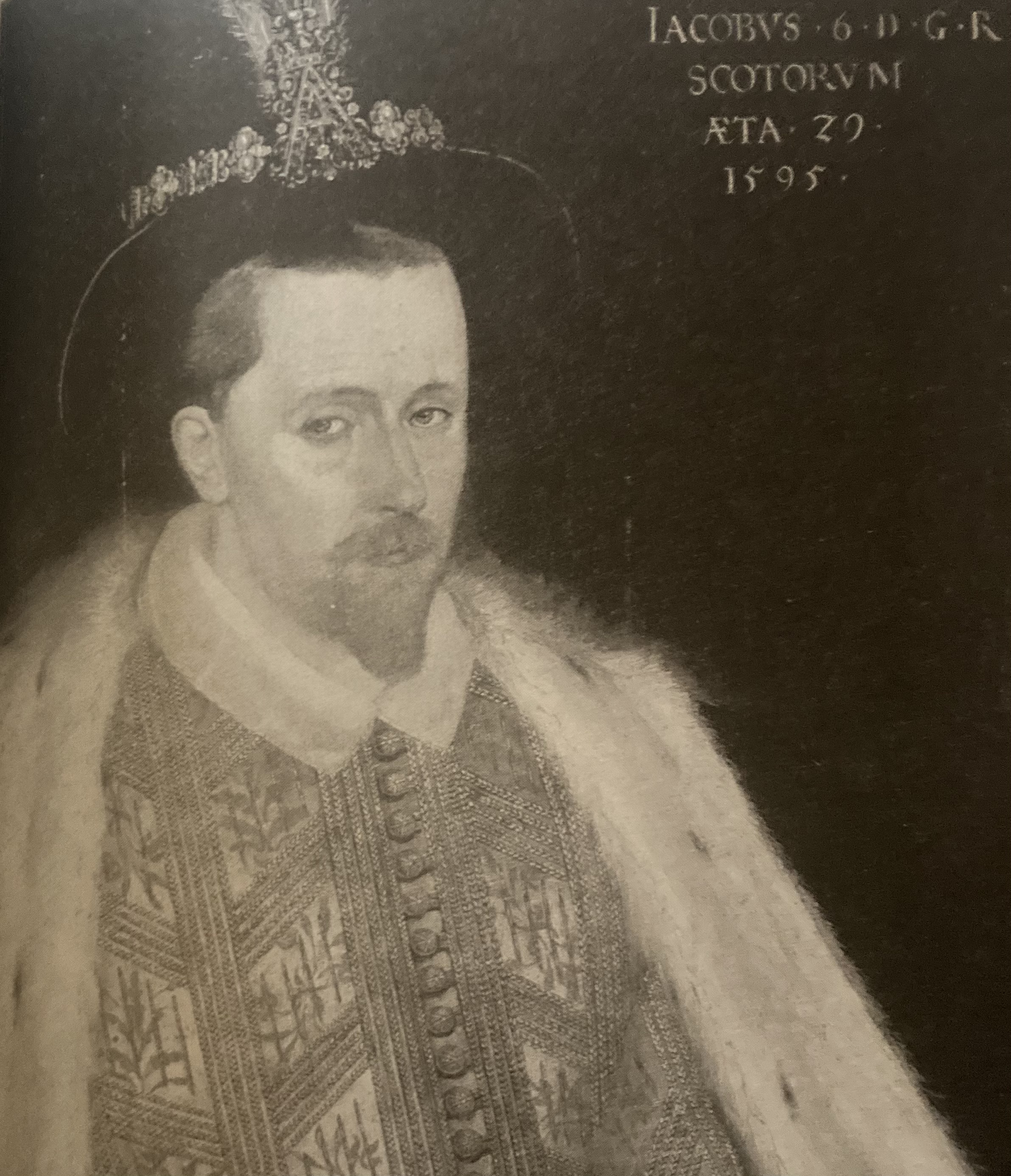
King James VI of Scotland at age 19, the future King James I of England.

So, what is a matrix, anyway? Did you know that it is a womb, that wellspring of all life on earth, that precious gift carried by the female of all species?

I didn’t know either, but now I do.  I saw it in my King James Bible, my 2022 Christmas gift to myself. More about that remarkable piece of literature presently.

In Exodus 12, God unleashes the Angel of Death upon the Egyptians, that final plague which will at last persuade Pharaoh to let his people go. The angel passes over and does not enter the houses of the Israelites when he sees the blood on their doorposts lintels.

Near the end of Chapter 12, God lays out the rules of the Passover commemoration. At the beginning of Chapter 13, He tells Moses, “Sanctify unto me all the firstborn, whatsoever openeth the womb among the children of Israel, both of man and beast, it is mine.”

Now here, Exodus 13: 12, 15, when Moses is repeating the Lord’s instructions to the people, is the passage that struck me:

That thou shalt set apart unto the Lord all that openeth the matrix, and every firstling that cometh of a beast which thou hast, the males shall be the Lord’s…And it came to pass, when Pharaoh would hardly let us go, that the Lord slew all of the first born of the land of Egypt, both the firstborn of man and the firstborn of beast: therefore I sacrifice to the Lord all that openeth the matrix, being males; but the firstborn of my children I shall redeem.”

I’ve checked several other translations of the Bible, and none that I’ve seen say “matrix” in the above passage. Not even the New King James version.  Why, I wondered, did this happen here, and apparently only here?

Let’s start with an online search. I found several definitions of matrix; most were mathematical or scientific. But here’s one clue. According to the Oxford Learner’s Dictionary, the second, and formal, definition is “the formal social, political, etc. situation from which a society or person grows and develops,” e.g. “the European cultural matrix.”

 Well, if it’s something from which one grows and develops, that seems pretty close to a mother’s womb, does it not? Even the word itself seems quite close to the Latin word for mother: mater.

So how did it get into the King James Bible? For a clue, I suggest God’s Secretaries: The Making of the King James Bible, by Adam Nicolson. The King James Bible is regarded, rightly I believe, as Nicolson says in the preface “the greatest work in prose ever written in English.”

And who wrote it? This is the amazing part. It’s the work of a committee. There’s the old joke about a camel’s being a horse designed by a committee. And there’s another saying attributed to G.K. Chesterton: “I’ve searched all the parks in all the cities and never found a statue to a committee.”

But the King James Bible is the exception that proves the rule. Six companies of translators, of whom we know about fifty names, did the job for King James I of England.  They were mostly high-ranking churchmen and academics, all very well connected to the political establishment. And they had to be. Their job wasn’t a religious or theological one. It was profoundly political.

James I had come down the Great North Road from Scotland, where he had been known as James VI. He had been king there since the age of one, when his mother, Mary Queen of Scots, was deposed. She was eventually executed in 1587 for plotting to overthrow Queen Elizabeth I. James succeeded the long-lived Elizabeth in 1603.

To say that he started off rather precariously is an understatement. Liz I had stayed long past her time, and there was a lot of bad stuff going on: a plague, the Gunpowder Plot, Catholic power-grab attempts both real and imagined. James, as king, was head of the Church of England. There were a lot of competing bibles already in circulation, and they were unending sources of trouble.

Just a few examples – William Tyndale, a Lutheran, had to flee to the continent when it looked like his translation was going to offend the authorities. He ended up being murdered – garroted — in Flanders, betrayed by an English spy who was probably working for Thomas More, according to Nicolson. Then there was the Calvinist Geneva Bible, an artfully done book that unfortunately contained many explanatory notes that attacked the idea of unfettered royal power. That was the bible brought to America by the Pilgrims; it wasn’t welcome in England, obviously.

 James needed a bible that would reinforce his power as head of the Church of England and king of the realm.  That’s why he assembled his translators and set them to work. It was politics. Religious doctrine and beliefs took a back seat.

But the finished product wasn’t a propaganda piece, either. It didn’t attempt to beat back the fashionable and controversial Puritan doctrines or to compete with the Catholics’ Douay-Rheims Bible. The translators weren’t shameless political suck-ups. They consulted all available versions of the bible in the course of their work, but they also went back to the sources, poring over ancient Greek and Hebrew texts.  They wanted to produce something universal, rather than contemporary.

They succeeded brilliantly, with a bible worthy of the age of Shakespeare, one whose “subject is majesty, not tyranny, and its political purpose was unifying and enfolding, to elide the kingliness of God with the godliness of kings, to make royal power and divine glory one indivisible garment which could be wrapped around the nation as a whole,” as Nicolson sums it up.

The First Westminster Company of translators took charge of the first twelve books of the King James Bible. It was they who selected “matrix” as the precise word for that rendition of Mosaic Law. Their director, Lancelot Andrewes, had been Royal Chaplain to both Elizabeth and James. He “could look the church’s adversaries in the eye, and he was clever enough to slalom around the complexities of theological dispute; not only a great scholar but also a government man, aware of political realities, able to articulate the correct version of the truth. He was a trusty…and used for his extensive network of connections.”

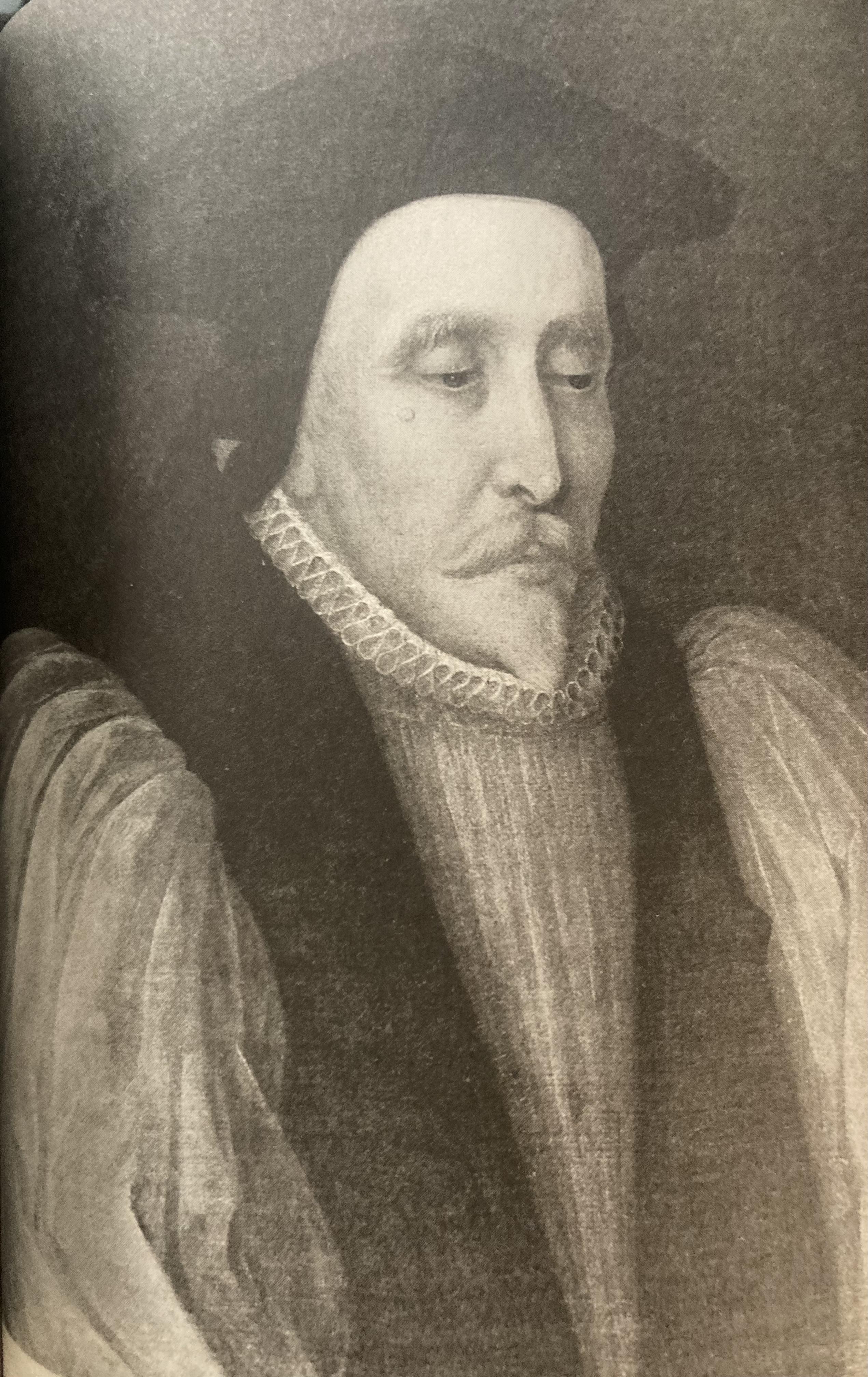
Lancelot Andrewes, chief translator of the King James Bible

Lancelot Andrewes spent five hours every morning in prayer, much of it as he cried copious tears, weeping for the miserableness of his soul.  Maybe he had a guilty conscience. You could say that Andrewes got a helping hand, albeit indirectly, from whores and hookers. Oops, sorry, I mean “sex workers.” How so?

He was also a former Bishop of Winchester. That was one of the most lucrative bishop gigs in the entire Church of England, thanks in large part to the efforts of “Winchester Geese.” Real geese dotted much of the Winchester landscape back in those times, but the area also had a robust and profitable prostitution industry. The busy and popular ladies of the evening were nicknamed after the geese.

The bishop of Winchester had vast land tracts and many properties that housed the dens of iniquity. Much of the bishop’s income came directly from those “Winchester Geese.” Profits from the brothel business also paid for the founding and upkeep of several of Oxford’s most prestigious institutions – New College, Magdalen, and Corpus Christi among them.

You might remember the 1966 pop song “Winchester Cathedral” by the New Vaudeville Band.  If you do, you recall that the singer lamented “Winchester Cathedral, You’re bringing me down. You stood and you watched as my baby left town.”

She probably left town because he didn’t pay his bill.

And now you know the rest of the story – of several stories, actually. I hope I’ve added even a little bit to your worldly wisdom, because

“He that walketh with wise men shall be wise: but a companion of fooles shall be destroyed.”

–Proverbs 13:20

The Day with Two Noons, and How Eastern Standard Time Came to Be

January 11, 2023

Many years ago, I was listening to a late-night radio show. Up came the topic of how the map of the world got divided up neatly into 24 segments, each of which registered the time on its clocks as different by one hour from the times in the adjacent segments.

                The show host – I believe it was Dick Summer of Boston’s WBZ  – noted that the job of laying out the world into those segments had been done by a little-known Russian cartographer by the name of Alex Andersrag.

                After an appropriate pause, he continued, “And that’s where we got the Alex Andersrag Time Band.”

                Boo! Hiss! My kind of groaner…one of the best I’ve ever heard.

                That sick pun came to mind recently when I read the real story of how time zones and standard times in America came to be. It was the work of a man who deserves to be remembered but whose name is virtually lost to history: Charles Ferdinand Dowd.

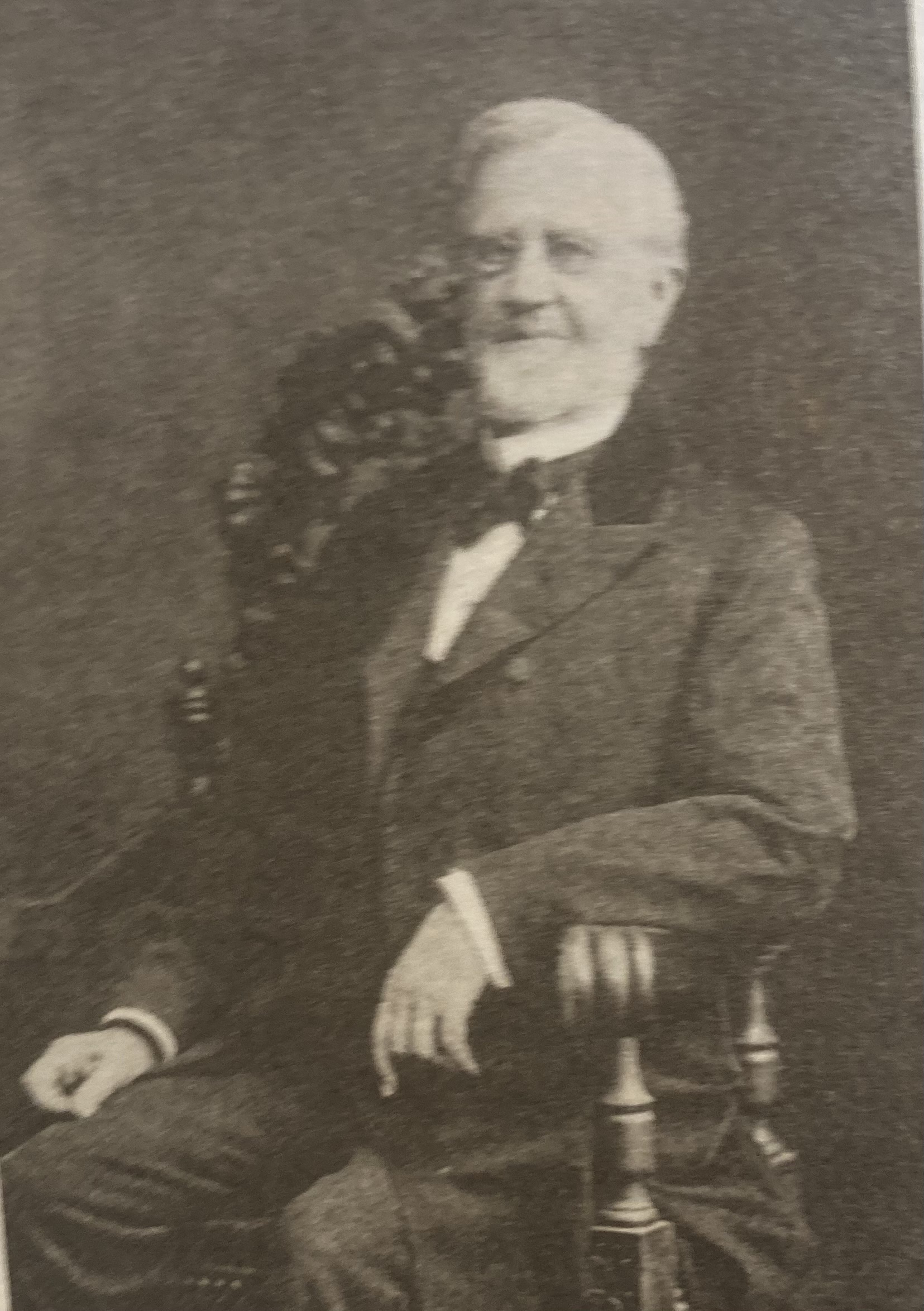
Charles Dowd

                Dowd graduated from Yale in 1853. He got married, moved to upstate New York and eventually settled in Saratoga Springs. He and his wife Miriam, a graduate of Mount Holyoke Seminary, bought the Temple Grove Seminary in Saratoga Springs and taught there for 35 years.

                According to one of his biographers, Dowd “liked order, and he disliked confusion.” He was also a frequent railroad traveler, and he knew that there was little order and much confusion that stemmed from the difference between local times and railroad times. It wasn’t only confusing. It was life-threatening.

                In 1853, the year Dowd graduated from Yale, a story in the New York Times laid out the problem that Dowd would eventually solve. Two express trains, speeding in opposite directions, had collided head-on and killed several passengers.

“Our columns groan again with reports of wholesale slaughter by railroad trains…the variation of a time-piece is assigned as the immediate occasion of the meeting…Has human ingenuity been exhausted, in devising the means – or has the power of Society proved unable to enforce by law such regulations as will prevent these horrible holocausts to the Railway demon?”

                What was the problem? There was no uniform standard of time. In every place in the country, they determined noon of the day astronomically. It was 12 noon when the sun was directly overhead. Just as one example, in Connecticut there was eight minutes’ difference registering on town clocks between the Rhode Island border to the east and the New York border to the west.

Every railroad in the country operated on its own sweet time when constructing its timetables. If there were any differences, transfer-seeking passengers had to figure them out. It was a nuisance, but as the case of the 1853 crash sadly proved, it could often be a fatal nuisance. And especially since the end of the Civil War and the driving of the Golden Spike in 1869, thousands of railroad lines crisscrossed the nation. Timely connections and uniform timetables became an even more critical need.

Charles Dowd, the order-obsessed philosophy professor from Saratoga Springs, set out to do it. He already had some technology-based tools at his disposal. In New York, citizens had been able to do away with reliance on sundials in 1877, thanks to Western Union. At noon every day, a telegraph operator at the Naval Observatory in Washington would tap a key. That signaled an electromagnet in New York, tripping a lever that released a large copper ball atop a pole at the Western Union Telegraph Building in New York. The ball descended, and New Yorkers knew that it was noontime.

That was nice for New York. But what about the rest of the country?

Dowd’s first try at an all-encompassing system failed. He made more than eight thousand calculations along five hundred rail lines, and he came up with a uniform national time. It didn’t work. The four-hour time difference between the coasts was too great. So he went back to work and drew up a set of four time zones, each fifteen degrees of longitude in width.

That was in 1863, when he presented it to his students at the seminary. Six years later, he proposed the system to a group of railway executives in New York City. And for the next fourteen years he lobbied and badgered anyone who would listen – engineers, astronomers, college professors, magazine and newspaper edits.  Dowd wasn’t in it for the money. He just wanted to solve the problem.

Fortunately, he’d found a champion. John Toucey was general manager of the New York Central and Hudson River Railroad. His line’s Grand Central Depot was the nation’s busiest. In 1883, a full 20 years after Dowd had devised the system, Toucey introduced it as a resolution before the General Railway Time Convention. The resolution consolidated the 50 existing time zones into four.

The new system became effective on Sunday, November 18, 1883. It helped that New York mayor Franklin Edson was on board, decreeing that all clocks comply with the new railway time. That day became known as “the day with two noons,” because the ball atop the Western Union Telegraph Building would descend twice. First it would signal 12:00 noon local time; then it would signal 12:00 Eastern Standard Time.

At 9:00 a.m. New York time on that day, the superintendent of Western Union’s Time Telegraph subsidiary stopped the pendulum of his regulator clock. Time stood still for three minutes and 58 seconds, when the pendulum was reactivated. Ten o’clock came and went, and then twelve noon New York time the ball dropped.  Four minutes later the ball dropped again. It was noon, Eastern Standard Time.

The U.S. Attorney General, Benjamin Brewster, tried to get in on the act. He stated that such a revision that affected the entire nation needed congressional approval. But the superintendent of the Naval Observatory ignored him and adopted the railway standard as the nation’s official timekeeper.

The New York Times covered the story of the new standard time on page five, remarking that “All intelligent persons will ask why the change was not made years ago.” And that very day its front page headline blared “TERRIBLE RAILWAY COLLISION IN ILLINOIS.”

Charles Dowd, the man who had made it all possible, was nearly forgotten. That’s because he didn’t write the history. He tried, but the man who told the story and claimed the credit was William Allen, an engineer and editor of the Travelers’ Official Railway Guide for the United States.  

At least Allen pointed out that Dowd’s original proposal in 1870 to his organization was “the first published proposition of which I have any knowledge.”  And somewhere along the way, Dowd received annual passes from all major railways, in recognition of his claim of designing the country’s time zones.

Dowd’s life ended tragically. At age 80, in November 1904, he went to visit a sick friend. As he was walking home, he was killed by a train as he crossed North Broadway in Saratoga Springs.  Delaware and Hudson train number 6, running late and speeding around a corner at 30 miles an hour just two blocks from the station, ran over him.

Saratoga Springs’ city fathers eventually recognized Charles Dowd’s towering achievement some years later when, near the site of the fatal accident, they placed a monument to his name: a sundial.

(Note: My source for this story is The New Yorkers: 31 Remarkable People, 400 Years, and the Untold Biography of the World’s Greatest City, by Sam Roberts.)

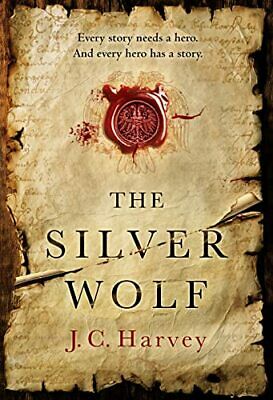
The Silver Wolf, by J.C. Harvey: Review and Reflection

March 4, 2022

William Tecumseh Sherman, the American Civil War general, famously stated to his men, “War is hell.”

J.C. Harvey

He also wrote to John Bell Hood, an opposing general, “You cannot qualify war in harsher terms than I will. War is cruelty, and you cannot refine it; and those who brought war into our country deserve all the curses and maledictions a people can pour out.”

That’s right, as far as it goes. But had General Sherman read J.C. Harvey’s The Silver Wolf, he might have suggested to General Hood that “We’ve had it pretty easy here. I’m just glad this isn’t the Thirty Years War.”

Horror and brutality. That’s what I felt about what life must have been like for people like Jack Fiskardo, the hero of The Silver Wolf.  Jacky Colliss Harvey the historian (Red: A History of the  Redhead and The Animal’s Companion, both previously reviewed here) dons her fiction-writer’s hat to tell his tale. As J.C. Harvey, she immerses us in the fog of the Thirty Years War, which ran from the Defenestration of Prague in 1618 to the Peace of Westphalia in 1648.

The Thirty Years War was one of history’s most devastating, destructive, complicated conflicts, and Harvey doesn’t intend to explain its broad sweep and its historical significance. Though she gives a concise summary in the introductory author’s note, she states that her book’s events

“stand in much the same relation to the events of the Thirty Years War as a tapestry does to its support: in other words, with just enough points of connection, I hope, to bear the weight…I have played fast and loose with documented history, opening real doors onto landscapes and happenings that never existed until I made them up. Then again, all too often, I would hit the horrid truth that no matter what I might create in my imagination, the actual events of the war would be worse: stranger, crazier, even more hideously comic; more incredible, more appalling.”

Fiskardo seems to be part Achilles, part Ulysses, part Frodo, and even part Harry Potter (without the magic tricks.) Harvey models him on the description of one real-life individual, Carlo Fantom, by 17th-Century biographer John Aubrey in his Brief Lives:

“[he] had such skills in the bearing of arms that it was said he had purchased them of the Devil, in especial, that he was a Hard Man, so could not be put down by bullets nor by steel; and that he carried with him always the silver token of  wolf, such as the Hard Men use, so that one may know another…His father was a gentleman-at-arms under King Henry of France and there was much black work, as the soldiers say, in his father’s death, and in his mother’s too.”

This book, subtitled Fiskardo’s War, is the first of a series. Because there are more books to come, I’m not spoiling it for you when I tell you that Jack Fiskardo lives to fight again, and that he has unfinished business to attend to. But many of those whom we meet do not survive, including Fiskardo’s parents. Like the real-life Carlo Fantom, Jack’s father Jean had once been a cavalry captain in the army of King Henry IV of France.

Along the way, we see Jack fighting for his life and barely surviving as a wharf-rat in the merciless port of Amsterdam; learning swordsmanship and horsemanship; dealing with spies and traitors; negotiating his price as he enlists in armies; narrowly escaping death as a town is sacked and burned; and revenge-killing one foe.

Perhaps the author played loose with some of the historical facts and dates, as she stated above, but she lets us know what life must have been like in those times. It’s not just in descriptions of the horrors of combat, and it’s even in the argot-infused soldiers’ conversations.

Consider the motivations of those who took up arms back in those days. They weren’t fighting to save the world for democracy or to rid us of the scourge of slavery. They were in it for the bucks, both their soldier’s pay and whatever they could carry away from villages, cities, and individual homes and farms that ever stood in their path.

The real-life Carlo Fantom fought in the Thirty Years War, then made his way to England to fight in the Civil War.  Here’s Harvey’s description of Fiskardo, showing up as a new recruit in the army of the Empire. Asked what action he’s seen, he replies

“Joined up at Heidelberg in twenty-two. I was a scout.”

“A scout, eh? That’s good enough for me. I pay eight gulden a month—“

“I get fifteen.”

“[The captain] is paid one hundred and fifty gulden a month – as much as any captain in the regiment. But out of that he has to find for his kit, his horses, his four boys, not to mention his pleasures, none of which come cheap…never mind. There’s always some new ruse, to keep his crew’s wages in his hands.  ‘All right, fifteen then, fifteen gulden a month, and you’d better be worth it.’”

I can’t imagine soldiers and officers in a modern army acting this way. But I think that is a good example of one of those real doors that Harvey said she has opened up into landscapes of that hard and brutal world.  We see many more of them.

Here’s a description of a meal at a tavern called The Carpenter’s Hat. “The meal is house-pot, a type of stew – potatoes, onion, shredded cabbage, flakes of fish (today it is salmon, both plentiful and cheap; Zoot runs a thrifty kitchen, as one might expect) – enriched with chicken livers and ground pork sausage, thickened with egg yolks, spiced with mace and sharpened up with vinegar.”

Eww. But I guess a man’s gotta eat. Especially a freebooting soldier of fortune.

How to become a gentleman-at-arms? Harvey covers that too. Jack comes under the tutelage of a Master Nicholas, who “offers tuition in rapier, fauchon, hanger, glaive. The smallest weapon in his armoury, all of which hangs neatly from racks on the classroom walls, is a novelty that fits between the knuckles of the fourth and middle finger; the largest, a Swiss broadsword, has a blade of four feet. Armed with such a weapon, at the height of his stroke a man can attain the velocity of a slash with a throat-cut razor.”

And what about that horror and brutality I mentioned earlier? Just a few examples.

Early in the book, Jack nearly dies at the hands of the gang on the Amsterdam docks. He’s found just in time with “a wound below the arc of his ribs, crusted with pus, like a fissure in a geode.” But he survives.

He also survives a climactic battle when the Swedish army of King Gustavus Adolphus attacks and destroys the town which the Imperial army is occupying.  Harvey’s meticulously researched description of the weaponry is masterful. Her telling of the up-close-and-personal nature of the killing is mesmerizing. Sickening, but mesmerizing.

A colonel Bronheim, already wounded, shouts in despair at his fleeing men. Then,

“At a window fifty feet away, a Swedish musketeer, less hurried than his fellows, takes a paper cartridge from his belt (another innovation, this), opens it with his teeth, tips powder and cartridge straight down the barrel of his musket and thinks, Now then. Let’s see what this can do. There. That fellow, that one bellowing and roaring – how could he miss?

“Kneeling, he balances its barrel on the windowsill. Squeezes the trigger, back, back, ba-a-ack…they’re a novelty, firelock muskets, and none of them quite trusts that the burning fuse, coiled in its iron pincer by the stock, coiled like the smallest, deadliest of snakes, will somehow every time find the touch-hole – and fires. A single shot, a calligraphic flourish of smoke.

“Bronheim, still bellowing, hears the shot that takes him; hears it come in like a hornet for the attack. Feels the course of fire it ploughs through his chest, feels those organs in its path implode.”

I’ll leave it to you to read the book and Harvey’s ever more graphic and gruesome account of Jack dispatching a foe with sword and dagger. But suffice it to say that it might just be enough to turn a guy like General Sherman into a peacenik.

Yes, war is hell. Always was.  

So we know what kind of guy Fiskardo is. He is a Hard Man. He has a silver wolf token.  Whoever it was that killed his mother lost it in the doing of that “black work.” The killer is still at large, and at the end of the book, when Jack is with the Swedish army, he tells his second-in-command as they march into Germany, “He’s there. Trust me. I can feel it in my blood.”

There’s another Fiskardo book coming, and then another. So move over, J.K. Rowling. Here’s J.C. Harvey.

Never Forget

January 27, 2022

Today, January 27, is International Holocaust Remembrance Day. It is the anniversary of the liberation of Auschwitz-Birkenau, the massive murder factory where more than a million Jews were put to death as part of Adolf Hitler’s Final Solution.

We must never forget those innocent victims of the Nazis’ insane crusade. Nor must we forget the five million other Jews and the five or six million other people who were killed by a nation that had gone mad. These numbers are estimates, educated guesses. No one really knows for sure just how many lives were snuffed out, how many life stories will never be told.

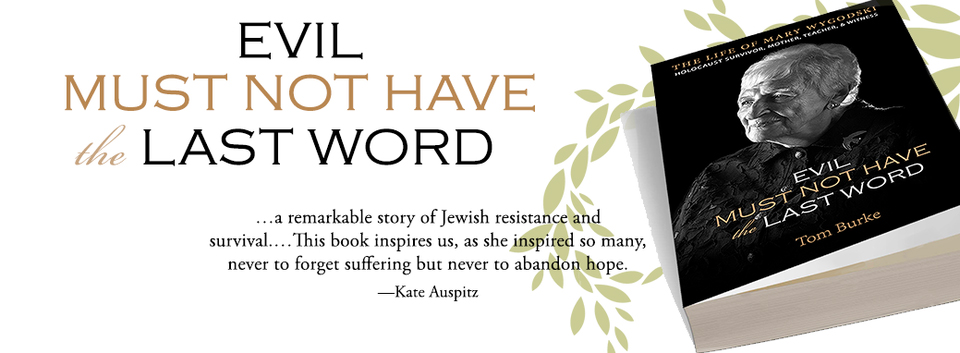
But some people lived to tell about it. I have been most privileged to help one of them, Mary Wygodski, to tell her story in book form. Evil Must Not Have the Last Word is the fruit of almost six years of research. It was released for publication on December 31, 2021.

The book is written in the first person. Mary is the principal narrator, but we hear the voices of several others: her husband Mort; her girlfriends Bella and Edith, who also survived the three concentration camps where Mary was imprisoned; her cousin, Genia Kovner; and her children and grandchildren, son Avi, daughter Charlene, and grandsons Matthew, Jeremy, and Elan.

The book took much longer to write than I had ever imagined. Once I had done several interviews with Mary, I realized that I needed to learn much more about the Holocaust and its aftermath, as least as it had directly affected her, in order to place her story in the proper context and to do it full justice. So I undertook the research that gave me an appreciation of, inter alia: the history and culture of her native city of Vilna, the wonderful “Jerusalem of Europe;” how the Nazis used people of the conquered lands to carry out much of their diabolical work; the particular history of the concentration camps at Kaiserwald, Stutthof, and Magdeburg; the Jews’ difficulties in escaping from post-war Europe to Palestine, America, and other places; and the emergence, through the crucible of war, of the new state of Israel.

So, to mark this Holocaust Remembrance Day, I am pleased to inform you that the book is available on all of the major online sites – Barnes & Noble, Amazon, Goodreads etc. – and that it can be ordered through your local bookstore.

If you wish to contact me directly about the book or would like to purchase a signed copy, please email me at tjburke@veteranscribe.com.

I will close this blog post with the book’s epigraph. It ends another Holocaust memoir, I Was a Boy in Belsen, and it sums up perfectly my own beliefs and feelings.

“Go home from this place and tell your children and your grandchildren that you have looked into the eyes and have shaken hands with people who have survived the greatest cataclysm mankind has unleashed on mankind. Tell them to tell their children and their children’s children, because these people will be mourned and spoken about and wept over for 10,000 years. For if they aren’t, we are all done for.”

— Paddy Fitzgibbon, On the Occasion of the Dedication of Irish Shoah Memorial, Listowel, Ireland, 2010

History I Never Knew: Saint Hildegarde, Sybil of the Rhine

September 22, 2021

Today’s history-I-never-knew blog post is from the annals of religion. Or, maybe it’s from the annals of medicine.  You can decide.

It took almost a thousand years for the Catholic Church to get it right about Saint Hildegarde of Bingen (1098-1179.) She’s known as “The Sybil of the Rhine” for her poetic prophecies. She was already canonized a saint, but it wasn’t until 2012 that Pope Benedict XVI named the learned Hildegarde a Doctor of the Church. She’s only the fourth woman to be so designated.

Hildegarde of Bingen

I’d say she deserves it. When it came to health care matters, she knew what was good for you.

According to “Drinking with the Saints: A Sinner’s Guide to a Holy Happy Hour,” Hildegarde was exceptionally wise, “with a keen insight into moral psychology and an avid interest in many subjects, including medicine. An important example of Hildegarde’s wisdom is her high regard for wine and beer.”

In her treatise “Causes and Cures,” Hildegarde’s prescription for treating a sick person is “Cerevisiam Bibat.”

Translation: “Let him drink beer.”

She explains why: “For beer fattens up man’s flesh and bestows a beautiful color to his face on account of the strength and good vitality of the grain. But water debilitates man and, if he is sick, sometimes produces a bluish discoloration around the lungs. For water is weak and does not have a strong power.”

Brilliant. Why didn’t they think of that before? Holy and wise she was, indeed. But medicine was hardly her only subject. She wrote fifteen books and composed dozens of hymns; she is one of the most renowned composers of sacred monophony, which will be familiar to people of my generation as Gregorian Chant.

Hildegarde founded two abbeys in Germany. They were dissolved in a nineteenth-century wave of secularization, but Benedictine nuns later re-established one as Eibingen Abbey. It is also known as Abtei St. Hildegard, and it is a “Klosterweingut,” a monastic winegrowing estate.  They make their own Riesling wine, which is unfortunately not distributed beyond the borders of Germany.

The wine from that abbey has nothing to do with the Blue Nun brand. You may remember how popular Blue Nun used to be, and the radio ads for it by Stiller and Meara. It was called a “Liebfraumilch,” or “Dear Lady’s Milk,” and the nuns in blue habits that are associated with it were garbed in that color as a display of devotion to the Virgin Mary.

Blue Nun was invented in the 1920s by the H. Sichel Schöne Company. The Blue Nun name and labeling was a branding maneuver to help boost exports. Up until that time, German wine labels were printed in a typeface called Fraktur, which was difficult to read. Blue Nun’s simplified visuals and graphics were a welcome change.  The first nuns depicted on the labels actually wore brown habits, not blue ones. But in the United States, even they couldn’t be shown initially because the Bureau of Alcohol, Tobacco, and Firearms prohibited images of nuns.

There’s a Hildegard wine put out by Au Bon Climat winery of Santa Barbara, California, but it has nothing to do with Hildegarde of Bingen. It’s named for Empress Hildegard, the wife of Charlemagne. She lived a couple of hundred years before our admired friend from Bingen. According to the Au Bon Climat website,

“The name Hildegard is a salute to the history of Burgundy and to her husband the King of the Franks, Charlemagne. During his rule in the early 800s the importance of wine and viticulture exploded. The Catholic Church and Charlemagne ruled most of Europe and both were interested in wine and viticulture.  The Church needed wine for the Eucharist and under Charlemagne more and more vineyards were planted in Burgundy. Charlemagne brought civilization and order back after the dark ages. Part of this rebirth was wine production.”

You might have a little more luck obtaining one of two Réserve Hildegarde beers, a blonde and an ambree, from the Brewery St. Germain in Aix-Noulette, France. They make the beers as “a special tribute to Hildegarde of Bingen, who lived and loved hops more than 800 years ago.”

So that’s my story of Hildegarde of Bingen. Kudos to Pope Benedict for his better-late-than-never accolade to her.

And let’s heed her excellent recommendation and raise a stein in her honor: “Cerevisiam Bibamus!”