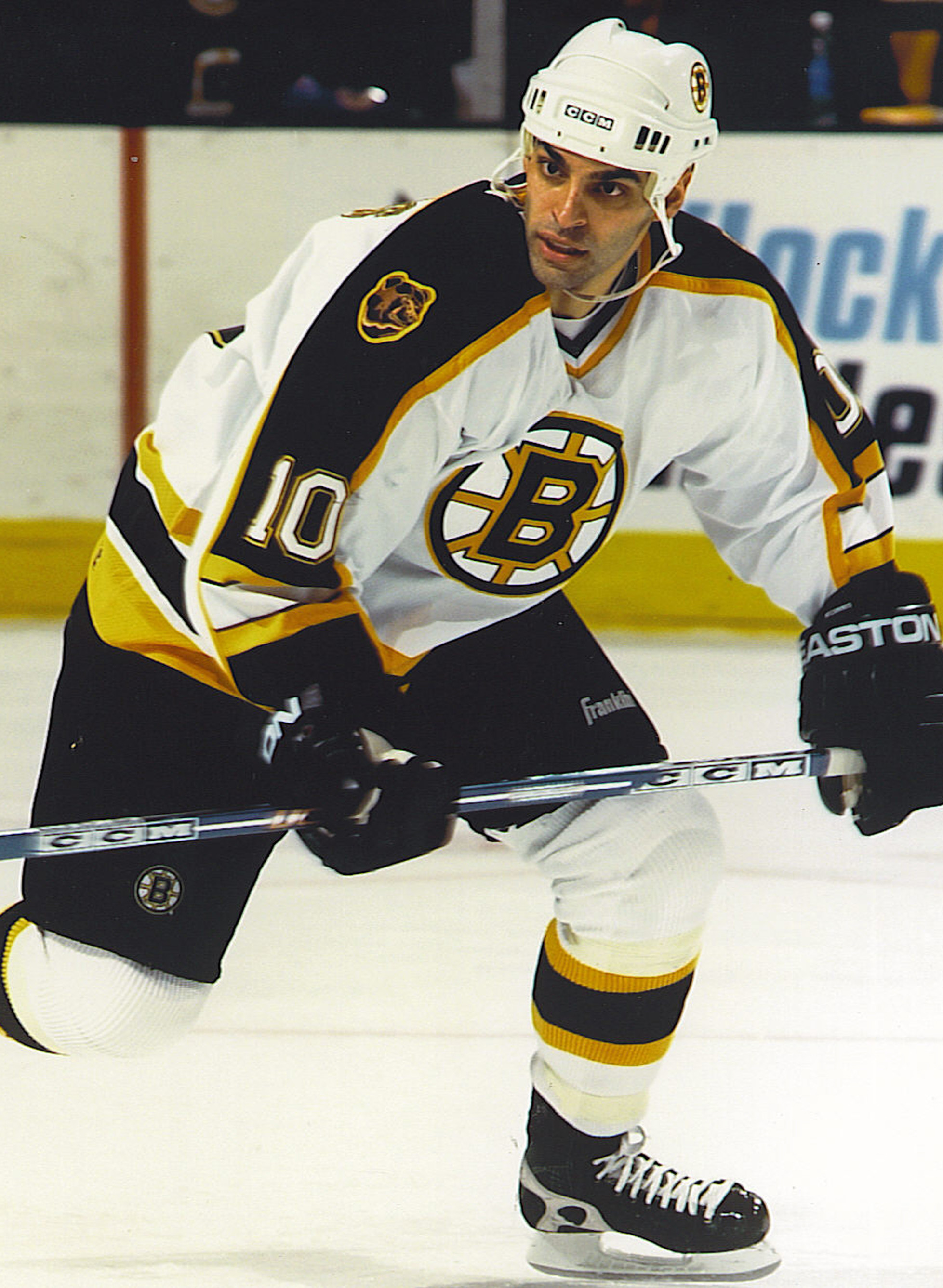
 Marty McInnis played three years of hockey at Boston College, represented his country at the Olympics in 1992, and enjoyed a ten-year career in the National Hockey League. Here is my profile of him from the Hingham, Massachusetts, Journal: http://tinyurl.com/8et56k7
Archive for the ‘People’ Category
Marty McInnis – You Couldn’t Get That Puck Away from Him!
September 13, 2012Lucien Tessier: Every Inch a Hero
September 9, 2012
Track captain and sprinter Lucien Tessier on the lawn at Boston College.
From time to time I post articles that I’ve done for other publications. Here’s my profile of Captain Lucien Tessier, USMC and Boston College track captain in 1965. His story is a sad one, of

Captain Lucien Tessier, USMC
a good man’s life that ended far too soon. It is a story that needs to be told, however, and I feel privileged to be the one who has done so. Boston College inducted him into its athletic Hall of Fame on September 7. A well deserved, and much overdue recognition of a wonderful young man.
This link is to the story that appeared in the Union Leader in Lucien Tessier’s home town of Manchester, New Hampshire: http://tinyurl.com/9umvk9x
A Remarkable Life: Vidal Sassoon
May 10, 2012What man wouldn’t want Vidal Sassoon’s job? Making beautiful women even more beautiful? Could it get any better than that? “If you don’t look good, we don’t look good.” Yes indeed!
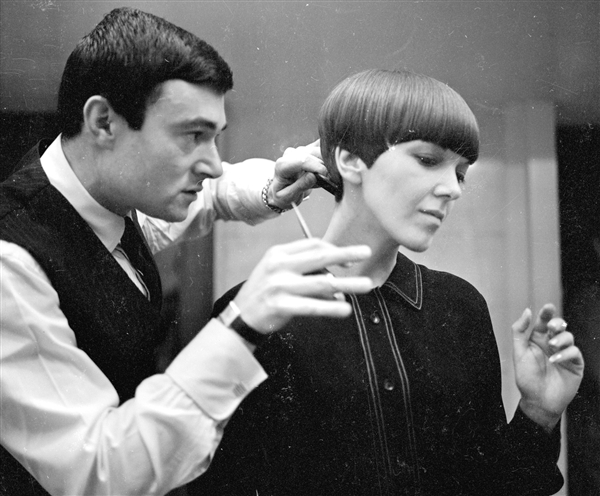
Vidal Sassoon cuts model Mary Quant’s hair, 1964.
It took Sassoon nine years to perfect his hairstyling technique. His secret? “The ability to look at somebody’s face and body structure. It’s like sculpture. You eliminate the superfluous. I dreamt of hair as an art form, giving the lead to other art forms.”
Well put, Vidal. We sensitive men always eliminate the superfluous in our dealings with lady friends, but that’s as far as we can go. Not many of us could ever hope to match your artistry. You made them feel as gorgeous as we knew they were. You did it for them. We reaped the benefits.
Vidal Sassoon, dead at 84, did it the hard way. He was born in London, into a poor family of Sephardic Jewish immigrants. Part of his youth was spent in an orphanage after his father abandoned the family. His mother remarried and reclaimed Vidal when he was 12. Like many boys, he wanted to be a star athlete. But his mother insisted he apprentice to a hairdresser and become a “shampoo boy” at age 14.
That was during World War II. A sign in the shop where he worked read “Madam, during an air raid, you are permed at your own risk.”
Sassoon also studied hard to get rid of his cockney accent, thereby to attract more upscale clients. When he wasn’t working on the ladies, he was a member of a Jewish patrol that battled homegrown British fascists in the streets of London. He also went to Israel to fight in the 1948 War of Independence, and after making his fortune he endowed the Vidal Sassoon International Center for the Study of Anti-Semitism.
It was in the 1960s that his modern style bobs rocketed him to fame, with clients such as Carol Channing, Jill St. John, and the British mini-skirt model Mary Quant. Guys like Michael Caine and Peter O’Toole also liked the look he gave them. Sassoon created an international sensation in 1967 when Roman Polanski flew him to L.A. to cut Mia Farrow’s hair. Price: $5,000. Farrow wore the ‘do in Rosemary’s Baby.
A chain of salons, along with sales of his haircare products, made Sassoon a very rich man. He sold his company in 1983 but stayed on for Procter & Gamble as the pitch man. He was married four times, and didn’t do much haircutting during his last few decades, except for a few select friends and clients.
These included his beloved dogs, “The only Shih Tzus around with geometric haircuts,” as he put it.
Lucky dogs.
Rest in peace, Vidal. You’ve earned it.
Anthony Manning: A Profile in Courage
March 2, 2012…And his parents are heroes too.
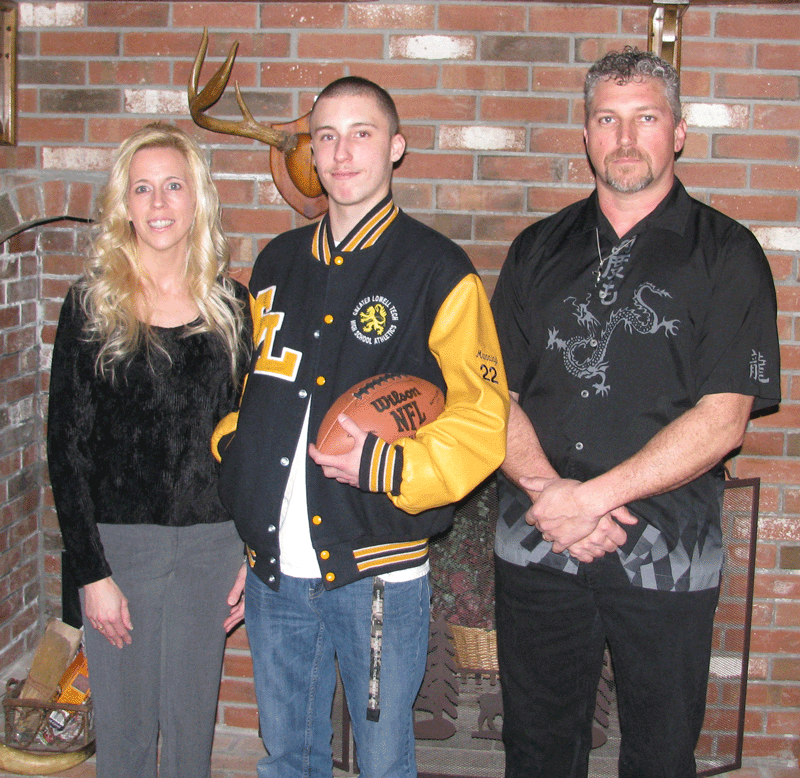
Anthony Manning III with his parents, Debbie and Anthony Manning Jr.
Anthony Manning III’s restrictive cardiomyopathy caused his heart to fail when he was eight years old. He was placed on life support at Children’ s Hospital in Boston and fortunately, a donor’s heart was found within a day. After transplant surgery he had a lengthy recovery and, by the time he got to high school, was fit enough to try playing for the football team.
Anthony was the first transplant patient from Children’s who was allowed to play the game. He was on the squad at Greater Lowell Vocational Tech High School for four years. The Gridiron Club of Greater Boston gave Anthony its Henry Smith Courage Award for the 2011 season.
Here is a link to the story I wrote about him and his remarkable parents for the Boston Globe North edition of March 1, 2012:tinyurl.com.6u8h2dm
Hey, Facebook Friends. I Don’t Care What They Say. I “Like” You.
February 2, 2012
Facebook Might Not Be Forever, But These Are!
The financial world is all agog over Facebook’s impending IPO, which will set the market value of the company at something like $100 Billion, of which Mark Zuckerberg will own around 30%. Nice going, kid.
I’ve enjoyed what Facebook offers, particularly the ability to make new friends and to reconnect with old friends and family around the world. This is what I “Like” most about it. I suspect that most of my FB friends feel likewise – ooh, lousy unintended pun.
But Facebook is a business. Business doesn’t succeed unless it delivers something of value. To understand what’s been going on with Facebook, and why it’s been so successful to date, be sure to read Andy Kessler’s Wall Street Journal column of Groundhog Day, 2012,
“The Button That Made Facebook Billions: The power of ‘Like’ as an emotional sensor is driving the company’s exorbitant valuation.”
Rather than attempting to condense and paraphrase Andy, I’ll quote him and another WSJ piece. They tell the story better than I can. Andy points out,
“As bizarre as this sounds, one of the most valuable innovations in technology over the last several decades is Facebook’s “Like” button. That’s what has propelled the company to a galaxy-orbit valuation for its forthcoming initial public offering, filed Wednesday.
“This is not only because the word “like” is, like, the identifying word of an entire generation. It’s because computing has evolved beyond just taking directions from humans—and instead is cozying up to us and sniffing out our emotions and intent.
“[…] running ads next to pictures of your buddy Johnny funneling beers at a lacrosse game is not exactly what [advertisers] had in mind. Then, in mid-2010, Facebook rolled out its Like button, which transformed the company from a somewhat interesting social network into a major media player. The power of Like as an emotional sensor is what’s driving Facebook’s exorbitant valuation.
“Google, worth $190 billion with $38 billion in annual sales, is the closest real competitor to Facebook. Google lures you to its site via its search engine and sells ads against results, paid per click…basically it runs an ad platform. It’s a great business with operating profits of 35%, similar to Facebook’s.
“Facebook doesn’t sell phones or tablets, or ship physical products or even do searches. Instead, it has a vibrant, pulsating community of 845 million people willing to share their personal lives with others. Facebook is a giant emotional locker.
“The adage about advertising is that only half of ads are effective, but no one knows which half. With the ‘Like’ button, Facebook is like Bob Eubanks on “The Newlywed Game,” who promised contestants “a prize chosen especially for you.” Advertising’s nirvana is an ad chosen especially for you. Of all the players, Facebook is the closest to delivering.”
The Journal article says that Facebook too is profitable, although development and employee costs are growing faster than its revenue, and
“Facebook’s revenue is still driven by online ads. The number of ads delivered on the site grew 42% and the average price per ad grew 18% over 2011 from 2010…”
So can they keep it up? How long will it last? Who knows – success in business breeds imitation and competition. There surely is a “Next Big Thing” out there somewhere. Only diamonds are forever.
In the meantime, let’s understand what’s going on here while we enjoy the ride and our online friendships.
With Facebook, What You ‘Like’ is What You See – in advertising pitches. Remember that you’re in control here!
Remember too – if you’re reading this, originally posted on Facebook, that means you’re my Facebook Friend. And, doggone it,
I “Like” You.
Why I Love Writing
August 4, 2011There are times when we of a certain age might feel pessimistic about “young people nowadays” and the future of our society under their direction. Then we meet someone like the young woman profiled in this article. This is why I love writing. It allows me to tell the stories of those like her.
 Veteranscribe's Blog