Archive for the ‘The World of Sport’ Category

Boston, City of Champions: The Full Story

November 5, 2013

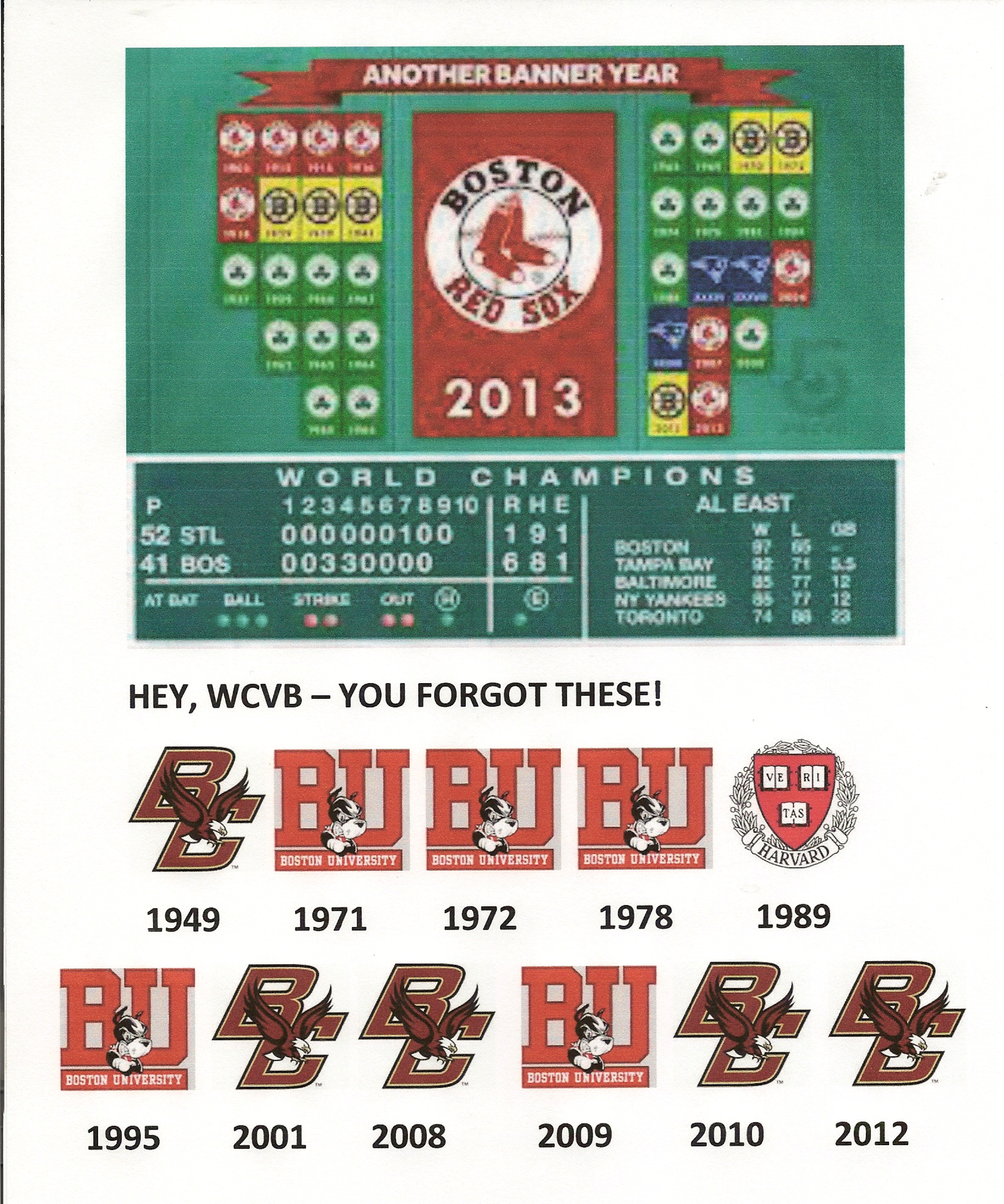
WCVB-TV, Channel 5 in Boston, has updated its “Banner Years” sign. And it’s impressive. Since 1903, Boston’s professional sports teams have racked up 34 championships:
17 NBA titles
8 World Series Crowns
6 Stanley Cups
3 Super Bowls
Eight of these titles have come since 2001.

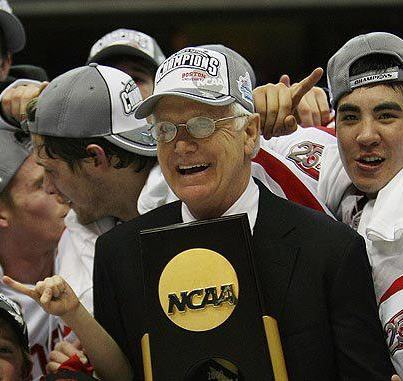
But that’s not all. With thanks and due respect, Channel 5, you left out the 11 NCAA Hockey Titles won by Boston teams since 1949:
5 for Boston College
5 for Boston University
1 for Harvard
Five of these 11 National Collegiate Hockey Championships have come since 2001.

The WCVB Banner with needed additions.

The WCVB Banner with needed additions.

A Look Back: Dick MacPherson, Gridiron Club’s Man of the Year for 2003

October 17, 2013

Coach Mac

Coach Mac

Ten years ago, in my term as president of the Gridiron Club of Greater Boston, we honored Dick MacPherson as our Man of the Year.

We had a great turnout, with speakers from Dick’s native Old Town, Maine, and from many of the places where he’d played and coached. These included Springfield College,. Maine Maritime Academy, UMass, Syracuse, and the New England Patriots. We also raised $10,000 for Dick’s designated charities, the Joslin Diabetes Centers in Boston and Syracuse.

Click on the link for the evening’s souvenir program book: DMacPhersonManofYear It has Coach Mac’s biography and full coaching record.

America’s Second “Ace of the Aces” – Greatest Generation Member Joe Foss (1915-2003)

October 13, 2013

Joe Foss on the cover of Life Magazine

Joe Foss on the cover of Life Magazine

Sports fans of a certain age, especially those of us who grew up with the New York Giants of the National Football League, remember fondly the arrival in 1960 of the American Football League, the Boston Patriots, Dallas Texans, Los Angeles Chargers, New York Titans and others. The man whom the upstart AFL owners picked as their commissioner, to lead them in their challenge to the NFL and its commissioner Pete “Pope Alvin” Rozelle, was the governor of South Dakota, Joseph Jacob “Joe” Foss. And what a choice it was.

Joe Foss grew up in a South Dakota farmhouse that had no electricity. At age 12, he visited a local airfield to see Charles Lindbergh on tour with his plane, the Spirit of St. Louis. At 16, he and his father paid $1.50 apiece to take their first aircraft ride, in a Ford Trimotor.

In 1933, while coming back from the fields during a storm, his father died when he drove over a downed electrical cable and was electrocuted as he stepped out of his automobile. Joe dropped out of school at 17 to run family farm. But after watching a Marine Corps aerial team perform aerobatics in open-cockpit biplanes, he was determined to become a Marine aviator. Joe worked at a service station to pay for books and college tuition and began to take flight lessons. His younger brother took over the farm, and Joe attended Sioux Falls College and then the University of South Dakota.

Joe paid his way through university by “bussing” tables and took part in football, track, and boxing. In 1940, he hitchhiked to Minneapolis to enlist in the Marine Corps Reserves.

World War II, the Second “Ace of Aces”

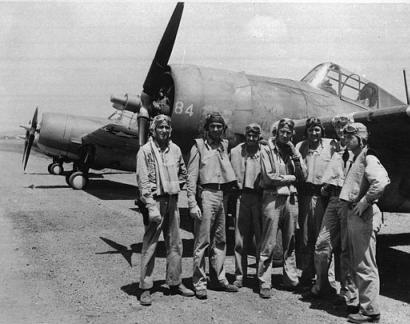
Men of the Cactus Air Force on Guadalcanal

Men of the Cactus Air Force on Guadalcanal

Foss became a Naval Aviator and was commissioned a second lieutenant. At age 26, he was considered too old to be a fighter pilot and was initially assigned to flying reconnaissance. He kept requesting combat, however, and eventually the Marines let him transfer to a fighting squadron. He became the squadron’s executive officer and was shipped with his mates to the Pacific island of Guadalcanal in 1942.

Foss and his group were catapult-launched off an escort carrier and flew 350 miles to reach the island, code-named “Cactus.” It was the brutal first extended encounter in the island-hopping campaign for the Marines. The air group became known as the Cactus Air Force. They were pivotal in the battle and in bringing ultimate victory.

Japan’s fighter plane, the Mitsubuishi “Zero”, was the best combat flying machine in the war’s early years. Foss shot down a Zero on his first mission. He barely escaped in his own shot-up Grumman Wildcat, but he landed it safely at full speed with three more Zeroes on his tail.

In three months of the battle for Guadalcanal, he and his boys of the Cactus Air Force shot down 72 Japanese Zeroes. Foss downed 26 of them. That matched the record held by America’s top World War I “Ace of Aces” Eddie Rickenbacker. America eventually surpassed Japan in aerial warfare capabilities and resources, and by 1945 the Japanese had no planes or pilots remaining to fight the air war.

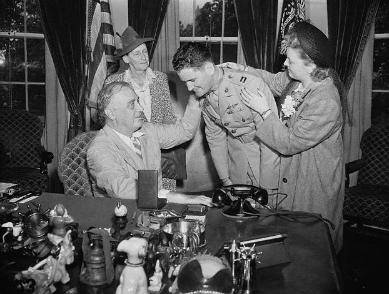
Receiving the Medal of Honor from FDR

Receiving the Medal of Honor from FDR

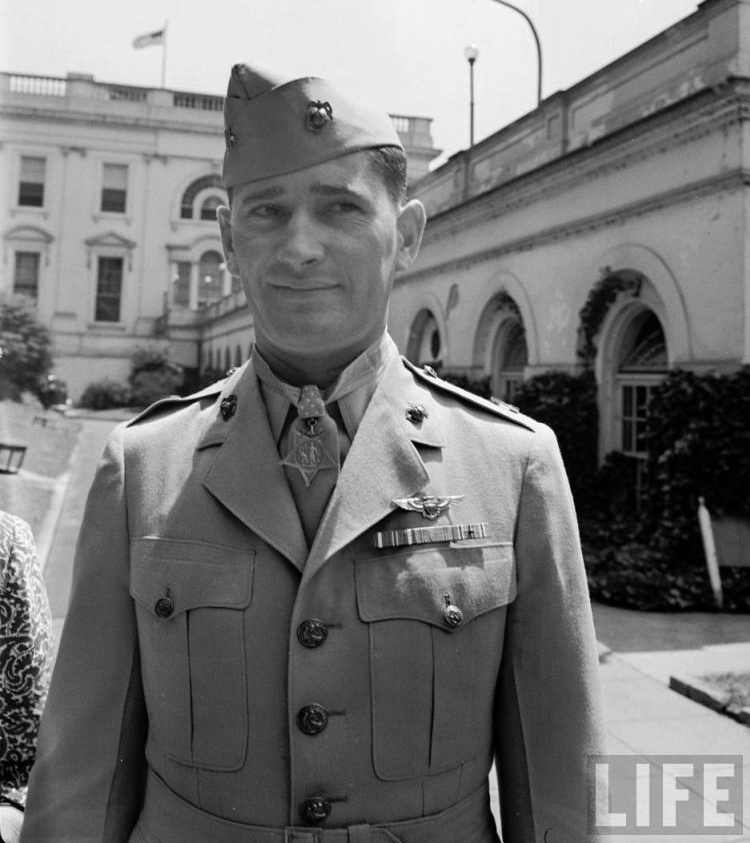
Foss returned to the United States and received the Medal of Honor from President Franklin Delano Roosevelt. The White House ceremony was featured in Life magazine, which portrayed the reluctant Captain Foss on the cover.

Foss returned to the Pacific in 1944 but did not register any more kills. He left active duty in 1945, but was recalled for the Korean War, was Director of Operations and Training for the Central Air Defense Command, and rose to the rank of Brigadier General.

Politics, Business, and Charitable Endeavors in Civilian Life

Foss served two terms in as Republican state legislator before becoming South Dakota’s youngest governor ever, at age 39. In 1958, he tried for the U.S. House of Representatives and lost to George McGovern, another World War II flyer.

Joe accepted the offer to become the first Commissioner of the newly created American Football League in 1959. He served there for seven years. In 1960, secured the league’s continued existence with a five-year, $10.6 million contract with ABC to broadcast AFL games. That deal arguably secured the future of ABC Sports as well. Joe stepped aside as league commissioner in 1966, two months before the historic merger of AFL and NFL and the creation of the Super Bowl.

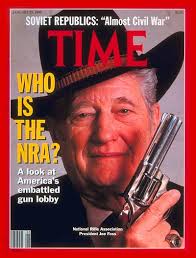
Joe Foss as NRA spokesman

Joe Foss as NRA spokesman

Joe hosted ABC ‘s The American Sportsman from 1964 to 1967, and he hosted and produced his own syndicated outdoors TV series, The Outdoorsman: Joe Foss, from 1967 to 1974. He spent six years as Director of Public Affairs for KLM Royal Dutch Airlines and two years as president of the National Rifle Association. He continued to speak out for Second Amendment rights and other conservative causes, once appearing on the cover of Time magazine wearing his trademark Stetson hat and holding a revolver.

Foss had a daughter with cerebral palsy, which undoubtedly played a part in his tenure as president of the National Society of Crippled Children and Adults. He also worked for Easter Seals, Campus Crusade for Christ, and an Arizona program for disadvantaged youths.

In 2001, he and his wife founded The Joe Foss Institute, a 501(c)(3) nonprofit organization that is still active today in promoting patriotism, public service, integrity and an appreciation for America’s freedoms. The Institute recruits military veterans to go into classrooms across the country to interact with students.

Handling Indignities with Dignity

In January 2002, the 86-year-old Foss was in the news when he was detained by security at the Phoenix Sky Harbor International Airport. He was scheduled to deliver an address at the NRA and speak to a class at the United States Military Academy. Because he had a pacemaker, he could not go through the metal detector. He was searched by the airport security people, who discovered his star-shaped Medal of Honor, a clearly marked dummy-bullet keychain, a second replica bullet, and a small nail file with Medal of Honor insignia. The airport functionaries did not recognize the Medal of Honor, demanded that it and the memorabilia be confiscated and destroyed, and required him to remove his boots, hat and belt.

Despite this ignorant and insulting treatment, Foss didn’t stoop to anything resembling “Do you know who I am?”

He said later, “I wasn’t upset for me. I was upset for the Medal of Honor, that they just didn’t know what it even was. It represents all of the guys who lost their lives – the guys who never came back. Everyone who put their lives on the line for their country. You’re supposed to know what the Medal of Honor is.”

Yes indeed. This was not a case of “Those who do not learn the lessons of history are doomed to repeat them.” Rather, it was a pathetic example of what can happen when people don’t bother to learn history or to respect those who made that history.

A Final Personal Comment

Joe Foss suffered a stroke in late 2002 and died on New Year’s Day 2003. He was buried in Arlington National Cemetery. I would like to thank him for many things. The first, of course, is for his military service. Boomers like me should never stop thanking our elders of the Greatest Generation for the hardships they endured and for the prosperous country they bequeathed to us.

Thanks also, Joe, for being the American Football League’s Number One Man. Those Boston Patriots’ games, especially at BC and Harvard, were unforgettable. It took a man of your stature to give the league the credibility it sorely needed. Later on, in your charitable endeavors, you were “a man for others” in the fashion that my own Jesuit educators preach to their students.

Finally, thank you for demonstrating such dignity and class after that unfortunate airport incident. You showed that you’d been living and fighting for a higher cause than yourself. It was never about you.

Yet, even as I acknowledge and recount all that Joe Foss did for his country, I can’t help but think that it would have been better if he’d taken a different path in 1960 and not run the American Football League. Like George McGovern, the man who kept him out of Washington DC – Joe Foss would have made a superb president of the United States.

Tim Tebow and the Patriots: Nice Move, Coach Bill

June 12, 2013

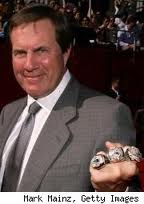
Bill Belichick and his coaching credentials

Bill Belichick and his coaching credentials

I’m amazed by how many people are driven batty by Tim Tebow and his ways of giving thanks to the Almighty. Legitimate evaluations of his football ability almost always get smothered by ad hominem blather.

Please correct me if I’m wrong, but I believe that Tim “Tebows” in gratitude after accomplishing something. It’s not as if he asks God to help him and his team win. I don’t remember that he ever compared his God to an inferior one worshiped by the teams he’s defeated. And there haven’t been too many of those lately anyway.

Let’s chill, see how he does, and save our opprobrium for the real religious hypocrites of the world. There are enough of them to go around. Thus far Tebow hasn’t murdered anyone who disagrees with him.

As for the football possibilities, I’m reminded of the old priest-and-rabbi joke where the two of them go to a boxing match. Just before the bell one of the boxers makes the sign of the cross. The rabbi turns to the priest in puzzlement. “What does that mean? What is it going to do for him?” The priest answers, “Not a damn thing if the kid can’t fight.”

And so it will be with the New England Patriots. Tebow’s feats in long-ago college and his pious, clean-living ways will not matter a whit to Bill Belichick. If Tim can’t contribute, he’ll be on the first train to Clarksville.

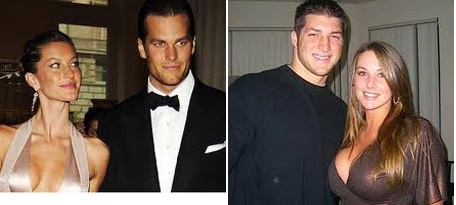
Tom Brady and Gisele Bundchen - Tim Tebow and Lucy Pinder

Tom Brady and Gisele Bundchen – Tim Tebow and Lucy Pinder

Boss Bill was certainly being himself at the press conference, wasn’t he? “He’s talented. He’s smart. He works hard. Let’s see how it goes.”

Tebow can’t be expected to direct the team the way Tom Brady does. But really, now – can anybody? Tim’s quite competitive with Tom in other areas of life, as one of the accompanying photos shows. But on the field, he needs to do different things. Belichick and his guys might just fashion a complementary role that will finally allow Tebow’s strengths to emerge while masking his shortcomings.

Chuck Fairbanks

Chuck Fairbanks

Think of Andy Johnson, one of New England’s most talented and underrated players ever. He played halfback for Chuck Fairbanks beginning in 1974, and lasted with the Pats until 1982. He could run, catch the ball out of the backfield, and throw the option pass – four TD passes in 1981.

Fairbanks spoke at a Gridiron Club dinner a few years ago. After the dinner we had a drink in the bar – he favored Pinot Noir – and I told him that I’d always liked Andy Johnson. He smiled and said, “Let me tell you about Andy Johnson.”

Before coming to the Patriots, Fairbanks had built a number of unstoppable wishbone-option teams at Oklahoma. One day he got a call from his buddy Vince Dooley, the coach at Georgia. Dooley told him that he had recruited this tremendously talented quarterback, and that he needed to build an offense around him. Problem was, he and his coaches didn’t know a thing about options or wishbones.

Fairbanks dispatched a few of his assistants to Georgia that summer to teach Dooley’s coaches all about the option. That season, sophomore quarterback Andy Johnson led the Dawgs to a record of 11-1. He ran for 870 yards and passed for 341. During his three-season college career he rushed 431 times for 1799 yards. At Florida, Tebow played four years and rushed 692 times for 2947 yards.

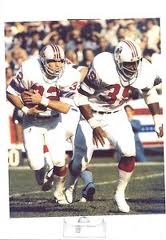
Sam Cunningham leads the way for Andy Johnson

Sam Cunningham leads the way for Andy Johnson

Fairbanks, like Belichick, knew all about selecting and managing football talent. He drafted Johnson in the fifth round and made him a running back. Johnson was in the backfield with Sam Cunningham and Steve Grogan – and I remain convinced that the 1976 Patriots, 11-3 and robbed by referee Ben Dreith in the playoff at Oakland, was the Patriots’ best team ever.

Is something similar going to happen with Tim Tebow? It can’t happen only if they don’t try. As Bill said, “Let’s see how it goes.”

Yes, let’s. Praise the Lord and pass the prolate spheroid. Nice move, Bill.

NCAA Hockey – Thoughts on this Year’s Playoffs and Championship Final

April 12, 2013

As far as I’m concerned, the NCAA Division One hockey championship game will be one of those clichéd contests where it’s too bad that one of the teams has to come out as the loser. There’s ample reason to cheer for Quinnipiac or Yale. And whichever one wins, we can feel good that two teams from the ECAC are going at it for the national title. This hasn’t happened since BU 5, BC 3 in back in 1978 when there was just one major college hockey conference in the East.

Why Yale

YaleI’d like to see Yale prevail to show that student-athletes can win a national championship in college hockey. One of the TV commentators said that Yale has never won a national title in anything. Perhaps the Elis were the best college football team in the land in the days of Walter Camp and Pudge Heffelfinger. But they didn’t have NCAA championships back in those days.

Yale – like all of its fellow Ivy League institutions – would never stand a chance of going all the way in football or basketball, so it would be good to see them make it happen in hockey. They’ve not had a great deal of success in hockey over the years, and only once before, in 1952, did they even make it to the NCAA’s semifinal round. Coach Keith Allain has done a great job in New Haven.

Why Quinnipiac

quinnipiacI’d like to see Quinnipiac prevail for two reasons. First, this is a school that has come out of nowhere to national prominence in hockey. They’ve invested in the program and supported Rand Pecknold and his coaching staff all through the team’s rise. Not all colleges will make that kind of commitment.

Hockey is expensive, and it will never bring in the television-related revenues of basketball and football. You must choose to make hockey an important part of your school’s culture, and you must be prepared to reap comparatively modest financial returns. Bravo to the schools that do so, and to Quinnipiac for being the latest. They can thank athletic director Jack McDonald for making it happen.

The second reason is personal. I’ve known Jack for many years. He is BC ’73, a Hall of Fame track man, and a superb human being. He worked in the athletic department at BC and had a successful tenure as A.D. at Denver before coming to Quinnipiac. It’s wonderful to see his vision and determination pay off.

Why the ECAC

ecaCTwenty-nine years ago, ECAC Division One was the only hockey conference that mattered in the East. There were 17 teams and three divisions – East, West, and Ivy. The scheduling was uniform, at long last, and the politics of playoff qualification were finally a thing of the past. “The ECACs” were the best hockey weekend of the year, period.

Then the Ivy league schools decided that they did not want to subject themselves to games with every one of those teams from the Great Unwashed. I was covering the sport for the Hockey News at the time, and I could never get anyone from the schismatic six to return a phone call or give an adequate explanation. It appeared that Princeton was the prime mover, and they were conveniently removed from the Boston media and could easily fend off inquiring reporters.

Fortunately for the Ivies, they were able to persuade Clarkson, Saint Lawrence, and RPI to stick with them instead of going over to the league that eventually became Hockey East. I heard it took a special appeal from Ivy presidents to their counterparts. Had it gone the other way, Ivy League hockey might have atrophied into a Division Two backwater. But the ECAC remained viable even though Hockey East has been vastly more successful on the national level in the almost three decades since then.

I’m still angry at those people, but they’re long gone. So bravo to the coaches and players of the current ECAC generation, and to the league’s classy commissioner Steve Hagwell. They are doing Eastern hockey proud.

What About the Future?

hockey eastI maintain to this day that the ECAC-Hockey East split was unnecessary and driven largely by Ivy snobbery. Some fabulous rivalries of bygone days have died off. I can only speak as a BC fan here, but I say that it’s terrible that my team rarely if ever plays Cornell, Brown, St. Lawrence, or Clarkson. There is absolutely no reason that ancient rivals BC and Harvard not have a game every year, but they don’t. Ditto for Eagles’ games with Yale and Dartmouth.

I like the intensity and the quality of Hockey East competition, but three regular-season games with each league rival are too many. With Notre Dame joining Hockey East next season, they’ll have to cut back to two Hockey East league games apiece. This should open up more available dates for the continuation or resumption of some the fine, old rivalries. We’ll probably see Penn State’s new team playing a few games in this area too, and more as time goes on.

Will there ever be a formal merger, a recombining, of ECAC and Hockey East? Doubtful, but not needed, especially if we see a few more interleague games along the way. In a way, there’s already one big national conference anyway. The pairwise rankings and power ratings pit your team against those of all conferences. The tougher your schedule, the better. Non-league games count as much as league matchups in figuring eligibility for the 16-team national tournament. Everyone knows what it takes to make it into that dance. All good stuff.

Final Thoughts
UMLI can’t end without a tip of the fedora to UMass Lowell. They were almost left for dead five or six years ago but have come all the way back and then some. It started at the top when Marty Meehan took over the reins at the school. It took more than a little lobbying with the Trustees by Marty and a number of others to keep UML in the big time. Hiring Norm Bazin to coach was a stroke of genius, or luck, or both.

The River Hawks were a jewel of consistency ever since January and all through the playoffs. They laid an egg against Yale, but they’ll be back. Like Quinnipiac, they’ve made the institutional commitment to the sport of hockey, and we’re better off for it.

And lastly, I want the Frozen Four to be a regular event at the TD Garden in Boston. It belongs back here, perhaps one year out of every four or five. Play the game of hockey in hockey cities, guys.

Jack Parker

March 14, 2013

I started covering college hockey in 1969, the same year that Jack Parker began his coaching career at Boston University. Jack is retiring after 40 seasons as head coach of the Terriers. Here’s a look back, and a few thoughts I’d like to share, on Jack and his life’s work.

Parker meets the media with Mike Lynch, left, and Robert Brown, right.

Parker meets the media with Mike Lynch, left, and Robert Brown, right.

Perhaps the only guy who knows how Jack Parker feels right now is Joseph Ratzinger, the former Pope Benedict XVI.

Both men departed voluntarily from “destination” jobs in their professions. Both devoted their entire working lives to their institutions. When there was some burning question or issue affecting their respective spheres of influence, the faithful immediately wanted to know what they thought about it.

It was more than a family gathering over at Boston University the other day when Parker made it official. This season, his 40th as Boston University hockey coach, will be his last. Many former players and devotees of BU hockey were on hand, of course, along with a crush of media people and dozens more like me who just had to be there. Though we hear it often, and it can sound trite, this was a time to summon all the families: Boston University’s, college hockey’s, and the sports fans of our fair city.

Yes, It’s Time

This was more than the announcing of a coaching change. A brick in the wall – no, make that a large, weight-bearing stone in the foundation – of Boston, City of Sports Champions, must be replaced.
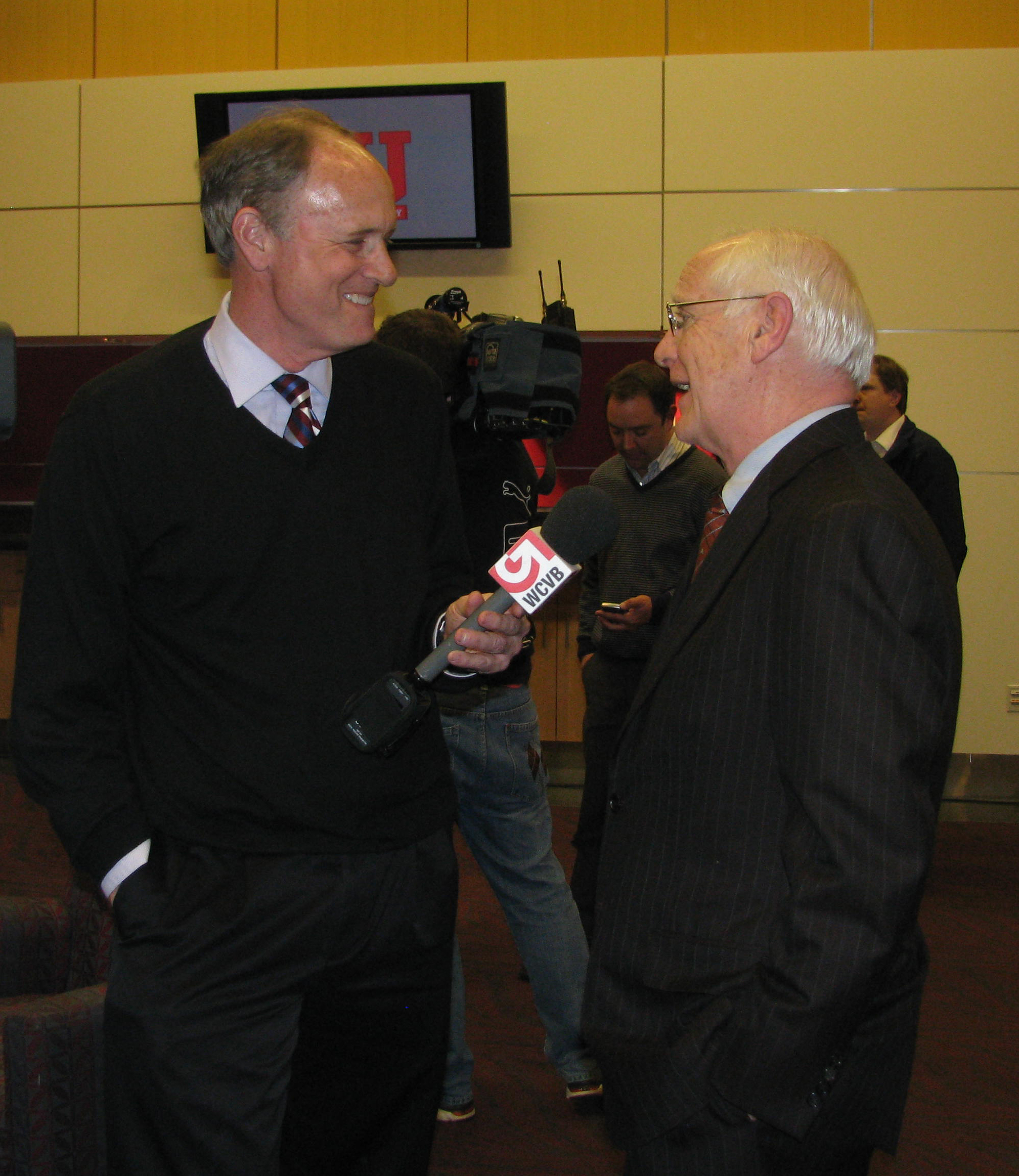
Parker with sportscaster Mike Dowling in one of many TV interviews

Parker with sportscaster Mike Dowling in one of many TV interviews

If there’s been one constant in Boston sports over the past half-century, it has been high-quality hockey at Boston University. Parker pointed out that he’s been reporting for duty at BU hockey for 48 of the last 49 years. That’s counts his time as a player and assistant coach. It is hard to imagine BU hockey without Jack Parker, but yes, it is time, as he said himself.

Athletic director Mike Lynch and President Robert Brown shared the podium with Parker. Supporting cast for him this day, they said all the right things and were appropriately noncommittal about the Who and the When of his successor.

We don’t need to recite chapter and verse of Jack Parker’s accomplishments. But his 21 Beanpot titles will stand for all time, and quite probably his total wins at one school – 894 and counting. His three NCAA championships in three separate decades – the first in 1978, the last in 2009 – show that the game never passed him by and that he could change with the times.

What It Takes, What It Brings

College hockey is a special sport. It’s genuinely big-time, in that many of its players go on to long and satisfying professional careers. But there’s not the money to be made in hockey that a school can make in football and basketball. Hockey is mightily expensive, with lots of equipment, costly physical plant, hefty travel expenses, and no television-package bonanzas. For basketball, all you need are five guys and five pairs of sneakers.

Embracing Dave Silk, 1980 Olympian and one of many former BU players who came to press conference

Embracing Dave Silk, 1980 Olympian and one of many former BU players who came to press conference

Not so in hockey. The institution has to love the sport, embrace it, acknowledge it as integral to the culture. That has been the case at BU, as Parker also stated when he said “This university makes it easy to win. You have to win if you’re going to stay around a long time. The school has to want you to win and be behind you. And this university for a long time has been behind the hockey program and behind the hockey coach.“

A little later on, when asked about the rewards of coaching, Parker cited the relationships he’s had with his players, and said “You don’t coach for the outcome. You coach for the process. A lot of people in this profession would be mighty disappointed in themselves if the only way they could get satisfaction is to win a national championship.”

While all three gentlemen skated around the big question of his successor, Parker responded to a question about that individual when he said “I hope he’s sincere.”

To me, that remark goes beyond hoping for a straight shooter who tells it like it is. I think what he really meant was that he wants a successor who embraces and articulates with sincerity and conviction the distinct values and brand of his institution.

That also means, without stating it, that Boston University’s new coach has to be one of the many Terrier alumni who coach hockey for a living. I don’t know which one is best suited to take the job, but the list is extensive and includes Joe Sacco, David Quinn, Sean McEachern, Mike Bavis, Mike Sullivan, John Hynes, Toot Cahoon, Terry Meagher, Buddy Powers, and possibly a few more.

I doubt very much that BU will go for a non-graudate, even though there are many talented coaches out there. If Norm Bazin (Lowell), Nate Leaman (Providence) or Mark Dennehy (Merrimack) were interested and offered the post, for instance, any of them would do a fine job and keep the Terriers in the upper ranks of Hockey East. But it just wouldn’t be quite the same as having someone who’s been brought up in the BU culture. If any school has learned that lesson, it’s Boston University.

Jack Parker took over the program early in the 1973-74 season after the school fired Leon Abbott over a recruiting issue. Parker had remained on staff as assistant after the school selected Abbott to succeed Jack Kelley in 1972. The hiring of Abbott was one of the biggest what-the-hell-are-they-thinking moves of all time. The administration snubbed Bob Crocker, a BU man who had been Kelley’s long-time assistant, chief recruiter, and co-architect of two NCAA champions.

Leon Abbott was from Western Canada and a capable hockey man. But he had no ties to Boston and was a terrible fit and puzzling choice for head coach of BU. Two years previously, BU’s ECAC quarterfinal playoff against Abbott’s RPI team was a disgraceful woodchopper’s ball. BU had blasted the brawling, mayhem-seeking Engineers 11-0. I remember writing that the RPI team resembled the thuggish droogs in the movie Clockwork Orange. That game was so bad that BU did not schedule RPI the following season.

Crocker went off to be head coach at Penn, a prestigious institution but one that that didn’t really care about hockey and didn’t deserve a BU guy as its leader. The Terriers were lucky that Jack Parker was still around when they pulled the trigger on Abbott. And so it was that a misguided decision led to Jack Parker’s early appointment to the job he would have eventually taken anyway.

But he was up to the task, even at the tender age of 28. He had learned his hockey under Kelley, also one of best coaches Boston has ever seen. But more importantly, Parker had also been steeped in the BU way.

In hockey, that matters. It’s not like basketball or football, where winning is enough. Wins matter in hockey, but so do the tradition and the culture of the institution. Other schools get that message too. In the Eastern leagues, Harvard, Northeastern, BC, UNH, Lowell, Cornell, Yale, Brown, and Dartmouth all have an alumnus as coach.

Friends and Rivals

Parker said that the worst incident of his entire career was Travis Roy’s broken neck, suffered on the first shift of the first game in 1995. Travis rebounded heroically and has been an inspiring presence around BU and the sporting world. Jack went on to add that one of the best things about his career was the manner in which hockey people of every lineage and description rallied around the young man.

Some of the changes in the game of college hockey during Parker’s long tenure have not been beneficial. But one thing that hasn’t changed is the people of the sport of hockey.

“Community” is a much-overused word. It’s a wishy-washy way of describing people who have some sort of common bond. It’s not adequate to describe the tight attraction, the effortless affinity, which we of the college hockey world share. Yes, we badger, tease, and throw verbal stink bombs at one another. But beneath our rivalries is a love and respect for those who play and coach our game, and an appreciation for the institutions that take the game as seriously as our own school does.

With BC coach Jerry York before their game at Fenway Park in January 2010

With BC coach Jerry York before their game at Fenway Park in January 2010

There is no better example of a spirited and appreciative rivalry than that of Boston University and Boston College. We’ve got something wonderful here, and no one knows that as well as Jack Parker. He’s frequently said that one of the best things for BU hockey is BC hockey, and one of the best things for BC hockey is BU hockey. He didn’t always believe that, but he does now. Each team brings its “A” game to every encounter, and it’s always better to be the pre-game underdog than the favorite.

In his first couple of seasons as BU head coach, Jack Parker was rather, er, high strung and a chain smoker as well. It seemed to me that he thought his job his job hinged on never losing to Boston College. BC had a number of off years early in Parker’s career, so for a while that was relatively easy to do.

But I recall fondly the 1976 season. BU was off-the-charts good again, but BC was coming back. They pulled a big upset in the Beanpot and had a couple of other tight losses. Playoff time was drawing near, and the Eagles had a shot at the eighth and final seeding. At a writers’ luncheon in the season’s final week, Parker declared “If we’ve got to play Boston College again my stomach is going to turn inside out.”

Sure enough, it was #8 BC at #1 BU, and it took a late rally and Rick Meagher’s goal-scoring magic to give BU a 6-5 win. The next year’s quarterfinal, same story. Number 4 BU over number 5 BC, 8-7. You can’t imagine the emotions, and you can’t match the memories. There have been many more such clashes, down through the years, and Jack Parker has been there for all of them.

Boston Boy, Hockey Statesman

Something else about Jack Parker. He’s not just about BU. He’s about Boston. He wore number 6 as a player because he admired Bill Russell, without a doubt the biggest winner that sport in Boston has ever produced. That was back in the sixties.

On the other end of his Parker’s career was his 2009 NCAA championship. Miami of Ohio was up 3-1 in the final. When Zack Cohen put home a rebound with 59 seconds left, what popped into Parker’s mind? Bernie Carbo’s pinch-hit 3-run homer against Cincinnati in Game Six of the 1975 World Series.

Carbo’s blast tied that game in the eighth inning. BU scored again to tie up Miami 17 seconds left, and then won it in overtime. Colby Cohen’s deflected shot fluttered up and over the goalie’s shoulder in much the same manner as Carlton Fisk’s 12th-inning home run sneaked inside the left-field foul pole against the Reds 34 years before.

After beating Miami in overtime for the 2009 NCAA Championship

After beating Miami in overtime for the 2009 NCAA Championship

I’d say 2009 had to be Parker’s most satisfying NCAA win. The record was 35-6-4, but it wasn’t his best team. Several squads that had been more talented didn’t make it all the way. His first national champion team had a record of 30-2. The crown was BU’s to lose that year. Not so in 2009. Nobody feared Boston University. They were good, but every playoff opponent thought the Terriers could be had. Didn’t happen. Every puck bounce and close call that truly counted went BU’s way.

I also appreciated Parker’s observations about the game itself. Asked for his views on how the game has changed in his 40 years, he immediately cited the adoption of the full face mask. Total facial protection has made college hockey much faster and much more dangerous. Football’s debilitating injuries and concussions are frequently in the media, but hockey has them too. We have not heard the last of it.

He also commented that the goaltending position has changed and improved dramatically over the past decade. True again. Finally, the college game is no longer a post-high school sport. Twenty-two year old freshmen and 25-year old seniors are not uncommon. That’s not good.

Final Words

I was glad I made it to BU for press conference and got to shake Jack’s hand. Can’t help but think that it would be rather cool to see him go out with 900 wins. We’ll see about that one. He’d have to make it to the Frozen Four. Not impossible but a long shot for this final Jack Parker squad. BU’s best is as good as that of any Eastern team. But we haven’t seen it very frequently this year, and five regulars who started the season are either injured or have left school.

Before closing I want to extend to Jack my congratulations, thanks, and best wishes. Thanks for his friendship and help over the years, and congratulations on the consistent high quality of play and the overall success of his teams over forty seasons.

I started covering college hockey for the Hockey News back in 1969-70. That was the same season that Parker came back to BU from a year at Medford High to become assistant coach to Kelley. I’ve been writing about the game and its people ever since. Though I no longer work the beat full-time, I’ve had at least one interview with Jack Parker every single season since then, as we prepared for the annual rite of February, the Beanpot.

Perhaps the greatest benefit of working as a writer is that you get to meet with all sorts of different people, and you easily put aside your preconceptions about them. Covering the entirety of Eastern college hockey while I was still a student at Boston College taught me that right away. I learned it primarily by covering BU.

Jack Kelley, coach of our bitterest and most implacable foe, wasn’t an ogre whose team of monsters lived to beat up on my school’s team – though they did so regularly. Kelley was unfailingly courteous, generous with his time, and obliging in explaining his thinking and strategies. So too has been Jack Parker. And all those BU kids I’ve interviewed along the way have been were pretty nice young men.

As I write, there’s still plenty of college hockey ahead of us. March is by far the best month of the year in this sport, and for four decades Jack Parker and his teams have been there to take part in it. This is his last hurrah, and I sincerely hope it’s a good, loud, and long one.
“Nevermore” Such a Rich Family Tradition of Sports and Service: The Poes of Princeton

January 20, 2013

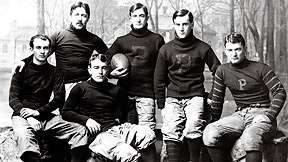
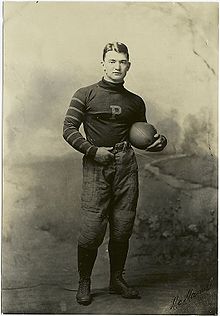
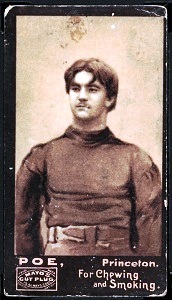
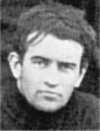
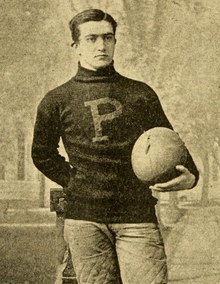
Princeton football heroes (L-R) Arthur Poe, Samuel Johnson Poe, Neilson (Net) Poe, Edgar Allan Poe, Gresham Poe and John Prentiss Poe Jr.

Princeton football heroes (L-R) Arthur Poe, Samuel Johnson Poe, Neilson (Net) Poe, Edgar Allan Poe, Gresham Poe and John Prentiss Poe Jr.

When Bill Belichick was drawing up his game plan for the American Football Conference championship game with the Baltimore Ravens, his eyes most surely had “all the gleaming of a demon that is dreaming.” Bill’s teams have established a winning tradition for professional football that will be difficult to match.

Still, whatever that particular game’s outcome, the New England Patriots have to go a long way to match the sporting, cultural, and military traditions of the relatives of Edgar Allan Poe. Edgar was born in Boston in 1809 and died in Baltimore in 1849. “The Raven” was his most famous poem. Published in 1845, it gave Baltimore’s current professional football team its nickname.

But “back in the day,” college football was king, and the mighty Harvard and Yale elevens perennially fought for national supremacy. The special nemesis of both the Crimson and the Elis were the Tigers of Princeton. And the most renowned of the athletes who played for Princeton were the six Poe brothers, all sons of Edgar’s cousin John Prentiss Poe. They all played football in college, and three of them served with distinction in World War I.

John graduated from Princeton in 1854. He later became attorney general of Maryland. From his “full paternal quiver” he sent all six sons to his alma mater. They were:

Samuel Johnson Poe, Class of 1884. He played halfback for the Tigers in 1882-83. He was also an All-American lacrosse player.

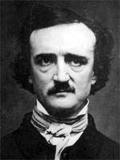
Edgar Allan Poe, second cousin of "The Rave" author and college football's first All-America quarterback.

Edgar Allan Poe, and college football’s first All-America quarterback.

Edgar Allan Poe, Class of 1891. Probably the best known of all the Poe boys, he was the country’s first All-America quarterback, chosen in 1889, when Caspar Whitney of Harper’s magazine selected the first All-America college football team. Edgar was captain of Princeton the team as a junior and as senior.

One story goes that after Princeton beat Harvard 41-15, a Harvard man reportedly asked a Princeton alumnus whether Poe was related to the great Edgar Allan Poe. The Princeton guy replied, “He is the great Edgar Allan Poe.'” The younger Edgar Poe graduated Phi Beta Kappa and later served as the Attorney General of Maryland from 1911 to 1915.

John Prentiss Poe

John Prentiss Poe

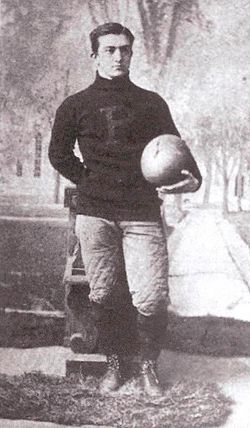
John Prentiss Poe, Jr., Class of 1895. Perhaps a typical “third child,” with both a reckless courage and a generous nature, he was a star halfback on the football varsity and class president. When he flunked off the team the next spring, his whole class turned out at Princeton Junction to see him off. He was readmitted in the fall, played even better, but again had to leave for academic reasons. This time he did not return. He set off on a series of adventures, coaching football at other colleges and working as a cowpuncher, gold prospector, surveyor, and soldier of fortune.

When World War I broke out he hastened to England and “took the King’s shilling” as a private in the Royal Garrison Artillery. He later applied for transfer to the infantry and was assigned to the 1st Black Watch. That famous Scottish infantry regiment was known to the Germans as the “Ladies from Hell” because of their ferocity and the kilts they wore.

John died in the Battle of Loos in September of 1915. He was with a detachment carrying bombs to another regiment and was part way across an open field when he was struck in the stomach by a bullet and killed. He was buried there, between the German and British lines, and relatives were never able to locate his grave.

His portrait, showing his stocky figure with the kilts and bonnet of the Black Watch, hangs in Madison Hall; it was given by the Princeton Alumni Association of Maryland. Poe Field, provided in his memory by classmates and friends, is used for lacrosse and intramural athletics. The John Prentiss Poe Football Cup, given by his mother, is Princeton’s highest football award. Now known as the Poe-Kazmaier Award, it goes annually to the member of the varsity football team who has best exemplified courage, modesty, perseverance, and good sportsmanship.

Neilson Poe

Neilson Poe

Neilson (Net) Poe, Class of 1897. He played in the backfield in 1895 and 1896, and later came back and coached. In World War I he was a lieutenant was in the U.S. Army’s American Expeditionary Force, the “Rainbow Division.” He was wounded in a 1918 battle in which his commanding officer was killed. Neilson took command and safely entrenched his men for 24 hours while suffering a bullet wound to the stomach and several shrapnel wounds. He was later awarded the French War Cross and the Distinguished Service Cross.

His coaching at Princeton spanned 20 years between the World Wars. He was in charge of the scrubs, who today would be known as the Scout Team. They were called “Poe’s Omelettes” because “they were good eggs who were beaten up.”

Arthur Poe

Arthur Poe

Arthur Poe, Class of 1900, was another All-American. He scored the deciding points in two consecutive victories over Yale. In 1898 he ran ninety yards for a touchdown and the only score of the game. Newspapers reported that he had recovered a Yale fumble, but Poe said that he had grabbed the ball from a Yale halfback’s arms, that he had a clear field and a ten-yard start for the goal line, and that he had never felt happier in his life.

In the 1899 game, with less than a minute to play, and with the score 10 to 6 in Yale’s favor, Bill Roper ’02 of Princeton recovered a fumble on Yale’s 30-yard line. It was getting dark and time was running out. The only feasible strategy was to kick a field goal, then worth 5 points, but Princeton’s two drop-kickers were out with injuries. Arthur Poe volunteered to try a drop-kick even though he had never kicked in a college game before. He dropped back to the 35-yard line, and (the newspapers said) made a perfect dropkick. Arthur’s version was different, however, He wrote:

“The pass from center came back perfectly which is more than anyone could truthfully say for the rest of the play. . . . The ball bounded a little too high off the ground as I dropped it and I got under it too much, raising it high into the air almost like a punt. It came down just about a foot over the crossbar and about a yard inside the upright. I wasn’t sure it was good until I turned to the referee and saw him raise his arms and heard him say `goal.’ . . . Then everything broke loose. . . . All I remember after that was being seized by a crowd of undergraduates and alumni who rushed out onto the field, and hearing my brother Net shout: `You damned lucky kid, you have licked them again.’

Gresham Poe

Gresham Poe

Gresham Poe, Class of 1902, was a substitute on the Princeton varsity in 1901. He was in a field artillery unit in the U.S. Army during the war. Gresham wasn’t quite the athlete that his older brothers were. He was inserted late into the 1901 game against Princeton to return a punt, and he received a loud ovation from Princeton fans. The Elis won that game 12-0, but they were prepared for yet more Poe family heroics against them too.

In 1899, the following poem by Booth Tarkington was read at the victory celebration. Gresham was just an incoming freshman at the time. In this poem, Eli Yale is addressing the Princeton Tiger:

“’Sir,’ I said, `All Poes are gone —
Johnson, Edgar, Neilson, John;
Arthur with the toe on which
Winning goals are kicked galore.
Tell me, tell me, gentle Tiger,
Is it possible there are more?’
`Stop!’ the Tiger cried, `there’s Gresham,
Getting ready to refresh ’em —
Don’t forget him. I implore.”’

Author Edgar Allan Poe

Author Edgar Allan Poe

Finally, we should note that Edgar Allan Poe’s son, Edgar Junior, also graduated from Princeton and fought for his country in World War I. He never played football, but he too carried on the tradition of service of that admirable family. He was a U.S. Marine lieutenant and was severely wounded, but survived.

So I ask – when will there be a New England football family that matches or surpasses the traditions of football prowess and military service of the Poes of Princeton?

Most likely – Nevermore!

The Vanishing Traditions of College Football

January 10, 2013

(These are my opening remarks at the Gridiron Club of Greater Boston’s annual Bob Whelan College Awards Night, held January 10, 2013 at the Westin Waltham Hotel)

Ladies and gentlemen, thank you for being with us this evening. Thank you for being part of what the Gridiron Club does – keeping alive the memories, standing up for all the tremendous good that comes from athletic competition, and carrying the flame of tradition.

It’s especially good and important that you’re joining us tonight, at this point in the history of college athletics. I say that because it seems – to me anyway – that not everybody the sporting world still values tradition as highly as it should be valued.

Let me give you an example. “Maryland, My Maryland.” Don’t you love that song? I get goose bumps when the Naval Academy Glee Club sings it before the post parade at the Preakness.

It’s a very nice musical rendition – set to the tune of “O Tannenbaum” – of a long poem that is not so nice. In fact, it may be the most militaristic and warlike piece of poetry every written by an American.

Maryland“Maryland, My Maryland” was the work of James Randall. He despised Abe Lincoln, calling him the despot and the tyrant. He wrote the poem 1861 to urge Maryland to secede from the Union and cast its lot with the Confederacy. One stanza:

Dear Mother! burst the tyrant’s chain,
Maryland My Maryland!
Virginia should not call in vain,
Maryland, My Maryland!
She meets her sisters on the plain-
“Sic semper!” ’tis the proud refrain
That baffles minions back amain,
Arise in majesty again,
Maryland! My Maryland!

Maryland and Virginia. The Old Line State and the Old Dominion. They’ve been sisters for hundreds of years. And whatever side you might have taken during the Civil War, you’ll probably agree with me that they belong together.

Virginia should not call in vain. But now she will. When she calls to Maryland from the football field, there will be no answer. Maryland will be out somewhere in the cornfields of Iowa. Maryland and Virginia first played football in 1919, and had a game every year since 1957. No more. Tradition? Who needs it?

TexasIf you’ve never been to College Station, Texas, put a Texas A&M football game on your bucket list. It’s a happening. It’s only 85 miles across the plains from Austin and the University of Texas. Up until 2008, Texas A&M and Texas had faced each other 117 times on Thanksgiving Weekends. It was a rivalry more fierce than any that we laid-back Northerners know.

PittHow about the Back Yard Brawl between Pitt and West Virginia? Fans travel just 70 miles along the Monongahela to see this game. For how many generations have the coal fields of West Virginia fed the blast furnaces of Pittsburgh? They belong together too. In football, the universities have played 104 times. 14th oldest rivalry. No more.

Kansas- Missouri. The Border War. In 2007, the universities decided they didn’t like the name of the game and changed it to “Border Showdown.” This rivalry harkens back to pre-Civil War days and “Bleeding Kansas.” The Civil War really began out there, years before Fort Sumter and Bull Run.

KansasThe teams even got their nicknames from that era. Jayhawkers were originally characters that included abolitionists, military regiments, robbers, and murderers. In the years following the Civil War, the term became synonymous with native Kansans. The Tigers were a home guard unit that protected Columbia, Missouri from marauding guerrilla bands.

The football series was a war, all right, and when the Kansas coach heard about the name change, he wasn’t pleased. His quote: “It’s a goddam war! And they started it!”
Kansas-Missouri was college football’s second-oldest rivalry. 120 games. Gone.

Nebraska-Colorado . First met in 1898. Total games – also mostly around Thanksgiving – a mere 69. That’s over now, too.

BYUBrigham Young-Utah. The Holy War. First played in 1896. 94 total games, and every year since 1946. They will play in 2013 and once more in 2016. But that’s it.

I’m sure there are many more such stories, and not just in football.

There’s going to be a lot of prosperity created in the coming years – when college leagues break up, and re-form, and have playoff games, and sign new television contracts, and establish even more networks.

But I’m not sure that we’ll be any wealthier, after all that. There’s a richness about life that can only come your way through friendships, and family – and through those traditions and rituals that anchor you in the world and define who you are.

So it is in sport. But we’re seeing many of those traditions disappear. That can’t be a good thing.

That’s why I say that your presence here, in the body as well as in spirit, is so important. That you sit in the stands, and come to the games in person, and now, that you are present for the well-deserved accolades and recognitions…You’re doing your part to preserve tradition – perhaps more than you realize.

So thank you again, for being with us at the Bob Whelan College Awards Night. We always appreciate your support. Especially this year.

Marty McInnis – You Couldn’t Get That Puck Away from Him!

September 13, 2012

Marty McInnis played three years of hockey at Boston College, represented his country at the Olympics in 1992, and enjoyed a ten-year career in the National Hockey League. Here is my profile of him from the Hingham, Massachusetts, Journal: http://tinyurl.com/8et56k7

Before Orr, Before Leetch, There Was Don Fox, Rushing Defenseman from Boston College

September 13, 2012

Don Fox

Don Fox, who grew up in Newton, Massachusetts and learned his hockey on the ponds and on the Charles River, was inducted into the Boston College Hall of Fame on September 7, 2012.  Here’s a link to his story, which I wrote for the induction ceremony and which was published in the Newton Tab on September 11, 2012: http://tinyurl.com/9pawkl4