Archive for the ‘Things in General’ Category

“Go Set a Watchman” – Book Review & Reflection

July 17, 2015

WatchmanThe prophet Isaiah, foretelling the harsh judgment of God against both the sinful people of Israel and of the surrounding kingdoms, writes (21:6) “For thus has the Lord said to me, ‘Go, set a watchman. Let him declare what he sees.”

The watchman sees chariots, and horsemen, and a lion, and more chariots approaching. Destruction and divine vengeance are upon the land. “Babylon is fallen, is fallen. And all the carved images of her gods, He has burned to the ground.”

Harper Lee’s long-anticipated second novel, Go Set a Watchman, tells also of destroyed images and harsh judgment. The biggest image, the most revered icon, is that of Atticus Finch, father of 26-year-old protagonist Jean Louise “Scout” Finch, the tomboy heroine of To Kill a Mockingbird. The harsh judgment is hers, delivered on her father, her town, and in her bewildered anguish, on herself as well.

Scout is not the only one who is disillusioned. All of us who grew up with Ms Lee’s first book have always considered Atticus Finch one of American literature’s greatest heroes. He was noble, and pure, and motivated by holy charity in his search for justice. Well, not so fast. We, like Scout, find that it’s a little more complicated than we thought.

In her climactic confrontation with Atticus, the shocked and appalled Jean Louise was allowed to “break her icons, one by one,” as her uncle, the eccentric but learned and worldly-wise Dr. Jack Finch, subsequently explains to her.

Author Harper Lee

Author Harper Lee

Jean Louise, home from New York for her annual two-week vacation, had seen her 72-year-old father taking part in a local council meeting in Maycomb, Alabama. Her icons are not the only ones that get broken; as Atticus comes down from his pedestal, one of ours does too.

That council had been formed to resist the workings of the NAACP, the Northern do-gooders, the Supreme Court, and all other external forces that had gathered to end the century of Southern Democrats’ resistance to the full emancipation of their former slaves. Repulsive, rodentine characters take the stage and spew racist, reactionary invective. Jean Louise slips into the building and watches from the “colored balcony.”

Though Atticus doesn’t engage in such speechmaking, he’s up on stage with them. So too is Henry Clinton, his young law associate who wants to marry Jean Louise. She can’t deal with it. She yearns for her own personal watchman, to help her declare what she sees.

I don’t think I’m giving away too much by reporting that Uncle Jack tells her that he, and not Atticus, had to be the one telling her what had happened during the daughter-father blowout. She would not have listened to her father, who had been like a god to her and “Our gods are remote from us, Jean Louise. They must never descend to human level,” as Jack puts it.

Uncle Jack, and Harper Lee, speak to all of us when he says, “…every man’s island, Jean Louise, every man’s watchman, is his conscience. There’s no such thing as a collective conscious…Remember this also: it’s always easy to look back and see what we were yesterday, ten years ago. It is hard to see what we are. If you can master that trick, you’ll get along.”

The book deals with the most serious of themes, but it’s also loaded with humorous asides and biting insights into human nature. Lee introduces the watchman quote during a church service that Jean Louise dutifully attended but “slept through with her eyes open.”

Of Mr. Stone, the youngish preacher who delivered the quote, she says, “There was nothing whatever that was wrong with Mr. Stone, except that he possessed all the necessary qualifications for a certified public accountant: he did not like people, he was quick with numbers, he had no sense of humor, and he was butt-headed.”

Mr. Stone had been dispatched to Maycomb by the Methodist Church Conference. Uncle Jack sums him up with “We asked for bread and they gave us a Stone.”

Jean Louise also sits through a “Coffee” run by her Aunt Alexandra. She endures the inane chatter of the ladies – the “magpies” who “wore gloves and hats, and smelled to high heaven of attars, perfumes, eaus, and bath powder. Their makeup would have put an Egyptian draftsman to shame.”

The subgroups of those Southern belles included the Newlyweds, the Diaper Set, the Light Brigade, and the Perennial Hopefuls. Reading Lee’s acerbic descriptions made me think of the beehive-coiffed and bigoted females of that terrific movie, The Help. Jean Louise would get along famously with Emma Stone’s heroine, Skeeter Phelan. Alison Janney’s character, Charlotte Phelan, would be instant simpatico with Uncle Jack.

Along the way there are several flashbacks to Scout’s childhood, to adventures and misadventures with her now-deceased brother Jem and their friend Dill, and to the trial of the falsely-accused Tom Robinson at the heart of Mockingbird.

Go Set a Watchman was written by Lee in the mid-1950s, which was right around the time of the Brown vs. Board of Education decision. Governor Orval Faubus may or may not have already fomented the 1957 crisis at Little Rock Central High School, which prompted Republican president Dwight Eisenhower to send in the 101st Airborne Division to restore order.

James Meredith, Bull Connor and Selma, the Freedom Riders, Strom Thurmond and the Dixiecrats defiantly raising the Confederate Flag in South Carolina – all these lay in the future. But Harper Lee saw what was happening. And like Isaiah’s watchman, she saw what was coming. She’s written another wonderful book. I’m only sorry she waited so long to let it be published, and I’m sorry that during her long life she didn’t see fit to write more of them.

Go Set a Watchman will probably never be as prominent in the canon of American literature, or as beloved, as To Kill a Mockingbird. But no matter. It’s a superb book. If you liked Lee’s first one, I think you’ll like the second – and may appreciate it even more.
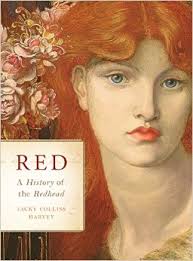

“Red: A History of the Redhead” – Book Review and Reflection

June 29, 2015

red - the bookThose who know me won’t be surprised that when I saw a review of Red: A History of the Redhead by Jacky Colliss Harvey, I ordered it immediately and devoured it as soon as it arrived. I wasn’t disappointed – but then again, what guy would ever be disappointed when the topic is redheads?

Harvey’s academic background in English and Art History as well as her work in museum publishing make her a natural to do a book like this. But she obviously worked very hard and researched energetically in other disciplines as well – biology, genetics, chemistry, physiology and business among them.

Early in the book, Harvey explains the quirky MC1R gene that produces a substance called eumelanin, which makes for dark skin, eyes and hair. Sometimes, however, the gene produces another substance called red or yellow phaeomelanin. It also teams up with another gene, HCL2, to bring forth all sorts of variants in hair, eye, and skin color.

Biology dictates that redheads don’t do well in strong sun and tropical climes. They’re more suited to higher latitudes like Scotland and Scandinavia. Their pale skin does a good job of processing Vitamin D from sunlight, and there’s less sunlight up North.

Redheads also smell different. The genes make their skin more acidic than that of blondes and brunettes, and it reacts differently to the chemicals of their perfume. So that’s why. I always thought it was nothing but pheromones – with which they are obviously abundantly blessed as well. Yikes. As if they actually need any help in that area. But moving on…

The parts I especially liked had to do with history: political, art, and cultural. If I want to understand why things are the way they are now, reading up on history generally provides solid clues. So does re-reading some of the books we had to get through in high school but never really appreciated.

Harvey unearths many of those clues. She goes back to Biblical legend as well as to our fourth-grade history and the mythology of ancient Greece and Rome to show how redheads have captivated and intrigued the rest of humanity. Seems it’s always been this way.

A fresco unearthed in the home of M. Fabius Rufus – whose name means “red” – in Pompeii depicted Cleopatra with red hair. The author surmises that the painting is probably one of Cleopatra, anyway, and that it’s not very likely that she did have red hair. But the point is that she acted like a redhead, and so was painted that way.

Cleopatra was a formidable and powerful woman, Mark Antony’s lover, and thought to be typical of the redhead stereotype that has stayed with us: a “flame-haired seductress, exotic, sensual, impulsive, passionate.”

In 403 A.D. Saint Jerome, the guy who translated the Bible, wrote to a woman about her daughter, “do not dye her hair red, and thereby presage her for the fires of hell.”

Lilith, the legendary lady of creation who thought herself Adam’s equal, unlike Eve, “refuses to lie beneath.” She rebelled and left him to live in the wilderness, and she is frequently depicted with red hair by religious artists.

The resurrected Jesus meets with his redhead disciple Mary Magdelene.

The resurrected Jesus meets with his redhead disciple Mary Magdelene.

Then there’s Mary Magdalene, perhaps my favorite Biblical character. I’ve come to believe that she was the truly indispensable disciple of Jesus. Even the Scriptures back this up. She was the first one to whom Jesus revealed himself after his resurrection. But she has gotten a raw deal from the guys who ran the Church in later centuries. They rewrote her story and made her a bad girl.

Pope Gregory (the Chant guy), in 591, declared that the “woman cured of seven devils” in Mark’s gospel was actually Magdalene. She took her unguent, “previously used to perfume her flesh in forbidden acts,” to wash Jesus’ feet. She had once “displayed her hair to set off her face,” but now that hair is what dried her tears of repentance. And what color is that hair in devotional paintings? Why, red, of course.

Jacobus de Verigine, an early author who compiled the lives of saints, writes that Magdalene was wealthy and “shone in beauty.” Moreover, her sins were her pleasure in looks, and riches, and in “giving her body to ‘delight’ rather than straightforward prostitution.” In other words, she loved it. And so she flouted all of the taboos of the medieval Christian Church. How could the popes and bishops possibly approve of Magdalene’s closeness to Jesus? They didn’t, and so they smeared her – before they also admitted that she repented.

The painting “Noli Me Tangere” (“Don’t Touch Me”) by Martin Schongauer shows a strawberry blonde Magdalene with the risen Jesus on Easter morning. And there was another redhead present at the crucifixion, as shown in “Calvary” by de Messina. The unrepentant “bad thief” is also a redhead.

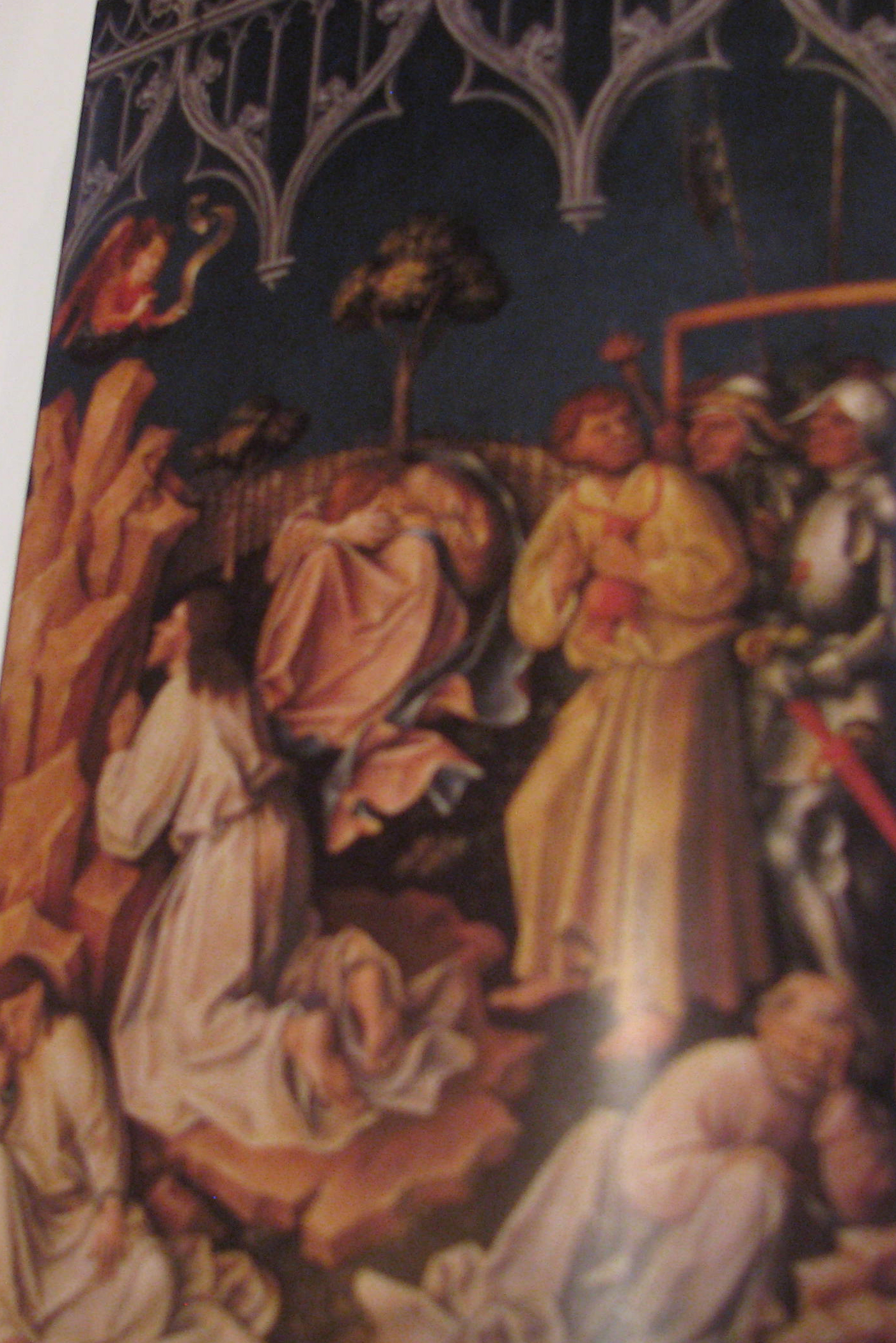
Red-headed Judas leads the soldiers to Jesus in Gethsemane.

Red-headed Judas leads the soldiers to Jesus in Gethsemane.

Going back to the night before the crucifixion, “The Agony in the Garden” painting in the Bavarian National Museum shows a red-headed Judas leading the soldiers towards Jesus. It is but a short step from there to one of the fueling elements of anti-Semitism: the treacherous, redheaded Jew.

Freckles were called “Judasdreck” in medieval Germany. Shylock, the Jewish lawyer in “the Merchant of Venice,” is usually depicted as a redhead. Fagin in Dickens’s “Oliver Twist” is “a very old, shriveled Jew, whose villainous-looking and repulsive face was obscured by a quantity of red matted hair.”

Those sexual taboos and those attitudes toward red hair didn’t die out in the Middle Ages, either. They remained around for a long, long time, and they haven’t entirely disappeared.

There’s much more than religiously-oriented historical discussion in Harvey’s book. But religion has been so powerful in shaping humanity’s behaviors, I thought it worth delving into here. And next time you’re grappling with some thorny issue and ask “What would Jesus do?” think of “Noli Me Tangere.” Jesus would pick the redhead.

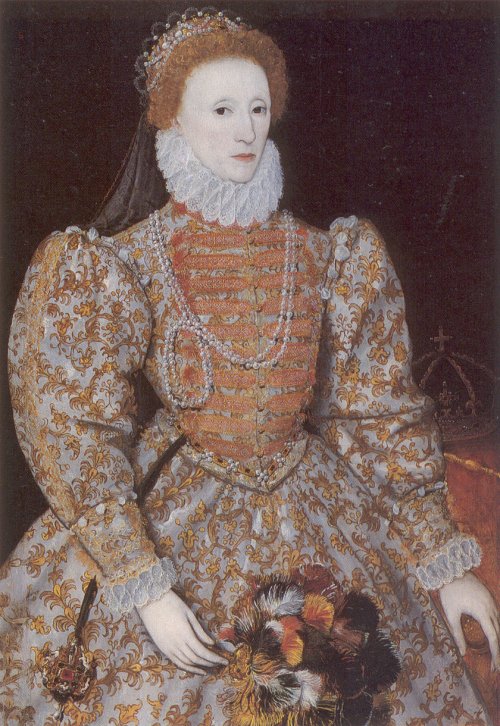
Queen Elizabeth I portrait in Britain's National Gallery.

Queen Elizabeth I portrait in Britain’s National Gallery.

Other famous and infamous redheads, real and fictional? How about Henry VIII and his daughter, Queen Elizabeth I? She supposedly had eighty wigs, and she liked to be seen in them to play up the connection with her father, who had declared her illegitimate.

The lists go on and, as we’d expect, pay a visit to Hollywood and its red-haired goddesses: Clara Bow, Rita Hayworth, Lucille Ball, and their many successors in movies. And in cartoons: The Little Mermaid, Jessica Rabbit, and Red Hot Riding Hood.

Millions of women want to be like them, and millions of men cheer that development. Red hair tint outsells all other hues. In 1970, L’Oreal sold only two shades of red hair coloring. By 1989, they were up to 16 shades, while Redken had 29 shades of red and Clairol had 43.

Lucille Ball once said, “Once in his life every man is entitled to fall madly in love with a gorgeous redhead.” For once, she’s not got any ‘splainin’ to do.

Lucille Ball

Lucille Ball

The author also quotes a firm named Upstream Analysis, which points out that up to a third of all TV advertising features a redheaded character, but redheads make up only somewhere between 2 and 6 percent of the population. So we all pay attention to redheads. They sell.

In the book’s last chapter, where she tells of her visit to Redhead Days in Breda, Holland, Harvey says that “gingerism” endures as one of humanity’s prejudices. I don’t watch “South Park,” so I was unaware of its episode on “Kick a Ginger Day.” OK, agree, kids can be cruel. They will pick on people who are different from them, and redheads are definitely different.

But savvy redheads are battling back against bullies and turning negative stereotypes hip and cool. A Canadian comedian responded to “South Park” by co-opting the Canada Dry logo and setting up “Kiss a Ginger Day.” Good for him. Sign me up.

Redhead Days brought together 6,000 of them from all over the world. I have to put that event on my bucket list.

I’d also love to take the redheaded Jacky Colliss Harvey to lunch, just to learn more about her research and her other work in museum publishing. She has an easy, enjoyable writing style, and she’s done a most interesting book on one of my favorite subjects.

The Remarkable Career of Maksymilian Faktorowicz

June 27, 2015
Rita Hayworth as Gilda.

Rita Hayworth as Gilda.
“Men go to bed with Gilda, but they wake up with me.”

He was so renowned and prized as the hairdresser to the Russian court that he did most of his work under military guard. But when he married secretly without first securing Czar Nicholas II’s permission, he had to flee the country. Faktorowicz used his own makeup to fake symptoms of jaundice in order to leave Moscow for America in 1902.

His early times in America were tough. A business partner defrauded him of most of his savings at the Louisiana World’s fair. His half-brother became known as “Jake the barber,” a notorious Prohibition gangster who once, literally, broke the bank at Monte Carlo.

But Faktorowicz was a resilient sort. He headed west, and in 1908 he set himself up in Hollywood with a business that hired out wigs to film extras. Then he did the extras’ makeup. Then he graduated doing makeup for the stars. Then he invented the term “makeup.”

In 1935, he was so popular and so much in demand that he opened his own “Makeup Studio.” It had color-coded rooms for his clients: one with salon-peach walls for “brownettes,” one with powder-blue walls for blondes, and a mint-green one for redheads. “Whenever there is red in the composition of the hair,” he said, “green will be becoming.”

Faktorowiczs’s many successes included the heart-shaped lips of Clara Bow, Hollywood’s “It Girl” and perhaps its first

Maksymilian Faktorowicz at work with his

Maksymilian Faktorowicz at work with his “beauty micrometer,” which detected tiny flaws in actor’s faces. Without a treatment of some sort, these flaws would show up on the big screen. The solution? Pancake makeup.

famous redhead; the platinum blonde look of Jean Harlow, which she maintained with a weekly wash of ammonia, Clorox, and Lux soap flakes; and the glorious copper curls of Rita Hayworth.

clara bow

Clara Bow, Hollywood’s “It Girl” (colorized).

Hayworth is the star that most frequently comes to mind when you say “Hollywood” and “redhead” together, even though her films were shot in monochrome rather than in color. She drove men wild with desire in many roles including that of the seductress and society girl Gilda, on stage and in a 1946 film. Her complaint about that role? She once sighed, “Men go to bed with Gilda, but they wake up with me.”

If, in my next life, I come back as Maksymilian Faktorowicz, I’ll take that as God’s message that I was a good boy in this life, and that I deserve a nice reward.

And you know who Maksymilian Faktorowicz is. We’ve all used his products.

Max Factor.

Autumn Leaves, and Ladies of Autumn: Two of My Favorite Things

September 8, 2014

reds2Maria von Trapp had cream colored ponies and girls in white dresses. I’ve got flame colored tree leaves and girls with grey tresses.

These are two of my favorite things: the reds and golds and yellows of autumn in New England, and the company of women of my generation. It’s almost that time of year when I encounter the former. Any time of the year will do for encountering the latter. They’re two of life’s greatest pleasures.

The blazing hues of fall carry along with them all that’s gone before: the snow blankets of winter, the grudging thaws of mud time, the hopeful green shoots and buds of early spring, the winds and showers and storms and happy days of summer…they’re all wrapped up and glowing through the glad symphony of September glory.

gold2The greying hairs and the crinkly countenances of the ladies bear with them all that’s gone before as well: the pangs of childbirth as they brought forth humanity’s next generation; the illness and distresses of their little ones; the ripening and blossoming of youths they nurtured; the kisses and embraces of loved ones; the laughter and the tears of shared joy and sorrow…they’re all wrapped up and retold in the whispers and smiles and sparkling eyes of mature womanhood.

I love to walk the woods and parkland trails, early of an autumn morning or in the full of day or in the cool of evening. I am grateful for all that the winter, spring, and summer stored up the beauty I see at this time of riotous color. Here in New England, in the season that is just about to begin, there’s magnificence that nowhere else on earth can match.

In like manner, I love to meet and talk with old friends. There’s no friend like a friend of my youth. Especially if that friend is a woman who, like me, is in the September of her years.

yellow2Her crown of hair might be full grey or just silver-streaked, but her life story is anything but grey. It rings forth with the color and variety of the autumn woods. Her laugh lines are like the tiny creases in the leaves that flutter down to my outstretched hands on breezy fall days. Those lines may have been born in times of merriment, like a warm and tranquil month of summer. Or they may have furrowed her brow in times of stress and care, as a blustery March blast once shook the strong green leaves.

Each woman’s life story is unique, but it’s always a story of love. I am grateful for that story, and I never tire of hearing it. Woman’s strength is God’s greatest gift to man.

I cannot understand men of my age who insist on the company of women who are fifteen or twenty or more years their junior. I feel sorry for them. It’s rather like he who, on the first cool night of fall, boards a plane for Florida and leaves New England’s harvest banquet hall right before the feast begins. All such men are missing out on the Lord’s plenty.

Give me New England in autumn. Give me women my own age. Two of my favorite things.

Joining the Team at Curry College

June 1, 2014

June 1 2014 (6)aI’m pleased to be the newest staff member of the Writing Center, one of the many services of Curry College’s Academic Enrichment Center. Earlier this week I met with my colleagues, a passionately dedicated group of writing professionals who love working with Curry’s energetic students.

Other offerings pf the AEC: Math Lab; Peer Tutoring and Teaching Assistant Program; Athletic Study Halls; Education Support Specialist Program; and Academic Classes including The Academic Writing Process, Read Around the World, Competencies for Prospective Educators, Peer Teaching in the Disciplines, Study Abroad Seminar, and Discovering Boston.

I’m looking forward to September. Go Colonels!

History I Never Knew, and Almost Never Got the Chance to Learn

May 6, 2014

King Richard III: Killed at the Battle of Bosworth Field, the End of the War of the Roses.

King Richard III: Killed at the Battle of Bosworth Field, the End of the War of the Roses.

King Richard III: How Historians and Archaeologists Got There Just in Time

In 2012, archaeologists discovered the body of King Richard III buried under a parking lot in Leicester, England. Then they were able to verify the body’s authenticity at the very last second of history available to them. Had they waited just a few more years to unearth those bones at the site of the old Greyfriars Church, no one would have been able to tell for certain whether the body was that of the king – a guy whose reputation was trashed so unfairly by William Shakespeare.

Analysis of the bones revealed that the deceased had eaten a diet of seafood and meat, which was consistent with that of a nobleman of those days. But to be sure it was he, they needed the DNA to match.

It had to be mitochondrial DNA, the only kind that passes through the generations unchanged from mother to child. Mitochondrial DNA can be preserved down the female line indefinitely. They found that genetic material in Michael Ibsen, a Canadian-born cabinetmaker and the 17th great-nephew of Richard III.

Michael Ibsen was the last possible source of DNA for Richard III. Through all generations to the present, there had been at least one female relative to keep the mitochondrial DNA of Richard III alive. But now there are no more female descendants, so when Michael Ibsen dies, that line will go extinct. They found Mr. Ibsen just in time.

Yes, Your Majesty, “Delay leads impotent and snail pac’d beggary.” But this long delay is finally over for the last English king to die in battle.

Whatever else his exaggerated faults and failings, Richard III was a brave man.

In Pace Requiescat.

Lives of Service, Lives of Generosity: Honoring “Men for Others”

February 14, 2014

BC High 1967 classmates Christoper Small, left, and Tom Burke after Chris received the school's prestigious Saint Ignatius Award.

BC High 1967 classmates Christoper Small, left, and Tom Burke after Chris received the school’s prestigious Saint Ignatius Award.

Today I attended a reception honoring my BC High 1967 classmate Christopher Small, who has been Executive Director of the Italian Home for Children for the past 35 years.

Chris received the St. Ignatius Medal, BC High’s highest alumni award. It goes to graduates who “have exemplified the ideals of the school through high moral character and selfless service to the community.”

Superb choice. Congratulations to Chris, thanks to him for his career as a man for others, and kudos to the school for its wisdom in selecting him.

The Italian Home is one of the most respected and well-run social service agencies in Massachusetts. It is also recognized by the Council on Accreditation (COA). This certifies that the Home meets the highest national standards and delivers the best quality care to its communities. About 100 children are served each day on the Home’s Jamaica Plain campus. Another 20 kids attend programs at its Cranwood Group Home in East Freetown.

In his briefs and gracious acceptance speech before the school’s entire student body, Chris talked about how his experiences at BC High helped him to discern the signs and signals that led him to his life’s work.

“I was always challenged to examine things for what they meant, both in general and in particular for me. Many times, I got a feeling – a feeling for when I was doing my best work, when I was making plans or judgments or decisions. It was the feeling that I was doing the right thing.”

At first, Chris had no thought of a career in social services. He went to BC, majored in physics and math for three years, and aimed to be a scientist. During vacations he worked at IHop. But in the summer following junior year, he got a job working with emotionally disturbed youngsters at the New England home for Little Wanderers.

“It took me a couple of weeks and a handful of experiences with these special kids to give me that feeling. I recognized that I was meant to work with them. At the ripe old age of 20, I was lucky enough to find the work that I was born to do,” he said.

After that summer, Chris didn’t bother finishing his science training at Boston College. Rather he went right into the field and eventually earned a degree in social work at Boston University.
Chris closed his remarks by telling the students that each of them was developing his own version of the feeling.

“I hope you pay attention to what your heart tells you, and to have the courage to let your choices by governed by who you really are, rather than by what you think others think you are. And however successful or influential you aspire to be, your greatest achievements will always involve what happens between you and others. They may be your loved ones, or good friends, or total strangers. But if you put others and their needs first, ahead of your own, it won’t feel like a sacrifice. Think of them as opportunities you’ll encounter unexpectedly, on whatever path you choose.

“Measure wealth not by the things you have but by the things that you have that you would not exchange for money,” he concluded.

Chris was one of three alumni recipients of BC High’s Ignatius Award. The others were mathematician Paul Sally, a Roslindale native and professor of mathematics at the University of Chicago, and Reverend Richard “Doc” Conway of the Boston archdiocese.

Professor Sally, a 1950 BC High graduate who died on December 30, 2013, taught at Chicago for 50 years. He led the University’s Mathematics Project, which developed “Chicago Math” for grade school children.

Father Conway, a Class of 1955 alumnus, grew up in Holy Name Parish in West Roxbury. He worked in many parishes in and around Boston. In 2012 he received the Crime Fighter of the Year award from the Boston Police for his work with the city’s young people.

BC High also honored William A. MacNeill with its Shields Award for his lifetime of service as a teacher, track coach, and vice president of development. A Roxbury native whose family was too poor to send him to BC High, MacNeill enlisted in the Army at age 17. He served in Europe and Korea and graduated from Boston College in 1956. He organized BC High’s first fund raising program in 1971.

I had Bill for history and as a coach in cross country. Later on, when I was in the development business, we’d frequently talk shop. He did a lot, very quietly and unobtrusively, for people and for other worthy causes in addition to BC High. I’m glad that he was among the honorees as well.

It was a good day to be back at the old school, all right!

Introducing Lane MacDonald, Newest Member of the Beanpot Hall of Fame

January 29, 2014

With the Beanpot, since 1952 the emblem of the college hockey championship of Boston.

With the Beanpot, since 1952 the emblem of the college hockey championship of Boston.

Speech by Tom Burke, Assistant Secretary of the Beanpot College Hockey Tournament, at the press luncheon at TD Garden, January 28, 2014.

Today I have the honor of introducing the Beanpot Hall of Fame Class of 2014. We have just one inductee. Lane MacDonald, Harvard University, Class of 1989. And where to begin?

Well, knowing a bit about Lane, I think he’d rather I speak of teams, and lines, and other people. So I’ll start there. A couple of years ago the Massachusetts Hockey Hall of Fame enshrined an entire Harvard line that we all know as the Local Line. Three Massachusetts kids named Corkery, McManama, and Hynes who terrorized opponents for three seasons in the early seventies. It was possibly Harvard’s best line ever.

When I raised that subject with Lane, and asked him about his own line, he said that that Harvard’s best lines were whichever ones had Joe Cavanaugh or Bill Cleary. But if you know your Harvard hockey history, or if you just remember the fabulous season of 1988-89, you might just cast your vote for the line of Lane MacDonald, Alain Bourbeau, and C.J. Young.

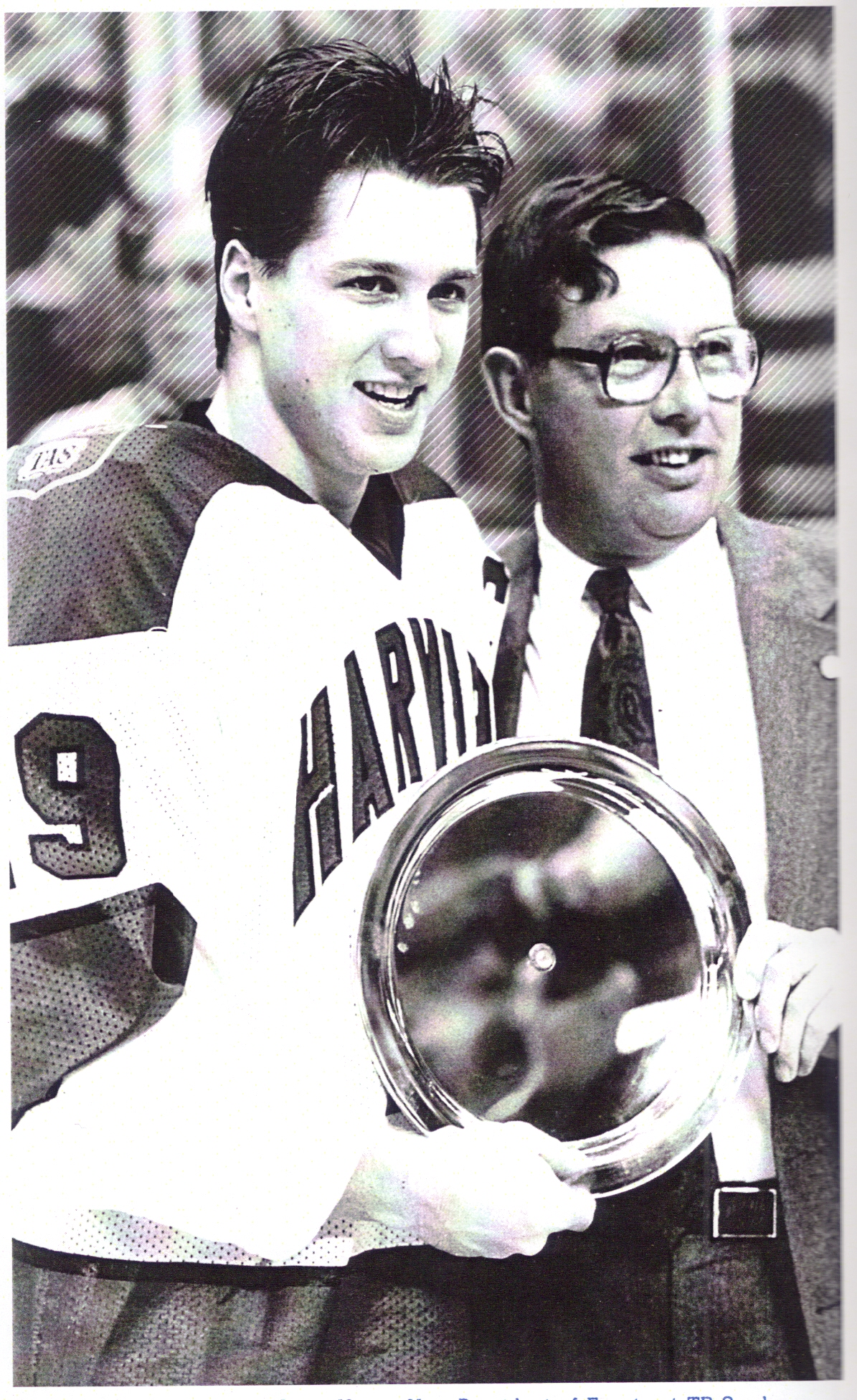
Lane MacDonald accepts MVP trophy from Garden VP Steve Nazro after Harvard defeated BU 9-6 for the 1989 Beanpot title.

Lane MacDonald accepts MVP trophy from Garden VP Steve Nazro after Harvard defeated BU 9-6 for the 1989 Beanpot title.

Lane was the team captain that year. Harvard had a record of 31-3. They won the Beanpot. They won the NCAA championship. Lane was the MVP in that Beanpot. He’s tied for third place in all time Beanpot scoring – 15 points, same as Art Chisholm of Northeastern, Vic Stanfield of BU, and Billy Daley of BC.

Many of you here remember Lane’s father Lowell. He had an 18-year professional career that began back in the days of the six-team National Hockey League. Lowell for the Red Wings, the Kings, and the Penguins. One of his teammates on the Pittsburgh Penguins was Bobby McManama, one of those guys on the Local Line that I mentioned a minute ago. Bobby came to the MacDonalds’ for dinner one night, and that meeting got Lane thinking about going to Harvard.

That’s where he ended up, and what a career it was. He’s Harvard’s top goal scorer of all time with 111. He had 12 shorthanded goals – the next player on the all-time list has 7. The only man who scored more goals than Lane in a single Harvard season is with us today – his coach Bill Cleary.

I’ve mentioned that Lane was captain of the NCAA champions of 1989. The MVP of that championship tournament is here too – coach Ted Donato.

Lane also played for the 1988 U.S. Olympic team in Calgary before he returned to Harvard for his final season. After Harvard, a pro career didn’t happen. Lane played in Switzerland and helped coach at Harvard for a year. But his playing career was cut short due to recurring problems from head injuries he’d suffered along the way.

Lane then entered the investment banking field, earned his MBA at Stanford, and now he’s a managing director at Harvard Management Company. Those are the financial guys who take care of the school’s endowment. So Lane is still scoring goals for Harvard.

Over the course of his career, the honors and accolades to Lane MacDonald the hockey player included:

ECAC Player of the Year
Twice a First Team All-America
The Walter Brown Award
The Hobey Baker Award
And membership in the United States Hockey Hall of Fame.

But now, as we of Beanpot Land all would agree, he is in truly distinguished company. He’s the newest member of the Beanpot Hall of Fame. Lane MacDonald.

Boston College Hall of Fame Inducts Eight New Members

October 4, 2013

The Boston College Hall of Fame inducted eight new members this evening. The members of the Hall’s 44th class are:

Football: Mike Cloud ’99, Stalin Colinet ’96, and Dick Cremin ’65
Basketball: Jessalyn Deveny ’05
Hockey: Ken Hodge ’88
Baseball: Chris Lambert ’05
Track and Cross Country: George Lermond ’25
Soccer, Lacrosse, and Ice Hockey: Anne Kavanagh ’81

I am the official Hall of Fame Biographer. You can read their biographies here. Hope you like them – it’s another class of great Boston College people, all of whom exemplify the school’s motto: Ever to Excel!

Reflections: A Pilgrimage to the Seashore

August 29, 2013

Some go to the chapel to pray. I go to the ocean. But I don’t recite prayers. I listen. I cannot help but hear God’s voice when I go to the water’s edge.

I hear the roar of His wrath in the surf’s endless assault on the rockbound coast. Crash. Retreat. Crash. Retreat.

IMG_7750I hear His whisper in the murmuring wavelets on a starry night — Orion and Ursa and playmates without number above me, countless grains of sand at my feet.

I remember His promise to Abraham, 4000 years ago.

“If you can number the stars, and count the grains of sand on the seashore, so shall your descendants be.”

Since I was young, I have come to the ocean to seek solitude. Or comfort. Or memories. Of my friends, my elders, my family, my sweethearts real and yearned for. They remain with me, like weathered stone monuments or faded snapshots. And on the shore I feel their presence, close by me again.

Sometimes, at twilight, when I walk the strand or sit on the rocks, and the darkening sky blends the horizon away, I hear the music.

The sweet, sad songs of my youth waft in on the salty breeze. My heart lifts up, and I am sixteen years old again. I’m Hugo, Kim’s One Boy. I’m Tony, and I just kissed a girl named Maria. I’m Rick, assuring Ilsa that we’ll always have Paris. Lord, I’m so gallant and debonair.

Or I’m just me, standing at the edge of the dance floor, watching her whirl and smile. I’m hoping that a slow number plays next, that I’ll get to her first, and that I’ll summon up the courage to ask her to dance. Lord, I’m so shy and nervous.

I am thankful to be here. Thankful for what I find when I come to the seashore. I find my own true nature, like a shell dug out of the sand. I find both good and bad.

Yes, the songs I hear are sad, but I’m not. Though there’s much, much, I would do differently if I could go back, I don’t want those days to return. I’ve lived them. I am at peace.

Now I do say a prayer. A prayer of gratitude for the gift of those days – of those years – and for all those who shared them with me.