Archive for the ‘Things in General’ Category

The Fascinating Georgia “Tiny” Broadwick, America’s First Lady of Parachuting

February 26, 2013

Tiny Broadwick's portrait at the First in Flight Shrine, Kitty Hawk, North Carolina.

Tiny Broadwick’s portrait at the First in Flight Shrine, Kitty Hawk, North Carolina.

She was called “Tiny,” weighing only three pounds when she was born in 1893, the seventh and last child of a poor farm family in Granville County, North Carolina. Georgia Ann Thompson was married at 12, a mother at 13, and a school dropout. After her husband was killed in an accident, she had to work 14-hour days in a cotton mill to support her daughter Verla. She seemed destined for a life of grinding, relentless poverty.

But when she saw “The Broadwicks and their Famous French Aeronauts” at the 1907 North Carolina State Fair, something happened to Georgia Ann Thompson. She just had to become one of those daring people. They ascended to the sky in hot-air balloons, then thrilled spectators by jumping out of the basket and floating to earth with the aid of parachutes.

Little Georgia asked show owner Charles Broadwick if she could travel with the group and become a part of the act. Broadwick was impressed by her good looks and spirit. He could see that pretty little girl, who stood all of four feet tall, would be a big hit. He agreed to hire her. Georgia’s mother let her go, but only if she’d leave the daughter at home in North Carolina and send back a portion of her salary to help.

Off to a Life of Adventure

So Georgia Ann Thompson escaped the tobacco fields and cotton mills and set off for a new life and an honored place in the history of aviation. Broadwick trained her in the art of parachute jumping, and she became the sweetheart of carnival crowds all across the land. Broadwick also got her father’s consent to legally adopt Georgia, because it was unseemly for a young girl to be traveling the country with an older man.

Her name became Tiny Broadwick. They called her The Doll Girl at the carnivals. She dressed in ruffled bloomers with pink bows on her arms, ribbons in her long curly hair, and a little bonnet on her head. But Tiny was anything but a demure princess. She was an utterly fearless daredevil, drawing large crowds wherever she went. Her first jump was in 1908. Newspaper stories described her as the most daring female aeronaut ever seen, chronicling the dangerous maneuvers she executed with apparently little or no fear.

From Balloons to Airplanes

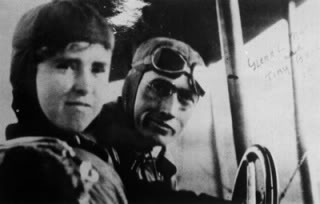
Tiny Broadwick and Glenn Martin

Tiny Broadwick and Glenn Martin

The Broadwicks traveled all over the country with their balloon act. But by 1912, that kind of performance was losing popularity. Times were changing, and heavier-than-air machines were rapidly getting better and better after the Wright Brothers’ pioneering work in the previous decade. Fortunately, a new opportunity arose for Tiny. Out in Los Angeles for the Dominguez Air Show, she met up with famed pilot Glenn Martin. He had seen her jump from a balloon, and he asked if she’d try parachuting from his airplane instead. Like Charles Broadwick, Glenn Martin saw how Tiny would attract spectators for his airplane shows.

Tiny immediately agreed to work for Martin, whose aircraft company is still with us today as Martin Marietta. Charles Broadwick developed a parachute for her. It was made of silk and was packed into a knapsack attached to a canvas jacket with harness straps. A string was fastened to the plane’s fuselage and woven through the parachute’s canvas covering. When the wearer jumped from the plane, the cover tore away and the parachute filled with air.

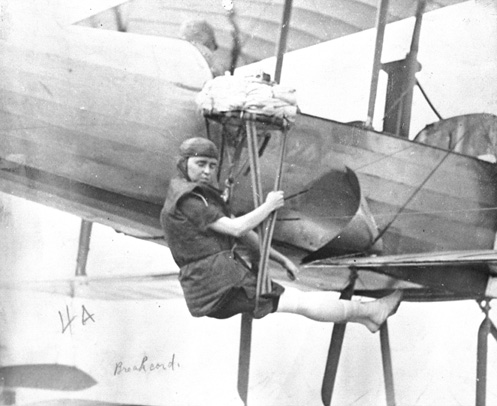
Tiny getting ready for her first jump from an airplane.

Tiny getting ready for her first jump from an airplane.

On her first jump, Tiny was suspended from a trap seat behind the wing and outside the cockpit, with the parachute on a shelf above her. Martin took the plane up to two thousand feet, and then Tiny released a lever alongside the seat, allowing it to drop out from under her. She floated to earth and landed in Griffith Park in Los Angeles, making her the first woman to parachute from an airplane. After that first jump from Martin’s plane, Tiny was in great demand all over the country. She also became the first woman to parachute into a body of water.

The Army Comes Calling

In 1914, representatives of the Army Air Corps visited Broadwick in San Diego and asked her to demonstrate a jump from a military plane. War was already raging in Europe. Many pilots of the corps had already perished, and more would surely follow if nothing was done to help them.

Tiny Broadwick and Army Air Corps officials before her demonstration jumps at North Island, San Diego

Tiny Broadwick and Army Air Corps officials before her demonstration jumps at North Island, San Diego

Tiny made four jumps at San Diego’s North Island that day. The first three went smoothly, but on the fourth jump, her parachute’s line became tangled in the tail assembly of the plane. The wind whipped and her flipped her small body back and forth, and she could not get back into the plane. But Tiny Broadwick did not panic. Instead, she cut all but a short length of the line and plummeted away toward the ground. Then she pulled the line by hand, freeing the parachute to open by itself. Thus she demonstrated what would be known as the rip cord. Her quick thinking and cool under pressure made Tiny Broadwick the first person ever to make a planned free-fall descent.

That accident she survived in mid-air demonstrated that someone who had to leave an airplane in flight did not need a line attached to the aircraft to open a parachute. A pilot could safely bail out of a damaged craft. The parachute became known as the life preserver of the air. During World War I, Tiny served as an advisor to the Army Air Corps.

Tiny Broadwick made more than 1,000 jumps from airplanes, enduring and surviving several harrowing mishaps. Once she ended up on top of the caboose of a train that was just leaving a station; she got tangled up in the vanes of a windmill and in high-tension wires. She suffered numerous injuries along the way – broken bones, sprained ankles, wrenched back. But she loved her work.

Her last jump was in 1922. Chronic problems with her ankles forced her into retirement. She eventually went to work on an assembly line in a tire factory. Later on, she worked as a companion-housekeeper for elderly people.

During World War II, Tiny Broadwick visited military bases and talked to pilots and air crews. She’d bring along one or more of her primitive parachutes and convinced the lads that if she could survive a jump, so could they. The parachute she used for her first military demonstration jump is now in the Smithsonian Institution in Washington.

Tiny spent most of her life in California. In 1955, she appeared on an episode of “You Bet Your Life” with Groucho Marx. She never remarried, but daughter Verla gave her six grandchildren. Tiny also lived to see 15 great-grandchildren and several more great-great-grandchildren. She died in 1978, at age 85. She was buried in Henderson, North Carolina, the town where she first lived with Verla and worked those long days in the cotton mill.

North Carolina prides itself as the state that’s “First in Flight.” Thanks in part to its daughter Georgia “Tiny” Broadwick, the little girl with the big dream and the courage to pursue it, North Carolina might also claim title as the state that was First From Flight – and safely back to earth again. Countless fliers from America who came after Tiny Broadwick would undoubtedly agree, and dip their wings in salute to her.

My Boston, My Beanpot

January 15, 2013

In 1995, on the occasion of the last Beanpot Tournament to be played in historic Boston Garden, I was featured speaker at the annual Beanpot Press Luncheon. Here’s what I had to say at that time – about what the Beanpot means to me and to the city, and about why it will always be special, and uniquely Boston. This is one of my all-time favorite addresses.
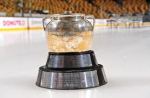
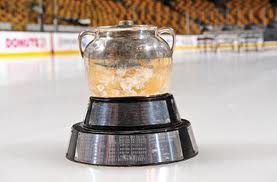
beanpot on iceI’m honored to be allowed to address you today. This is the last time we’ll be gathered for our Beanpot Luncheon in the House of Magic, as Eddie Powers used to say. We all have so many memories from this building.

I’m not going to do much personal reminiscing about Beanpots past, though. I have a much bigger message. I have some thoughts about Boston. About this tournament. About its mystique. Its grandeur. Its irresistibility.

I would like to tell you my biggest Beanpot thrill, however. On that wild overtime night, back in 1980, Alan Segal and I were on the air. I had the play-by-play mike when Wayne Turner scored his goal. Northeastern has won the Beanpot! After 29 years! And I told the world about it. That’s a big thrill, for people like me.

There was another man on play-by-play that night. He probably told more people about it than I did. I want to thank him for all he’s done for Boston sports, and congratulate him on his retirement. Longtime Boston Bruins announcer Bob Wilson, would you please stand and be recognized?

That was special. We all like to see the underdog win. But that goal was the most important in the history of this tournament. It made the Beanpot a four-team event. It brought Northeastern to a new level of prestige. It was level Northeastern hadn’t yet achieved, and which it’s maintained to this day. That goal re-made Northeastern hockey. We’re all better off for it. And I told the world about it. That was a thrill.

But enough of my personal memories. Whenever Snooks Kelley took this podium, we all looked forward to him. And he said the same thing every year. The Beanpot is not just an athletic must. It’s a social must.

And that’s true. There are people in Boston who come to the Beanpot who never attend another sporting event. I think I know why that happens. That’s my message.

So no more personal reminiscences…although 1976…Richie Smith…going around Gary Fay for that shorthanded goal…Gary’s still got a bruise on his cheek where he fell down…one of two shorthandeds by BC that night…I was broadcasting that game too, with David Pearlman…another big upset, BC over BU…that was special But why is the Beanpot so special to Boston?

Father Frank Sweeney of Boston College has a book about out city. It’s called “It Will Take a Lifetime.” And it begins this way:

Boston to me is the poetry of its street names. Cornhill. Cricket Lane. Haymarket. Pudding Lane. Appian Way. Province Steps. Battery March. Damnation Alley. Pie Alley. Turnagain Alley. Winter Street. Summer. Autumn, Spring.”

The first time I read those words they just leapt off the page at me. That’s because when I was a little boy, I and my friends used to sneak into town from Winthrop on Saturdays and explore our city. Meet it up close and personal. I didn’t know what those street names meant then. But I know now. And nothing compares to Boston, for the sheer poetry of its street names. It’s just one of the things that made growing up in Boston so wonderful.

But when I was growing up here, Boston to me was its sporting life. Sport is as old as humanity. Sport identified with cities is as old as civilization. Every city has its sporting life. But here in Boston, we’re truly blessed. We of my generation have four matchless traditions. They’re really not traditions, they’re more like defining events. They remind us of who we are. They make our city a small town. They bring us together. These four traditions are:

Fenway and the Sox
 The Boston Marathon
 Celtic Pride
 and the Beanpot Tournament

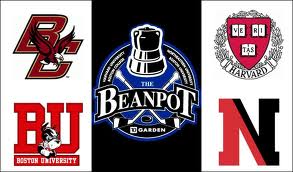
beanpost schoolsAnd the greatest of these is the Beanpot Tournament. It’s the most essentially Boston, of all these four, for reasons that we’ll see. But let’s look at them.

Fenway and the Sox. A field of dreams. It was in the movie. And well it should have been. You’ve all had the same dream I have. I dream of being Carlton Fisk. Only in Game 7, not Game 6. And when that ball goes off into the night, and the series crown comes back…finally, we banish the miserable ghost of Harry Frazee, and we welcome back the shade of the Bambino, back to where he really belongs…everybody from Boston has that dream. We’re all waiting together for it to happen. And some day it will.

The Marathon. The most ancient of athletic events. Once a year, it happens here. On Patriots’ Day. That’s the day America was conceived, and they fired the shot heard ‘round the world. For the Boston Marathon now, the whole world turns its eyes to Boston. And all of Boston turns out, millions of us, to welcome the athletes of the world to our city. That’s Boston at its best. And it’s not just a race, the Boston Marathon. It’s a man. Old Johnny Kelley. The marathon isn’t over until Johnny finishes. And we all wait to welcome that man, forever young at heart. What an achievement. Over 62 years competing in that grueling test. We’ll never see his like again.

Celtic pride. As old Johnny is to individual achievement, the Celtics are to professional team achievement. 16 world championships. Eight in a row. The Celtics always found a way to win for us. They won when they should have, and they won when they shouldn’t have. No matter how much they were up against it, the Celtics always dug way down, deep into the very soul of their team, and found a way to win.

You might ask what all this has to do with a talk about the Beanpot. I think it has a lot to do with it.

That’s because the man who owned the Celtics, the man who was ultimately responsible for all they were able to accomplish, was a hockey man. He was a founder of the Beanpot. He was a man for all seasons in Boston. Walter Brown. He was my uncle. I want to tell you about him.

I was the last member of my family to see Uncle Walter alive. I stopped in his office here in the Garden one day. It was about 33 years ago. I was all excited and nervous. I’d been accepted to BC High for the fall. He said to me, “You know, I wanted to go to BC High. They wouldn’t let me in. I had to go to Bryant and Stratton.”

That’s true. And he never went to college. But by the peak of his career here, Walter was president and owner of the Celtics. President of the Bruins. President of the Garden. And president of the BAA. A man of sterling character, charitable to a fault. If ever any one man personified our city, if ever there was a First Citizen of Boston Sport, that man was Walter Brown. A hockey man, first and foremost.

A brief digression. Boston has taken some hits, over the years, on the subject of bigotry. But here’s the Boston that I choose to believe in. Boston broke the color line in the National Basketball Association. It’s a bit hard to believe now, but that league had no black players until Boston, in 1952 I believe, drafted a man named Chuck Cooper. He was the best man available, and they took him.

It wasn’t as courageous as Branch Rickey’s taking Jackie Robinson. But it was the right thing to do. And it cost the Celtics and Walter Brown a lot of money. That’s because Abe Saperstein, the man who owned the Harlem Globetrotters, was furious. He now had to compete for his players. He threatened to boycott Boston, and he did. Boston had to pass up those lucrative Friday night doubleheaders, with the Trotters playing the first game.

But principle triumphed. The right thing won, over the expedient. That’s why, I think, that the Celtics were always able to reach down, further than any other team, and pull out those championships year after year. I am a firm believer that the good guys will win in the end. That’s what the Celtics did.

That’s what I choose to believe about Boston. That’s the character of our city. And it was the hockey man who owned the basketball team, one of the men who founded the Beanpot, who showed us the way.

But of all his accomplishments, I think Walter would be most proud of this Beanpot Tournament, and what it’s become. As I’ve said, he was first, last, and always a hockey man. Manager of the 1936 Olympic Team. Manager of he 1948 team. Owner of the Boston Americans. Hockey Hall of Fame member. President of the Bruins. [1995 Boston University captain] Jacques Joubert, you have his trophy.

Second, because the Beanpot, more than any of our matchless traditions, literally is Boston. His city. Our city. All of the people who built this city, who made it the world class metropolis it is – even though we don’t have a megaplex – not only come to the Beanpot. They play in the Beanpot. And who are they?

The men of Harvard are here. The people who came to these very shores first. The people who defined our American way of life. Boston is the education capital of the world. That’s because Harvard is here. Oh, there are others, but they all stand in line behind John Harvard’s school. Since 1636, the best and the brightest have gone to Harvard. They go there still. Wasn’t it only fitting that the first Beanpot champions were the men of Harvard?
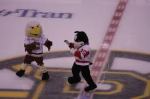
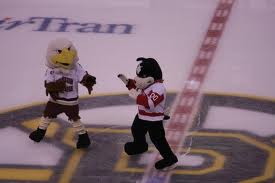
beanpot mascotsThe Catholics are here. Boston College. My school. There is no group of people who have done more to shape and mold our city of Boston, since its founding, than the Catholics. In wave after wave the Catholic immigrants came to Boston. Uneducated, but devout and hard working. And when there was nobody else around to educate them, Boston College was here.

Then there’s Northeastern. I like to call them the kids of the American dream. Because they did it all on their own. The hard way. It takes an extra year to put yourself through Northeastern. You study. You work. Then you study some more. And work some more. And by the time you’re through with the Co-Op program, you’re ready for anything that life could ever throw at you. Northeastern University has given Boston many thousands of graduates in all sorts of professions. But more than that, Northeastern has given Boston an outstanding work ethic. That’s Northeastern’s enduring gift to Boston.

And there’s Boston University. And because this is the Beanpot Luncheon, after all, we save the best for last. And friends, I must confess that I couldn’t find a way to capture, in a capsule, the educational essence of BU. It’s a big, sprawling place. They’ve got everything there. All range and manner of grad and undergrad schools and programs. And maybe, just maybe, the educational character of BU has been eclipsed, from where I stand, by the incandescent personality of the man who runs the place. If you’ve got a question, the man who runs BU has your answer. And it’s always a good answer.

And I want my friends from BU to know how very special they are. I’ve been a student in the Metropolitan College. My grandfather, George V. Brown, was your first athletic director. And you play your superb brand of hockey – the pride of the East – in Walter Brown Arena.

You’re special to all of us who love the Beanpot too. Just look at the Beanpot achievement of Boston University. As old Johnny was to individual accomplishment, as the Celtics were to professional team accomplishment, so is Boston University to college hockey and the Beanpot.

Seventeen championships. 16 second places. In the title game 27 of the last 31 years. There’s no way to explain such a record. Like the Celtics, the Terriers win when they should. They win when they shouldn’t. It doesn’t matter if the coach is Parker or Abbott or Kelley.

I think I know why that happens now. I think that the Terriers, like the Celtics, carry a little bit of Walter Brown with them. They skate down from Walter Brown Arena to Walter Brown’s beloved Garden and something wonderful happens. Celtic green has become Terrier scarlet. You wear it well, BU.

And every time I see Boston University skate out onto the Boston Garden ice, the Boston College man in me says “Oh, God. Here they come again!” But the Beanpot man in me, the Bostonian in me, just tingles with anticipation. I’m seldom disappointed. I know I’m going to see something grand. And so does everyone else in Boston, no matter where their allegiances lie.

That’s what the Beanpot means to me, my friends. That’s what it does to me. That’s what it does to my city.

Boston is indeed many things. The poetry of its street names. The education capital of the world. And Boston is the Beanpot. And the Beanpot is Boston. That’s why it’s a social must. That’s why it’s irresistible. That’s why we’ve all got to be there.

Players. Coaches. Best of luck This is your time. Let’s make this Beanpot, the last one in the old Garden, the House of Magic, the Grande Dame of Causeway Street, one we’ll never, ever forget.

Delivered at the Beanpot Press Luncheon
February 2, 1995

The Babe and the Bar — and Other Fun Facts about Popular Candies

October 28, 2012

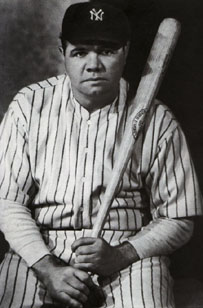
George Herman Ruth

Every child knows the story. Baby Ruth candy bars were not named after Babe Ruth, baseball’s Sultan of Swat. The Curtiss Candy Company dubbed its confection Baby Ruth in honor of the daughter of President Grover Cleveland.

Wrong! That’s a myth. It’s World Series time, so we’re thinking baseball. Halloween is coming, so we’re thinking candy bars. Let’s tell the rest of the story.

Babe Ruth’s Rise to Fame and Breakout Year of 1920

As every Boston baseball fan knows, George Herman Ruth began his career as a pitcher for the Red Sox. He was too good a hitter to keep out of the lineup, so he did a lot of pinch hitting too. In 1919, his sixth and final year with Boston, he hit 29 home runs, up from 11 in 1918. Then came Harry Frazee’s detested sale of the Babe to the Yankees.  In 1920, Ruth hit 54 home runs in the media capital of the world. The following year, he whacked 59 of them. He became the biggest celebrity in sport.

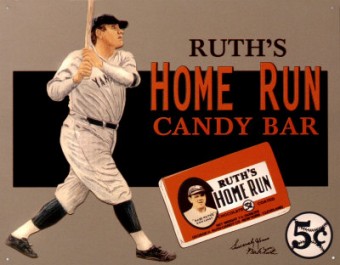
In that year of 1920, Curtiss renamed its Kandy Kake confection “Baby Ruth.”  After the product relaunch, company founder Otto Schnering tried to get Ruth to endorse the Baby Ruth bar. Ruth refused. Instead, in 1926, the George H. Ruth Candy Company tried to register with the United States Patent and Trademark Office its own trademark confection: “Ruth’s Home Run Bar” and “Babe Ruth’s Own Candy.”

The Curtiss Baby Ruth

Here Come the Lawyers

The commissioner of patents turned Babe down, ruling that “Babe” was too close to “Baby,” particularly as it related to “Ruth.” The Court of Customs and Patent Appeals upheld that ruling in 1931, saying that there would be confusion if “Babe” and “Baby” competed for the same sweet-tooth market. The court said it was evident that George Herman Ruth was trying to capitalize on his own nickname, at a time when sales of Baby Ruths were as high as $1 million a month.

Schnering had also sued Ruth’s company for trademark infringement.  Ruth, of course, accused Schnering of using his name. Schnering professed to be shocked, shocked, at such an accusation. Why, his candy was named after “Baby” Ruth Cleveland, Grover’s daughter. The little girl, he maintained, had once visited his company.

Plausible testimony? Grover Cleveland had not been president for 24 years at the time the candy bar hit the market. Ruth Cleveland had died in 1904, at the age of 12, and Grover passed away in 1908. The candy bar didn’t appear until 12 years later.

George Herman Ruth Candy Company’s Home Run Bar

The candy maker steadfastly maintained that it was just a coincidence when it renamed Kandy Kake “Baby Ruth” in the very year that George Herman Ruth exploded onto the national scene with his baseball heroics. Schnering also declared that Babe Ruth wasn’t even famous – another whopper – so why would he possibly want to associated his candy bar with the Babe.

Baby Ruth Cleveland indeed! But the courts believed the company – or they ruled in its favor anyway.  Ruth never collected a penny in royalties. All he could say, in closing, was “Well, I ain’t eatin’ your damned candy bar anymore!”

The Story Doesn’t End  

In 1923, Schnering hired a pilot to fly his plane over Pittsburgh and drop several thousand Baby Ruth candy bars over the city. Each candy bar was equipped with a parachute to avoid injuring people.

The Curtiss Candy Company’s headquarters was close to Wrigley Field. In 1932, they set up a giant lighted Baby Ruth sign near the spot where Babe Ruth’s supposed “called shot” home run landed. This advertising of the candy bars remained there for four years.

Babe Ruth’s Home Run Bar is long gone, but Baby Ruth has survived and prospered. Nestle now owns the Baby Ruth candy bar. It obtained the right to use Babe Ruth’s name and likeness from CMG Worldwide, which represents Ruth’s estate.  Nestle can use the famed ballplayer in Baby Ruth marketing campaigns. In 2006, Baby Ruth became “the official candy bar of major league baseball.

The Story Behind Other Candy Names

The November 2012 issue of Mental Floss magazine recounts this tale. It also tells how several other popular confections were named. Samples:

Mr. Goodbar got its name in 1925 when a taster at the Hershey Company said “That’s a good bar.” Milton Hershey didn’t hear him correctly, but thought that “Mr. Goodbar” was a good name for the new candy. Milton, not surprisingly, got his way.

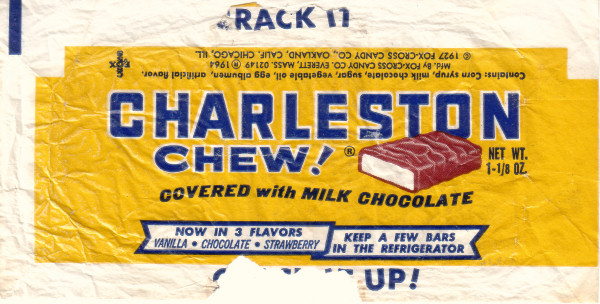
Charleston Chew was introduced in 1922, when the Charleston was a popular dance. Even I remember watching people doing the Charleston on our black-and-white television – which had two channels, Four and Seven, along with the educational Channel Two.

Junior Mints is a play on the 1940s stage production Junior Miss.

Tootsie Roll is named for the daughter of Leo Hirschfeld, the candy’s creator.

Kit Kat debuted in 1935 as Rowntree’s Chocolate Crisp. The name changed in 1937 to ride along on the reputation of the Kit Kat Club, a swingin’ British men’s club of the 18th Century.

3 Musketeers wasn’t always a chocolate bar. At its 1932 introduction, it consisted of three separate pieces – chocolate, vanilla, and strawberry – hence the name.

Snickers was named for the favorite horse of the bar’s inventor, Frank Mars.

Milky Way’s name had nothing to do with astronomy.  Its name comes from a malted milkshake of the 1920s.

….and now you know the rest of the story!


Earthshine: The DaVinci Glow

July 8, 2012

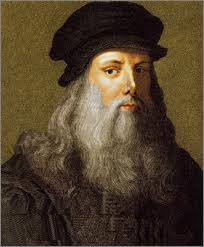
When you think of Leonardo Da Vinci, you probably think of the Mona Lisa or 16th-century submarines or, maybe, a certain suspenseful novel that has been made into a movie. That’s old school. From now on, think of the Moon. Little-known to most, one of Leonardo’s finest works is not a painting or an invention, but rather something from astronomy: He solved the ancient riddle of Earthshine.

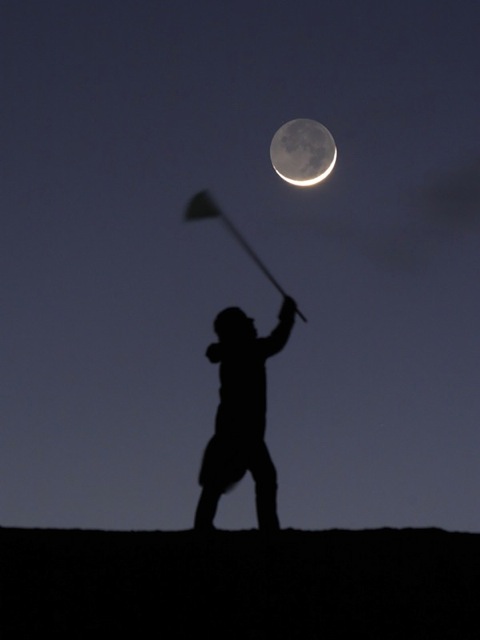
You can see Earthshine whenever there’s a crescent Moon on the horizon at sunset.  Look between the horns of the crescent for a ghostly image of the full Moon. That’s Earthshine.  There should be one on July 15 – and at dawn that day it will also be framed in a celestial triangle with Jupiter and Venus. Worth getting up early to see it – hope there are no clouds!

For thousands of years, humans marveled at the beauty of this “ashen glow,” or “the old Moon in the new Moon’s arms.” But what was it? No one knew until the 16th century when Leonardo figured it out.

In modern times, the answer must seem obvious. When the sun sets on the Moon, it gets dark–but not completely dark. There’s still a source of light in the sky: Earth. Our own planet lights up the lunar night 50 times brighter than a full Moon, producing the ashen glow.

Visualizing this in the 1500s required a wild kind of imagination. No one had ever been to the Moon and looked “up” at Earth. Most people didn’t even know that Earth orbited the sun. (Copernicus’ sun-centered theory of the solar system wasn’t published until 1543, twenty-four years after Leonardo died.)

Leonardo

Wild imagination was one thing Leonardo had in abundance. His notebooks are filled with sketches of flying machines, army tanks, scuba gear and other fantastic devices centuries ahead of their time. He even designed a robot: an armored knight that could sit up, wave its arms, and move its head while opening and closing an anatomically correct jaw.

To Leonardo, Earthshine was an appealing riddle. As an artist, he was keenly interested in light and shadow. As a mathematician and engineer, he was fond of geometry. All that remained was a trip to the Moon. This marvelous Renaissance man made that mental journey.

In Leonardo’s Codex Leicester, circa 1510, there is a page entitled “Of the Moon: No Solid Body is Lighter than Air.” He states his belief that the Moon has an atmosphere and oceans. The Moon was a fine reflector of light, Leonardo believed, because it was covered with so much water. As for the “ghostly glow,” he explained, that was due to sunlight bouncing off Earth’s oceans and, in turn, hitting the Moon.

Not oceans – clouds do most of Earth’s reflecting. And the Moon has no atmosphere. But he was basically right. Nice going, Leonardo da Vinci!

Firsts and Superlatives

June 25, 2012

Americans love a winner. That’s what General George Patton said, anyway.  I don’t disagree with the old polo player and 1912 Olympic pentathlete, but I’ll go a step further and say that Americans also love superlatives. We enjoy learning about them – the first, the best, the biggest, the highest, the lowest, the hostess with the mostest. Finally, we like to know the stories behind their stories, the real scoop. So here, in no particular order, are several firsts, superlatives, and back stories that I hope you find interesting.


The First President of the United States

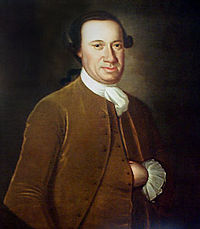
John Hanson

The first president of the United States was not George Washington.  His name was John Hanson.  He was from Maryland, a delegate to the Second Continental Congress, and was the first of eight men to serve one-year terms as president under the Articles of Confederation.

On March 1, 1781, Maryland’s ratification of the Articles put them into effect. In November of that year, Hanson became the first President of the Continental Congress to be elected for an annual term as specified in the Articles.  His title was “President of the United States in Congress Assembled.”

Unlike the Constitution, the Articles of Confederation did not enumerate the powers of the president.  There was no executive branch of the government, and the presidency was largely a ceremonial position.  But Hanson and his successors were the only individuals who had the responsibility to correspond and negotiate with foreign governments.  John Hanson also approved the Great Seal of the United States, which is still in use today.

Upon his death on November 21, 1783, an obituary in the Maryland Gazette read, in part, “It is doubtful that there ever lived on this side of the Atlantic a nobler character or shrewder statesman…And it is extremely doubtful if there has ever lived in an age since the advent of civilization a man with a keener grasp of, or a deeper insight into, such democratic ideals as are essential to the promotion of personal liberty and the extension of human happiness. He was firm in his opinion that the people of America were capable of ruling themselves without the aid of a king.”


The World’s Highest Mountain

Mount Everest (29,027 feet above sea level) is not the highest mountain on the earth. The highest, when measured by distance of mountain peak to the center of the earth, is Mount Chimborazo (20,702). Chimborazo is an extinct volcano in Ecuador. It is right near the Equator, and because the earth bulges out at the Equator due to centrifugal force of the earth’s rotation, Chimborazo’s peak is 7,109 feet farther from earth’s core than Everest’s.

Near Chimborazo is Cayembe, slightly lower and directly on the Equator. it is the only place on the Equator where there is snow year-round.


The First All-America Quarterback

In 1889, Caspar Whitney of Harper’s magazine selected the first All-America college football team.  All of the team’s members were from the “Big Three” teams – Harvard, Yale and Princeton. The quarterback on the team was Edgar Allan Poe, who played for Princeton. He was named for his famous second cousin twice removed.

The story goes that after Princeton beat Harvard 41-15, a Harvard man reportedly asked a Princeton alumnus whether Poe was related to the great Edgar Allan Poe. The Princeton guy replied, “He is the great Edgar Allan Poe.'”

Poe graduated Phi Beta Kappa and later served as the Attorney General of the State of Maryland from 1911 to 1915.  Had he been born a century or so later, he would certainly have been a first round draft choice of the Baltimore Ravens.

The Richest Country on Earth

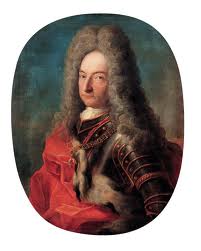
Anton Florian von Liechtenstein

Liechtenstein has the world’s highest per capita income. It is also the only country in the world to be named after people who purchased it, the only country of the Holy Roman Empire that is still in existence, and the world’s biggest exporter of false teeth.

Liechtenstein is Europe’s fourth-smallest country (after Vatican City, Monaco, and San Marino). It is named for the Liechtenstein dynasty, which from around 1140 had possessed Castle Liechtenstein in Lower Austria. Through the centuries, the Liechtensteins acquired vast tracts of land in Central Europe. But all of their territories were held as fiefs under other nobles; none of the lands were held directly under the imperial throne. That meant the Liechtensteins were unable to qualify for a seat in the Reichstag, the imperial parliament.

The family wanted into the Reichstag, so they finally arranged to purchase the “lordship,” of Schellenberg in 1699 and the county of Vaduz in 1712. These places fit the bill; their sovereigns reported directly to the Emperor.

On January 23, 1719, Holy Roman Emperor Charles VI decreed that Vaduz and Schellenberg were united into a single territory. He raised the territory to the status of principality and named it in honor of his “true servant, Anton Florian of Liechtenstein.”   That’s how Liechtenstein became a sovereign member state of the Empire.  It is the only surviving state (of around 1,800) of that Empire.  Not a bad accomplishment, but it’s not like the owners actually cared about the place.  No princes of Liechtenstein even set foot in the principality for over 120 years after it came into being.

Welcome to my blog!

November 16, 2009

This is my first post. Welcome!

I set up  this blog site about a year and half before I decided to start blogging in earnest. I’m looking forward to writing about language, communications, writing, history, current affairs, sports, and society in general.  I’ll comment on what I’ve read, movies and shows that I’ve seen, good things (and perhaps not-so-good things) that others have said, written, and done.

I won’t be telling you what I had for breakfast, or how my last trip to the market turned out.

I hope you’ll find what I have to say to be worthwhile, and that you’ll let me know how you feel.