Hey, it’s summer. So what do we do? We travel. We read. And as Emily Dickinson succinctly reminded us, we can do both at the same time: “There is no Frigate like a Book//To take us Lands away.”
I’ve done a bit of traveling in this manner over the past many weeks. I’d like to share a few thoughts and impressions of some of my journeys with you. First up:
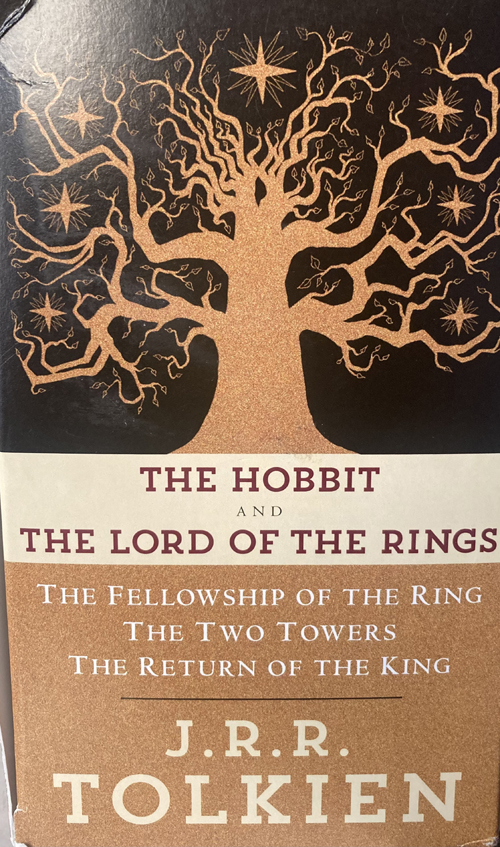
The Lord of the Rings, by J.R.R. Tolkien
This was my second time around for Tolkien’s masterwork, the trilogy plus The Hobbit, its indispensable prelude. If, like me, you’re already read it, I think you’ll get an immense amount of enjoyment if you take it up again. And if you have children or grandchildren who are looking for something good to read, something that will stay with them for many years, they can’t do any better than The Lord of the Rings.
Some 50 years after my first reading, I remembered almost every highlight of Frodo Baggins’s epic journey. Nominated the bearer of the One Ring of Power by the elves, men, and dwarves in the Council of Elrond, he succeeds –just barely – in his heroic quest to carry the Ring to the only place where it could be destroyed and kept away from the Dark Lord Sauron: the volcanic depths of Mount Doom in the desolate Land of Mordor.
I knew how it was going to end, so on this second reading I found that I could go at a more leisurely pace, picking up on some of the details I’d missed, recognizing for the first time some of the imagery and classical allusions, and enjoying the songs and the poetry.
On the other hand, I remembered very little of the Great War of the Ring. It actually took up more of The Return of the King, the trilogy’s third book, than did the perilous journey of Frodo and his ever-faithful servant Sam. The war served to distract Sauron and his armies as Frodo and Sam inched closer to Mount Doom. Aragorn, the organizer and leader, marries the Elven queen Arwen and takes back the throne as Elessar, King of the West. The good guys won, and the Third Age of Middle Earth came to an end.
In the foreword, Tolkien writes, “As for any inner meaning or ‘message,’ it has in the intentions of the author, none…I cordially dislike allegory in all its manifestations…I much prefer history, true or feigned, with its varied applicability to the thought and experience of readers.”
Well, whatever the author intended, I again absorbed several messages, all of which can be found in great literature: examples of courage, loyalty, steadfastness, love, deceit, treachery. They’re all on display here. So too is the eternal truth about power. The lust for power overwhelms and corrupts even the best of us.
Along the way the One Ring mesmerized and seduced the good warrior Boromir and the once-good wizard Saruman the White. Nor could Frodo, brave and virtuous, resist. At the end of his quest, rather than cast the Ring into the cracks of doom, he declares “I have come, but I do not choose now to do what I came to do. I will not do this deed. The Ring is mine!”
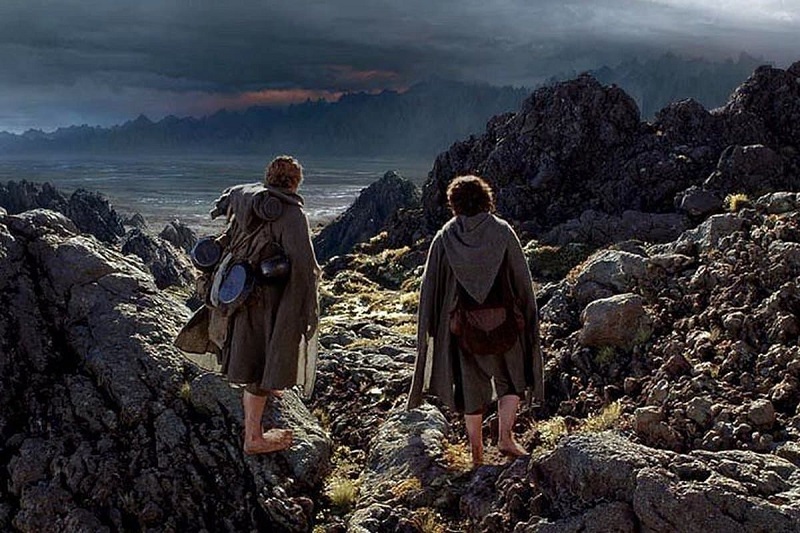
As Frodo puts the Ring on and becomes invisible, Sam gets bowled over by the repulsive Gollum, who once possessed the Ring and has stalked them all the way. Gollum wrests the Ring away from Frodo, but topples into the volcano and assures his own and the Ring’s destruction. Thus does an evil creature with evil intent bring about a good end – yet another lesson.
Truth to tell, Sam is a great a hero as Frodo. Loyal and totally devoted to his master, he saves Frodo from the monstrous spider Shelob. He also briefly takes custody of The Ring while Frodo is bound up in Shelob’s cave and nearly dies. A further lesson and reminder: it’s often the humble who perform the most heroic deeds.
Turning to the language and imagery and poetry, I did remember almost verbatim the introductory verses:
Three Rings for the Elven-kings under the sky,
Seven for the Dwarf-lords in their halls of stone
Nine for mortal men doomed to die,
One for the Dark Lord on his dark throne
In the Land of Mordor where the Shadows lie.
One Ring to rule them all, One Ring to find them,
One Ring to hold them all and in the darkness bind them
In the Land of Mordor where the Shadows lie.
The above lines set the stage for Frodo’s heroic quest. I did not, however, recall this even more beautiful poem, which came as a postscript in a letter to Frodo from the wizard Gandalf. It foreshadows the exploits and eventual triumph of Aragorn:
All that is gold does not glitter
Not all those who wander are lost;
The old that is strong does not wither,
Deep roots are not reached by the frost.
From the ashes a fire shall be woken,
A light from the shadows shall spring;
Renewed shall be blade that was broken,
The crownless again shall be king.
These are just two of the many poems and songs that grace the pages of The Lord of the Rings. As for the imagery and allusions, Frodo’s leave-taking of Sam almost reminded me of Jesus preparing his followers for the coming time when He would be in Heaven, and no longer be with them.
“Where are you going, Master?” cried Sam, though at last he understood what was happening.
“To the Havens, Sam” said Frodo.
“And I can’t come.”
“No, Sam. Not yet, anyway, not further than the Havens. Though you too were a Ring-bearer, if only for a little while. Your time may come. Do not be too sad, Sam. You cannot he always torn in two. You will have to be one and whole, for many years. You have so much to enjoy and to be, and to do.”
When at last they came to the gate of the Havens, Cirdan the Shipwright came forth to greet them. “Very tall he was, and his beard was long, and he was grey and old, save that his eyes were as keen as stars.” All I could think about here was Charon the Boatman of Greek mythology. Of course, Charon was a nasty guy who ferried damned souls across the black waters of the River Styx to eternal perdition.
But Cirdan led Frodo and Sam to the quay where a great white ship lay waiting. Gandalf was waiting there, and he would make the journey as well. He had been sent to Middle Earth to combat the Dark Lord, and now his mission as well as the Third Age were ended. Gandalf’s farewell to Sam and companions Merry and Pippin also had its religious overtones.
“Well, here at last, dear friends, on the shore of the Sea comes the end of our fellowship in Middle Earth. Go in peace! I will not say: do not weep; for not all tears are an evil.”
Perhaps that’s the final lesson. We of riper years know it well; those of a younger age have yet to learn it. Not all tears are an evil.
 Veteranscribe's Blog