As I write this, it’s the last day of February. Presidents are on everyone’s mind.
Last week, the country celebrated Presidents’ Day. It used to be Washington’s Birthday, celebrated on February 22. He was born on that date in 1732, but did you know that he actually was born on February 11, 1731? At the time of his birth, the Julian calendar was still in use, and would be for the first 20 years of his life. The Gregorian calendar was adopted in 1752, adding a year and 11 days, in order to more accurately calculate leap years.

Then there’s Lincoln’s Birthday on February 12. Abe deserves his own holiday, in my opinion, but he didn’t get one. I suppose that a Presidents’ Day, in which we honor both of these giants of American history, is a reasonable approach.
This year too, we’re going to be electing a president, come November. So we’re all thinking of that, and mostly with some trepidation. I don’t think I’m being too overtly political here when I say that most likely you agree with me and with most of America that none of the prospective candidates for the November ballot is in any way comparable to our Founding Fathers.
The Founders, after all, were brave, articulate, forthright men of sterling character. They put their lives on the line. And they were totally honest. All the time. Beginning with that felled cherry tree in George Washington’s back yard, they never told a lie. Always played it straight.
Er, not exactly. Not all the time. But sometimes, you gotta do what you gotta do, even if it means lying or exaggerating or dissembling. And history will reward you for it, if you play for the good guys. Consider these little-known backstories about two of our most revered founders, Thomas Jefferson and George Washington.
Take Jefferson and his writing of the Declaration of Independence. Without a doubt, that document is masterful and sublime – at least at the beginning, with the “We hold these truths to be self-evident, that all men are created equal, that they are endowed by their Creator with certain unalienable Rights, that among these are Life, Liberty and the pursuit of Happiness….” And so on.
But that first section ends with “The history of the present King of Great Britain is a history of repeated injuries and usurpations, all having in direct object the establishment of an absolute Tyranny over these States. To prove this, let Facts be submitted to a candid world.”

Those “facts,” are anything but facts. Rather, they are 28 ad-hominem accusations against King George III, a king to whom on December 6, 1775, the Second Continental Congress had declared its allegiance while distancing itself from the real oppressors, the British Parliament: “Allegiance to Parliament? We never owed – we never owned it. Allegiance to our King? We have ever avowed it – our conduct has been ever consistent with it.”
So what happened, over the following six months? Did George III turn into a hateful monster? Did he desire to put into place a reign of tyranny and terror? Of course not. But Thomas Jefferson, probably the most facile wordsmith of all the leaders in the colonies, had to paint the King as just such a villain. He had to make it personal. The nuanced truth behind the issues be damned. And it worked.
Andrew Roberts’s fine book, “The Last King of America,” takes up the rhetorical excesses of the Declaration of Independence in great detail. He maintains that, because it was the King to whom Congress had recently declared allegiance, “unless it took the form of a personal attack, it would not answer the Loyalists’ argument that it was possible to become independent of Britain but remain in a political condominium of some sort with the Crown.”
In other words, they had to go negative – sound familiar? – and do it in a personal manner which also had to be untruthful in the extreme. The 28 charges “were kept deliberately unspecific regarding places and dates, for the obvious reason that most were untrue, since George had never sought to establish any kind of tyranny over America.”
Space doesn’t allow us to go into the detail that Roberts lays out. But here are just a few examples:
“He has kept among us, in times of peace, standing armies without the consent of our legislatures.” Well, yeah. The French and Indian War had concluded in 1763, and according to Roberts “a standing army on the western border had been the only way of protecting the colonies; the colonies had actually voted their thanks for what the British army had done.”
“He has transported us beyond the seas to be tried for pretended offences.” That never happened. A law allowing for this had been in place since the time on Henry VIII, and it was to deal with traitors and treasonable crimes. But George III never used it.
“He has transported large armies of foreign mercenaries to complete the works of death, desolation, and tyranny, already begun with circumstances of cruelty and perfidy scarcely paralleled in the most barbarous ages, and totally unworthy of the head of a civilized nation.” But Jefferson failed to mention that, fighting on America’s side, were Baron von Steuben, the Marquis de Lafayette, General Casimir Pulaski’s Legion, Bartholomew von Heer’s Provost Corps, and General Armand’s Independent Chasseurs.
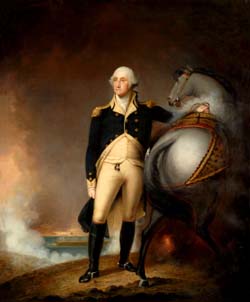
“He has excited domestic insurrections against us and has endeavoured to bring on the inhabitants of our frontiers the merciless Indian savages, whose known rule of warfare is an undistinguished destruction of all ages, sexes, and conditions.” Jefferson must have forgotten that Congress tried to outbid the British for the supports of the Indigenous Nations, and that Stockbridge Native Americans were members of the Massachusetts Militia, and that Massachusetts had a provincial alliance with the Mohawks.
“He has plundered our seas, ravaged our coasts, burnt our towns, and destroyed the lives of our people.” This points to the destruction of Norfolk, Virginia. Only problem was that Norfolk was primarily a Loyalist town and the burning was done by the Patriots, not by the Redcoats.
By now, I think you get the point. Thomas Jefferson never let the facts get in the way of a good story. And that final item lets us segue neatly into an adventure in plausible deniability by the father of our country, George Washington. He was almost certainly involved in and ultimately responsible for “The Great Fire of 1776” in New York. More than 500 buildings, including Trinity and Lutheran churches, were destroyed.
British soldiers had marched triumphantly into New York on September 15, 1776. Washington’s army had to flee, but six nights later, fire broke out in the city’s southern wharves. There were no bells left in the city of sound the alarm; Washington’s men had taken them all for cannon fodder. Strong winds had spread the blaze and turned much of the city, which was also teeming with Loyalists, into a waste land.
Washington had wanted to burn the city down before he fled, but Congress forbade it and told him to make a peaceful retreat. He complied grudgingly.
But two weeks later, writing to Lund Washington, a distant relative and manager of his Mount Vernon estate, GW stated, “Providence – or some good honest Fellow, has done more for us than we were disposed to do ourselves.”
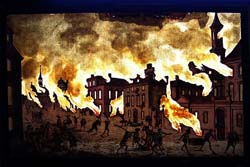
The rhetoric on the Patriots’ side claimed it was indeed some divine providence, or perhaps even British soldiers out plundering the city, that started the blaze. The Brits believed otherwise, pointing out that arsonists had to have done it because the blaze broke out in several places at once. They also pointed to Washington’s absconding with the fire bells as something that couldn’t have been a coincidence.
A subsequent investigation by the Brits couldn’t prove anything. But in June 1777, they caught Abraham Patten, a spy who was plotting to set afire the town of Brunswick, NJ. Before he was hanged as a spy, Patten admitted that he had helped start the New York fire. He didn’t name any accomplices, however. Shortly thereafter, Washington wrote to John Hancock and requested that they secure some funds for Patten’s widow.
No, we can’t expect our presidents to be totally honest all the time. We should know that by now. And they should have known it back in 1776. Some things never change.
 Veteranscribe's Blog