Posts Tagged ‘English history’

Book Review and Reflection  – “Katherine:” Back to the Middle Ages.

February 24, 2025

Several times during the last few weeks, I found myself thinking of Jiminy Cricket and Emily Dickinson.

Jiminy, those of a certain age will recall, used to sing “Books take you ‘cross the sea and down along a trail that never ends.”  Emily, many will remember from high school, wrote “There is no Frigate like a Book, To take us Lands away.”

I recently returned from across the sea and lands away when I put down the 592-page historical novel Katherine, by Anya Seaton.  This was one of those exceptional books that I just didn’t want to end. I felt like I was back in that time of Geoffrey Chaucer, of courtly love and arranged dynastic marriages, of treachery, adultery, and murder in the castles, of the Black Death and the Hundred Years’ War, and of the history plays of William Shakespeare.
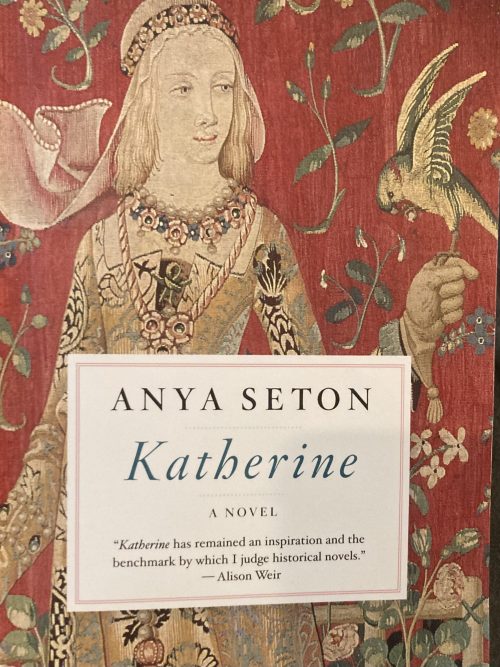
Katherine Swynford was mistress, love-of-life and eventual third wife to John of Gaunt, one of England’s greatest noblemen. Son of King Edward III and Duke of Lancaster, he never became King of England. But he would have been a much better monarch than his simpering nephew, Richard II, who succeeded Edward III on the throne and eventually screwed things up royally – pun intended.

Gaunt was smitten by Katherine’s beauty and regal presence almost from the time they met.  He was married to the wealthy Blanche of Lancaster, with whom he had three children. Catherine, without dowry and second daughter of Payn de Roet, a knight who died at an early age, was married to another knight of slender means, Sir Hugh Swynford.  She bore him two children.

Swynford was in Gaunt’s service and was a reliable and fierce warrior, but that’s about all he had going for him. He died under mysterious circumstances after returning from a military campaign. Gaunt’s first wife Blanche perished in the Black Death plague. Their spouses’ deaths would have freed John  and Katherine to be together and make it official, you’d have thought, but that’s not what happened. He first married Queen Costanza of Castile, and he spent a good deal of time away in Spain trying to win more military victories and to become king of that realm. When he was in England, he eclipsed in strength and prestige the hapless King Richard, but he remained loyal until his death.

John’s loveless, political second marriage didn’t keep him and Katherine from having four children of their own. Somehow, that flame kept flickering and never went out. John found ways to share some of his wealth and keep her and their four bastard children financially solvent. It wasn’t that she was always there standing by him. They were apart and out of touch for long periods of time. She even contemplated suicide at one point. They finally married after his second wife died and spent three years together as husband and wife.

The author, Anya Seaton, took about a year and a half to write this book. She stayed true to historical fact and interpolated plausible though undocumented facts and motives where the record was lacking. She traveled through England and stood where her chronicled events took place. Her sources, among others, were Gaunt’s personal registers and the Jean Froissart’s Chronicles, highly detailed descriptions of the events of the Hundred Years’ War.
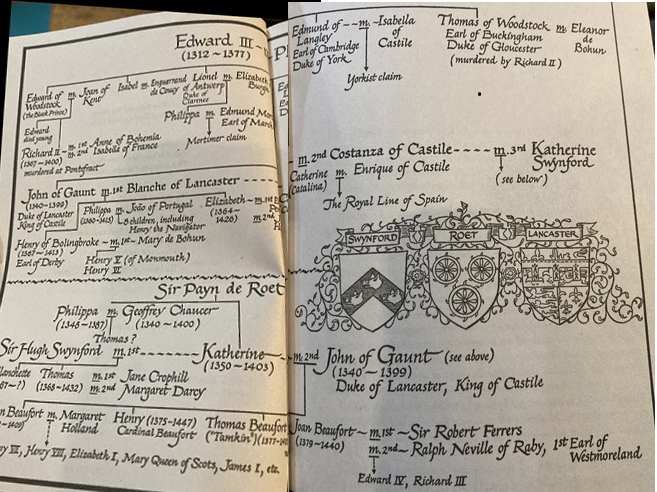
John’s and Katherine’s genealogy chart

As she remarked in her journals, “I’m writing at least plausible history… I’m taking some liberties, etc.”  Some of those liberties included imagining a deep-seated demon that plagued Gaunt from childhood and almost caused him to plunge England into a civil war. She has Katherine intervene and, through loving attention, quell the fires of his fury. As Seaton describes it, “Pretty psychiatric but I had to do it.”

Another couple of undocumented surmises by the author were her treatment of Geoffrey Chaucer and of Julian of Norwich, the revered religious leader, anchoress and author of the book of mystical devotions, Revelations of Divine Love.

Chaucer was actually Katherine’s brother-in-law, in a loveless marriage to her sister Philippa. He makes several brief appearances and inserts some wry and pithy observations; Seaton imagines that his Troilus and Criseyde was inspired by Katherine and John.  She also had Swynford poisoned by a treacherous loyalist of Gaunt’s, although there is no evidence of that. Late in the book, Katherine, overwhelmed with guilt and on the brink of despair, is brought to Julian. Her experiences there, of course, are imagined by the author. Still, it is plausible – and I wanted to believe it was this way – that Julian relayed the following divine message to Katherine:

“It is truth that sin is the cause of all pain; sin is behovable – none the less all shall be well…Accuse not thyself overdone much, deeming that thy tribulation and thy woe is all thy fault; for I will not that thou be heavy or sorrowful indiscreetly.”                                                                                                                                                                                     

Yes, these are liberties taken by the author.  But they work. As Seaton’s biographer Lucinda MacKethan points out about this book and Seaton’s next work, The Winthrop Woman, “Some readers have criticized the history of these works as too heavy, but for most, Anya’s great respect for what might be called the knowability of the worlds she was bringing to light in their greatest asset.”

I have to agree with that. As mentioned above, I felt like I was immersed in those worlds. No one can know what the people in them were actually thinking and feeling.  And her description of the sack and burning of Savoy Palace during the Peasants’ Revolt was nothing short of terrifying. It certainly seemed true to history as far as I was concerned.

And for those aforementioned history plays of Shakespeare – particularly I Henry IV, Henry V, and Richard II – I finally learned who all those characters and parties to the conflicts were. They include, in addition to John of Gaunt, Henry Bolingbroke, Edward the Black Prince, Lord Harry Percy of Northumberland and his son Hotspur, Wat Tyler, Jack Straw, and the Dukes of Gloucester and York. They flit in and out of the history plays, and I always had a hard time remembering who the good guys were and who the bad guys were. Now I feel that I know where they all fit in the tumultuous history of the period.

Anyone who has read Shakespeare or dabbled in history has at least heard the name John of Gaunt. Like me, you probably regarded him as one of the big-time operators in a bygone age. And in that, you’d be right. But that’s the extent of it. Like me, you also would not have realized the profound impact he had on the history of the country of England. Nor, I daresay, had you ever heard of the formidable woman, the long-time mistress who at last became his wife, without whom John of Gaunt would have been just another member of the gone-and-forgotten noble class.

After Gaunt’s death, Richard II went off the rails and was succeeded by Bolingbroke, Gaunt’s son from his first marriage. He became Henry IV, and his son was the much mythologized Henry V. The Beauforts, who were the initially illegitimate children of Gaunt and Katherine, were the progenitors of Henry VII, the Tudor royal line, and the Stuart royal line. That includes, among others, Henry VIII, Elizabeth I, Mary Queen of Scots, and James I. Katherine’s grandsons were Edward IV and Richard III.

Quite a legacy. As the final line of this wonderful book states, in quoting the witches in Macbeth, “Thou shalt get kings, though thou be none.”
History I Never Knew – “The Matrix” and Its Biblical Origin

February 13, 2023

I’m not big on science fiction, so I never saw that Keanu Reeves movie about a dystopian future; Wikipedia calls “The Matrix” “the cyberpunk of science fiction.” Not my thing.  I do vaguely remember matrices from Algebra II. Wasn’t very good at them or that subject, but at least I passed.

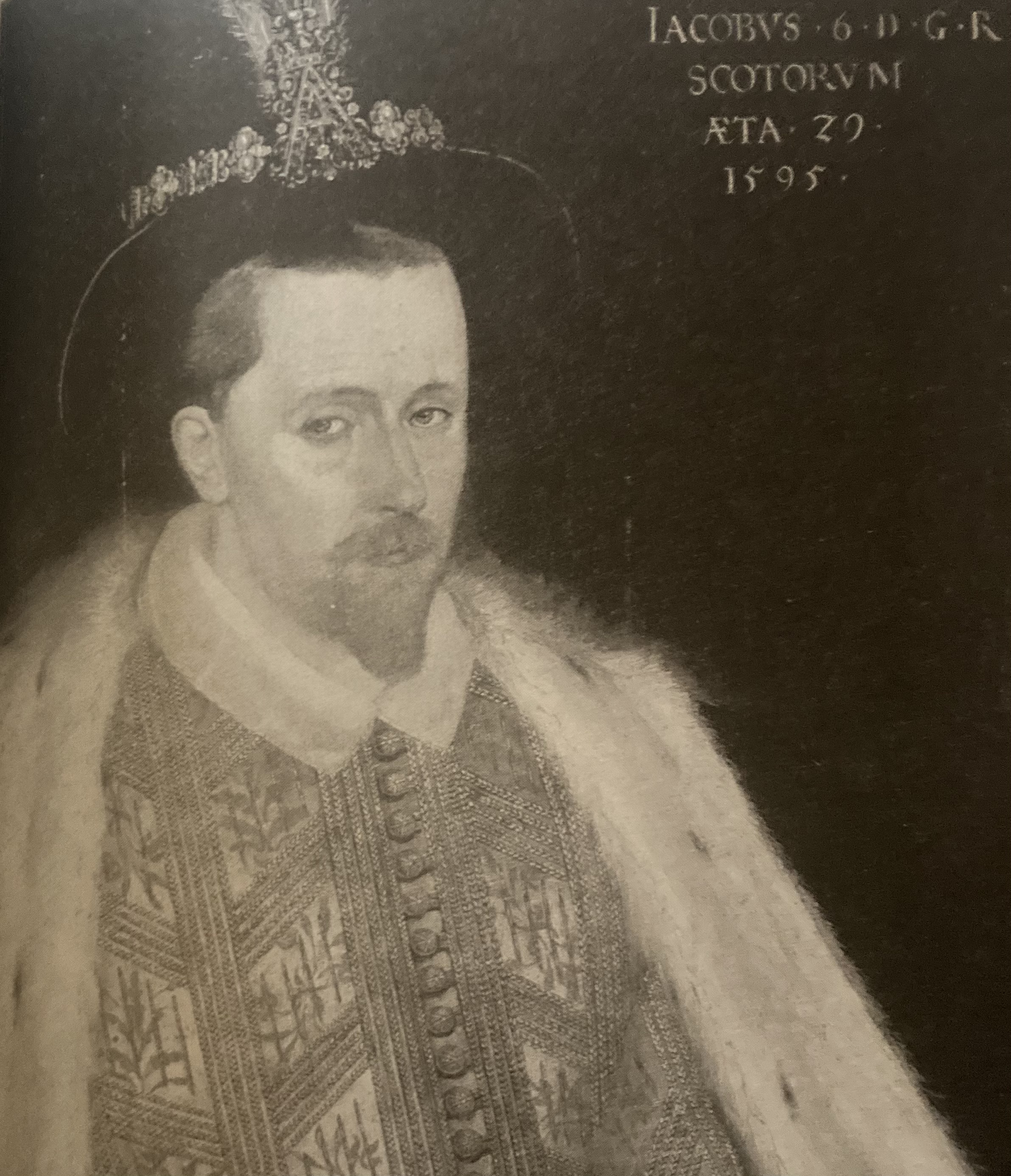
King James VI of Scotland at age 19, the future King James I of England.

So, what is a matrix, anyway? Did you know that it is a womb, that wellspring of all life on earth, that precious gift carried by the female of all species?

I didn’t know either, but now I do.  I saw it in my King James Bible, my 2022 Christmas gift to myself. More about that remarkable piece of literature presently.

In Exodus 12, God unleashes the Angel of Death upon the Egyptians, that final plague which will at last persuade Pharaoh to let his people go. The angel passes over and does not enter the houses of the Israelites when he sees the blood on their doorposts lintels.

Near the end of Chapter 12, God lays out the rules of the Passover commemoration. At the beginning of Chapter 13, He tells Moses, “Sanctify unto me all the firstborn, whatsoever openeth the womb among the children of Israel, both of man and beast, it is mine.”

Now here, Exodus 13: 12, 15, when Moses is repeating the Lord’s instructions to the people, is the passage that struck me:

That thou shalt set apart unto the Lord all that openeth the matrix, and every firstling that cometh of a beast which thou hast, the males shall be the Lord’s…And it came to pass, when Pharaoh would hardly let us go, that the Lord slew all of the first born of the land of Egypt, both the firstborn of man and the firstborn of beast: therefore I sacrifice to the Lord all that openeth the matrix, being males; but the firstborn of my children I shall redeem.”

I’ve checked several other translations of the Bible, and none that I’ve seen say “matrix” in the above passage. Not even the New King James version.  Why, I wondered, did this happen here, and apparently only here?

Let’s start with an online search. I found several definitions of matrix; most were mathematical or scientific. But here’s one clue. According to the Oxford Learner’s Dictionary, the second, and formal, definition is “the formal social, political, etc. situation from which a society or person grows and develops,” e.g. “the European cultural matrix.”

 Well, if it’s something from which one grows and develops, that seems pretty close to a mother’s womb, does it not? Even the word itself seems quite close to the Latin word for mother: mater.

So how did it get into the King James Bible? For a clue, I suggest God’s Secretaries: The Making of the King James Bible, by Adam Nicolson. The King James Bible is regarded, rightly I believe, as Nicolson says in the preface “the greatest work in prose ever written in English.”

And who wrote it? This is the amazing part. It’s the work of a committee. There’s the old joke about a camel’s being a horse designed by a committee. And there’s another saying attributed to G.K. Chesterton: “I’ve searched all the parks in all the cities and never found a statue to a committee.”

But the King James Bible is the exception that proves the rule. Six companies of translators, of whom we know about fifty names, did the job for King James I of England.  They were mostly high-ranking churchmen and academics, all very well connected to the political establishment. And they had to be. Their job wasn’t a religious or theological one. It was profoundly political.

James I had come down the Great North Road from Scotland, where he had been known as James VI. He had been king there since the age of one, when his mother, Mary Queen of Scots, was deposed. She was eventually executed in 1587 for plotting to overthrow Queen Elizabeth I. James succeeded the long-lived Elizabeth in 1603.

To say that he started off rather precariously is an understatement. Liz I had stayed long past her time, and there was a lot of bad stuff going on: a plague, the Gunpowder Plot, Catholic power-grab attempts both real and imagined. James, as king, was head of the Church of England. There were a lot of competing bibles already in circulation, and they were unending sources of trouble.

Just a few examples – William Tyndale, a Lutheran, had to flee to the continent when it looked like his translation was going to offend the authorities. He ended up being murdered – garroted — in Flanders, betrayed by an English spy who was probably working for Thomas More, according to Nicolson. Then there was the Calvinist Geneva Bible, an artfully done book that unfortunately contained many explanatory notes that attacked the idea of unfettered royal power. That was the bible brought to America by the Pilgrims; it wasn’t welcome in England, obviously.

 James needed a bible that would reinforce his power as head of the Church of England and king of the realm.  That’s why he assembled his translators and set them to work. It was politics. Religious doctrine and beliefs took a back seat.

But the finished product wasn’t a propaganda piece, either. It didn’t attempt to beat back the fashionable and controversial Puritan doctrines or to compete with the Catholics’ Douay-Rheims Bible. The translators weren’t shameless political suck-ups. They consulted all available versions of the bible in the course of their work, but they also went back to the sources, poring over ancient Greek and Hebrew texts.  They wanted to produce something universal, rather than contemporary.

They succeeded brilliantly, with a bible worthy of the age of Shakespeare, one whose “subject is majesty, not tyranny, and its political purpose was unifying and enfolding, to elide the kingliness of God with the godliness of kings, to make royal power and divine glory one indivisible garment which could be wrapped around the nation as a whole,” as Nicolson sums it up.

The First Westminster Company of translators took charge of the first twelve books of the King James Bible. It was they who selected “matrix” as the precise word for that rendition of Mosaic Law. Their director, Lancelot Andrewes, had been Royal Chaplain to both Elizabeth and James. He “could look the church’s adversaries in the eye, and he was clever enough to slalom around the complexities of theological dispute; not only a great scholar but also a government man, aware of political realities, able to articulate the correct version of the truth. He was a trusty…and used for his extensive network of connections.”

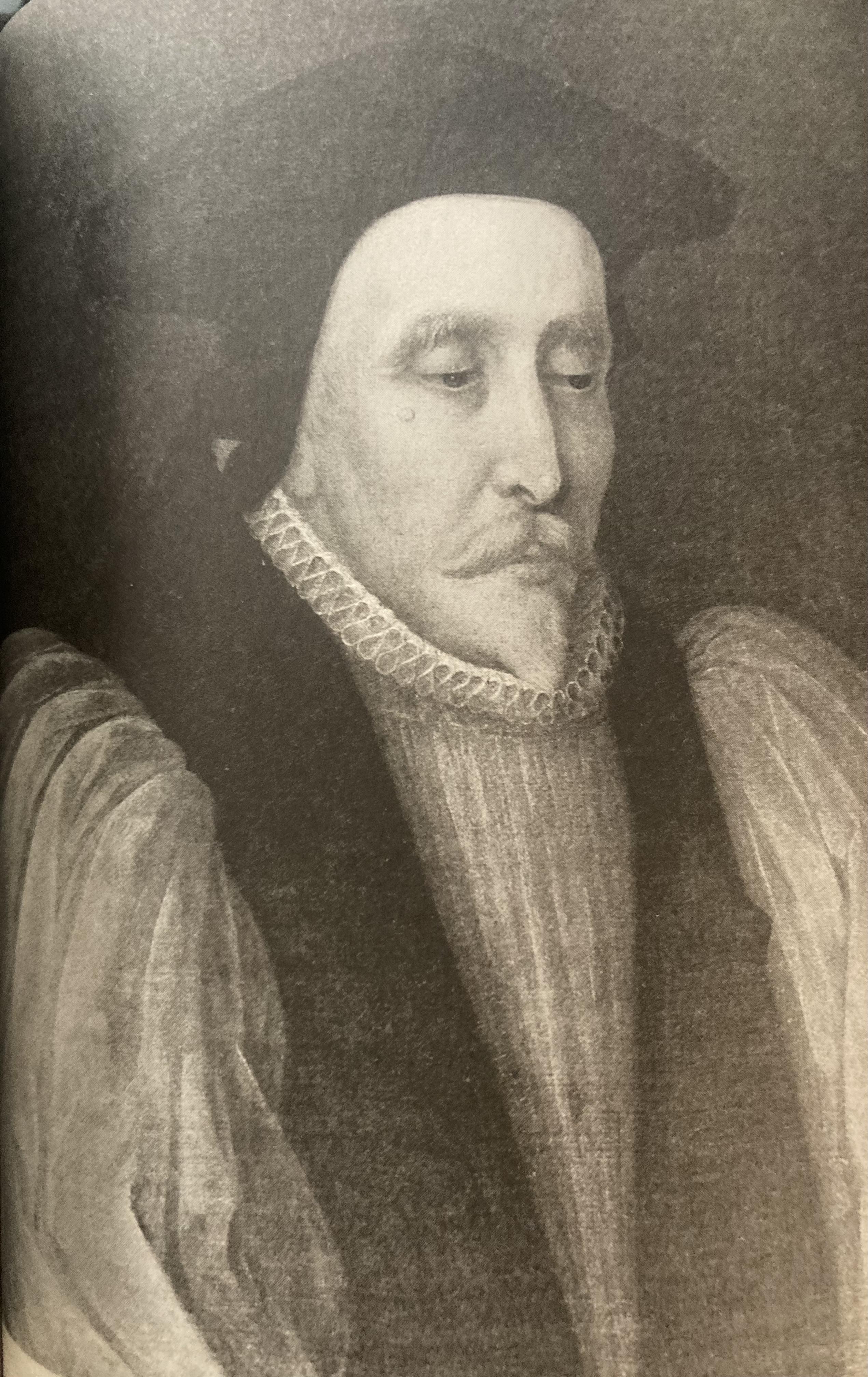
Lancelot Andrewes, chief translator of the King James Bible

Lancelot Andrewes spent five hours every morning in prayer, much of it as he cried copious tears, weeping for the miserableness of his soul.  Maybe he had a guilty conscience. You could say that Andrewes got a helping hand, albeit indirectly, from whores and hookers. Oops, sorry, I mean “sex workers.” How so?

He was also a former Bishop of Winchester. That was one of the most lucrative bishop gigs in the entire Church of England, thanks in large part to the efforts of “Winchester Geese.” Real geese dotted much of the Winchester landscape back in those times, but the area also had a robust and profitable prostitution industry. The busy and popular ladies of the evening were nicknamed after the geese.

The bishop of Winchester had vast land tracts and many properties that housed the dens of iniquity. Much of the bishop’s income came directly from those “Winchester Geese.” Profits from the brothel business also paid for the founding and upkeep of several of Oxford’s most prestigious institutions – New College, Magdalen, and Corpus Christi among them.

You might remember the 1966 pop song “Winchester Cathedral” by the New Vaudeville Band.  If you do, you recall that the singer lamented “Winchester Cathedral, You’re bringing me down. You stood and you watched as my baby left town.”

She probably left town because he didn’t pay his bill.

And now you know the rest of the story – of several stories, actually. I hope I’ve added even a little bit to your worldly wisdom, because

“He that walketh with wise men shall be wise: but a companion of fooles shall be destroyed.”

–Proverbs 13:20