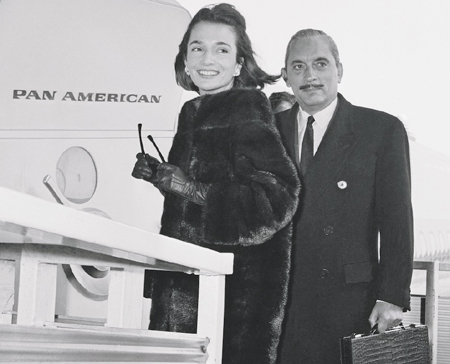
Does the name Princess Lee Radziwill ring a bell? If you’re a member of my boomer generation, it should. Caroline Lee Bouvier was Jackie Kennedy’s younger sister. A failed actress but an active, on-the-prowl socialite, her second of three marriages was to a Polish aristocrat, Prince Stanislaw Albrecht Radziwill. He divorced his second wife to marry Lee, and because his second marriage had never been recognized by the Catholic Church, he was free to marry.
Her Serene Highness Princess Caroline Lee Radziwill
For a while, it looked like Lee had beaten her big sister in the husband-hunting game. Jackie had to settle for a congressman from Massachusetts. But we all know how that turned out.
Anyway, when she got married, Lee began using the title Her Serene Highness Princess Caroline Lee Radziwill. The royalty-besotted American press ate it up and referred to her as Princess Radziwill. However, that was all stuff and nonsense. The Radziwills could no longer call themselves prince, princess, etc. as of 1921 when Poland established its constitution. That document abolished the legal recognition of titles. That didn’t matter to Lee and the Radziwills; as far as they were concerned, they were still royalty.
But who were these Radziwills, anyway? According to “Goodbye Eastern Europe: An Intimate history of a Divided Land,” by Jacob Mikanowski, the Radziwills were “an immensely rich Lithuanian family with a bottomless appetite for power and pleasure.” Many of the Roma, or gypsies as they also were called, had settled in Lithuania and went to work for the Radziwills.
The family’s roots go back to the 15th Century. They had immense wealth and longed to be kings of the Polish-Lithuanian Commonwealth. The other aristocrats and nobles successfully blocked that ambition, so the Radziwills developed expertise in other areas.
The coolest of these endeavors? The training of dancing bears.
If you lived in the Eighteenth Century and wanted a dancing bear for your royal court, you would send your animal to the Bear Academy in Smarhon, which is in today’s Belarus. The Radziwills owned that town. At the academy, on the Street of the Skoromokhs (jesters), the Romas trained the Radziwills’ dancing bears. They also took on the bears of private clients; you had to pay the animals’ room and board for the duration of their training period.
Lee and Stanislaw Radziwill
The Roma taught the bears not only to dance, but also to play the role of servants, waiting on tables, bringing water to the table, and so on.
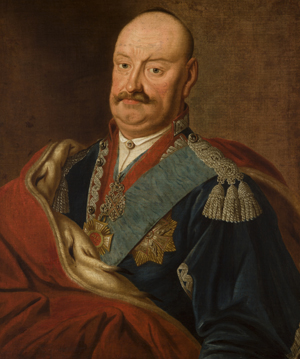
One of the most famous feats took place in the latter part of the eighteenth century, when Prince Karol Radziwill, known as Lord Lovey, owned the town. He was “preposterously rich, possessing sixteen cities, 683 villages, and 25 forests, as well as a mansion in Paris.” Lord Lovey was also “a drunk, a womanizer with a fondness for Jewish women, and a teller of talk tales.”
One day, the leader of the Roma, “king” Jan Marcinkiewicz, decided to play a trick on Lord Lovey. He had his Gypsies teach a group of bears how to pull a horse carriage. He then harnessed six of them and rode off to Lovey’s castle. The prince got such a kick out it that he treated Marcinkiewicz like a real king. He threw a feast that lasted several days. At the end, they all rode off to the prince’s summer palace, trailed by crowds of bears, Gypsies, burghers, and noblemen.
That’s the way the super-rich used to play in those days. Nowadays, they build spaceships and send their girlfriends up to the exosphere or rent the entire city of Venice for their wedding. I think it must have been more fun in Lord Lovey’s time.
And that’s the family into whom Jackie Bouvier’s sister married. Lee and Prince got divorced in 1974 after 15 years of marriage. They had two kids. She married a third time, and that one lasted 13 years. After third divorce, she again began calling herself Radziwill. On one Saturday Night Live episode, Roseanne Roseannadanna referred to her a “one of those classy ladies where you don’t know what she’s the princess of.” Lee lived her final years in the Upper East Side of Manhattan, so I guess she had no room for those Radziwill dancing bears.
Several times during the last few weeks, I found myself thinking of Jiminy Cricket and Emily Dickinson.
Jiminy, those of a certain age will recall, used to sing “Books take you ‘cross the sea and down along a trail that never ends.” Emily, many will remember from high school, wrote “There is no Frigate like a Book, To take us Lands away.”
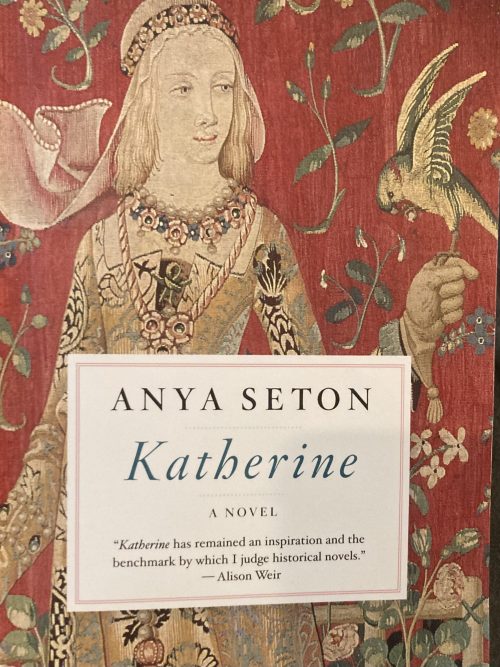
I recently returned from across the sea and lands away when I put down the 592-page historical novel Katherine, by Anya Seaton. This was one of those exceptional books that I just didn’t want to end. I felt like I was back in that time of Geoffrey Chaucer, of courtly love and arranged dynastic marriages, of treachery, adultery, and murder in the castles, of the Black Death and the Hundred Years’ War, and of the history plays of William Shakespeare.
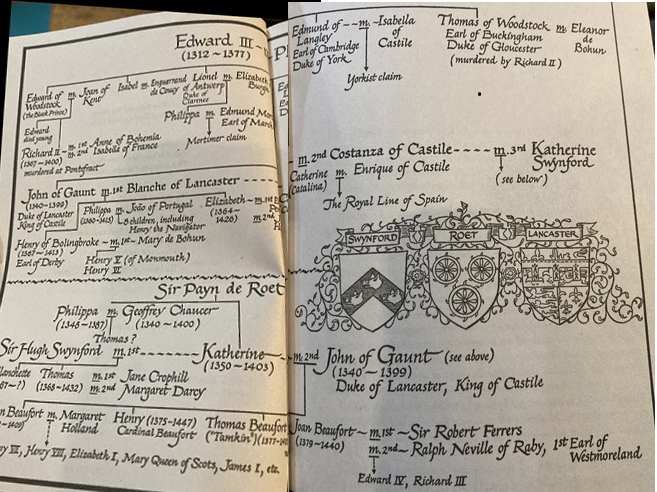
Katherine Swynford was mistress, love-of-life and eventual third wife to John of Gaunt, one of England’s greatest noblemen. Son of King Edward III and Duke of Lancaster, he never became King of England. But he would have been a much better monarch than his simpering nephew, Richard II, who succeeded Edward III on the throne and eventually screwed things up royally – pun intended.
Gaunt was smitten by Katherine’s beauty and regal presence almost from the time they met. He was married to the wealthy Blanche of Lancaster, with whom he had three children. Catherine, without dowry and second daughter of Payn de Roet, a knight who died at an early age, was married to another knight of slender means, Sir Hugh Swynford. She bore him two children.
Swynford was in Gaunt’s service and was a reliable and fierce warrior, but that’s about all he had going for him. He died under mysterious circumstances after returning from a military campaign. Gaunt’s first wife Blanche perished in the Black Death plague. Their spouses’ deaths would have freed John and Katherine to be together and make it official, you’d have thought, but that’s not what happened. He first married Queen Costanza of Castile, and he spent a good deal of time away in Spain trying to win more military victories and to become king of that realm. When he was in England, he eclipsed in strength and prestige the hapless King Richard, but he remained loyal until his death.
John’s loveless, political second marriage didn’t keep him and Katherine from having four children of their own. Somehow, that flame kept flickering and never went out. John found ways to share some of his wealth and keep her and their four bastard children financially solvent. It wasn’t that she was always there standing by him. They were apart and out of touch for long periods of time. She even contemplated suicide at one point. They finally married after his second wife died and spent three years together as husband and wife.
The author, Anya Seaton, took about a year and a half to write this book. She stayed true to historical fact and interpolated plausible though undocumented facts and motives where the record was lacking. She traveled through England and stood where her chronicled events took place. Her sources, among others, were Gaunt’s personal registers and the Jean Froissart’sChronicles, highly detailed descriptions of the events of the Hundred Years’ War.
John’s and Katherine’s genealogy chart
As she remarked in her journals, “I’m writing at least plausible history… I’m taking some liberties, etc.” Some of those liberties included imagining a deep-seated demon that plagued Gaunt from childhood and almost caused him to plunge England into a civil war. She has Katherine intervene and, through loving attention, quell the fires of his fury. As Seaton describes it, “Pretty psychiatric but I had to do it.”
Another couple of undocumented surmises by the author were her treatment of Geoffrey Chaucer and of Julian of Norwich, the revered religious leader, anchoress and author of the book of mystical devotions, Revelations of Divine Love.
Chaucer was actually Katherine’s brother-in-law, in a loveless marriage to her sister Philippa. He makes several brief appearances and inserts some wry and pithy observations; Seaton imagines that his Troilus and Criseyde was inspired by Katherine and John. She also had Swynford poisoned by a treacherous loyalist of Gaunt’s, although there is no evidence of that. Late in the book, Katherine, overwhelmed with guilt and on the brink of despair, is brought to Julian. Her experiences there, of course, are imagined by the author. Still, it is plausible – and I wanted to believe it was this way – that Julian relayed the following divine message to Katherine:
“It is truth that sin is the cause of all pain; sin is behovable – none the less all shall be well…Accuse not thyself overdone much, deeming that thy tribulation and thy woe is all thy fault; for I will not that thou be heavy or sorrowful indiscreetly.”
Yes, these are liberties taken by the author. But they work. As Seaton’s biographer Lucinda MacKethan points out about this book and Seaton’s next work, The Winthrop Woman, “Some readers have criticized the history of these works as too heavy, but for most, Anya’s great respect for what might be called the knowability of the worlds she was bringing to light in their greatest asset.”
I have to agree with that. As mentioned above, I felt like I was immersed in those worlds. No one can know what the people in them were actually thinking and feeling. And her description of the sack and burning of Savoy Palace during the Peasants’ Revolt was nothing short of terrifying. It certainly seemed true to history as far as I was concerned.
And for those aforementioned history plays of Shakespeare – particularly I Henry IV, Henry V, and Richard II – I finally learned who all those characters and parties to the conflicts were. They include, in addition to John of Gaunt, Henry Bolingbroke, Edward the Black Prince, Lord Harry Percy of Northumberland and his son Hotspur, Wat Tyler, Jack Straw, and the Dukes of Gloucester and York. They flit in and out of the history plays, and I always had a hard time remembering who the good guys were and who the bad guys were. Now I feel that I know where they all fit in the tumultuous history of the period.
Anyone who has read Shakespeare or dabbled in history has at least heard the name John of Gaunt. Like me, you probably regarded him as one of the big-time operators in a bygone age. And in that, you’d be right. But that’s the extent of it. Like me, you also would not have realized the profound impact he had on the history of the country of England. Nor, I daresay, had you ever heard of the formidable woman, the long-time mistress who at last became his wife, without whom John of Gaunt would have been just another member of the gone-and-forgotten noble class.
After Gaunt’s death, Richard II went off the rails and was succeeded by Bolingbroke, Gaunt’s son from his first marriage. He became Henry IV, and his son was the much mythologized Henry V. The Beauforts, who were the initially illegitimate children of Gaunt and Katherine, were the progenitors of Henry VII, the Tudor royal line, and the Stuart royal line. That includes, among others, Henry VIII, Elizabeth I, Mary Queen of Scots, and James I. Katherine’s grandsons were Edward IV and Richard III.
Quite a legacy. As the final line of this wonderful book states, in quoting the witches in Macbeth, “Thou shalt get kings, though thou be none.”
As I write this, it’s the last day of February. Presidents are on everyone’s mind.
Last week, the country celebrated Presidents’ Day. It used to be Washington’s Birthday, celebrated on February 22. He was born on that date in 1732, but did you know that he actually was born on February 11, 1731? At the time of his birth, the Julian calendar was still in use, and would be for the first 20 years of his life. The Gregorian calendar was adopted in 1752, adding a year and 11 days, in order to more accurately calculate leap years.
Jefferson at work
Then there’s Lincoln’s Birthday on February 12. Abe deserves his own holiday, in my opinion, but he didn’t get one. I suppose that a Presidents’ Day, in which we honor both of these giants of American history, is a reasonable approach.
This year too, we’re going to be electing a president, come November. So we’re all thinking of that, and mostly with some trepidation. I don’t think I’m being too overtly political here when I say that most likely you agree with me and with most of America that none of the prospective candidates for the November ballot is in any way comparable to our Founding Fathers.
The Founders, after all, were brave, articulate, forthright men of sterling character. They put their lives on the line. And they were totally honest. All the time. Beginning with that felled cherry tree in George Washington’s back yard, they never told a lie. Always played it straight.
Er, not exactly. Not all the time. But sometimes, you gotta do what you gotta do, even if it means lying or exaggerating or dissembling. And history will reward you for it, if you play for the good guys. Consider these little-known backstories about two of our most revered founders, Thomas Jefferson and George Washington.
Take Jefferson and his writing of the Declaration of Independence. Without a doubt, that document is masterful and sublime – at least at the beginning, with the “We hold these truths to be self-evident, that all men are created equal, that they are endowed by their Creator with certain unalienable Rights, that among these are Life, Liberty and the pursuit of Happiness….” And so on.
But that first section ends with “The history of the present King of Great Britain is a history of repeated injuries and usurpations, all having in direct object the establishment of an absolute Tyranny over these States. To prove this, let Facts be submitted to a candid world.”
George III
Those “facts,” are anything but facts. Rather, they are 28 ad-hominem accusations against King George III, a king to whom on December 6, 1775, the Second Continental Congress had declared its allegiance while distancing itself from the real oppressors, the British Parliament: “Allegiance to Parliament? We never owed – we never owned it. Allegiance to our King? We have ever avowed it – our conduct has been ever consistent with it.”
So what happened, over the following six months? Did George III turn into a hateful monster? Did he desire to put into place a reign of tyranny and terror? Of course not. But Thomas Jefferson, probably the most facile wordsmith of all the leaders in the colonies, had to paint the King as just such a villain. He had to make it personal. The nuanced truth behind the issues be damned. And it worked.
Andrew Roberts’s fine book, “The Last King of America,” takes up the rhetorical excesses of the Declaration of Independence in great detail. He maintains that, because it was the King to whom Congress had recently declared allegiance, “unless it took the form of a personal attack, it would not answer the Loyalists’ argument that it was possible to become independent of Britain but remain in a political condominium of some sort with the Crown.”
In other words, they had to go negative – sound familiar? – and do it in a personal manner which also had to be untruthful in the extreme. The 28 charges “were kept deliberately unspecific regarding places and dates, for the obvious reason that most were untrue, since George had never sought to establish any kind of tyranny over America.”
Space doesn’t allow us to go into the detail that Roberts lays out. But here are just a few examples:
“He has kept among us, in times of peace, standing armies without the consent of our legislatures.” Well, yeah. The French and Indian War had concluded in 1763, and according to Roberts “a standing army on the western border had been the only way of protecting the colonies; the colonies had actually voted their thanks for what the British army had done.”
“He has transported us beyond the seas to be tried for pretended offences.” That never happened. A law allowing for this had been in place since the time on Henry VIII, and it was to deal with traitors and treasonable crimes. But George III never used it.
“He has transported large armies of foreign mercenaries to complete the works of death, desolation, and tyranny, already begun with circumstances of cruelty and perfidy scarcely paralleled in the most barbarous ages, and totally unworthy of the head of a civilized nation.” But Jefferson failed to mention that, fighting on America’s side, were Baron von Steuben, the Marquis de Lafayette, General Casimir Pulaski’s Legion, Bartholomew von Heer’s Provost Corps, and General Armand’s Independent Chasseurs.
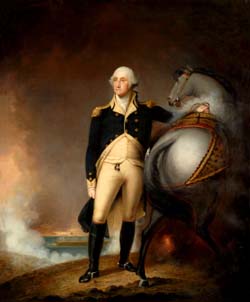
George Washington at Dorchester Heights, Boston
“He has excited domestic insurrections against us and has endeavoured to bring on the inhabitants of our frontiers the merciless Indian savages, whose known rule of warfare is an undistinguished destruction of all ages, sexes, and conditions.” Jefferson must have forgotten that Congress tried to outbid the British for the supports of the Indigenous Nations, and that Stockbridge Native Americans were members of the Massachusetts Militia, and that Massachusetts had a provincial alliance with the Mohawks.
“He has plundered our seas, ravaged our coasts, burnt our towns, and destroyed the lives of our people.” This points to the destruction of Norfolk, Virginia. Only problem was that Norfolk was primarily a Loyalist town and the burning was done by the Patriots, not by the Redcoats.
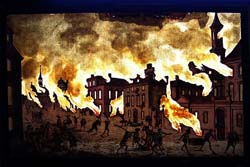
By now, I think you get the point. Thomas Jefferson never let the facts get in the way of a good story. And that final item lets us segue neatly into an adventure in plausible deniability by the father of our country, George Washington. He was almost certainly involved in and ultimately responsible for “The Great Fire of 1776” in New York. More than 500 buildings, including Trinity and Lutheran churches, were destroyed.
British soldiers had marched triumphantly into New York on September 15, 1776. Washington’s army had to flee, but six nights later, fire broke out in the city’s southern wharves. There were no bells left in the city of sound the alarm; Washington’s men had taken them all for cannon fodder. Strong winds had spread the blaze and turned much of the city, which was also teeming with Loyalists, into a waste land.
Washington had wanted to burn the city down before he fled, but Congress forbade it and told him to make a peaceful retreat. He complied grudgingly.
But two weeks later, writing to Lund Washington, a distant relative and manager of his Mount Vernon estate, GW stated, “Providence – or some good honest Fellow, has done more for us than we were disposed to do ourselves.”
The Great Fire of 1776
The rhetoric on the Patriots’ side claimed it was indeed some divine providence, or perhaps even British soldiers out plundering the city, that started the blaze. The Brits believed otherwise, pointing out that arsonists had to have done it because the blaze broke out in several places at once. They also pointed to Washington’s absconding with the fire bells as something that couldn’t have been a coincidence.
A subsequent investigation by the Brits couldn’t prove anything. But in June 1777, they caught Abraham Patten, a spy who was plotting to set afire the town of Brunswick, NJ. Before he was hanged as a spy, Patten admitted that he had helped start the New York fire. He didn’t name any accomplices, however. Shortly thereafter, Washington wrote to John Hancock and requested that they secure some funds for Patten’s widow.
No, we can’t expect our presidents to be totally honest all the time. We should know that by now. And they should have known it back in 1776. Some things never change.
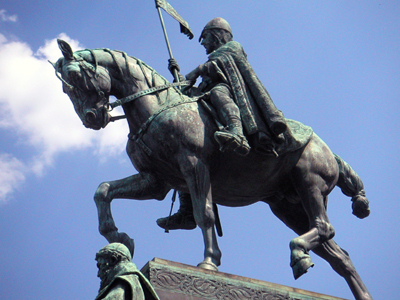
Wensceslas as armed knight on horseback in Prague’s Wenceslas Square.
Maybe you’ve even heard the joke about how he like his pizza cooked:
“Deep and crisp and even.”
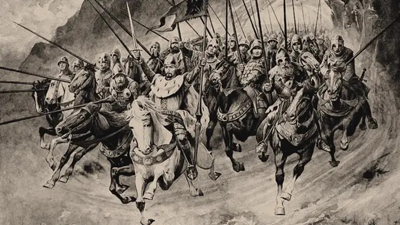
But who was this guy, the patron saint of the Czech Republic, whose statue stands in Wenceslas Square in Prague? Legend holds that if the Czech homeland is ever threatened, the statue will come to life, summon the army that sleeps beneath Mount Blanik, ready to defend the homeland. Wenceslas will wield his sword, which is hidden under the stones of the Charles Bridge and is to be found by a child when peril from enemies looms for Prague.
Here’s the rest of the story. There was actually a Wenceslas – real name Václav the Good, as Wenceslas is the Latinized version. He wasn’t a king; rather, he was Duke of Bohemia. He apparently was a very nice guy. He was from a very dysfunctional family, and he died because of his opposition to slavery.
The Charles Bridge
Yes, slavery. It wasn’t invented in the American South. They used to have it all over Europe. And Prague was the main market for slaves who were being moved overland from central Europe to the west and south.
Wenceslas was against slavery; he would buy slaves himself and set them free. But he ticked off three rich guys who had made big money in the slave trade. Their names were Tira, Česta, and Hněvsa; all three of them stabbed him before his own brother, Boleslas, ran him through with a lance.
Boleslas, the bad guy, took over the realm and knew where his bread was buttered. He, nominally Christian like Wenceslas, let the slavers make their money. He reigned for more than 35 years.
It didn’t matter that Boleslas already ruled over half the country at the time of the killing. It wasn’t enough for him, and it was the money that mattered.
According to “Christendom” by historian Peter Heather, Christianity was spreading throughout Europe in those years, driven largely by the political decrees and conquests in the long reigns of Charlemagne and his son, Louis the Pious.
Václav and Boleslas’s father, Vratislaus I, was the Duke of Bohemia and a Christian. Their mother Drahomíra, though baptized before the marriage, was aligned with Bohemia’s pagans. As a child, Václav was raised largely by his Christian paternal grandmother, Ludmila — who was later canonized as a saint in her own right.
When Václav was about 13, his father died in battle and Ludmila became regent. But the regency did not last long. His mother Drahomíra had Ludmila killed, and she then tried to suppress Bohemia’s Christians.
Wenceslas leads the Blanik Knights down the mountain to rescue Prague from its enemies.
When Václav became Duke of Bohemia himself at age 18 and came of age, he banished his mother and foiled her suppression plans by working to spread Christianity. He commissioned the building of several churches including part of what is now St. Vitus Cathedral in Prague. He also developed a reputation as a wise and compassionate ruler, known for his deeds of mercy.
But to try and avoid disputes, the country was split in two, and half was given to the younger brother, Boleslas. But Boleslas wanted the whole enchilada. He also remained the favored son of Drahomira. In September 935 he plotted with the slave-owning a group of noblemen to kill his brother. He did so by exploiting Wenceslas’s religious faith. He invited Václav to a church dedication on Sept. 27, 929. The next day, while Václav was on his way to prayer, Boleslas and his henchman attacked and killed him.
Only the good die young. Wenceslas was 22. On the base of his statue, the inscription reads “Saint Wenceslas, duke of the Czech land, prince of ours, do not let perish us nor our descendants.’”
I’m told by those who’ve visited that part of Europe that Prague is a particularly beautiful city and that the Charles Bridge is spectacular. That’s one place I’d love to visit. But I won’t be diving into the Vltava River and searching though the rocks for Wenceslas’s sword. As the legend tells us, that’s a job reserved for a child.
Did you ever have one of those job interviews in which the robot doing the hiring looked down the list of boilerplate questions and asked, “Where do you see yourself in five years?”
Didn’t you hate that? I did. I always mumbled something that didn’t meet expectations. But I must tell you of the one answer that I wished I’d had the wits to deliver. It was by Jim, a former work colleague who was looking for a humdrum emerging-from-retirement position, answering the phone at an insurance company’s customer inquiry desk.
“I see myself in a rocking chair on my front porch in five years.”
He got the job. Maybe because he was both prescient and honest.
Jim’s cheeky reply came to mind today when I read a magazine piece (National Review, February 2024 edition) about another magazine, long since out of business. That magazine was Saturday Review/World, and the year was 1974. The editor, antinuclear activist Norman Cousins(1915-1990) conceived and published an entire issue titled “2024 A.D.” Beneath that banner headline came the subtitle “A probe into the future by…” followed by nineteen names of the most eminent minds of the day.
So how did they do?
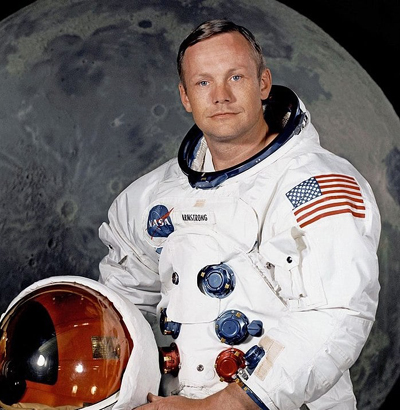
Some of them whiffed. Astronaut Neil Armstrong (1930-2012) predicted that by 2024 there would be colonies of humans on the moon, with “massive subterranean lunar cities, ‘underground apartments and workrooms…connected by tunnels and powered by giant solar generators and flywheels spinning at incredibly high speed.’” He also said that we’d have had manned space flights to Mars and probably a few selected asteroids.
Neil Armstrong
None of that happened, of course. In case you’d forgotten (I did) the last U.S. moon landing was back in 1972, two years before Armstrong made this prediction.
Faring little better than Armstrong was Clare Boothe Luce(1903-1987),the playwright, congresswoman, and ambassador. Despite a few advances such as availability of birth control pills and better access to higher education, Luce lamented that there has been little progress in “overthrowing male supremacy…and achieving equality of the sexes….[and that the American woman of 2024 would be] playing many more roles that were once considered masculine. I see her making a little more money than she is making now. But I still see her trying to make her way up – in a man’s world – and not having much more success than she is having now.”
Nice try, Clare. Looks like you really didn’t have a lot of faith in women and their abilities.
So who got it right? Surprisingly (for me anyway) three of the best answers came from people who’d seen and lived in the darkest and cruelest recesses that humanity devised during the 20th Century: Communism and Nazism. Perhaps seeing those evil systems from the inside gives one a special clarity of mind. See if you agree.
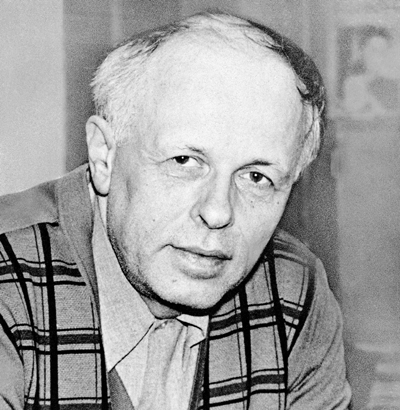
Andrei Sakharov
Russian physicist and human rights champion Andrei Sakharov (1921-1989), who won the Nobel Peace Prize in 1974, foresaw the unique role that “communications and information” would play, beginning with the creation of a “global telephone and videophone system. Then came his prophecy about what we could only call “the Internet:”
“Far into the future, more than fifty years from now, I foresee a universal information system, (UIS) which will give everyone access at any given moment to the contents of any book that has ever been published or any magazine or any fact. The UIS will have individual miniature-computer terminals, central-control points for the flood of information, and communication channels incorporating thousands of artificial communications from satellites, cables, and laser lines.
“Even the partial realization of the UIS will profoundly affect every person, his leisure activities, and his intellectual and artistic development. Unlike television, the major source of information for many of our contemporaries, the UIS will give each person the maximum freedom of choice and will require individual activities.”
Wow. Sakharov was off a little bit on his timing, but that’s all.
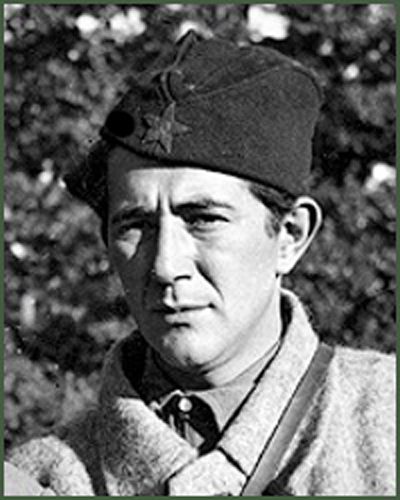
Milovan Djilas
Milovan Djilas (1911-1995) was from Yugoslavia. He was a higher-up in the regime of dictator Josip Broz (Tito), but he became disillusioned with communism and spent six years in prison for his honesty. He saw what would happen in his part of the world when he wrote:
“The most significant change in the next fifty years will be the disintegration of the Soviet empire…The crucial factors will be the domestic ferment and the pressure from China…[and possibly] uprisings in Eastern Europe…With the collapse of the Soviet empire, the Eastern European countries now under Soviet hegemony will become independent and will join the European community. Germany will be reunited, without a civil war.”
Got that right.
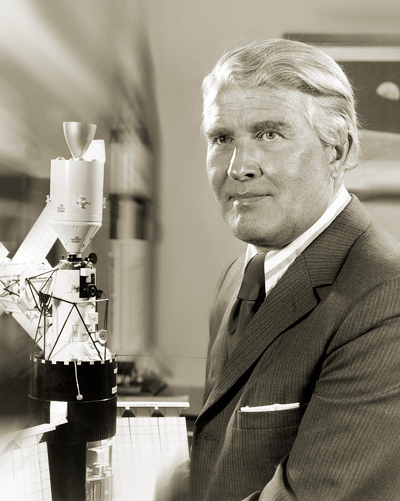
And how about Wernher von Braun(1912-1977), the rocketry whiz who designed the V-1 and V-2 rockets that rained down on Britain from Adolf Hitler’s Germany, and who came to America after World War II and was the guiding genius behind the Saturn Rocket program?
With a vision much like that of Sakharov, the former Nazi foresaw the power and ubiquity of orbiting satellites, which would spawn a “revolution…a global telephone network interconnecting nearly 100 nations…handling millions of television channels simultaneously and billions of telephone conversations [and providing] direct ties between computers in support of such operations as banking or ticket reservations.”
There was even more, and finely detailed it was, to von Braun’s preview:
Wernher von Braun
“Controlled by an orbital switchboard, laser beam connections could be established (and withdrawn after use) that provide direct links between any two points on Earth. The abundance of available channels would soon lead to worldwide video-telephone service. And as communications improve, commuting for work would go out of style. It would become more convenient to let electrons, rather than people, do the traveling.
“The average American household of 2024 will be equipped with an appliance that combines the features of a television set with those of a desk computer and a Xerox machine. In addition to serving as a TV set and a print-out device for news, the push-button-controlled console will permit its owners to receive facsimile-radioed letters, review the shelves of a nearby grocery store, order food and dry goods, pay bills, balance books, and provide color-video-telephone service to any point on Earth.”
Not totally accurate, but you get ample partial credit and a high final grade, Herr von Braun.
Some others who contributed predictions to that 1974 Saturday Review/World were Indira Gandhi, Robert McNamara, Coretta Scott King, David Rockefeller, and Pierre Trudeau.
The NR piece does not mention any of their predictions. But it does surmise – and I think correctly – that it would be “difficult to imagine anyone convening a panel of ‘influencers’ like this today.” And that’s unfortunate. Society as a whole doesn’t have too many people to whom it can look, with trust and confidence, for advice and guidance.
Maybe there are a few out there who can see the future as clearly as did Messrs. Sakharov, Djilas, and von Braun. But I wouldn’t know where to look for them.
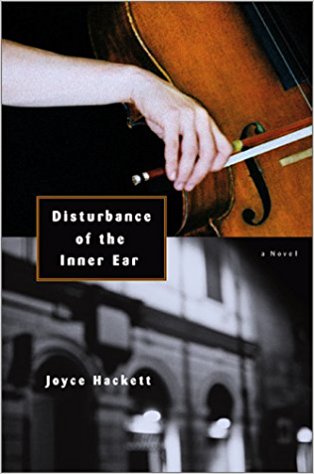
When a best-selling author recommends someone else’s book, you listen. That’s what happened to me recently, and I’m glad it did.
The book is Disturbance of the Inner Earby Joyce Hackett. I was surprised to learn that it was Hackett’s first book; it’s so beautifully written and masterfully crafted. I enjoyed Hackett’s writing style and learned a great deal about music, about human nature, and about a subject that’s of particular interest to me, The Holocaust. Hackett is both a gifted writer and a thorough, meticulous researcher. This book won her the Janet Heidinger Kafka Prize when it appeared in 2002.
The author who made the recommendation to me was Jacky Collis Harvey, whose smashing debut book Red: A History of the Redhead, came out two years ago. My review of that book is here. Jacky, with whom I’m connected on Facebook, made the suggestion after learning of my interest in The Holocaust.
Jacky didn’t know that I’ve also been trying to learn a little bit more about music – its history, its techniques, its people. I’m totally ignorant about all things musical, but even I know how important that music has always been and will always be to humanity. Disturbance gives deep and informed insight into the motivations and mindset of the musically gifted and into the instruments that they play.
Author Joyce Hackett
The protagonist of Disturbance is Isabel Masurovsky, daughter of Yuri, who was a survivor of the Nazi concentration camp at Theresienstadt in Czechoslovakia. That camp was smaller and somewhat less well known than the giant complexes like Auschwitz, Dachau, and Buchenwald. It was a Potemkin Village, a “model ghetto” that the Nazis spiffed up on the surface for visits by the International Red Cross. The Nazis had promoted the place as a resort or spa; they even conned many elderly Jews into paying large sums of money for “lakefront” locations that did not exist. Yuri’s parents were among those that paid up in this manner.
Yuri makes it out of the camp, aided by his musical talent and by the several favorable twists and turns of fate that we hear in many survivors’ stories. He settles in Brooklyn, where Isabella is born. She becomes a child prodigy on the cello, making her debut at Carnegie Hall at age 14. But her parents get killed in a car accident and she gives up playing.
Ten years later, she’s adrift in Milan, Italy. The elderly Signor Perso, her teacher, guardian, and the last person on earth who knows her story, suddenly dies. Isabel takes up with the smooth and seductive Giulio Salvagente, a surgeon and a part-time male prostitute who is carrying his own heavy load of emotional baggage. She also gets a gig teaching the viola to the American teenager Clayton Pettyward, whose father happens to own a priceless cello that she calls The Savant.
In an article in Bella Online, Hackett said that she interviewed about 400 cellists before writing. She also visited the city of Terezin, where Theresienstadt is located, and spoke with many Holocaust survivors. That’s the type of research that I imagine is done by another of my favorite fiction writers, Jodi Picoult. An author who works that hard obviously has great respect for her readers as well as for her subject. Hackett, who doesn’t play an instrument, stated
“I think research is mostly about, not being ‘right,’ but about being ‘not wrong.’ So often it introduces a vocabulary for a life and a set of concerns and a way of perceiving, but once a writer knows everything, she is able to write very little on a topic.
“…While I was doing my research, at a certain point a cellist I was interviewing, Gary Hoffman, quoted a sentence to me almost word for word that I had written the week before in the voice of my narrator. He said: ‘When you are playing in that perfect zone, the notes come in slow motion, like a series of home run pitches you can smack–one after the other.’ Well, my narrator knew nothing about baseball, but I’d written in a line about how in a perfect performance the notes come in slow motion, and time stops.”
Giulio and Isabel need each other, but it takes a while for them and us to realize it. Hackett’s descriptions of their erotic encounters are alone worth the price of the book. They’re refresher courses in the facts of life, imparting new insights into lovemaking while giving the reader palmar hyperhidrosis and tachycardia.
Isabel neatly links Giulio’s sexual performances with her own musical performances, musing, “I wondered about the sex he had with the women he hung around with. Having to sweep away one rich, dead-bored woman after another seemed to me like having to perform the same program, over and over, to one tone-deaf music hater at a time.”
She brings in another musician-analogy when she jumps into the driver’s seat of Giulio’s new standard-shift automobile and teaches herself, on the spot, to drive it so that she can make a climactic escape to Theresienstadt with the precious cello:
“But I was not about to hand myself over to Giulio. Driving a car, I told myself, could hardly be more difficult than playing the Rococo Variations. I occurred to me to listen for the sound I wanted, the smooth, rhythmic groan from the groin of the engine that Giulio had made, and work back toward the movements. This was the secret: in second, my limbs had molded themselves to the needs of the machine. I managed to circle the parking lot without chugging, and then I was coasting up the exit ramp as if I’d always known how.”
We see more of Hackett’s elegant descriptions in Isabel’s climactic escape. She steals Giulio’s car and dashes from Italy through Austria and Germany into Czechoslovakia. She has no papers or passport, but manages to get through the border crossings with luck and guile. With the tension of the chase building, she approaches the Brenner Pass into Austria and says
“I was approaching the border with no passport but Clayton’s…There was no break in the rail, no exit to make a U-turn. The slopes beside the highway were thickly covered with sharp, spiky evergreens that looked as if they’d impale you if you pulled over and jumped. “
But she makes it to Czechoslovakia. In the grimy town of Litomerice, adjacent to Terezin, she muses,
“I wandered around the won for what seemed like hours. Litomerice looked as if it had aspired to charm for fifteen minutes during the Hapsburg reign, then gotten drunk and let its face go to hell. Most of the buildings were decrepit and peeling: a few had been refaced in gooey apricot. There was not one tree in town.”
This is great writing. It not only paints pictures; it evokes strong, visceral reactions. You’re there, and you feel what she must have felt. Hackett’s style here reminded me of Catherine Marenghi’s elegant yet gripping descriptions of everyday phenomena in her superb 2016 memoir Glad Farm – which, like Disturbance of the Inner Ear, was also its author’s first book.
Isabel and Giulio do exorcise their respective demons. She makes peace with her past. As she does so, Hackett gives the reader much food for thought about The Holocaust, about the people who survived it, and about their descendants who keep memories alive.
Of her own experience in the research and writing of the book, Hackett later wrote in Boston Review,
“More than anything else my book turned out to be about the task of living after trauma, about accepting that there is no mastery of the past, or another’s experience, while also facing the stark ethical imperative that is adulthood: to extricate ourselves from the warped narratives we inherit in order to avoid doing damage to others in the present. I wrote my way out of a past that was not my own by hurling myself back into its reality…”
She cites Holocaust survivor/author Imre Kertesz’s writing of the prisoners’ greatest fear, that the truth of history would not be told and recorded. She also points out that when she took her trip to Terezin, “Still, all over Europe, the battle for the story was still being waged.”
That would have been close to 20 years ago, and I’m afraid that the battle for the story of The Holocaust is still being waged. Maybe the battle will never be over. That’s why books like this will always be important.
A while back I read that Albert Einstein supposedly said, “If you want your children to be intelligent, read them fairy tales. If you want them to be very intelligent, read them more fairy tales.”
As it turns out, that’s not a direct quote, but it comes close to his message. One day, a mother of young children sought out the good doctor and asked what kind of books her kids should read in order to prepare for careers in science.
His reply was “Fairy tales and more fairy tales” because, he explained, a creative imagination is the essential element in the intellectual equipment of the true scientist. Fairy tales, in his opinion, are the childhood stimulus to this quality.
There’s more. Bulgarian-born Maria Popova, author behind the superb blog “Brain Pickings,” maintains that “Fairy tales — the proper kind, those original Brothers Grimm and Hans Christian Andersen tales I recall from my Eastern European childhood, unsanitized by censorship and unsweetened by American retellings — affirm what children intuitively know to be true but are gradually taught to forget, then to dread: that the terrible and the terrific spring from the same source, and that what grants life its beauty and magic is not the absence of terror and tumult but the grace and elegance with which we navigate the gauntlet.”
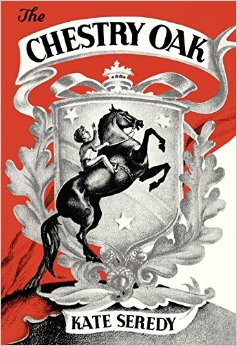
“The Chestry Oak” by Kate Seredy was written for children. But is not a fairy tale. There are no ghosts, dragons, or evil witches. It is historical fiction, the story of young Prince Michael of the Chestry Valley in Hungary – the same part or the world that gave us Maria Popova. The story has much of the terrible and the terrific. But the terror and tumult of the gauntlet that Michael navigates, as do his father, his nanny, and others in the tale, is all too real.
Michael is six years old when World War II breaks out and the Nazis conquer Chestry Valley. That kind of evil, National Socialism — and its accomplice and jackal Communism – actually existed, and not all that long ago. Moreover, it seems, we’ve been gradually taught to forget them and to dread them. They can’t happen here, can they?
Michael’s home, Chestry Castle, becomes the local headquarters for the Nazi military. The vile Herman Goering’s presence is felt, though he doesn’t make an appearance. Michael’s father, the Prince of Chestry, does not actively resist or defy them, and many of his countrymen consider him a traitor.
Michael’s life, and that of the realm’s mighty stallion Midnight, is spared when an Allied bombing raid destroys the castle and kills almost everyone in the valley. He carries with him an acorn that had previously dropped from the thousand-year-old Chestry Oak. The tree had once sheltered Saint Stephen, patron saint of Hungary, as he led the people of the valley in battle against heathen hordes.
Every prince of Chestry would, on his seventh birthday plant, plant a seed from that oak. Michael cannot plant the acorn on that day, however, and the tree is destroyed by bombs. The story tells how he eventually learns the whole truth about what happened and how he keeps his solemn promise to his father. He eventually does plant the last acorn. He fulfills his mission as the bearer and custodian of his people’s history and collective memory.
Though “The Chestry Oak,” written in 1948, is based on actual events, it has many of the desirable qualities and lessons that Popova identifies in fairy tales. It is unsanitized and unsweetened. It tells of both soaring goodness and monstrous evil springing from the same source – members of the human race. It tells of our need to preserve the ancient values, of the gallantry and nobility of ordinary people, of the precious worth of personal honor and fidelity to promises.
Also, even with its historical grounding, the story feels a little like both J.K. Rowling’s “Harry Potter” and C.S. Lewis’s “Chronicles of Narnia.” There’s a bit of the film “War Horse” in there too; my equestrian friends will like the descriptions of Prince Michael’s horsemanship.
My grandsons, ages three and one, are too young for “The Chestry Oak.” I’ll save it for them, maybe until the day when they’ve learned at least a bit of history of our world. In the meantime, I’ll try to share with them those wonderful stories and characters that you and I got to know when we were children.
That’s the least I can do, and I thank Dr. Einstein and Maria Popova for reminding me why those stories are so important.




 When a best-selling author recommends someone else’s book, you listen. That’s what happened to me recently, and I’m glad it did.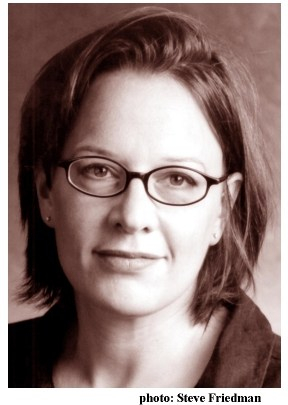
 A while back I read that
  Veteranscribe's Blog