Posts Tagged ‘Prague’

History I Never Knew: Good King Wenceslas

January 14, 2024

You’ve probably heard the Christmas hymn:

“Good King Wenceslas looked out

On the Feast of Stephen”
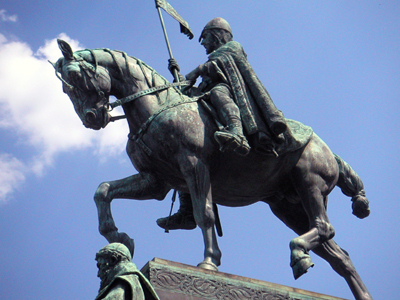
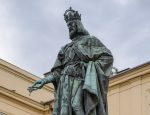
Wensceslas as armed knight on horseback in Prague’s Wenceslas Square.

Maybe you’ve even heard the joke about how he like his pizza cooked:

“Deep and crisp and even.”

But who was this guy, the patron saint of the Czech Republic, whose statue stands in Wenceslas Square in Prague? Legend holds that if the Czech homeland is ever threatened, the statue will come to life, summon the army that sleeps beneath Mount Blanik, ready to defend the homeland. Wenceslas will wield his sword, which is hidden under the stones of the Charles Bridge and is to be found by a child when peril from enemies looms for Prague.

Here’s the rest of the story. There was actually a Wenceslas – real name Václav the Good, as Wenceslas is the Latinized version. He wasn’t a king; rather, he was Duke of Bohemia. He apparently was a very nice guy.  He was from a very dysfunctional family, and he died because of his opposition to slavery.

The Charles Bridge

Yes, slavery. It wasn’t invented in the American South. They used to have it all over Europe. And Prague was the main market for slaves who were being moved overland from central Europe to the west and south.

Wenceslas was against slavery; he would buy slaves himself and set them free.  But he ticked off three rich guys who had made big money in the slave trade. Their names were Tira, Česta, and Hněvsa; all three of them stabbed him before his own brother, Boleslas, ran him through with a lance.

Boleslas, the bad guy, took over the realm and knew where his bread was buttered. He, nominally Christian like Wenceslas, let the slavers make their money. He reigned for more than 35 years.

It didn’t matter that Boleslas already ruled over half the country at the time of the killing. It wasn’t enough for him, and it was the money that mattered. 

According to “Christendom” by historian Peter Heather, Christianity was spreading throughout Europe in those years, driven largely by the political decrees and conquests in the long reigns of Charlemagne and his son, Louis the Pious.

Václav and Boleslas’s father, Vratislaus I, was the Duke of Bohemia and a Christian. Their mother Drahomíra, though baptized before the marriage, was aligned with Bohemia’s pagans. As a child, Václav was raised largely by his Christian paternal grandmother, Ludmila — who was later canonized as a saint in her own right.

When Václav was about 13, his father died in battle and Ludmila became regent. But the regency did not last long. His mother Drahomíra had Ludmila killed, and she then tried to suppress Bohemia’s Christians.
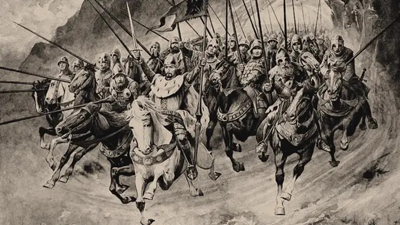
Wenceslas leads the Blanik Knights down the mountain to rescue Prague from its enemies.

When Václav became Duke of Bohemia himself at age 18 and came of age, he banished his mother and foiled her suppression plans by working to spread Christianity. He commissioned the building of several churches including part of what is now St. Vitus Cathedral in Prague. He also developed a reputation as a wise and compassionate ruler, known for his deeds of mercy.

But to try and avoid disputes, the country was split in two, and half was given to the younger brother, Boleslas. But Boleslas wanted the whole enchilada. He also remained the favored son of Drahomira. In September 935 he plotted with the slave-owning a group of noblemen to kill his brother.  He did so by exploiting Wenceslas’s religious faith. He invited Václav to a church dedication on Sept. 27, 929. The next day, while Václav was on his way to prayer, Boleslas and his henchman attacked and killed him.

Only the good die young. Wenceslas was 22. On the base of his statue, the inscription reads “Saint Wenceslas, duke of the Czech land, prince of ours, do not let perish us nor our descendants.’”

I’m told by those who’ve visited that part of Europe that Prague is a particularly beautiful city and that the Charles Bridge is spectacular. That’s one place I’d love to visit. But I won’t be diving into the Vltava River and searching though the rocks for Wenceslas’s sword. As the legend tells us, that’s a job reserved for a child.
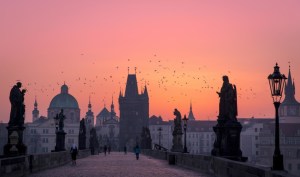
History I Never Knew: The Charles Bridge, Prague

November 10, 2019

The Charles Bridge at Sunset

Today’s history lesson is about a place on my bucket list.

I’d love to visit Prague some day. I’m told that it’s a magnificent old city. Part of the reason for that is that somehow the physical ravages of modern war did not reach it. That’s a good thing.

There’s also a personal tug. Prague is the city where, in 1933, America’s National Hockey Team won its first world championship. Our team, the Massachusetts Rangers, defeated the Toronto National Sea Fleas, 2-1 in overtime, to take the title. The overtime goal was scored by John Garrison, “The Ghost of Harvard Yard.” The coach of the team was my uncle, Walter Brown. It was the first time ever that an American team defeated the Canadian team in international competition.

But back to today’s lesson – it’s about the city’s most-photographed sight, the Charles Bridge over the Vltava River in the city’s center. It’s been known at the Charles Bridge only since 1870, in belated recognition of Holy Roman Emperor Charles IV. It was he who laid the first stone, back in 1357.

Holy Roman Emperor Charles IV

Charles was big into numerology. And so he insisted that the first stone be set in place at exactly 5:31 a.m. on July 9 of that year.

Why such precision? Because the date and time make for a palindrome: 135797531 (or 1357 9, 7 5:31). That number, which reads the same backward and forward, is carved onto the stones of the Old Town Bridge Tower at the east end of the bridge. Charles believed that it would bring a magical strength to the structure. All righty, then.

The bridge wasn’t finished until 1402. Its length is 1,692 feet. For more than 400 years it was the only means of crossing the Vltava, and it was therefore the most important connection between Prague Castle and Prague’s Old Town. The bridge helped to make Prague an important nexus for trade between Eastern and Western Europe.

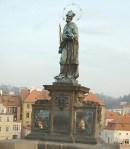
There’s more superstition beyond Charles IV’s numerology. The bridge was also constructed in perfect alignment with the tomb of Saint Vitus and the setting sun on the equinox. More recently, people came to believe that rubbing the plaque at the base of the statue of Saint John of Nepomuk will grant you a wish.

Saint John of Nepomuk

John was murdered on the orders of King Wenceslas IV during the bitter conflict of church and state that plagued Bohemia in the latter 14th century. In 1390 he was made vicar general for the archbishop of Prague. In 1393 the archbishop, with John’s support, excommunicated one of the favorites of the king and thwarted the king’s ambition to make a new bishopric out of the province of Prague.

John was arrested as the archbishop’s chief agent. Wenceslas personally tortured him with fire, after which he reconsidered and released him on an oath of secrecy regarding his treatment. John, however, was dying, and to conceal the evidence Wenceslas had him gagged, shoved into a goatskin, and cast into the Vltava. Bohemian Catholics came to regard John of Nepomuk as a martyr.

Saint John’s statue is one of 32 points of interest (see map) on the bridge. Things also got interesting there around the time of the horrific Thirty Years War (1618-1648). The war began in May of 1618, touched off by the colorfully-named Defenestration of Prague. In that incident, three Catholic officials, emissaries from the Holy Roman Emperor, were tossed from an upper window of Prague Castle by an angry mob of Protestant Bohemian rebels.

Statues and Attractions on the Charles Bridge

Three years later, on June 21, 1621 after the Battle of White Mountain, the 27 leaders of the anti-Habsburg revolt were executed. Their severed heads were displayed for all to see on the Old Town Bridge Tower. Apparently, that grisly measure – quite common in those times – wasn’t much of a deterrent.

Near the end of the war, the Swedes occupied the west bank of the Vltava. As they tried to advance into the Old Town the heaviest fighting took place right on the bridge. During the fighting, they severely damaged one side of the Old Town bridge tower, and the remnants of almost all gothic decorations had to be removed from it afterward.

It wasn’t until the late 17th and early 18th centuries that the bridge became the attraction that it is today. That’s when the alley of baroque statues was installed on the bridge’s pillars.

Charles IV’s numerology didn’t spare the bridge from severe damage. In 1890, a huge flood hit Prague. Thousands of rafts, logs and other floating materials from upstream gradually formed a giant barrier against the bridge. Three arches were torn down by the pressure, and two pillars collapsed from being undermined by the water, while others were partly damaged.

Two statues, St. Ignatius of Loyola and St. Francis Xavier, fell into the river. The Ignatius statue was replaced by statues of Saints Cyril and Methodius. For the St. Francis statue, they had a replacement cast.

1890 Flood Damage

It goes without saying that the Charles Bridge, also known as Karlův Most and Karlsbrücke, is one of the most visited and photographed sites in Prague.

No wonder, eh? It’s a place I’d love to visit myself.

And now you know the rest of the story.