Archive for the ‘The World of Sport’ Category

Beanpot Musings and Post-Mortems

February 24, 2015

Well, it was worth waiting for.

The 63rd annual Beanpot Hockey Tournament was the first ever in which both rounds underwent postponements for snow. After a two-week delay, the 2015 championship game took place on February 23. About halfway through the third period, after Northeastern had stormed back from a two-goal deficit to Boston University at 3-3, p.a. announcer John Dolan turned to me and said, “This is what it’s all about.”

And it was. The teams had been battling with reckless abandon for the entire contest, and somehow, coming down the home stretch, they dug deeper within themselves and called for more. The fans from Northeastern and Boston University were in full-throated roar, as they too had been all game long.

There’s a lot of good college hockey yet to be played at TD Garden this year – both the Hockey East championships and the Frozen Four – but I doubt they’ll come close to matching the atmosphere of Beanpot.

Nobody asked me, but here are some deep thoughts to rival those of Jack Handey.
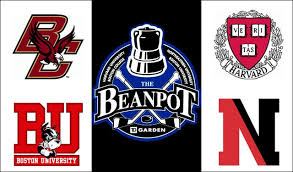
beanpotBig Picture: I know that the result, a BU championship, is a familiar one. But the Beanpot is once again a four-team tournament. Three of the games this year went into overtime. In the one that didn’t, Northeastern scored with less than two minutes to play to defeat Boston College 3-2.

All four Beanpot teams are contenders for advance to the NCAA Tournament. They won’t all make it; only BU is certain to receive a bid. But they’re all good enough.

Northeastern’s Knocking: Yes, it’s 27 years and counting since the Huskies won a Beanpot. That was in 1988. It took them 29 years to win their first one, back in 1980. But during that initial span of 29 years, Northeastern made it past the first round to the championship game exactly three times. In olden times, they were the Beanpot doormat. Not any more.

Since 1999, NU has played in the championship game eight times, including five of the last seven years. They will be back in the winner’s circle again soon. Husky fans, don’t lose faith.

So will Harvard. The Crimson last won a Beanpot in 1993. That, also, is far too long a time. I thought that, going into this year’s tourney, Harvard was the best team. I’ve also told more than a few people that if Harvard gets another crack at BU in post-season, Harvard will win. Their go-ahead goal in the third period of this year’s first round, double-overtime loss to BU should not have been disallowed.

Harvard’s first line of Alex Kerfoot, Kyle Criscuolo, and Jimmy Vesey is as good as any in college hockey – including Jack Eichel’s line at BU. Harvard has skill and speed, and they like to hit. They’ve also gotten good goaltending from Steve Michalek. After losing the consolation game, 3-2 in overtime to BC, Harvard will likely have to win the ECAC playoff championship in order to make the NCAAs. They can do it.

Goalies: Michalek set a new Beanpot single-game record with 63 saves against BU. The old record of 52 was set by Jimmy Barton of BC in a 5-4 loss to BU in 1970. Michalek has the bigger number now, and hats off to him. But as far as I’m concerned, Barton’s performance, over 60 rather than 82+ minutes, is still the best ever.

BU outshot Harvard this year but did not outplay them by much at all. Harvard probably should have won in regulation but had that goal disallowed. But back in 1970, BU’s barrage against Barton and the Eagles was constant, overwhelming, and unrelenting.

The MVP: Matt Grzelcyk is Boston hockey’s feel-good story of the year. He’s the Townie kid whose father works on the Garden bull gang. He’s the kid who always dreamed of Beanpot heroics. His dream came true with two goals, including the overtime winner.

Everyone has been talking about the year Eichel has been having, and rightfully so. He’s several cuts above everyone else, even as a freshman. The only other freshman of comparable skill I’ve ever seen was Brian Leetch of Boston College back in 1987. Eichel does it all, and the pros are drooling, but I hope he sticks around for at least another year. Eichel and linemates notwithstanding, Boston University would not be where it is without Grzelcyk.

Matt is a defenseman, a member of the junior class. His team mates elected him captain to lead the turnaround after last year’s miserable performance. He had only played half the games last year before going down with a serious shoulder injury. But they elected him anyway.

I frequently hear sports fans and sports writers wax poetic about this coach or that coach. “He’ll get them up for the big game,” of “He won’t let them lose again,” and so on. That’s overstating things by quite a bit.

Success is all up to the players on the team, and especially to the upperclassmen who’ve been around for a while. The coach picks the players, sets the agenda, devises the strategy, teaches the game – but the players must take responsibility for their fate.

That’s what’s happened at BU. When the players came back to campus in the summer, they wore t-shirts with “Never Again” printed on the back. Grzelcyk, along with the team’s only seniors, Evan Rodrigues and Cason Hohmann, have been leading the way. I suggest that they’re the ones who are primarily responsible for BU’s fast return to the Beanpot championship.

Boston College, whose run of consecutive Beanpot crowns ended this year at five, has enjoyed a huge run of success since they made it to the NCAA Final at the Garden in 1998. Coach Jerry York is another who picks his players carefully, makes sure they buy in fully to his way of doing things, and then puts the onus on them to perform.

For the past decade and a half, BC has had at least one high-scoring line, usually two, and sometimes even three. Not so this year. The Eagles have found goals very hard to come by. Every game is a nail-biter. But they’re still in second place in Hockey East with one weekend of play remaining.

This may have been the best-coached team of Jerry’s tenure. It also follows that it’s a well-captained team. Like BU, BC has a junior defenseman, Michael Matheson, as captain. There are also two senior forwards, Quinn Smith and Michael Sit, who are alternate captains. BC has built a solid winning record on a good defense corps, strong goaltending, and four lines of grinders and muckers.

Next Year: The first-round Beanpot pairings will be the same was this year’s championship round. Harvard and Boston College will play in the early game, and Northeastern will face BU in the nightcap.

Maybe in 2016 we’ll finally, at long last, see a Beanpot final of Harvard vs. Northeastern. For me, that’s a bucket-list item.
Calling Wayne Turner!

February 5, 2015

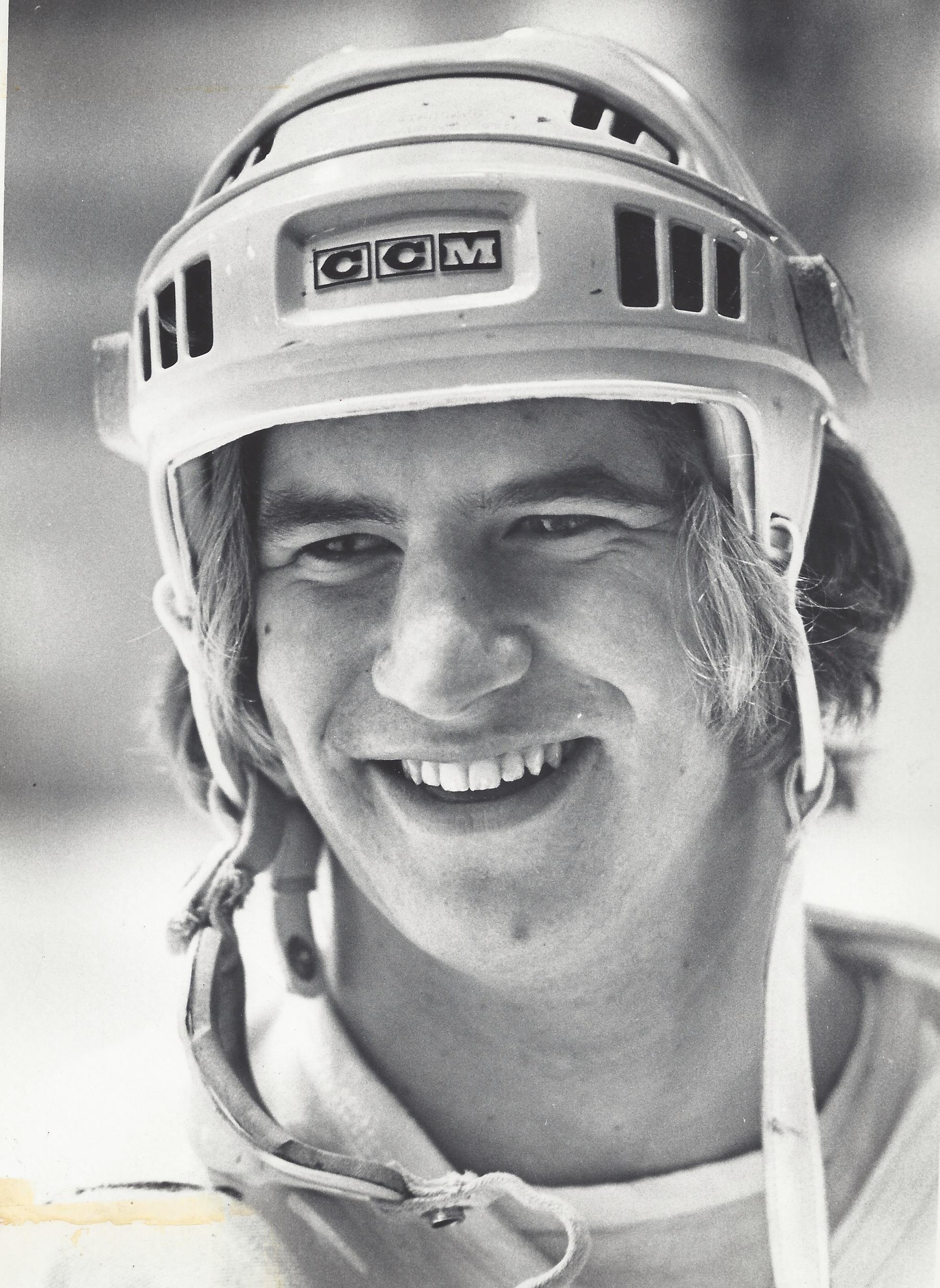
Wayne Turner holding the coveted Pot in 1980. Is there any wonder that NU hockey fans refer to the man from Kitimat, British Columbia as "Beanpot?"

Wayne Turner holding the coveted Pot in 1980. Is there any wonder that NU hockey fans refer to the man from Kitimat, British Columbia as “Beanpot?”

Where have you gone, Wayne Turner? Husky Nation turns its lonely eyes to you.

In Boston, it’s starting to feel like 1978 with all this snow on the ground and predictions of more.

On Causeway Street, though, I hope we time-travel back to 1980. We need this generation’s Wayne Turner to come through with the game-winning goal and to bring the Beanpot back to Northeastern.

After that, we need 2016-2018 to reprise 1981-1983. In those three years, BU, BC, and Harvard all won a Beanpot championship. We need this February festival to be a true, four-team event in which every squad has a strong chance to emerge the winner. The years from 1980 to 1983 were the only four-season span in which every team took the title once. I think that such balance is coming back. Let’s hope that it does.

It’s hard to believe that the Huntington Hounds haven’t been Beanpot champions since 1988. They have come up empty in their last 26 tries.

When Turner scored that magical overtime goal to beat BC 5-4 back in 1980, it gave Northeastern its first Beanpot crown ever. That took 29 years to accomplish. We had waited too long back then, and we’ve waited too long now.

It’s just as bad over at Harvard, if not worse. The Crimson have not been Beanpot champs since 1993. Moreover, Harvard has made it to the final round just once since the year 2000.

On Monday night, Northeastern will be making its seventh appearance of the current millennium in the Beanpot title game. This is the fifth time in the last seven years NU has gotten that far. By contrast, before NU won the 1980 championship on its 29th try, it had made it to the final round exactly twice.

There has never been a championship final game pitting the Huskies against Harvard. We almost got to see one this season. Boston University spoiled that possibility when they beat the Crimson 4-3 in double overtime in round one. Harvard’s Steve Michalek’s incredible 63-save goaltending show went for naught.

Northeastern got a goal from defenseman Dustin Darou and beat Boston College 3-2 in the second game of this year’s first round. It came with less than two minutes to play and just before midnight. Maybe Darou is the Huskies’ Malcolm Butler. Dustin had scored only one other goal in his college career up until that point.

That set up this year’s final, with the 11-11-4 Huskies taking on the 17-4-4 Terriers. NU’s win over BC was not a giant upset. The Eagles were favored, but only slightly. Northeastern’s record is deceiving. They started off 0-8-1, so since mid-November their record is 11-3-3. And it’s been against some pretty tough foes.

It’s unfortunate that the postponement for snow, followed by those horrendous snarls on the roadways and on public transit systems, kept the first-night crowd at the Garden well under capacity. The whole evening was college athletics at its best.

Every year we say that the teams are evenly matched and that any one of them could win. But it was true this year. Both Harvard and Boston College played terrific games, even in defeat. The Garden fans, all of them knowing that their respective teams had a real chance to win, were loud and spirited.

Even the national anthem singers, Taylor Carol of Harvard and Grace Greene of Boston College, delivered boffo performances. Grace’s sons Matt and Justin played hockey for BC a few years ago. Her “Land of the Free” flew higher than the Garden rafters, much to the delight of the cheering fans.

If you were there, I’m sure you agree that it was a wonderful night of sport. If you weren’t, you missed something special.

Next year the first-round pairings are the same as this year’s second night: BC-Harvard in the opener and BU-Northeastern in the nightcap. So maybe in 2016 we’ll see that long-awaited championship matchup between the Huskies and the Crimson.

Harvard needs a Beanpot win. They’re vastly improved, and they’ll have most of their stars back again next year. So there’s reason to be optimistic.

But Northeastern has been knocking on the Beanpot door incessantly. They’ve won it only four times. They’re way overdue. It’s time for them to win again.

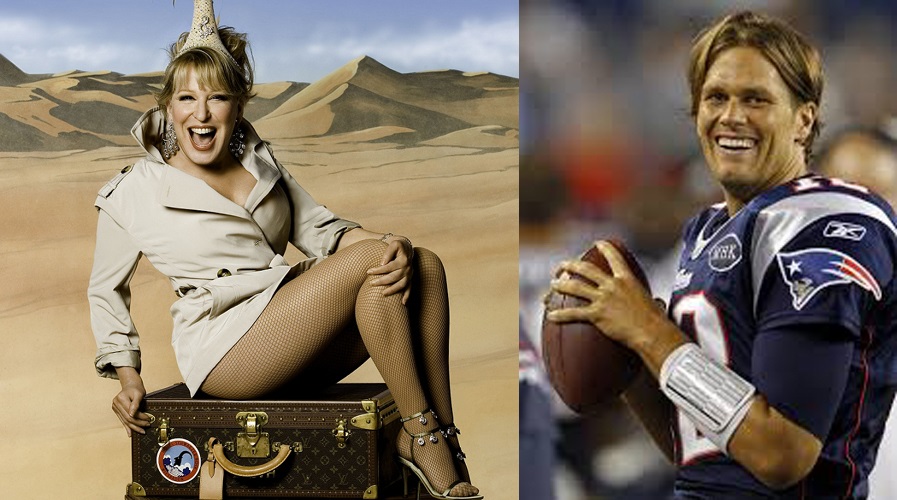
Bette Midler and Tom Brady

January 27, 2015

Bette and Tom: Two Consummate Professionals

Bette and Tom: Two Consummate Professionals

I love Bette Midler – her acting, her singing, her delightedly devilish approach to life.

I love Tom Brady – his passing, his play calling, his fiendishly aggressive approach to football.

I appreciate what they do, and I’ll pay to see them do it. I don’t know either of them personally, and I don’t particularly care to. That might dim their halos, extinguish their auras. I’ll watch them – from a distance.

Well, okay, I admit. I would love to take Bette Midler to lunch at Rossetti’s, and then to walk for a while along Winthrop Beach with her. “Beaches” was a wonderful movie with great songs, particularly “Wind Beneath My Wings.” I’d like to know if Bette, in person, is really the way she was portrayed in that movie. I’d risk dimming her halo to find out. But I digress.

Bette’s song “From a Distance” is one of my favorites. It came on while I was driving the other day, and I started humming along with her. Just before that, I’d heard yet another breathless, indignant-sounding dispatch on what’s become known as “deflategate.” Enough, already!

The song and the “scandal” are more closely related than one might think.

If anyone feels even a touch of disappointment at the mere possibility that Tom Brady might have been behind the needless altering of pigskin air pressures, here’s why. We’re no longer viewing his football heroics from a distance. Instead, we’re seeing – or we might be seeing, though I personally doubt it – one gritty little detail about what it takes to win at big-time professional sports. We don’t like it at all.

We are witnessing a reality show. We want fantasy fiction.

We want to watch the unerring spiral passes, the leaping balletic catches, the split-second artful deflections, the bursts of pure sprinter-speed, the mighty tests of strength. They’re beautiful manifestations of skill in Tom’s game, and they’re real. Just like the majestic eagle of whom Bette sings.

We don’t want to see the thumbs in the eyes, the ankle twists beneath the pileups, the forearm shots, the cleated stomps on unprotected joints. They’re ugly manifestations of brutality in Tom’s game, and they’re real too. Just the agonized last minutes of life of the fish, seized from the river by that eagle, run through by saberlike talons and pecked to death in the aerie.

Those things are obscene, in the original sense of the word. They have to take place away from the stage, as when Macduff and Macbeth exit, dueling, and Macduff returns with Macbeth’s severed head. We know that the killing and beheading happen, but we must be spared the discomfort of watching.

There’s something else about those unsavory tactics in pro football. Every player who’s good enough to make it to that level expects them. Dirty play is a reality that not everybody practices. But they all accept it and deal with it. We shouldn’t cheer it or like it. But we shouldn’t be shocked – shocked – that it takes place.

This is not to say we ought not to be angry and disgusted with some parts of the game. We should even hate some things about it.

I hate the Oakland Raiders. I was in Foxboro in 1978, watching from the press box when Jack Tatum paralyzed Darryl Stingley with a vicious, open-field hit.

I hate West Virginia University. I was at Boston College in 1974, watching from the press box when a hoodlum defensive player deliberately injured BC star Mike Esposito. The guy jumped onto Mike’s shoulder and upper arm, after a tackle and out of bounds.

West Virginia – different coach, same dirty tactics – did it to BC again in 1983. This time it was to Troy Stradford. They threw him to the ground and piled on his arm after a kickoff return.

All of those cretinous thugs should have been banned from the game. I will always root against the teams that spawned them. I don’t care how long ago it was. I don’t care if they recruit rosters full of altar boys. I hope that they always lose – badly.

That is the serious stuff. Deflategate is not. And it probably never happened anyway. How silly and risky would it be for Tom Brady to order an assistant ball boy to suck more air out of the footballs after they’d passed inspection?

Even if deflategate did happen that way, it’s nowhere near the realm of the aforementioned unsavory football tactics. Rather, it would be an example of going a hair’s breadth too far with something that every successful team does: find ways to gain that little edge, that slight advantage that can befuddle opponents and lead to victory. Sometimes they’re within the boundaries of the rules, sometimes they’re not.

We’d rather watch from our distance and not hear about this stuff either. But our beloved Celtics coach Red Auerbach was famous for it. So too was 1980 Olympic hockey coach Herbie Brooks, when he coached at the University of Minnesota. Tarnished halos, anyone?

The world will never be as Bette Midler sings: “no one is in need…no guns, no bombs, and no disease, and no hungry mouths to feed.” But that doesn’t mean we should not love our own corners of the world and do our best to make those corners better.

Professional sport will never be as we long for it to be: contests in which every participant plays fairly, honestly, and in rigid adherence to both the letter and the spirit of the rules. But that doesn’t mean we should not watch them, root for our favorites, and admire the talent and hard work of the athletes.

Let’s not spoil it for ourselves. Let’s put an end to obsession about manufactured ills like deflategate.

And as Forrest Gump would tell you, “That’s all I have to say about that.”

A Chat with One of American Hockey’s All-Time Greats

December 19, 2014

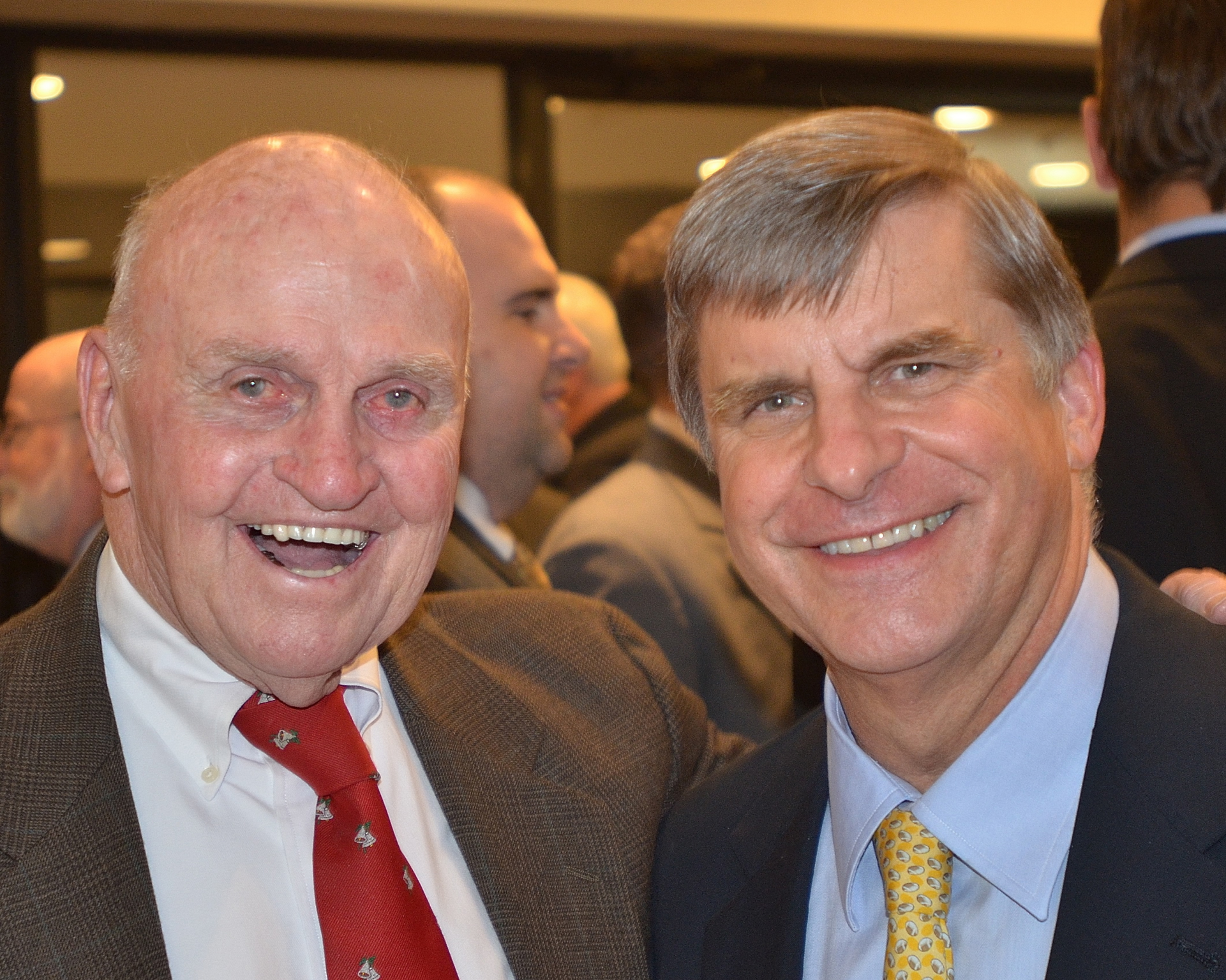
Bill Cleary and Tom Burke at Gridiron Club of Greater Boston Awards Dinner, December 18,2014

Bill Cleary and Tom Burke at Gridiron Club of Greater Boston Awards Dinner, December 18,2014

Harvard hockey legend Bill Cleary attended the Gridiron Club Dinner on December 18. That evening, Crimson coach Tim Murphy received the Division One Coach of the Year Award, and defensive lineman Zach Hodges won the Bulger Lowe Award.

Bill was one of the stars of the 1960 United States Olympic hockey team. He and Bob Cleary, along with Billy and Roger Christian of Minnesota, were the two sets of brothers who led Coach Jack Riley’s crew to the Gold Medal.

All due respect, boys of 1980, but that 1960 team pulled off the true “Miracle on Ice.” They had a perfect 7-0-0 record at the games in Squaw Valley. They defeated the Czechs twice and knocked off Russia and Canada too. Cleary had a goal in the 2-1, come-from-behind win over the Canadians. Len Ceglarski, another of college hockey’s greatest coaches, once told me that Bill Cleary was the greatest American-born player he’d ever seen.

Bill told me of another BC hockey player who should have been mentioned in “Tales from the Boston College Hockey Locker Room.” His cousin George Malone played for BC teams from 1940 through 1942. George had a goal and an assist in the Eagles’ 6-4 win over Saint Nick’s in the championship game of the National AAU Tournament at Boston Arena.

That game, on March 8, 1942, gave Boston College its first national championship. The NCAA Tournament would not become a reality until six years later, after World War II.

It was also the final hockey game of George Malone’s life. He joined the Army Air Corps and died in a mission over Germany. His name may be seen on the Roll of Honour at the American Memorial Chapel in Saint Paul’s Cathedral, London.

Thank you, Bill Cleary, for all you’ve done for hockey. And thank you, George Malone, for your service to the game of hockey, and to God and country.

There’s Still Time to Get an Autographed Stocking Stuffer for that Special Hockey Fan in Your Life!

December 15, 2014

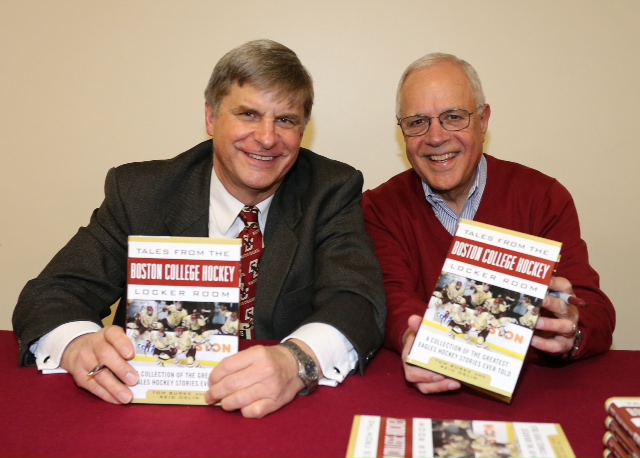
Co-authors Tom Burke and Reid Oslin at Book-Signing Event on December 13, 2014

Co-authors Tom Burke and Reid Oslin at Book-Signing Event on December 13, 2014

Almost a hundred people took home personally-inscribed and autographed copies of “Tales from the Boston College Hockey Locker Room” last Saturday night. An added bonus: we saw the Eagles whip Michigan by a score of 5-1.

Michigan and Boston College played each other for the first time in the first-ever NCAA hockey tournament. That was on March 19, 1948. The Wolverines won that game, 6-4 in overtime.

The book has the full story of that game, and of many more memorable hockey games and hockey people. We think you’ll enjoy it, but don’t take it from us. Here’s what some of the experts have said:

“Fabulous read! Terrific look back on our history here!”
–Jerry York

“A great read! And this from a BU guy!”
–Gary Fay

“‘Tales’ tells not only the remarkable story of the B.C program’s many triumphs, titles, Beanpots, national championships, and extraordinary roll-call of stars who went on to excel as Olympians and Pros but, even more importantly, of its genuine commitment to the proper canons of collegiate sport.”
–Clark Booth

We’ll be at the Winthrop, Massachusetts Public Library on Tuesday, December 16, from 6:30 to 7:45.

We’ll be at BookEnds of Winchester, 559 Main Street in Winchester, Massachusetts, on Sunday, December 21 from 2:00 to 4:00.

If you can’t make it to either session and you’d like an inscribed copy, please email eaglepuckhistory@gmail.com and we’ll get right back to you.

You can also find “Tales from the Boston College Hockey Locker Room” at your local book store or can order it from the Boston College Bookstore or from most online book sellers.

Merry Christmas to All!

Please Join Us for an Evening of Sports Talk!

November 11, 2014

Authors Tom Burke and Reid Oslin Invite You to

doyles logoDoyle’s Cafe – “Boston’s Best Pub”
3484 Washington Street
Jamaica Plain, MA 02130

Tuesday, November 18, 7:30 to 9:00 p.m.

No Cover! No Minimum! Just bring a love of Boston sports (especially hockey!)

tom and reidTom and Reid’s new history of Boston’s sport at Boston’s college, Tales from the Boston College Hockey Locker Room, is now available at bookstores everywhere.

The book, published by Skyhorse Publishing of New York, chronicles the long and successful history of “The Montreal Game” at Boston College. It begins with the early days of “ice polo” on rivers and outdoor rinks of the 1890s and runs through the Eagles’ skein of four NCAA Championships since 2001.

Cover front2The authors interviewed dozens of former Eagle players, coaches, and rivals along the way. Included are chapters on the origins of hockey at the Heights; on BC’s iconic coaches John “Snooks” Kelley, Len Ceglarski, and Jerry York; on the NCAA Tournament’s origin and evolution; and, of course, on the Beanpot Tournament.

The book also recaps many memorable Boston College games and seasons, but it is not just for BC loyalists. As the Authors’ Note at the beginning states,

“College hockey is a unique sport. It is ‘big time,’ with many of its best players going on to win Olympic medals and carve out successful professional careers. Yet it is a ‘small’ sport as well. Relatively few schools have chosen to make the game a part of their athletic tradition and to invest the time and treasure required for success. So the college hockey community is a tightly knit one. We’re an extended family. We’re all in this together.”

Here are just a few of the comments the book has received to date:

“Fabulous read! Terrific look back on our history here!”
–BC head coach Jerry York

“A great read – and this from a BU guy!”
Gary Fay, Terrier power play point man extraordinaire

“Thoroughly enjoying my copy.”
Jim Reid, former Northeastern University crew captain and Winthrop High School’s first hockey co-captain.

“Great read, thanks for the Beanpot props!”
Mike Powers, BC’s 5-goal man in Beanpot opener, 1973

Tom Burke was Eastern College Hockey’s first national correspondent. He wrote for the Hockey News for eighteen years and was a New York Sunday Times college hockey contributor for seven years. He has served as a member of the Hobey Baker Award Selection Committee, and he annually presents the Walter Brown Award, which is named for his uncle Walter, to New England’s best American-born Division One player. Tom serves as assistant secretary of the Beanpot Tournament and has contributed to the annual Beanpot game programs for over thirty years. He also is the Boston College Varsity Club Hall of Fame’s biographer, has been the arena voice of BC hockey for twenty-seven years, and the stadium voice of BC football for thirty-nine years. Tom grew up in Winthrop, Massachusetts and now resides in West Roxbury.

Reid Oslin was affiliated with Boston College and its athletic program for forty-one years, including twenty-four years (1974–1997) as the Eagles’ associate athletic director and sports information director. During this period he attended hundreds of Boston College athletic events and got to know thousands of student athletes, coaches, staff members, and fans. He served as the senior media relations officer in the university’s Office of News and Public Affairs before retiring in 2012. Oslin is also the author of two books on the history of Boston College Football. He is a native of Springfield, Massachusetts and now resides in Scituate.

If you have questions or comments, or to schedule a talk by the authors, please email eaglepuckhistory@gmail.com.

Student Athletes, Part 2: Don’t Lose Sight of Them, or of the Value of What They Do. Consider Boston College’s Paul Taylor

October 27, 2014

It’s almost November 2014, and the embarrassing stories and commentary about college sports and athletes continue thick and fast. This time it’s the University of North Carolina’s long history of “paper courses” for big-time players. Last month it was a college football player who took money for his autograph. Earlier we heard more than one credible allegation of sexual misconduct by college football stars.

I hate hearing these stories. It’s not that I doubt them. It’s not that I want them squashed so that the games can go on. It’s not that I want the miscreants to escape with a tut-tut followed by a rah-rah. I hate these stories because they cast a dark cloud over all the rest of the college athletes. The noise about the bad actors can obscure the stories of the vast majority whose accomplishments both on and off the fields of play are exemplary and worthy of emulation.

So here’s a blog post in counterpoint to what we’ve been hearing and reading lately. It’s a profile of Paul Taylor, one of ten such pieces that I wrote for the Boston College Hall of Fame induction earlier this month.

Paul Taylor photo for bioPaul Taylor: Boston College’s First Rhodes Scholar and First Hall-of-Fame Fencer

The fastest moving object in sport, save for the bullet in shooting, is the tip of the sword in fencing. Smaller than a dime, it explodes at the target from a meter away. The target is you, the fencer. You must defend yourself with no more than a slender blade and all the guile, cunning, and wit you can muster.

Fencers are either tacticians or warriors. Paul Taylor was a warrior. He wielded the foil and, as Boston College fencing coach Sydney Fadner puts it, “He was aggressive. He was confident in his attacks. He went out after the touch, rather than waiting for the touch to come to him.”

Over four years of hand-to-hand combat up and down the 14-metre strip, Paul Taylor’s approach paid off. In the five-touch foil bouts – three per fencer per meet – Paul amassed the highest winning percentage, .673, in Boston College history. He had 103 career wins and 50 losses. No other BC fencer to date has 100 wins in foil, where one scores a point only through a touch of the tip to the foe’s torso.

Paul twice qualified for the NCAA National Championships, advanced another time to the NCAA Northeast Regionals, and in senior year he finished fourth in the Intercollegiate Fencing Association (IFA) championships.

Foilists must be durable, patient, strong, and smart. Coach Fadner explains that foil encounters can run longer those of the epee and the sabre, and that Taylor displayed both the creativity and the endurance to advance and retreat relentlessly until scoring the touch.

“Paul was the total package. He worked very hard and he made the people around him better. He was naturally talented as an athlete and could have been successful in any sport. He was always confident but never cocky; he was very humble about it all, actually,” she said.

Paul believes that his weakness was that very aggressiveness, stating “If I err on the side of anything, it’s in not being quite patient enough.” He then went on to explain that mental acuity and adaptability are essential to fencing success. Every opponent has strengths and weaknesses that the fencer must ward off and exploit, recognizing both in split seconds through the thrusts and parries as the blade tips seek their target.

Fencing is also an unusually physically demanding “asymmetric” game. One’s front leg is always the front leg, with stress and strain on hamstring and quadriceps throughout the advances and retreats. The back leg remains in back, with the calf and Achilles tendon working overtime. A genteel sport, it’s not.

BC 2001 Fencing Team poses on -- appropriately - the library steps. Freshman Paul Taylor is at left end of second row.

BC 2001 Fencing Team poses on — appropriately – the library steps. Freshman Paul Taylor is at left end of second row.

If you wonder which institutions of higher education do well in fencing, look to the elite academic schools — the Ivies, Duke, Stanford, Penn State, Northwestern, and Notre Dame. Paul was admitted to Duke but took a liking to Boston College during a campus visit to his sister Lisa, a member of the Class of 2001. He stopped by the Physics Department in Higgins Hall, and professors Kevin Bedell and Mike Graf showed him around.

“I had a really nice feeling about Boston College, right from the beginning,” he said. “Not many places would do that for some random person walking in the door. I liked that the department was small, and you could get to know the professors. And it was that way with the Classics Department. I had taken Latin before BC and wanted to continue with it.”

Paul compiled a perfect 4.0 grade point overage over four years in his dual major of physics and classics. He is the first Boston College student to be named a Rhodes Scholar. At graduation he received the Edward H. Finnegan, S.J. Award, the school’s highest academic honor and the only one awarded university-wide.

A native of Elm Grove, Wisconsin, Paul discovered fencing while at a summer camp in Milwaukee. In high school he played basketball and baseball. But he flourished with the swordsmanship learned mostly from a Russian-speaking immigrant named Boris Shepsulevich. It made for “interesting communications,” as Paul describes it.

Boston College teammates elected him captain in both his junior and senior years. But all along the way he had been a leader anyway. As a freshman, recalled that year’s captain Greg Shea, Paul quickly took the top spot among the trio of fencers competing in foil.

“I was shocked at how talented he was. A lot of guys have swagger coming in. But he took advice very well, and you never knew how much better he was than everybody else. He had a quiet confidence,” said Greg.

Haynes Ko earned a spot on the team during his junior year thanks to Taylor’s tutelage. He’d been in a recreation class that met before fencing practice, and he asked Taylor to teach him the sport. Paul stayed after practice regularly and schooled Ko in footwork and blade work. By the middle of junior year, Ko was the number-two fencer on BC’s saber unit.

While teammates looked up to Paul both in competition and in academics, not everyone was aware of his other passion: social services. He tutored BC students in calculus and physics and taught inmates at a youth detention facility. On most Sunday mornings, he volunteered at Haley House, a soup kitchen near Copley Square. He was Haley House Volunteer of the Year in 2003.

Paul became interested in astrophysics during a summer internship at the Smithsonian Astrophysical Observatory at Harvard. Astrophysics, like his college major physics, deals with calculations and simulations. Astronomy, on the other hand, is observational, a geography of the heavens. At Oxford he earned a doctorate in astrophysics, working on computer simulations of collapsing stars, testing progenitor conditions for gamma-ray bursts, a type of sidereal explosion.

After teaching a year at the African Institute for Mathematical Sciences (AIMS) near Capetown, Paul began postdoctoral work on functional magnetic resonance imagery (MRI). He is now concentrating on brain research with MRI, targeting both children exposed to fetal alcohol syndrome and people who have tested positive for HIV. He also teaches at AIMS facilities in South Africa, Ghana, and Senegal.

Eulogy for My Brother, Jackie Burke

October 16, 2014

Delivered by Thomas Burke at funeral mass, Saint John the Evangelist Church, October 16, 2014

John V. Burke

John V. Burke

On behalf of Jackie’s son Patrick and all of Jackie’s brothers and sisters, I thank you all for being with us this morning. Your presence here and your thoughtfulness during recent weeks has meant a great deal to everyone.

Our lives are but a brief moment in time between two vast eternities. Jackie’s moment is ended, and he has entered the eternity that follows. But however brief was his life, however brief is anyone’s life, that doesn’t mean it cannot be filled with wonderful and happy memories. And as Mr. Carson of Downton Abbey reminds us, “The business of life is the acquisition of memories. In the end, that’s all there is.”

So let’s share some of those memories of my brother. I’m sure you all have many favorite ones, as do I. Jackie is with us now in spirit, his pain is gone, and he wants us to smile when we think of him today.

Childhood. Jackie was born ten years after I was. That decade’s age difference let me be the big brother in ways that Peter and Jimmy weren’t able to. I delivered newspapers all through grammar school, and my bike was equipped with a special, extra-large, industrial strength wire basket on the front. It was ideal for carrying 75 Boston Globes or one two-year old boy.

When I was taking care of Jackie, I used to love riding about the town with him in that basket. We’d go to the parks, the playgrounds, the beaches. Every time down at Winthrop Beach, he would point out “the balls.” Those giant golf-ball domes atop the Fort Heath radar towers.

It’s so much fun showing new and wondrous things to little ones. And for me, on those rides around town, I got to show him off to all the friends I’d meet. Especially to the girls. How I loved to do that.

I was so proud of my baby brother.

Adolescence. That meant hockey memories. They begin with all those years of my mother and Catherine McDonald driving Jackie and the McDonald boys here, there and everywhere. They all became very good hockey players, and when they got to high school they played together on the “Irish Line.” Jackie was the right wing, Bobby the center and Joe the left wing. They were the highest scoring high school Division One line in the state in 75-76. They won the East Coast Aero Tech Trophy for that. They’re in the Winthrop High Hall of Fame.

Jackie did pick up one edgy little habit along the way. When he scored a goal, sometimes he’d rub it in by turning his stick around and pretending he was shooting the goalie with the Ugly Gun. The Danvers athletic director complained to Jim Evans, and he put a stop to it.

I was there for those state tournament games at the Garden. That third overtime against Norwood – after midnight – Jackie stealing the pass in the Winthrop zone and going in alone for the winning goal, 4-3. Then again in the Eastern Mass final against Braintree, he got the game winner.

I made it into the locker room after the Braintree game. Reporters were all over the place, and I happened to catch a glimpse of one guy’s notepad after he interviewed Jackie. By that time, word had gotten out that he was the nephew of the late Walter Brown, and Jackie told the reporter that he used to come in to the Garden and practice with the Bruins. Well, Jackie was five when Walter died in 1964. He never knew his uncle Walter, and he certainly never practiced with the Bruins. I tapped the reporter on the shoulder and asked him not to include that tall tale that Jackie concocted in the flush of victory.

Sorry, Jack. I’ve never told anyone about that. But I think I saved you a little embarrassment. Not that your uncle wasn’t pleased to see what you’d done, watching from the Second Balcony. He coached the first American World championship hockey team, he ran the Garden from 1937 to 1964, he was president of the Bruins, and he never had a hockey thrill like that from any family member.
Those were great times. I knew that I’d never see a performance like that again.

I was so proud of my younger brother.

When the cancer came, it was horrible. It’s an angry, diabolical disease. Neither surgery nor intense radiation could slow it down. But Jackie fought it all the way. He got excellent support from his nurses, especially Colleen Kilbride, and from Patrick, a trooper during that battle just as he had been for his country, when he served in the US Marines in both Iraq and Afghanistan. Jackie’s friends rallied to put on a nice benefit evening for him – Charlotte Macrillo Flynn, Owen Gillis, Sharon McCarthy and their committee. Jackie was fighting a lonely battle but he wasn’t alone.

The last day I saw Jackie was on October 7. I was with him for a couple of hours at his apartment. He was in a lot of pain and had difficulty talking. We knew how hard it was for him to take care of himself. When he and I were alone together I asked him to consider going to hospice care. He wrote me a note on his note pad that said “No. If I go there, that means I’m giving up. I’m not giving up. I’m going to fight this.”

That wasn’t what I’d hoped to hear at the time. And eventually he relented. Patrick brought him to the hospice in Danvers to next day. The following morning, Jackie was asleep when Peter stopped by to visit. I was getting ready to leave and go up there later in the day when Peter called. Jackie had not awakened, but had died that afternoon.

So the last time I saw Jackie, he was still fighting, still battling against odds that had become impossible. But maybe that’s just what we should expect of a hockey player.

I was so proud – I am still so proud – of my brother.

Jackie, now it is time to say goodbye. You’re back with Mom and Dad. You’ve probably already been in on some pickup hockey games. And if they designed it properly, hockey players’ heaven is the old Boston Garden, that House of Magic where you had your greatest triumph. It’s jammed with 13,909 souls. And Mom, Dad, Uncle Walter, and all the rest are cheering you on from Section 34, Rows C and D.

Please give them our love. Your brothers and sisters, and all of us here today, will be along to join you by and by.

Atque in perpetuum, frater, ave atque vale.

And forever, brother, hail and farewell.

Student-Athletes: They’re All Around Us

October 8, 2014

The athletes who grab the headlines, unfortunately, are often the ones whose behavior on and off the field is less than admirable. You know who they are, and you know the college and professional teams that tolerate them.

I’ve long maintained that the bad actors in college sports are a very small minority who get a disproportionate share of the attention. Over the years, I’ve met and written about hundreds of admirable, talented, well-rounded people whose stories should be told again. Their excellence in sport is just the beginning.

Bob Dirks, Boston College ’09, is one such student-athlete. The story below is my profile of Bob for her induction to the BC Hall of Fame on October 17, 2014.

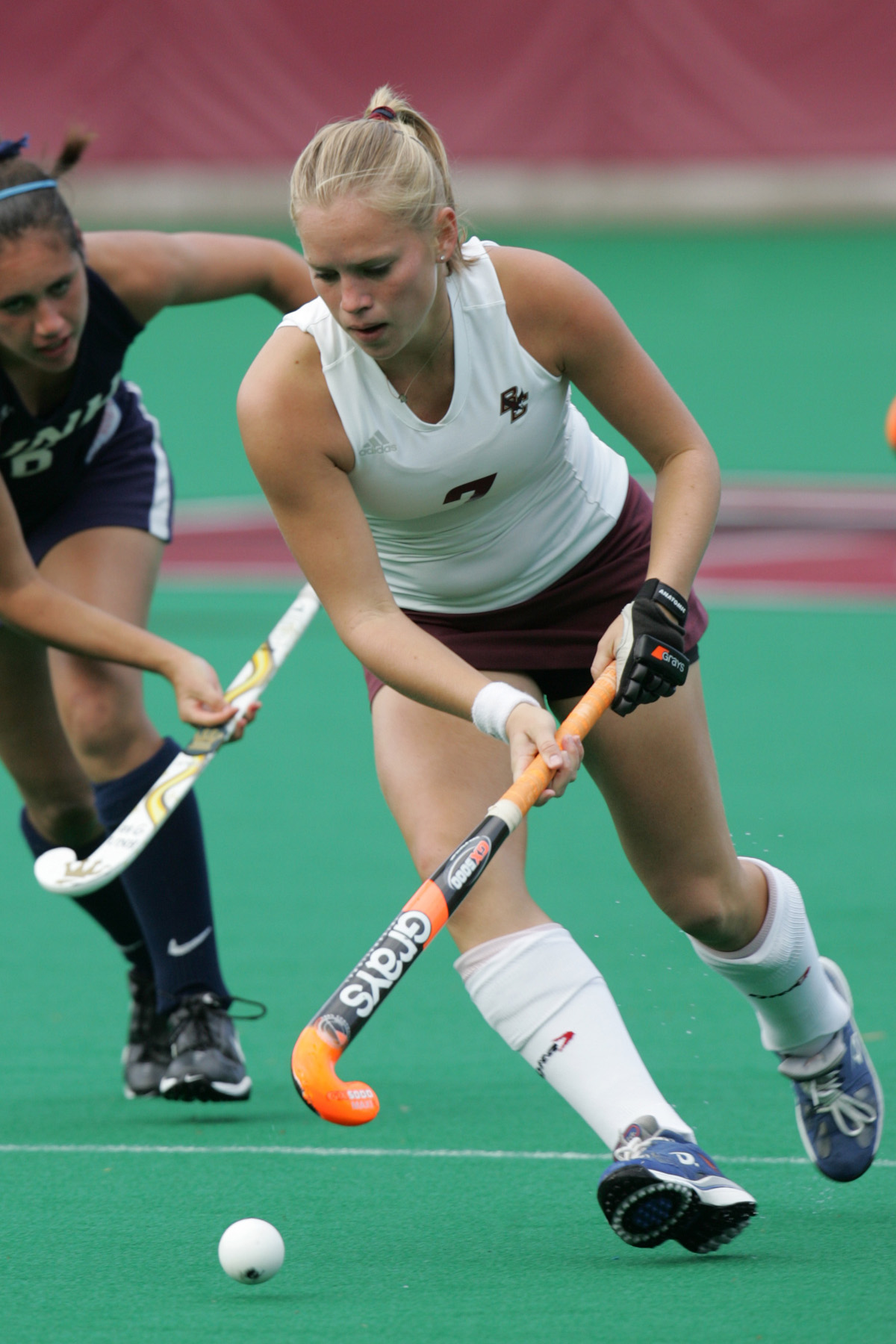
Bob Dirks, BC Field Hockey Star from Malden, the Netherlands

Bob Dirks, BC Field Hockey Star from Malden, the Netherlands

Bob Dirks ‘09
Field Hockey

By Tom Burke

Final examinations had not yet concluded for the graduating students of Stedelijk Gymnasium in Nijmegen, the Netherlands, when the thick binder arrived at the home of Bob Dirks. A field hockey prodigy, perennial East Holland All-Star and member of the national champion squad, she had accepted a scholarship to play at Boston College under new coach Ainslee Lamb.

Bob, the youngest of four children in the athletic Dirks family, opened her mail that day and immediately thought she’d made a huge mistake.

“Here I was, 18 years old, about to move to another country, where I don’t speak the language, and I get this workout package. Ten weeks. Weight lifting, running seven miles, running 45 minutes straight. I threw it into the corner of my room. ‘There’s no way I can do this.’”

The day she finished finals, Bob telephoned the BC coach and told her “I don’t think I can run even one mile. If these are the prerequisites, I’m sure that I can’t go there.”

“Just do what you always do in the summer to get fit,” Lamb assured her frazzled prize recruit. “We’ll see what you can do when you get here.”

Reassured by her long-time youth coach Frank Stofneel, who’d spent a year in America, Bob went off to the store with her mother and bought a pair of running shoes. As it turned out, there would be plenty that Bob could do, and did, during freshman year at Boston College.

It was the Eagles’ first year in the ACC. Bob scored 11 goals and five assists for 27 points and earned Regional All-America honors. Her first goal came in a 3-2 win over Kent State. Bob had been ready to enroll there until the Kent State coach, Kerry DeVries, told her “You are my number one recruit and as I coach I want you here. But as a mother of three children, I know what is best for you, and it is Boston College.”

But the transition was not easy. Phone calls home to parents Mariette and Noud were frequent. Weight lifting and endless rounds of physical conditioning were completely new. So was the sporting culture.

“The sports mentality is something that is unknown in Europe. If you look at the American World Cup team, they may not be the most skilled, but they never give up. They’re always supporting each other. In the Netherlands, I played on skill. In America there is much more emphasis on fitness. By the end of four years, I’d had no idea that I could ever have run so much,” said Bob.

“The first word that comes to mind when I think about Bob is ‘dominant,’” said Lamb. “She came here at a very transitional time. She was an impact player right away and she helped elevate our program to be able to compete with the best in the country.

Bob's speed, skill, and adept use of the backhand kept the defenders off balance

Bob’s speed, skill, and adept use of the backhand kept the defenders off balance

“For Bob, the demands were higher physically. It was an aggressive game with more contact. Her strength on the ball had to improve a little bit. But she never lost the foundation she had with her Dutch hockey and was always willing to learn.”

Bob was an accomplished scorer when she arrived in college. Her possession skills and defensive game quickly blossomed. She was masterful and difficult to defend against with her passing, shooting, and flicking the ball from the reverse side of her stick. Classmate Christine Almendrales said,

“Bob was very good at deception, drawing the defender out and then being able to pass. She hung onto the ball a little longer than most players. She could retain the ball and score. With her dribbling skills she could change direction and not get tackled by the defender’s stick.”

Lamb also said that, as the center forward, Dirks would determine the team’s press, or defensive tactics. Her moves, as she pursued the ball when the opponent was in control, dictated the defensive responses by the rest of the BC team.

Things only got better for Bob after freshman year. For the next three seasons she was named a First Team All-American. Her 62 goals and 150 career points are tops on the Eagles’ all-time list, and she is fourth in career assists with 26. She was a superb student in the Carroll School of Management, posting a 3.385 GPA in her double major of finance and management leadership. She won Eagle of the Year as a senior, and earned an ACC postgraduate scholarship.

There was one other thing that Bob brought to America from home: her devotion to community service. By age 12, she was instructing younger kids in field hockey. At age 17 she began coaching physically disabled children. During recruiting talks with Coach Lamb, she learned that a small group of athletes were involved in community outreach through the Student Athlete Advisory Committee (SAAC).

Bob, Almendrales, and Lauren Gilooly of the sailing team all pitched into expand SAAC, initiating or building up programs that included visits to Franciscan Children’s Hospital, the Pen Pal Picnic, and service trips to New Orleans and Vietnam. Bob was SAAC vice president as a senior.

Bob’s preferred volunteer activity was Moe Maloney’s HEAR program, in which student-athletes visit local elementary schools and tell life lessons. As a foreigner, and bearing an American boy’s name, Bob was a star of those visits. She liked to tell kids what it was to be different. Her favorite stop was the Horace Mann School for the Deaf in Allston.

Bob returned to the Netherlands after graduation and earned a master’s degree in business, then took a year off for foreign travel. After two years of management consulting, she came to work full time at Akzo Nobel, a global paint and chemical company with some 50,000 employees in more than 80 countries. Bob is Akzo Nobel’s Project and Change Manager. Her current assignment is the reorganization of the information technology department, making it work more efficiently and effectively throughout the world. She still plays field hockey, three times a week.

College Student-Athletes: A Modest Proposal

August 29, 2014

Every championship tournament of the National Collegiate Athletic Association shall consist of:

1) On-field competition in the respective sports. They will be organized and seeded in the usual ways and will proceed through as many rounds as necessary to determine the national champion.

2) In-studio competition among all of the teams that have qualified for the on-field competition. The in-studio competition will be in the format of the “College Bowl” television shows. Initial matchups will be identical to those in the on-field competition. The teams will proceed through as many rounds as necessary to determine the national champion.

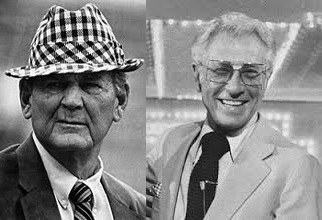
Paul Bryant and Allen Ludden, giants of the gridiron and television studio, respectively. The Bryant-Ludden Trophy, emblem of student-athlete superiority, will be named in their honor.

Paul Bryant and Allen Ludden, giants of the gridiron and television studio, respectively. The Bryant-Ludden Trophy, emblem of student-athlete superiority, will be named in their honor.

Special Rules:

All competitions will be televised and broadcast over as many media outlets as possible so as to maximize available revenues.

All funds and rights fees from the tournaments, including revenue from the sale of souvenirs, t-shirts, software packages, etc. will be pooled.

Each time a team in either field wins a match, it will gain a “victory point.” The more victory points an institution receives, the higher its share of the winnings.

After all competitions are complete, and the champions in both sectors determined, the money will be distributed to the schools and to the competing athletes. Fifty percent of each institution’s winnings will go to the school to use as it sees fit. The other fifty percent will be paid directly to the student-athletes.

The members of the in-studio teams must be selected from the playing rosters of the on-field teams. They must be letter-winners in their respective sports, not nonparticipating bench-warmers.

The team captain of the on-field team must be one of the members of the studio team. However, it is not mandated that he or she also be designated as captain of the studio team.

The team that scores the most victory points in a given academic year, and therefore wins the most money, will receive the coveted Bryant-Ludden Trophy, the new emblem of the highest level of student-athlete achievement in America.

Now let’s let the games begin!