Archive for the ‘The World of Sport’ Category

Lucien Tessier: Every Inch a Hero

September 9, 2012

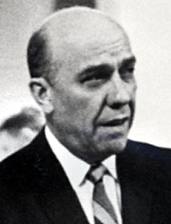
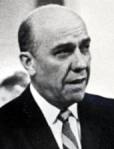
Track captain and sprinter Lucien Tessier on the lawn at Boston College.

From time to time I post articles that I’ve done for other publications. Here’s my profile of Captain Lucien Tessier, USMC and Boston College track captain in 1965. His story is a sad one, of

Captain Lucien Tessier, USMC

a good man’s life that ended far too soon.  It is a story that needs to be told, however, and I feel privileged to be the one who has done so. Boston College inducted him into its athletic Hall of Fame on September 7. A well deserved, and much overdue recognition of a wonderful young man.

This link is to the story that appeared in the Union Leader in Lucien Tessier’s home town of Manchester, New Hampshire: http://tinyurl.com/9umvk9x

It’s About Time!

July 31, 2012

The Art, Science, and Business of Timekeeping, in the Olympics and Long Before

Michael Phelps was 4.10 seconds behind Ryan Lochte in the 400-meter Individual Medley at the 2012 Olympics.  Lochte lost the lead to a Frenchman on the final relay leg and checked in 0.45 seconds behind.

Mere fractions of seconds now separate Gold Medal winners from out-of-the money participants. The swiftest will reap millions and bask in fame for the rest of their lives. The slower – barely, but still slower – ones who finish in their wakes will join the madding crowd in anonymity.

“As long as I’m around you’re second best. You might as well learn to live with it,” said Edward G. Robinson as Lancey Howard in The Cincinnati Kid. Live with it, they will. Maybe they won’t like it, but the also-rans should be bloody well proud that they even had a chance to compete.

Is there a higher honor for an athlete than to represent his country in the Olympic Games? I don’t think so. Well done, ladies and gentlemen, whatever your time or place of finish happens to be. That’s the editorial comment. Now, to our story.

Time is Money

The games of the Thirtieth Olympiad take place in London. It’s fitting. London is home to the Royal Observatory at Greenwich, which has long been the world’s point of geographical reference and is the fons et origo of modern timekeeping. Back in 1836, the Royal Observatory knew, down to the second, what time of day it was. But they had just about no way of sharing that information with the public.

Enter the first entrepreneur of time: John Henry Belville, an astronomer and meteorologist who worked there. He built up a lucrative side business – selling time.  Customers – local merchants, dockyards, shipping offices, instrument shops – paid a subscription fee for a weekly visit from Belville and his personal chronometer. That pocket timepiece, which was nicknamed Arnold, was tuned to the observatory’s clock to within one-tenth of a second.

Belville died in 1856, and his young widow Maria took over the time-supply business with the blessing of the Observatory. Her daughter Ruth inherited both the business and Arnold. Though telegraph, radio, and telephone’s “speaking clock” service moved onto the scene, the “Greenwich Time Lady” was most reliable and had a loyal following of customers. Ruth stayed in the time-selling business until 1940.

Timekeeping in Sports

Omega, the official timekeeper of the games, is now able to calibrate race times to one-thousandth of a second.  The starter’s “gun” is integrated with the laser detectors at the finish.  There’s no longer a human element to Olympic timing.
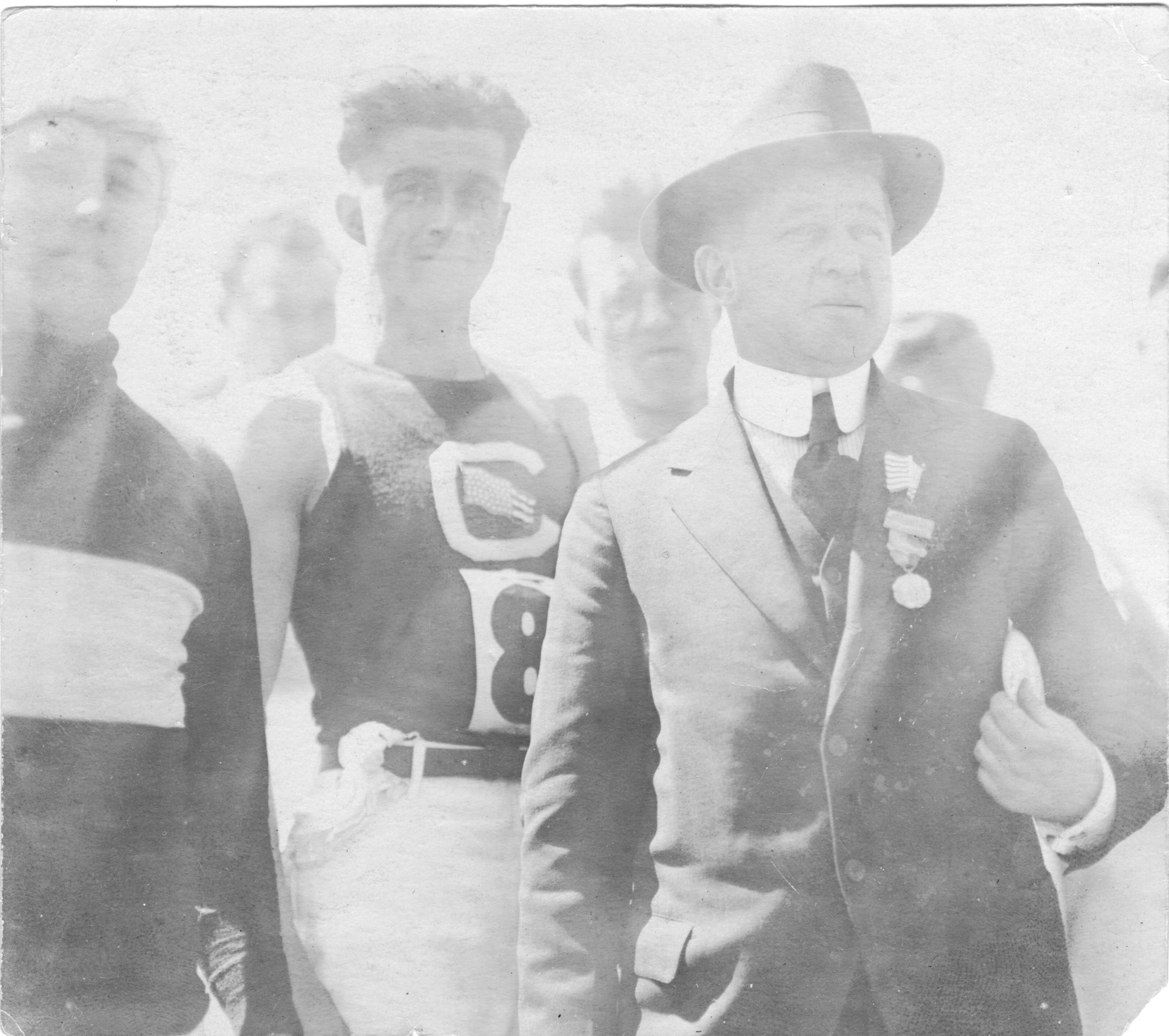
George V. Brown (right), the writer’s grandfather, finish line judge at 1932 Olympics in Los Angeles.

Omega has been the Olympic timekeeper for eight decades. The relationship began back in 1932, at the Los Angeles Olympics. Omega supplied 30 stopwatches for the track judges.  These watches were accurate to a tenth of a second. In the Amsterdam games of 1928, the timers had all used their own stopwatches.

The writer has little doubt that one of those who used the first official Olympic stopwatches from Omega was his grandfather, George V. Brown (pictured here).  George V. had been involved with U.S. Olympic Track and Field since the first London games in 1908. In Los Angeles, he was a finish line judge.

More accurate watches didn’t make for undisputed decisions at the 1932 Games, however. The 100 meter duel between Thomas Edward “Eddie“ Tolan and Ralph Metcalfe, both USA sprinters, is described thusly by Robert Parienté in his book La Fabuleuse Histoire de l‘Athlétisme:  “Everyone saw Metcalfe win, and yet he was only placed second… Metcalfe was beaten by the rule book.”

The timekeepers‘ hand-held Omega stopwatches had recorded three times of 10.3 seconds for Metcalfe and two times of 10.3 and one of 10.4 seconds for Tolan. Even so, Tolan was declared the winner. Why? Both competitors reached the finishing tape at exactly the same moment, but the rules specified that the race is finished only when the athlete‘s torso has completely crossed the finishing line marked on the ground.  Tolan crossed before Metcalfe. This rule, which was often interpreted in different ways, was changed in 1933. Since then, the winner has been the first person to cross the line with any part of his or her torso.
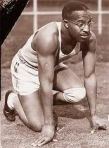
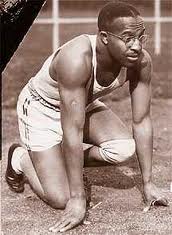
Thomas Edward “Eddie” Tolan

The results list shows both Metcalfe and Tolan with times of 10.3 seconds. Even though this time, which was achieved against a headwind of 1.4 m/sec, equaled the world record then held by Tolan, it was never officially recognized as such by the IAAF.  Tolan won two gold medals in Los Angeles, and Metcalfe went down in the history books as an unlucky loser. In the 200 m final, he was wrongly told to start the race from the relay mark and ran 3.5 m further than he needed to, finishing third as a result. Unbelievably, neither Metcalfe nor Tolan was a member of the USA 4 x 100 m relay team!
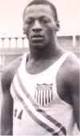
Ralph Metcalfe

Metcalfe did not win a gold medal until 1936, when he was part of the US relay team that included the legendary Jesse Owens. Tolan and Metcalfe were the world‘s top sprinters before

Owens began to rewrite the sporting history books. Metcalfe set a total of 15 unofficial world records over 100 yards, 100 m, 200 m, 220 yards and the 4 x 100 m relay; Tolan set 14.

Tolan later became a teacher. Metcalfe spent the last seven years of his life as a Democrat member of the House of Representatives. Both were members of Alpha Phi Alpha, the first academic fraternity for blacks in the USA.

The Horse and the Stopwatch

Stopwatches were not a new thing in 1932. As far back as the 1850s, they came into demand in America because of the famous racehorse, Lexington. Here too, is an interesting story in the history of race relations and American sport.

Lexington was a beautiful bay that stood at 15 hands and 3 inches. He was foaled in 1850, bred for a Dr Elisha Warfield, who named him Darley. Darley’s trainer was a former slave known as Burbridge’s Harry. He was a superb and well-known trainer, but Darley could not be entered into races by the Burbridges because the trainer was black. The horse first ran under Dr. Elisha Warfield’s name.
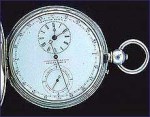
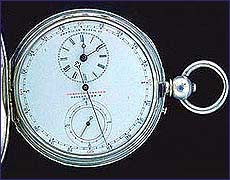
The Chronodrometer from American Watch Company

Darley was fast and strong.  He won his first two races handily and was purchased by a Richard Ten Broeck. The horse was renamed Lexington, and he proceeded to become one of the most popular of all race horses during his day.  He raced seven times and won six of them. Those races were four miles long. In April 1865, Lexington was raced against the clock. He complete four miles in seven minutes and 19 ¾ seconds, a record speed that he held for more than twenty years.

Lexington’s success spurred demand for timepieces that could measure fractions of seconds.  In 1869, the American Watch Company of Waltham, Mass. introduced the “chronodrometer,” or improved timing watch. The company made about 600 of the watches between 1859 and 1861. The watch sold for $50, compared to as much as $350 for a high-grade European import.

The Photo Finish
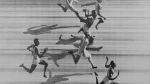
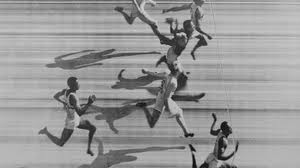
The first Olympic photo finish. Harrison Dillard wins the 100 Meters in 1948.

The Omega company’s website claims that the “Birth of Modern Sports Timekeeping” came at the second London Olympic Games in 1948. The world’s first independent, portable and water-resistant photoelectric cell, made by Omega, made its Olympic debut in 1948. There was also the Racend Omega Timer, a device that combined a Race Finish Recording photo finish camera with a timer.

The first photo finish came in the 1948 Men’s 100-Meter Final.  In that race, Harrison “Old Bones” Dillard of the United States finished in 10.3 second and beat out fellow American Barney Ewell by a tenth of a second.

Then at Helsinki in 1952, Omega became the first company to use electronic timing in sport with the Omega Time Recorder .

The Clock that Saved Professional Basketball

Hard to believe, but the National Basketball Association has not always used the 24-second clock. The league had been in operation for five years before the owners realized that they had to speed up the game or go out of business. Fans were often disgusted and upset when teams would hold the ball for minutes on end.  In 1954, Syracuse Nationals owner Danny Biasone figured it all out with some simple arithmetic.
Biasone believed that basketball was most entertaining when it was neither a stallball game nor a wild shootout. His personal observation put the optimal level of shots per team at 60. That meant 120 shots per game. So he divided the length of each game, 48 minutes or 2,880 seconds, by 120. The result? 24 seconds per shot.

We’ve Come a Long Way

As with almost any subject, the history of timekeeping has a number of interesting developments in the 5,000 or so years since the Egyptians started building obelisks to track the passage of time with their shadows.

The Chinese used candles with evenly-spaced markings to track the passage of time. The Greeks had the clepsydra, which might have been the first way to record attorneys’ billable hours.  It was used to limit the length of lawyers’ speeches, actually. A hollow vessel with a hole in the bottom, the clepsydra was filled with water that would gradually run out into another vessel.  When the water was gone, the speaker’s time was up.

“Clock” comes from cloche, the French word for “bell.” The first mechanical clocks originated in European monasteries. They were faceless devices that marked the time with chimes rather than with hands.

The Swiss were talented horologists, as we all know. In 1577, Jost Burgi of Switzerland invented the minute hand. But it didn’t get popular until some 80 years later, when the addition of a pendulum decreased clocks’ daily margin of error from 15 minutes to about 15 seconds.

Back to Britain for our final story, and another lesson in economics.  Advocates of big government and of taxing everything that moves should be aware of yet another example of the killing power of taxes, this one involving timepieces. In 1797, British Parliament in its wisdom passed a law requiring citizens to register privately-owned timepieces, then pay taxes on them. The scheme, predictably, devastated the British clock making industry.  The law was repealed just nine months later.

The All-Star Game: What a Classic It Was Back When

July 10, 2012

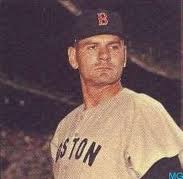
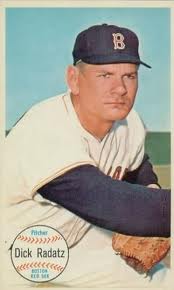
Dick Radatz

Members of “Red Sox Nation” don’t know how good they have it: World Series championships, playoffs, perennial contender status. Back in the bad old days when I was growing up, the only thing we could ever look forward to was the All-Star game. The Red Sox never had any hope of winning the American League pennant. They were mediocrity personified.

You had to win the pennant to get into the World Series. There were no playoffs, no wild cards. And just about every year, the Yankees would have the regular season title clinched by the end of July.

There was almost no television coverage of baseball from out of town either. So the only time we could see the mythical immortals of the National League was in the mid-summer All-Star game. At least one player from every team had to make the All-Stars, so we could root for a smattering of our local heroes against the titans from afar.

The game was a very big deal. The baseball card companies even hustled out packets of All-Star cards around that time. And the teams played to win. Many of the starters would play the entire game. A lot of those who made it to the game just rode the bench.

From 1950 through 1980, there were 35 All-Star games, because in three of those years they played two games. The National League won 28 of the 35. It was close to utter domination.  Musial, Spahn,

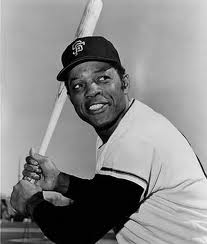
Willie Mays

Matthews, Mays, Marichal, Clemente, McCovey, Drysdale, Koufax – demigods all – were the typical opponents. We of junior circuit were always overmatched.

The Carmine Hose’s perennial representatives were Ted Williams and his successor, Carl Yastrzemski. Others who made it onto the team more than once in that era included Frank Malzone, Pete Runnels, and Jackie Jensen.  Sox fans could hope they would get in for an inning or two, and maybe one at-bat.

In 2009, six Red Sox made the All-Stars.  This year the only Sox player on the team is Ortiz. The team is in last place. Feels familiar. To me, not to the Gen-Xers, and not to the Millennials. They’ve been spoiled.

The Monster

Back before anyone invented the term “closer” or dreamed up “saves” as a baseball statistic, Boston Red Sox relief pitcher Dick Radatz was the best in the business. And he pitched for us!

He was big, burly, and intimidating beyond words. He threw heat, heat, and more heat. For three seasons, 1962-64, Dick Radatz and his fastball were masters of the late-innings – not just the ninth. Mickey Mantle dubbed him “The Monster.” It stuck. Radatz didn’t last long in the majors. Once he lost just a tad off his fast ball, he was history.

Richard Raymond Radatz was born in in Detroit and graduated from Michigan State. College graduates in pro baseball were a rarity back then. I once heard – it may have been from him – that he was only the 25th college grad ever to play major league ball. I don’t know if that’s true, but it sounds plausible.

I met Dick one evening in a corporate “Legends” box at a Red Sox game.  He was an ideal host in that venue; he loved to tell stories and share his knowledge of the sport. Radatz was also a good sport with a sense of humor. I decided to kid him during handshakes and introductions by saying that my name was Johnny Callison. He glared at me, then broke into a grin and said, “They were bringing me the keys to the Corvette, and that guy took it away from me. Let me tell you about Johnny Callison.”

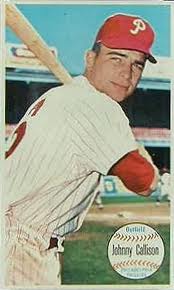
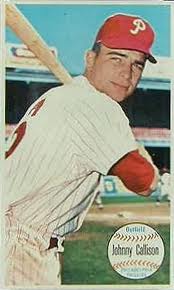
Johnny Callison

John Wesley Callison was a right fielder who grew up in Oklahoma, broke in with the White Sox, and was traded to the Phillies in 1961. In Philadelphia, he blossomed into a star. Supreme Court Justice Sam Alito was a big fan. Callison’s single against the Chicago Cubs in a 1962 game was the first hit ever seen by a live television audience in Europe. A portion of that game was shown on the first transatlantic broadcast via Telstar, which had been launched a few days earlier.

The 1964 Game

Radatz and Eddie Bressoud, a journeyman shortstop who was enjoying a career year, were the only Red Sox on the American League’s 1964 All-Star squad. Bressoud had also done Boston an enormous favor. He was the guy who came here in trade for Don Buddin, the hapless butt of endless jokes and one-liners. Boston writer Clif Keane once suggested that Buddin’s license plate be “E6.”

The game was a thriller, played in brand-new Shea Stadium adjacent to the New York World’s Fair. Radatz took the mound in the seventh inning with American League leading 4-3. The first player he faced was Callison, who flied deep to right field; the long out carried to the warning track. Radatz then retired the next five batters.

The Nationals tied the game in the last of the ninth. Willie Mays – maybe the greatest ball player ever, and certainly one of the top five – walked after fouling off five third-strike pitches. He stole second and scored on a bloop single and a bad throw by the grossly overrated Yankee Joe Pepitone.

Callison came up with two outs and two men on base. He stepped into the batter’s box, then asked for time and went back to the dugout. He emerged a minute later and blasted a Radatz fastball into the seats for a walk-off home run, the third in All-Star Game history. In previous years, Stan Musial and Ted Williams had also ended the All-Star Game with a home run. That hit earned Callison the game MVP award, a Chevrolet Corvette.

Years later, Radatz related, he encountered Callison and asked why he had gone back to the dugout.  Callison explained that, with his own bat, he hadn’t quite been able to “get around” on Dick’s fastball.  His fly-out had gone to the warning track – not good enough. So Callison borrowed a bat from his teammate, Willie Mays. Willie’s bat was one ounce lighter. A single ounce made all the difference.

An Address to the National Champions

April 15, 2012

Master of Ceremonies’ greeting to Boston College hockey team at its annual Pike’s Peak Club Awards Banquet.

January 21st.  It was a long bus ride home from Orono. Two straight losses, six in the preceding ten games. It was the winter of our discontent.

But now, is the winter of our discontent made glorious summer by these sons of York.

Not only do we have the Iliad of Homer to guide us. William Shakespeare is a fan too. And he had Boston College in mind when he wrote, “This story shall the good man teach his son.”

This story – that we’ll retell today – is the marvelous and inspiring tale of the Boston College Eagles, 2011-2012. It will be told as long as ice hockey is played in Boston.

I thank the Pike’s Peak Club for once again allowing me to serve as your Master of Ceremonies. I’ve been around Boston College hockey since 1968, did seven seasons on radio color, and the last 26 as your p.a announcer. In football, it’s been 36 seasons.

Over all that time I’ve felt privileged to be able to play any kind of role in presenting to the world the grand and glorious enterprise that is Boston College sports. I usually speak to you from far away.  This afternoon, we’re face-to-face, and it’s a thrill for me to be here.

And I think that I’ll be doing more than speaking to you. I’ll be speaking for you. And for the 160,000 living alumni of Boston College. And for all those alumni who have gone before us and are now watching with pride from the Second Balcony.

Gentlemen, you’ve brought home to the Heights yet another national championship. You have heard, and heeded, the motto of your University, taken from the words of Homer’s wise man Nestor. You remember!

The Trojan War was going poorly – rather like the hockey season back in January. Nestor comes to the tent and reminds the great warrior Achilles of the teachings of Peleus, Achilles’ father: “Fight ever amongst the foremost. Outvie your peers. Aien aristeuein.”

Ever to Excel. Our motto. Your watchword. All Boston College people aspire to it. You show us how it’s done.

The annual Pike’s Peak Hockey Banquet recognizes and honors the heroes of the present day. We also take this opportunity to remember and salute the memory of many individuals whose names you’ll be hearing in a little while when we present the named awards. They are giants of eras past, and they are still with us as we meet today and celebrate our national championship.

Pike’s Peak, as we know, towers over Colorado Springs. That was almost a second home to Boston College. In the first eight years of the NCAA Championship Tournament at the old Broadmoor World Arena, the Eagles made it five times. The Pike’s Peak Club founders were all players who’d themselves been to that mountain and once, in 1949, made it all the way to the top.

This year, for the third time in five, you’ve scaled that mountain. You stand on top, as national champions. And as a Boston College man, I’m especially proud and grateful to you for doing it this year. It is very important, and most fitting, that a team that represents Boston College achieved a national championship in 2012.

Why do I say that?

This past 12 months or so was not a particularly good time for the world of sports. Some of the news we heard – and continue to hear – ranged from mildly disconcerting to downright distressing. It was everywhere; in professional, college, and high school ranks. Maybe, in some people’s minds, sport wasn’t worth all the attention we pay to it.

And then, along comes Boston College hockey. Banishing the January doldrums and never tasting defeat again. Your victory march did so much to set things right. It’s not only for your fans and the people of your school. It’s for everyone who knows and loves athletic competition. For everyone who values sportsmanship and fair play.

We all know Grantland Rice’s famous line, “When the One Great Scorer comes to mark against your name, He writes, not that you won or lost, But how you played the game.”

We generally quote Mr. Rice following a gallant try that ends up in defeat. Not this time. It was not that you won. It was how you did it…with speed and grace and skill. But more importantly, with dignity and class.

You’ve restored the faith of the entire sporting world. And now they look to you, just as they looked to Governor John Winthrop’s Boston, the shining City on a Hill. You’ve shown them just what a winner is, what a winner can be, what a winner should be. That winner is Boston College.

To repeat something I said a year ago…Boston College hockey is the gold standard, the acme, the epitome of all that’s best in college athletics. I’m convinced that there is no academic pursuit, no student activity, no administrative function, no alumni undertaking, that can proclaim to the world, as proudly and as surely who we of Boston College are, and what we believe in, as our athletic program. And especially, our hockey program.

Your story is that story which the good man will teach his son. And those sons who don the gold sweater and lace up the skates in years to come will remember it. They’ll strive to meet those standards, both athletic and personal, that you have set. That will be your lasting legacy.

I’ll conclude with a personal note, and an echo of another old favorite. I always dreamed of being a great athlete. Who doesn’t?  But I wasn’t, so I had my heroes. And I want you to know you’re my heroes. You’re everything that I’d like to be.

Because nothing flies higher than an Eagle.

Anthony Manning: A Profile in Courage

March 2, 2012

…And his parents are heroes too.

Anthony Manning III with his parents, Debbie and Anthony Manning Jr.

Anthony Manning III’s restrictive cardiomyopathy caused his heart to fail when he was eight years old.  He was placed on life support at Children’ s Hospital in Boston and fortunately, a donor’s heart was found within a day. After transplant surgery he had a lengthy recovery and, by the time he got to high school, was fit enough to try playing for the football team.

Anthony was the first transplant patient from Children’s who was allowed to play the game. He was on the squad at Greater Lowell Vocational Tech High School for four years. The Gridiron Club of Greater Boston gave Anthony its Henry Smith Courage Award for the 2011 season.

Here is a link to the story I wrote about him and his remarkable parents for the Boston Globe North edition of March 1, 2012:tinyurl.com.6u8h2dm


The Jewish Holidays and the Pennant Race: A Baseball Story

September 20, 2011

Rosh Hashanah falls on September 28, and Yom Kippur is on October 7. I wish my Jewish friends every happiness and blessing of this holy time, and I hope that 5772 will be a very good year for you.

As usual, the Jewish holidays come just at that time of the year when the baseball season draws all of our sporting attention.  Either the pennant races are heading down to the wire, or the playoffs or World Series have just begun.  This is a good time to retell the story of Hank Greenberg and Yom Kippur in the year 1934, as recounted in the Baseball Almanac:

Hank GreenbergHank Greenberg was a baseball player. A team leader. A league leader. A Jew. Both Rosh Hashanah and Yom Kippur fall in the regular season and in 1934 Greenberg’s Detroit Tigers were involved in the pennant race.

Greenberg wrote in his autobiography, “The team was fighting for first place, and I was probably the only batter in the lineup who was not in a slump. But in the Jewish religion, it is traditional that one observe the holiday solemnly, with prayer. One should not engage in work or play. And I wasn’t sure what to do.”

Greenberg’s rabbi said that Rosh Hashanah was a “festive holiday” and playing would be acceptable. Hank played and hit two home runs including a ninth inning game winner.

“I caught hell from my fellow parishioners, I caught hell from some rabbis, and I don’t know what to do. It’s ten days until the next holiday — Yom Kippur.”

 Those words, and his choice not to play on Yom Kippur due to its significance, inspired Edgar Guest to pen the following:

Came Yom Kippur

A Hank Greenberg Poem

Author: Edgar Guest. Published in Detroit Free Press, 1934.

“Came Yom Kippur — holy fast day world wide over to the Jew,

And Hank Greenberg to his teaching and the old tradition true

Spent the day among his people and he didn’t come to play.

Said Murphy to Mulrooney, ‘We shall lose the game today!

We shall miss him on the infield and shall miss him at the bat

But he’s true to his religion — and I honor him for that!’”

Boston College Inducts 14 New Hall of Fame Members

September 17, 2011

Click on this link to go to a pdf copy of the program for this year’s induction of Boston College Hall of Fame members:  http://tinyurl.com/43zdaoj

Gene DeFilippo – athletic director

Pete Olivieri – administration

Cara Blumfield – softball

Scott Gieselman, Bill Romanowski, Jack Flanagan, Tom Meehan – football

Jack Farrell, Bernie Teliszewski – football and baseball

Jay Hutchins – soccer

Amber Jacobs – basketball

Brian Leetch – hockey

George Ravanis – baseball

Katie Ryan Kieran – cross country/track

Don Croatti – Donlon Award for Special Achievement

Boomer Baseball Fans will Appreciate

August 13, 2011

“Numbering high among my most cherished sports memories is the night in the Sixties, in New York, when Ted Soltaroff, my writer chum, took me to the Polo Grounds to watch Sandy Koufax pitch a two-hitter. He went nine innings, of course, but those were the days when a starter was expected to go nine, or at least eight, rather than to be hugged by his teammates if he managed six, to be followed on the mound by a succession of multimillionaire holders and closers.”

– Mordecai Richler

All-Star Game Memories: How Johnny Callison Vanquished Dick “The Monster” Radatz, with a Little Help from Willie Mays

July 13, 2011

Back before anyone invented the term “closer” or dreamed up “saves” as a baseball statistic, Boston Red Sox relief pitcher Dick Radatz was the best in the business. He was big, burly, and intimidating beyond words. He threw heat, heat, and more heat. For three seasons, 1962-64, Dick Radatz and his fastball were masters of the late-inning world. Mickey Mantle dubbed him “The Monster.”

Dick Radatz

Richard Raymond Radatz was born in in Detroit and graduated from Michigan State. I met him one evening when he was hosting a “Legends” box at a Red Sox game.  Dick was an ideal host in that venue; he loved to tell stories and share his knowledge of the sport. Radatz was also a good sport with a sense of humor. I decided to kid him during handshakes and introductions by saying that my name was Johnny Callison. He first glared at me, then broke into a grin and said, “They were bringing me the keys to the Corvette, and that guy took it away from me. Let me tell you about Johnny Callison.”

John Wesley Callison was a right fielder who grew up in Oklahoma, broke in with the White Sox, and was traded to the Phillies in 1961. In Philadelphia, he blossomed into a star. Supreme Court Justice Samuel Alito was his big fan. Callison’s single against the Chicago Cubs in a 1962 game was the first hit ever seen by a live television audience in Europe. A portion of that game was shown on the first transatlantic broadcast via Telstar, which had been launched a few days earlier.

Johnny Callison

The 1964 All-Star game was a close affair. The American League called upon Radatz in the seventh inning with American league leading 4-3. The first player he faced was Callison, who flied out deep to right field; the long out carried to the warning track. Radatz then retired the next five batters.

The Nationals tied the game in the last of the ninth on a walk, a bloop single, and a bad throw by Yankee Joe Pepitone. Callison came to bat with two outs and two men on base. He stepped into the batter’s box, then asked for time out and went back to the dugout. He emerged a minute later, then blasted a Radatz fastball into the seats for the All-Star Game’s third-ever walk-off home run. In previous years, Stan Musial and Ted Williams had also ended the All-Star Game with a home run. That earned Callison the game MVP award, a Chevrolet Corvette.

Years later, Radatz related, he encountered Callison and asked why he had gone back to the dugout.  Callison explained that, with his own bat, he hadn’t quite been able to “get around” on Dick’s fastball.  His fly-out had gone to the warning track – not good enough. So Callison borrowed a bat from teammate Willie Mays. Willie’s bat was one ounce lighter. A single ounce made all the difference.

Yogi and Artie, Hall of Famers, Need Some Company

July 2, 2011

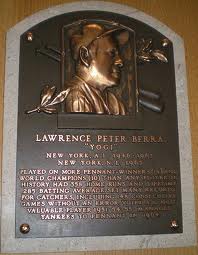
Yogi Berra's Plaque in Baseball's Hall of Fame

Excellent cover story on Yogi Berra in the week’s Sports Illustrated.  I had forgotten, or perhaps never knew, that he was aboard an assault craft on D-Day back in 1944. Yogi had played one season of minor league baseball before joining the Navy and volunteering for duty on a rocket boat that led the invasion of Utah Beach.

The same issue has a brief profile of  Artie Donovan, who also served in World War II and returned home to fashion a brilliant career in the sport of football.

We know stories of other athletic immortals who did likewise – Ted Williams the fighter pilot; Warren Spahn, who fought in the Battle of the Bulge; Christy Mathewson, accidentally gassed in a training exercise in World War I; Milt Schmidt, Woody Dumart and Bobby Bauer, the “Kraut Line” who went off together to face the Germans as members of the Royal Canadian Air Force .  Like Yogi, all these gentlemen are enshrined in their respective Halls of Fame: Spahn, Williams and Mathewson  at Cooperstown, Donovan at Canton, the “Krauts” in Toronto.

But how many other men of that era left the playing fields to don the uniform of their country and did not make it back?  There must be dozens of them, if not hundreds. They may have lost their lives in battle or suffered debilitating injuries, or may have been too old to resume their athletic careers after the war.

Our Northern neighbors and partners in freedom just celebrated their national holiday.  America is preparing for its own birthday, to celebrate the incomparable gifts that our parents, grandparents, and earlier forebears earned for us and bequeathed to us.

At this time of patriotic reflection and thanks to those who made our lands what they are today, here’s a thought for those who run the Halls of Fame in baseball, football, hockey, basketball, and all the other sports, for that matter. You’re the Keepers of the Flame. You honor and remember those who achieved and excelled. Now tell us the stories of those who might also have achieved and excelled, but who put their sporting lives aside for a higher cause and did not return. Carve them a niche, enroll them, and down through the years, tell your visitors about them – how good they were, how greater still they might have been.